June 13, 2026
The Supply Chain Calculus That Brought Washington to Tashkent
Decades of globalised manufacturing created a quiet dependency that few Western policymakers fully appreciated until it became a strategic liability. Critical minerals — the foundational inputs for everything from electric vehicle batteries to precision-guided munitions — became concentrated in a single dominant supplier ecosystem. China now controls roughly 60% of global rare earth mining output and an even larger share of processing capacity, according to data tracked by the U.S. Geological Survey. When that concentration became impossible to ignore, Washington began looking east, past the familiar corridors of European and Pacific alliances, toward a region that had spent decades waiting for precisely this moment: Central Asia.
The U.S. and Uzbekistan investment pact, formalised through a memorandum of understanding signed in Tashkent on June 9, 2026, is the most concrete expression yet of this strategic recalibration. However, framing it purely as a diplomatic milestone undersells what it actually represents: a structural rewiring of how American capital is expected to flow into a resource-rich frontier economy that has spent nearly a decade transforming itself into a viable destination for Western institutional investment.
When big ASX news breaks, our subscribers know first
Understanding the Architecture: More Than a Single Agreement
The term "investment pact" implies a single document, but the U.S. and Uzbekistan investment pact is better understood as a layered institutional architecture assembled from several interlocking components. Each layer serves a distinct functional purpose, and together they form a framework designed to convert political intent into durable capital deployment. Furthermore, the Uzbekistan minerals initiative that preceded this agreement laid important groundwork for the structures now being formalised.
The core components include:
- A Joint Investment Framework establishing the formal structure for multi-sector economic cooperation
- A proposed U.S.–Uzbekistan Joint Investment Holding Company designed to aggregate and channel financing from multiple institutions
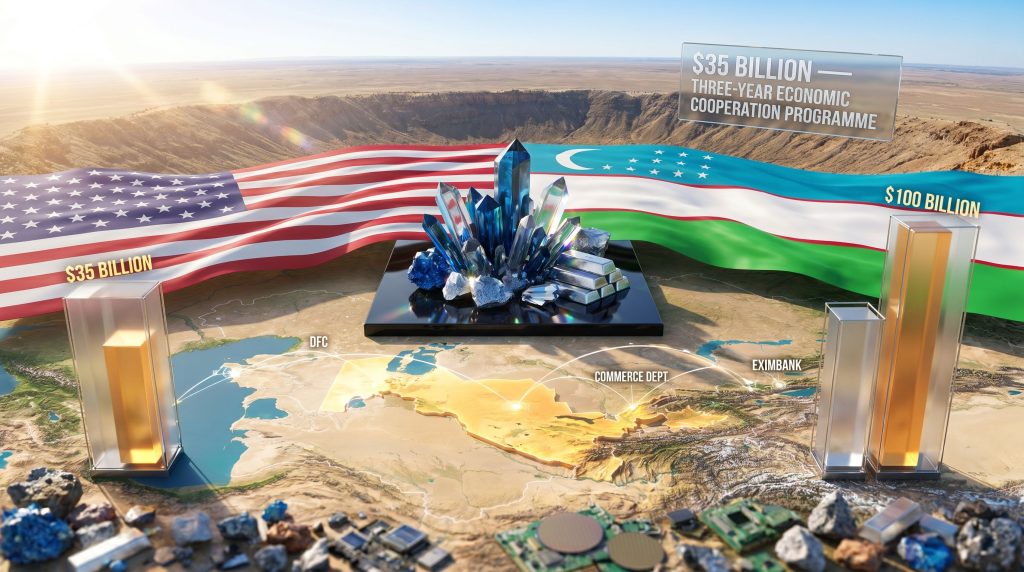
- A three-year Economic Cooperation Programme valued at $35 billion
- The formalisation of the American-Uzbek Business and Investment Council, providing the governance interface between political agreements and commercial execution
What distinguishes this framework from earlier bilateral economic declarations is the emphasis on mechanism over aspiration. Rather than restating shared values and promising future engagement, the architecture creates named institutions, defined financing channels, and a co-governance structure with identifiable principals on both sides.
The MOU is structured around actionable economic outcomes, functioning as a framework that moves the U.S.-Uzbek relationship from intent to mechanism, according to commentary published by UzDaily, a semi-official Uzbek news outlet.
The Proposed Joint Investment Holding Company: How It Would Work
The most technically significant element of the entire framework is the proposed holding company. If incorporated as planned, it would function as a purpose-built capital aggregation vehicle, bypassing the slow, case-by-case approval processes that have historically constrained bilateral investment in the region.
Its intended design includes:
- Drawing financing from the U.S. International Development Finance Corporation (DFC) and the Export-Import Bank (Eximbank), the two primary U.S. development finance institutions
- Coordinating private sector capital alongside those public institutions to create blended finance structures
- Covering the full critical mineral value chain, from grassroots exploration through to downstream processing and refining, rather than stopping at extraction
- Extending across energy, infrastructure, agriculture, and technology verticals under a single governance umbrella
The full value chain dimension deserves specific attention. Most bilateral investment frameworks focus on upstream activity, funding extraction while leaving processing capacity underdeveloped. This creates a structural dependency where raw materials leave the country for processing elsewhere, often in China. A framework explicitly designed to fund the downstream processing layer, within Uzbekistan itself, would represent a meaningful break from that pattern.
| Feature | Traditional Bilateral Investment | Joint Holding Company Model |
|---|---|---|
| Approval process | Case-by-case, government-led | Institutionalised, streamlined |
| Capital sources | Single-agency or sovereign | Multi-agency and private capital |
| Value chain focus | Typically upstream extraction only | Full chain from exploration to processing |
| Governance structure | Diplomatic channels | Dedicated business council co-governance |
| Speed to deployment | Slow and bureaucratic | Accelerated through pre-agreed frameworks |
As of mid-2026, the holding company remains a proposed entity. Its formal incorporation and governance structure represent the single most important next milestone for observers monitoring whether this framework moves from architecture to action.
Uzbekistan's Mineral Endowment: The Asset Base Behind the Strategy
What Does Uzbekistan Actually Produce?
The geopolitical logic of the U.S. and Uzbekistan investment pact becomes considerably sharper when examined against Uzbekistan's actual resource base. The country is not simply a convenient geopolitical pivot point — it holds genuinely significant reserves of materials that sit at the top of Western supply chain priority lists. Indeed, the broader critical minerals demand surge has made identifying such resource-rich partners an urgent priority for Washington.
Uzbekistan is among the world's top producers of gold, consistently ranking in the global top ten. Its state mining company, Navoi Mining and Metallurgical Combinat (NMMC), operates the Muruntau gold deposit, one of the largest open-pit gold mines on Earth by reserves. Beyond gold, Uzbekistan holds confirmed deposits of:
- Uranium: Uzbekistan ranks among the top ten uranium-producing nations globally, a fact that carries growing strategic weight as nuclear energy re-enters Western energy planning
- Copper and molybdenum: Essential inputs for grid infrastructure and clean energy hardware
- Tungsten and fluorite: Less discussed but increasingly critical for defence manufacturing and industrial chemistry
- Rare earth elements: Present in deposits that remain incompletely surveyed, representing significant exploration upside that Western capital has not yet systematically mapped
Why Rare Earths Matter Here
The incomplete exploration coverage of Uzbekistan's rare earth potential is a point that deserves emphasis. Soviet-era geological surveys, while extensive, were conducted under different economic priorities and with different technological tools than those available today. Modern airborne geophysical surveys and geochemical sampling techniques routinely identify mineralisation that earlier programmes missed or undervalued. Consequently, the country's declared resource inventory may substantially understate its actual endowment — a speculative but geologically grounded observation relevant to rare earth supply chains that informed exploration investors should weigh carefully.
Disclaimer: Exploration potential assessments are inherently speculative. Investors should not rely on geological projections as indicators of future economic value without reference to formal resource estimates produced under internationally recognised reporting standards.
The $35 Billion Programme and the $100 Billion Horizon
The headline figures attached to the pact require careful contextualisation. The three-year Economic Cooperation Programme carries a stated value of $35 billion, a number that encompasses projected commitments across all targeted sectors rather than capital already committed or deployed.
| Programme Component | Detail |
|---|---|
| Total Programme Value | $35 billion |
| Programme Duration | Three-year Economic Cooperation Programme |
| Primary Financing Institutions | DFC, Eximbank, private investors |
| Existing U.S. Business Presence | Approximately 340 companies operating in Uzbekistan |
| 2025 Bilateral Trade Volume | Exceeded $1 billion |
| Long-Term Investment Ambition | Up to $100 billion over the coming decade |
The $100 billion long-term figure originates from statements made by President Shavkat Mirziyoyev following a bilateral meeting with U.S. leadership in November 2025, as reported by Reuters. That figure represents an aspirational target across a ten-year horizon rather than a committed programme, and should be interpreted accordingly. The distinction between committed capital and stated ambition is material for investors and analysts trying to size the actual near-term opportunity.
Bilateral trade between the two countries exceeded $1 billion in 2025, a meaningful baseline given that this trade relationship was negligible as recently as a decade ago. Approximately 340 U.S. companies are already operating within Uzbekistan's economy, providing an existing commercial infrastructure on which the new framework can build.
Sectoral Focus: Where the Capital Is Actually Targeted
Critical Minerals and Resource Extraction
This is the sector with the most direct connection to U.S. national security priorities. The DFC has been explicitly reoriented in recent years toward reducing Chinese dominance in critical mineral supply chains. Uzbekistan's confirmed uranium, copper, and rare earth deposits make it a natural candidate for DFC-backed extraction and processing investment. In addition, the broader relationship between critical minerals and energy security underpins much of Washington's urgency in establishing this framework.
Energy Infrastructure
Grid modernisation, power generation capacity, and fuel distribution network construction are all identified targets. Uzbekistan's energy infrastructure carries significant Soviet-era legacy constraints, creating both a genuine development need and a corresponding investment opportunity for U.S. firms with grid and power sector expertise.
Agriculture, Technology, and AI
Precision irrigation, sprinkler system deployment, and poultry production cluster development are specifically mentioned. This is often overlooked in coverage focused on the minerals dimension, but agriculture accounts for a substantial share of Uzbekistan's employment and GDP. Furthermore, digital infrastructure investment and AI-sector capacity building round out the framework, with Uzbekistan positioning itself as a regional IT hub for software development and data processing services.
The next major ASX story will hit our subscribers first
Geopolitical Context: The China Counter-Strategy Hidden in Plain Sight
Understanding why the U.S. and Uzbekistan investment pact matters requires understanding what it is designed to displace. China's Belt and Road Initiative has financed hundreds of billions of dollars in infrastructure across Central Asia over the past decade, creating transport corridors, energy pipelines, and financing relationships that have deepened Chinese economic influence throughout the region. The evolving geopolitical mining landscape makes this competitive dynamic increasingly consequential for Western policymakers.
Uzbekistan has historically maintained a more cautious posture toward BRI participation than some of its neighbours, partly by design. President Mirziyoyev, who came to power in 2016 following the death of long-serving predecessor Islam Karimov, has actively pursued a diversification strategy, attracting capital from multiple external partners rather than becoming dependent on any single one.
This diversification posture creates an opening for Western capital that does not exist in countries where Chinese financing is more deeply entrenched. The institutional architecture of the U.S. pact is specifically engineered to offer something BRI generally does not: transparent governance alignment, Western legal standards, and market access beyond the Chinese domestic economy.
Russia's influence in the region, primarily through energy supply chains and the significant labour migration dynamic between Uzbekistan and Russia, adds another dimension of complexity. A large proportion of Uzbekistan's remittance income has historically flowed from workers in Russia, creating an economic interdependency that constrains Tashkent's freedom of manoeuvre even as it pursues Western partnerships.
| Framework | Primary Backer | Value Estimate | Key Focus | Governance Model |
|---|---|---|---|---|
| U.S.–Uzbekistan Investment Pact | United States | $35B (3-yr) / $100B (decade) | Minerals, energy, AI, agriculture | Business council co-governance |
| Belt and Road Initiative | China | Hundreds of billions (aggregate, regional) | Infrastructure, transport, energy | Bilateral state-to-state lending |
| C5+1 Diplomatic Framework | United States | Non-quantified | Governance, security, trade | State Department led |
| B5+1 Private Enterprise Process | United States | Non-quantified | Business-to-business commerce | Commerce Department facilitated |
The B5+1 Connection and the Bishkek Roadmap
The June 2026 MOU did not emerge in isolation. It was the direct commercial operationalisation of a roadmap established at a B5+1 meeting held in Bishkek, Kyrgyzstan in February 2026, which gathered economic leaders from the five Central Asian nations under the private enterprise dimension of the government-to-government C5+1 initiative.
The B5+1 framework is relatively little-known outside specialist foreign policy circles, but it functions as the commercial engine beneath the diplomatic superstructure of C5+1. Where C5+1 addresses governance, security, and multilateral trade policy, B5+1 focuses specifically on business-to-business commercial relationship building, investment facilitation, and private sector deal flow.
The Bishkek meeting established the commercial priorities and investment thesis that the Tashkent MOU subsequently converted into binding commitments. This sequencing matters: it signals that the June 2026 agreement was not an improvised diplomatic gesture but the output of a structured, multi-month planning process.
Key Decision-Makers and the Governance Signal They Send
The leadership architecture behind the pact carries its own informational content for investors and analysts. On the Uzbek side, three principals stand out:
- President Shavkat Mirziyoyev, who has been the architect of Uzbekistan's foreign investment liberalisation since 2016 and who personally outlined the $100 billion ambition to U.S. leadership
- Laziz Kudratov, Minister of Investment and the Uzbek signatory to the June 2026 MOU
- Saida Mirziyoyeva, Head of the Presidential Administration and appointed Co-Chair of the American-Uzbek Business and Investment Council, whose direct involvement signals executive-level commitment to implementation
The appointment of Saida Mirziyoyeva to co-chair the Business and Investment Council is a governance signal that experienced Central Asia investors will read carefully. Direct involvement from within the presidential administration typically accelerates project approval timelines and reduces the bureaucratic friction that has historically slowed foreign investment deployment in the region.
On the U.S. side, Assistant Secretary of Commerce David Fogel served as lead signatory, with the DFC and Eximbank positioned as the primary institutional financing vehicles. The involvement of two separate U.S. financing institutions, rather than a single lead agency, is consistent with the blended finance architecture described elsewhere in the framework.
Risks, Limitations, and What Investors Should Watch
No assessment of the pact is complete without an honest accounting of the execution risks that could prevent the framework from translating into deployed capital.
Structural risks include:
- The holding company remains unincorporated, and its governance formation is the critical first milestone
- A $35 billion programme spanning five sectors across three years requires sustained political commitment across multiple electoral cycles in the United States
- Uzbekistan's regulatory environment, while meaningfully improved under Mirziyoyev, still presents compliance and transparency challenges that U.S. institutional investors operating under Foreign Corrupt Practices Act obligations must navigate carefully
Competitive risks include:
- China's existing financing relationships and infrastructure presence in Uzbekistan will not dissolve simply because a new Western framework exists alongside them
- Russia's structural economic entanglement, particularly around energy supply and remittance flows, creates dependencies that constrain Tashkent's policy flexibility
Execution risks include:
- The pact's exceptionally broad sectoral scope — covering mining, energy, agriculture, IT, and AI simultaneously — risks diffusing institutional attention and slowing capital deployment timelines
- MOUs and business council frameworks have a historically mixed track record of converting stated investment intentions into completed, operational projects
Investors and analysts tracking the U.S. and Uzbekistan investment pact should treat the formal incorporation of the Joint Investment Holding Company as the primary observable indicator of whether this framework is transitioning from diplomatic architecture to active capital deployment.
Frequently Asked Questions: U.S. and Uzbekistan Investment Pact
What is the U.S.–Uzbekistan investment pact?
It is a bilateral economic framework formalised in June 2026, encompassing a Joint Investment Framework, a proposed Joint Investment Holding Company, a $35 billion three-year Economic Cooperation Programme, and the American-Uzbek Business and Investment Council.
How much is the U.S.–Uzbekistan investment pact worth?
The three-year Economic Cooperation Programme carries a stated value of $35 billion. Uzbekistan's President has outlined a longer-term ambition of attracting up to $100 billion in U.S. investment over the coming decade, as reported by Reuters following a November 2025 bilateral meeting.
What sectors does the pact cover?
The framework targets critical minerals, energy infrastructure, agriculture and agro-technology, information technology, and artificial intelligence.
Which U.S. institutions are involved?
The DFC and Eximbank are the primary financing institutions, alongside the U.S. Department of Commerce, which led the MOU signing process.
Is the Joint Investment Holding Company operational?
As of mid-2026, the holding company remains a proposed entity. Formal incorporation represents the critical next milestone.
Why is Uzbekistan strategically important to the United States?
Uzbekistan holds significant confirmed reserves of critical minerals including uranium, gold, copper, and potentially rare earth elements. Its geographic centrality in Central Asia, combined with a decade of economic reform under President Mirziyoyev and a deliberate diversification posture away from exclusive dependence on Chinese or Russian capital, makes it the most viable anchor point for U.S. strategic investment in the region.
Milestones That Will Define Whether This Pact Delivers
For those monitoring the framework over the coming years, the following observable milestones will determine whether it delivers on its stated ambitions:
- Formal incorporation of the Joint Investment Holding Company and publication of its governance structure
- First project announcements under the American-Uzbek Business and Investment Council with named U.S. private sector participants
- DFC and Eximbank credit approvals explicitly linked to Uzbekistan projects within the framework
- Critical mineral extraction or processing agreements involving U.S. private sector capital, particularly in uranium and rare earth segments
- Progress benchmarks against the $35 billion three-year target, which will become publicly assessable as project-level disclosures accumulate
- Movement toward the $100 billion decade-long ambition as a long-horizon indicator of sustained political commitment on both sides
The coming eighteen months represent the most informative window for assessing whether the institutional architecture of the U.S. and Uzbekistan investment pact is genuinely operational or whether it remains, as many bilateral economic frameworks before it have remained, an impressive structure built on aspirational foundations.
Want To Catch The Next Major Mineral Discovery Before The Market Does?
The U.S.–Uzbekistan investment pact signals a structural shift in how Western capital is being directed toward critical mineral supply chains — exactly the kind of macro development that precedes significant ASX discovery opportunities. Discovery Alert's proprietary Discovery IQ model delivers real-time alerts the moment significant mineral discoveries are announced on the ASX, turning complex geological and market data into actionable insights for investors at every level — explore what historic discoveries have already delivered and begin your 14-day free trial today to position yourself ahead of the market.