July 14, 2026
The Commodity Reallocation Era and What It Means for Legacy Mining Assets
The global mining industry is undergoing one of its most consequential portfolio reshuffles in decades. As capital flows accelerate toward copper, lithium, and other energy-transition metals, assets that once defined corporate empires are being reassessed with brutal honesty. Diamonds, long the prestige cornerstone of diversified mining conglomerates, now sit awkwardly in portfolios increasingly shaped by electrification demand, artificial intelligence infrastructure, and the industrial logic of the energy transition. Against this backdrop, the De Beers Venetia mine halt is not simply an operational headline. It is a signal that the structural economics of natural diamond mining have reached an inflection point that even the world's most powerful diamond company cannot absorb without consequence.
When big ASX news breaks, our subscribers know first
Understanding Venetia's True Weight in the Global Diamond Economy
South Africa's Most Significant Diamond Asset
To appreciate why the De Beers Venetia mine halt carries such outsized implications, it helps to understand exactly what Venetia represents in quantitative terms. The mine has historically contributed approximately 40% of South Africa's total annual diamond output, making it the undisputed cornerstone of the country's gem sector. At the global level, Venetia accounts for roughly 10% of De Beers' worldwide production footprint, which means any operational disruption at this single site registers meaningfully across the company's consolidated figures.
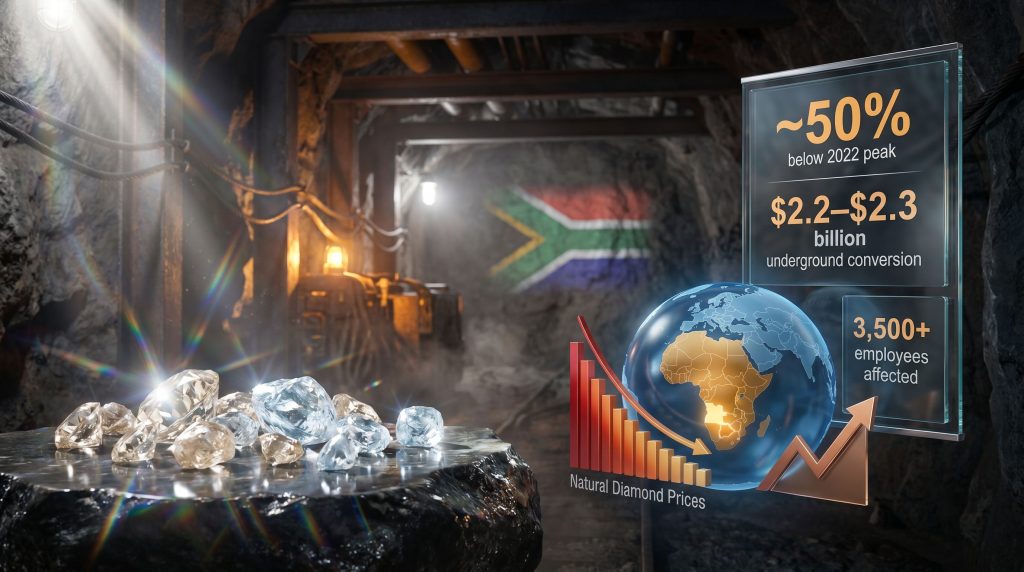
The scale of capital committed to Venetia further underscores its strategic importance. Over the past decade, De Beers invested between $2.2 billion and $2.3 billion to convert the operation from an open-pit facility into a fully underground mine, representing the largest single capital commitment made in South Africa's diamond sector in the modern era. The underground mine's projected operational lifespan extends to at least 2045 to 2049, a horizon that speaks to the asset's long-term geological viability even when near-term market conditions are deeply unfavourable.
The Underground Transition: A Generational Engineering Shift
Venetia's transformation from surface to underground mining is itself a story worth understanding in technical terms. Open-pit extraction, which concluded in December 2022 after approximately three decades of surface operations, exploits near-surface kimberlite ore bodies through progressive benching and blasting. As ore grades typically diminish closer to the surface over time, deeper kimberlite pipes become accessible only through underground methods.
Underground diamond mining involves a fundamentally different set of engineering challenges. At Venetia, the transition required the construction of vertical shaft infrastructure, underground haulage systems, and ore processing connectivity at depth, all while maintaining surface operations and eventually transferring the full production load below ground. The first diamonds recovered from underground operations were extracted in July 2023, and the facility is designed to sustain an annual production capacity of approximately 4 million carats.
Kimberlite pipes, the geological formations that host diamond deposits like Venetia, narrow with depth but can maintain high-grade ore over substantial vertical extents. This is precisely why the underground conversion warranted a multi-billion-dollar commitment. A 5% decline in De Beers' Q2 2023 production figures was directly linked to this planned transitional phase rather than any unexpected geological or mechanical failure, a distinction that matters when interpreting the mine's operational track record. For further technical context, the De Beers Venetia mine overview document provides comprehensive background on the asset's geological profile.
The Venetia mine halt must be read in its correct context: a strategically vital, recently converted underground operation that is technically sound but commercially unviable under current pricing conditions. The geological asset is intact. The market has retreated.
Three Structural Forces Converging on the Natural Diamond Market
The Price Collapse That Outlasted the Cycle
Natural diamond prices remain approximately 50% below their 2022 peak, a deterioration that has persisted well beyond what commodity analysts would typically classify as a cyclical correction. Understanding the commodity price impact on legacy assets like Venetia requires examining three compounding forces that explain this sustained depression:
- Reduced consumer discretionary spending in China, historically one of the most important luxury diamond markets globally, which has been constrained by property sector stress, youth unemployment, and subdued consumer confidence.
- Post-pandemic demand normalisation, which followed an artificial surge in luxury goods consumption during 2021 and early 2022 when stimulus-fuelled spending temporarily inflated diamond valuations across all market segments.
- The structural rise of laboratory-grown diamonds, which now offer consumers chemically and visually identical stones at dramatically lower price points, permanently reshaping the competitive landscape for natural stones.
Each of these forces would be significant in isolation. Together, however, they have created a pricing environment that makes operating high-cost underground diamond mines economically untenable without either accepting deep losses or temporarily suspending production.
Lab-Grown Diamonds: Understanding the Disruption Mechanism
The laboratory-grown diamond industry deserves more technical scrutiny than it typically receives in mainstream coverage. Synthetic diamonds are produced primarily through two methods: High Pressure High Temperature (HPHT) processing, which replicates the geological conditions under which natural diamonds form, and Chemical Vapour Deposition (CVD), which grows diamond crystals from a carbon-rich gas onto a substrate wafer. Both methods produce stones that are physically, chemically, and optically identical to mined diamonds, a fact that standard gemological testing cannot differentiate without specialised spectroscopic equipment.
The price differential between natural and synthetic diamonds has widened to a degree that would have seemed implausible a decade ago. Lab-grown stones now trade at a fraction of equivalent natural diamond prices, and that gap has continued to widen as production efficiency improves and manufacturing scale increases. This is not a temporary arbitrage. It reflects a permanent structural cost advantage for synthetic producers that no amount of marketing can fully neutralise.
De Beers has responded by investing heavily in campaigns designed to promote the provenance narrative around natural diamonds, emphasising geological rarity, billions-of-years formation timelines, and emotional authenticity. While this strategy has merit in the ultra-luxury segment, it faces significant headwinds across mid-market and fashion jewellery categories where price sensitivity is the dominant purchasing variable.
| Market Segment | Natural Diamond Outlook | Lab-Grown Threat Level |
|---|---|---|
| Ultra-high-net-worth luxury | Stable, rarity premium intact | Low |
| Mid-market engagement rings | Moderate to significant pressure | High |
| Fashion and everyday jewellery | Substantial erosion underway | Very High |
| Investment and collectible stones | Selective resilience | Low to Medium |
Capital Discipline as the Only Available Lever
With revenue compressed and no immediate demand recovery in sight, De Beers has responded through aggressive cost management. Since 2024, the company has reduced annual administrative expenditures by more than $100 million, whilst simultaneously trimming capital spending across its operational portfolio. The two-year Venetia suspension is the most visible expression of this capital discipline strategy, directly affecting over 3,500 employees and creating substantial socioeconomic exposure across Limpopo Province communities that depend on the mine's economic activity.
The National Union of Mineworkers had previously been engaged in wage negotiations with De Beers centred on a 9% wage increase demand against the company's counter-offer of 6%, adding a labour relations dimension to an already complex operational environment.
Anglo American's Strategic Pivot and the De Beers Divestiture
Why Copper Has Displaced Diamonds at the Top of the Portfolio
Anglo American's decision to pursue the sale of De Beers is rooted in a calculated assessment of where long-term commodity demand is heading. Copper sits at the intersection of every major infrastructure trend shaping the global economy over the next three decades. Furthermore, the growing copper supply crunch means electric vehicle manufacturing, grid-scale battery storage, renewable energy transmission, and data centre buildout all require copper in quantities that existing mine supply cannot comfortably meet. This creates a structural supply deficit that copper prices are expected to reflect over time.
Diamonds, by contrast, lack this industrial demand anchor. Their value is derived from cultural desirability and perceived scarcity, both of which are now under pressure from synthetic alternatives and shifting consumer preferences. The divergence in commodity outlooks makes Anglo American's portfolio reallocation toward copper a rational capital allocation decision, even if it means parting with a 138-year-old institution that helped define the modern diamond industry. This shift is also emblematic of broader mining industry consolidation trends reshaping corporate portfolios globally.
The Ownership Transition: Who Could Acquire De Beers?
The acquisition of De Beers carries complexity that extends well beyond a conventional merger and acquisition transaction. Multiple investor groups are reportedly evaluating acquisition structures, with interest attributed to parties based in the UAE and Oman. Any credible bid must also account for the sovereign interests of Botswana and Angola, both of which have articulated clear expectations for enhanced governance participation and economic benefit-sharing arrangements.
| Potential Acquirer Profile | Primary Interest | Key Complexity Factor |
|---|---|---|
| Gulf sovereign or private capital | Asset diversification and prestige | Regulatory approvals and sanctions risk |
| Botswana government interests | Resource sovereignty and revenue share | Financing capacity and political alignment |
| Angola state interests | Regional influence and production access | Governance frameworks and joint structures |
| Private equity consortium | Restructuring upside on long mine life | Debt capacity over extended horizon |
Botswana hosts De Beers' most productive global operations through the Debswana joint venture, making its participation in any ownership structure a practical necessity rather than simply a political preference. This dynamic reflects a broader continental shift toward resource nationalism and in-country beneficiation, as African governments increasingly seek to capture downstream value from mineral wealth. Consequently, these resource export challenges mirror the wider resource export challenges that commodity-dependent economies are navigating globally.
The Socioeconomic Fallout in South Africa's Limpopo Province
More Than 3,500 Jobs and an Entire Regional Economy in Uncertainty
The immediate human impact of the De Beers Venetia mine halt is concentrated in Limpopo Province, one of South Africa's most economically vulnerable regions. With direct employment exceeding 3,500 workers, the ripple effects through contractor networks, local suppliers, and community service businesses extend the affected population considerably further.
South Africa's mining sector already operates under significant structural employment pressure, with decades of mechanisation, commodity cycles, and energy cost escalation having progressively reduced headcount across the industry. A flagship asset suspension of this magnitude compounds existing vulnerabilities in a region with limited economic diversification and high dependency on the mine's wage bill.
The Production Vacuum and Its Broader Consequences
With Venetia contributing approximately 40% of national diamond production, the two-year suspension creates a material gap in South Africa's gem sector export revenue. Junior and mid-tier diamond producers operating in the country lack the scale to compensate for Venetia's absence, meaning the aggregate production shortfall will be real and measurable.
Scenario consideration: If market conditions fail to recover within the two-year suspension window, particularly if lab-grown diamond penetration continues accelerating, De Beers may face a choice between extending the pause, permanently scaling down underground capacity, or accepting a distressed asset sale at compressed valuations. The mine's long-life profile to 2045 to 2049 provides genuine optionality, but only if sufficient capital can be preserved through the pricing trough.
Is the Natural Diamond Market Facing a Structural Reset?
Reading the Demand Recovery Signals Carefully
De Beers Group CEO Al Cook has pointed to what the company characterises as protracted challenging conditions whilst simultaneously identifying emerging signs of consumer demand recovery in the United States, the world's largest diamond jewellery market. This cautious optimism is notable because any sustained improvement in American discretionary spending would provide a meaningful demand floor for natural stones, given that US consumers have historically absorbed a disproportionate share of global diamond jewellery value.
However, the critical question is whether US demand recovery can offset the structural compression occurring in China and the mid-market globally. These are not equivalent forces. Chinese luxury consumption, when it returns, may increasingly favour other categories over diamonds, particularly given the cultural resonance that lab-grown stones are building among younger Chinese consumers who view synthetic diamonds as technologically sophisticated rather than inferior. In addition, rising critical minerals demand is fundamentally reshaping where both capital and consumer attention are directed.
Where Does the Lab-Grown Disruption Curve Stabilise?
Industry observers remain divided on whether a market segmentation equilibrium will eventually emerge between natural and synthetic diamonds, or whether the disruption will continue compressing natural diamond valuations across all but the most exclusive tier.
The more optimistic view holds that natural diamonds will retain a durable premium in specific emotionally charged contexts, most notably engagement rings and significant gifting occasions, where provenance and geological authenticity carry genuine sentimental weight for buyers with the means to pay the premium.
The more sobering view contends that as lab-grown stones become ubiquitous and culturally normalised, the natural diamond premium will compress to a niche reserved for ultra-high-net-worth collectors and investors in exceptional stones, leaving the mass market permanently dominated by synthetics. Under this scenario, the addressable market for Venetia's production at economically viable price points is structurally smaller than any historical model would have projected.
The next major ASX story will hit our subscribers first
Key Statistics at a Glance
| Metric | Data Point |
|---|---|
| Venetia's share of South Africa's diamond output | Approximately 40% |
| De Beers' global production from Venetia | Approximately 10% |
| Underground conversion investment | $2.2 to $2.3 billion |
| Employees affected by the operational pause | More than 3,500 |
| Projected mine operational life | To 2045 to 2049 |
| Natural diamond price decline from 2022 peak | Approximately 50% |
| Annual cost reductions since 2024 | More than $100 million |
| Underground annual production target | Approximately 4 million carats |
| Open-pit closure date | December 2022 |
| First underground diamonds extracted | July 2023 |
Three Scenarios for the Medium-Term Trajectory
Scenario A: Market Recovery and Operational Resumption
Natural diamond demand stabilises, anchored by a recovering US consumer market and a gradual return of Chinese luxury spending. De Beers resumes Venetia operations within the two-year window, the underground facility reaches target annual capacity of approximately 4 million carats, and the asset becomes a productive centrepiece for whichever entity ultimately acquires De Beers from Anglo American.
Scenario B: Prolonged Suppression and Ownership Transition Under Pressure
Diamond prices remain structurally depressed through 2027 and beyond. The Venetia suspension extends, Anglo American completes the De Beers divestiture under compressed valuation conditions, and a new ownership structure, potentially incorporating African sovereign participation from Botswana and Angola, attempts to restructure operations around a lower-cost operating model calibrated for a permanently smaller natural diamond market.
Scenario C: Permanent Market Bifurcation
The natural diamond market permanently divides into two distinct tiers. An ultra-premium segment, characterised by exceptional stones with verifiable geological provenance and institutional investment interest, maintains pricing resilience. A commoditised mid-market, constituting the bulk of historical volume, is overwhelmingly displaced by lab-grown alternatives. De Beers repositions its entire brand and commercial strategy toward the premium segment, potentially operating Venetia at reduced capacity but preserving its symbolic value as a source of authenticated natural gems.
Disclaimer: The scenario projections presented above are analytical frameworks intended to illustrate possible trajectories under different market conditions. They do not constitute financial advice or investment recommendations. Actual outcomes will depend on a wide range of variables including consumer behaviour, production economics, ownership transitions, and broader macroeconomic conditions.
FAQ: De Beers Venetia Mine Halt
Why has De Beers halted operations at the Venetia mine?
De Beers announced a two-year operational suspension at Venetia in response to sustained unfavourable market conditions, including natural diamond prices sitting approximately 50% below their 2022 peak and intensifying competition from laboratory-grown alternatives. The decision is also consistent with the company's broader cost reduction programme and Anglo American's strategic repositioning toward copper.
Is Venetia closing permanently?
No. The mine is not closing permanently. Its operational lifespan is projected to extend to at least 2045 to 2049 following the completion of the underground conversion. The current halt is a market-driven temporary measure.
How many workers are affected?
The suspension directly affects more than 3,500 employees, with additional downstream impacts on contractors, suppliers, and community-dependent businesses across the Limpopo Province region.
What is De Beers' ownership situation?
De Beers is majority-owned by Anglo American, which is actively pursuing a divestiture as part of its strategic shift toward copper and industrial metals. Multiple potential acquirers, including Gulf-based investors and African sovereign interests from Botswana and Angola, are reportedly evaluating acquisition bids.
When did Venetia transition to underground mining?
Open-pit extraction concluded in December 2022. Underground mining produced its first diamonds in July 2023, with a target annual capacity of approximately 4 million carats.
Want to Know Which ASX Mineral Discoveries Could Deliver the Next Major Return?
While legacy mining assets like De Beers' Venetia navigate structural market pressures, Discovery Alert's proprietary Discovery IQ model scans the ASX in real time, instantly alerting subscribers to significant new mineral discoveries across copper, lithium, and over 30 other commodities — the kinds of opportunities that have historically generated extraordinary returns, as showcased on Discovery Alert's dedicated discoveries page. Begin your 14-day free trial today and position yourself ahead of the broader market.