
August 14, 2026
Natural Diamond Mining at a Structural Inflection Point
Commodity markets are no strangers to cyclical pain, but the pressures bearing down on the natural rough diamond sector carry a distinctly different character from prior downturns. Unlike the demand shocks of 2008 or the supply disruptions of earlier decades, the challenges facing major producers today blend cyclical weakness with structural transformation. When a producer commits billions of dollars to extending the life of a flagship underground mine, then pauses that very operation within years of its first ore milestone, the decision demands a deeper level of analysis than simple market softness can explain.
The De Beers Venetia mine production pause, announced in July 2026, is precisely that kind of decision. It sits at the intersection of depressed rough diamond pricing, the accelerating disruption from lab-grown diamonds, and the capital allocation pressures cascading down from Anglo American's broader portfolio restructuring agenda. Understanding what this pause means for the asset, for De Beers as an enterprise, and for the global natural diamond supply chain requires unpacking each of these dimensions systematically.
When big ASX news breaks, our subscribers know first
Venetia: South Africa's Premier Diamond Asset and Its Underground Transformation
The Venetia mine, located in South Africa's Limpopo province, holds a singular position within the country's mining landscape. It is South Africa's largest diamond-producing operation and one of the most significant kimberlite pipe systems in the southern hemisphere. After approximately three decades of open-pit extraction, surface ore reserves were effectively exhausted, with the open-pit chapter closing in December 2022.
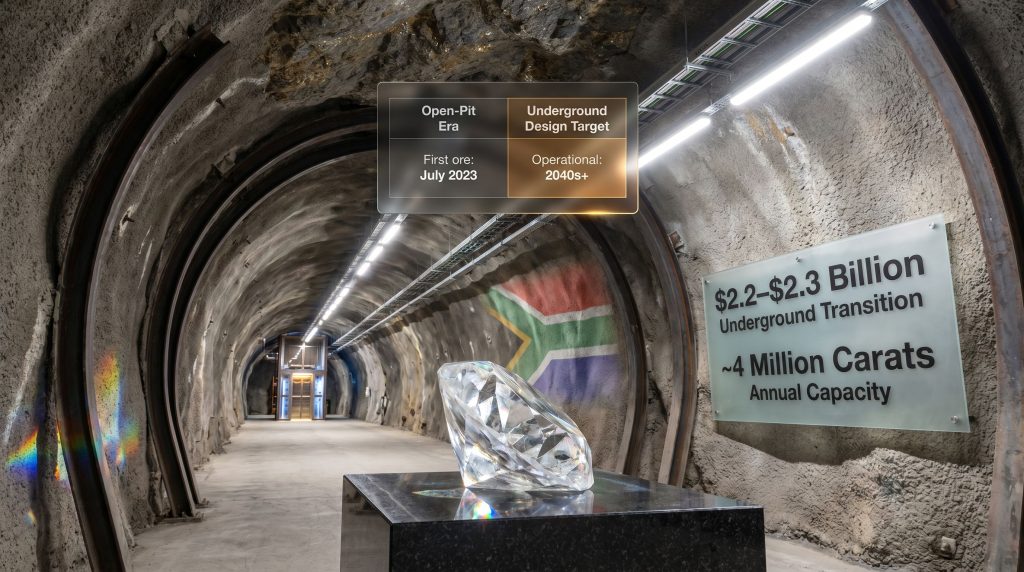
What followed was one of the most capital-intensive mining transitions undertaken on the African continent in recent memory. De Beers committed an estimated $2.2 to $2.3 billion to convert Venetia from a surface operation into a deep underground mine, targeting ore bodies that open-pit methods could not economically access. The first underground ore reached surface in July 2023, a meaningful technical milestone confirming the viability of the transition.
The underground design targets an annual production capacity of approximately 4 million carats, with a projected mine life extending into at least the 2040s. At the time of the pause announcement, construction of the underground infrastructure was approximately 70% complete, meaning a substantial portion of the capital commitment had already been deployed.
| Metric | Open-Pit Era | Underground Design Target |
|---|---|---|
| Operational Period | Approx. 30 years (to Dec 2022) | 2040s and beyond |
| First Ore Milestone | Legacy production | July 2023 |
| Annual Carat Capacity | Variable | Approx. 4 million carats |
| Capital Investment | Sunk legacy cost | Approx. $2.2–$2.3 billion |
| Construction Progress (2023) | N/A | Approx. 70% complete |
A lesser-known but critical geological dimension of the Venetia underground project is the nature of kimberlite pipe mining at depth. As operations move deeper, ore grades and diamond size distributions can shift considerably from those encountered in near-surface open-pit mining. Underground kimberlite ore often requires more selective mining methods, and the cost per tonne extracted rises sharply relative to bulk open-pit operations. This means that the economic viability of deep underground production is particularly sensitive to rough diamond price benchmarks, since the margin buffer is inherently thinner than in surface mining.
The Commercial Logic Behind the Two-Year Pause
Rough Diamond Market Deterioration and Its Upstream Effects
The rough diamond trading environment has deteriorated materially over the past several years, driven by a combination of demand-side headwinds and a structural supply-side competitor that did not exist at meaningful scale a decade ago. Understanding these commodity price impacts is essential to contextualising the decision. Rough diamond prices, tracked through indices such as the IDEX Rough Diamond Index, have experienced sustained weakness, with the midstream segment accumulating excess inventory that suppressed upstream buying appetite.
The three major consumer markets for polished diamonds, being the United States, China, and India, have each delivered disappointments. US bridal demand, which has historically been the most stable anchor of global diamond consumption, showed signs of softening as younger consumer cohorts demonstrated greater openness to lab-grown alternatives. China's post-pandemic luxury spending recovery proved shallower than anticipated, and India's domestic polished market faced margin compression from excess supply in the cutting and polishing sector.
Market Mechanics Note: The rough diamond supply chain operates in a distinctive way that amplifies downstream weakness. De Beers distributes rough diamonds through a controlled sales system known as sights, where authorised buyers (called sightholders) purchase pre-sorted parcels at fixed prices. When sightholders refuse boxes or request deferrals, it signals acute downstream stress, effectively forcing upstream producers to respond through production adjustments rather than price reductions alone.
The Lab-Grown Diamond Disruption: Structural, Not Cyclical
The most consequential force bearing down on the natural rough diamond market is not a demand cycle but a supply-side technological disruption. Lab-grown diamonds (LGDs), produced through either Chemical Vapour Deposition (CVD) or High Pressure High Temperature (HPHT) processes, have achieved near-gem chemical and optical equivalence to mined diamonds. Crucially, the manufacturing cost of LGDs has collapsed over the past five years, with retail prices for lab-grown stones now trading at discounts of 50% to 80% below comparable natural diamonds in some size and quality categories.
This price compression undermines one of the core mechanisms that natural diamond producers have historically used to support rough prices: supply restriction. When synthetic alternatives can fill consumer demand at a fraction of the price, reducing natural diamond output has a far diminished effect on market-clearing prices than classical supply economics would predict. The natural diamond industry is, consequently, navigating a scenario where its pricing power is being structurally eroded from below.
Cost Rationalisation and Capital Deferral as Rational Strategy
Within this context, the De Beers Venetia mine production pause is best understood as a disciplined capital preservation decision rather than a retreat. The operational logic is straightforward: continuing to accelerate underground ramp-up spending during a period of compressed rough diamond prices would lock in losses at exactly the wrong point in the cycle. By suspending active mining while maintaining critical infrastructure, De Beers avoids generating carat volumes that would need to be sold at depressed margins, while preserving the asset's technical readiness for an eventual recovery.
This approach has clear precedent in the broader mining industry consolidation landscape. Copper, iron ore, and coal producers have repeatedly employed temporary production suspensions during price troughs, resuming operations when conditions normalise. The key distinction that matters for investors is whether suspended infrastructure is maintained (indicating intent to restart) or allowed to deteriorate (signalling a more permanent withdrawal). De Beers has explicitly committed to continued infrastructure investment during the pause period, which carries significant interpretive weight.
Key Strategic Insight: Preserving a $2.2–$2.3 billion underground asset through a market downturn, rather than running it at a loss to maintain volume, reflects the long-cycle capital discipline that separates strategically managed mining operations from those focused purely on near-term output metrics.
Corporate Ownership Pressures and Portfolio Context
Anglo American's Influence on De Beers Decision-Making
De Beers operates as a majority-owned subsidiary of Anglo American, and the capital allocation pressures at the parent company level are inseparable from asset-level decisions at Venetia. Anglo American has itself been navigating a significant portfolio rationalisation period, exploring divestiture options across several commodity segments as it works to simplify its business and improve returns to shareholders.
This parent company dynamic creates a layered decision-making environment. Asset-level operational choices must satisfy not only De Beers' own commercial objectives but also Anglo American's group-level capital efficiency requirements. In environments where parent companies are actively reviewing asset portfolios, subsidiary management teams face heightened pressure to demonstrate capital discipline, making a pause at a cash-consuming underground ramp-up project more, rather than less, likely.
De Beers has simultaneously indicated plans to reconfigure its global operating model, directing resources toward core business functions while reducing corporate overhead. While specific operational details of this restructuring have not been publicly disclosed, the combination of site-level production suspension and corporate cost reduction points toward a comprehensive effort to right-size the business for a prolonged period of revenue pressure.
Supply Implications and Market Effects
Venetia's Weight in Global Rough Diamond Supply
The significance of the De Beers Venetia mine production pause to global supply depends on how the asset's designed capacity is contextualised within total world rough diamond output. Global rough diamond production from major producers including Alrosa (Russia), De Beers (Botswana, Namibia, South Africa, Canada), Rio Tinto, and others has ranged between approximately 110 and 130 million carats annually in recent years. A 4-million-carat-capacity asset at Venetia, while not the single largest mine globally, represents a meaningful incremental supply source whose two-year absence from active production will have a measurable, if modest, effect on total available rough supply.
Furthermore, South Africa mining decline trends more broadly suggest that the Venetia pause does not occur in isolation. The more significant supply impact is timing-related. The Venetia underground mine was expected to be a growing contributor to De Beers' total output as its ramp-up progressed. Delaying that ramp-up pushes the mine's peak production contribution further into the future, reducing De Beers' overall output ceiling for the next several years.
Producer Response Strategies Compared
| Response Type | Strategic Implication | Venetia Relevance |
|---|---|---|
| Temporary Production Pause | Preserves asset, defers capex, signals confidence in recovery | Current De Beers approach |
| Inventory Accumulation | Manages market supply without halting production | Alternative approach, carries working capital cost |
| Permanent Mine Closure | Irreversible asset impairment, supply permanently removed | Not applicable to Venetia |
| Accelerated Ramp-Up | Captures recovery upside by building production ahead of demand return | Post-pause potential strategy |
Stakeholder Considerations and Investor Watch Points
Limpopo Employment and Socioeconomic Dimensions
Venetia is one of the most significant private sector employers in Limpopo, a province that faces persistent economic development challenges. A two-year operational suspension carries genuine socioeconomic implications for workers, contractors, and the surrounding communities that depend on mine-related economic activity. Workforce management during the suspension period, including decisions around retention, redeployment, or redundancy, will be closely watched by South African labour unions and the Department of Mineral Resources and Energy.
South Africa's mining sector operates within a complex regulatory environment that includes obligations under the Mineral and Petroleum Resources Development Act and broad-based black economic empowerment frameworks, both of which introduce additional layers of stakeholder management complexity during any operational curtailment.
What Investors Should Monitor
For those tracking the diamond mining sector, the De Beers Venetia mine production pause creates a specific set of forward-looking signals worth monitoring:
- Rough diamond price indices: Recovery in IDEX or De Beers sight prices would be the most direct trigger for an accelerated restart discussion
- Sightholder sales volumes: Any material uptick in De Beers' ten-sight selling cycle would signal improving midstream confidence
- Infrastructure milestone updates: Continued underground development progress during the pause confirms management's intent to restart
- Anglo American strategic announcements: Any movement on De Beers' ownership structure could reshape the asset's operational trajectory independently of market conditions
- Lab-grown diamond price floors: Stabilisation of LGD retail pricing, if it occurs, would reduce one of the primary sources of structural pressure on natural rough benchmarks
Scenario Analysis: Venetia Restart Pathways
| Scenario | Trigger Conditions | Likely Restart Timing |
|---|---|---|
| Base Case | Gradual rough diamond price recovery | End of stated two-year pause window |
| Accelerated Recovery | Strong demand rebound in US and China, LGD market stabilisation | Earlier than planned restart |
| Extended Pause | Prolonged market weakness, continued LGD share gains | Beyond two-year window |
| Strategic Divestiture | Anglo American portfolio restructuring leads to De Beers sale | New operator timeline, uncertain |
Disclaimer: Scenario projections above are analytical frameworks based on publicly available information and should not be interpreted as financial advice or forward guidance. Diamond market conditions are subject to multiple variables that are inherently difficult to forecast with precision.
The next major ASX story will hit our subscribers first
Three Structural Forces Reshaping Natural Diamond Economics
The De Beers Venetia mine production pause is a single event within a larger transformation affecting the entire natural diamond industry. A broader mining industry analysis reveals three converging forces that are redefining the economics of the sector:
- Demand-side generational shift: Younger consumer demographics in key markets are demonstrably more willing to accept lab-grown diamonds for jewellery purposes, eroding the cultural premium that underpinned natural diamond pricing for decades
- Supply-side concentration vulnerability: Natural diamond production is heavily concentrated in a small number of large kimberlite pipe mines, making the supply chain structurally sensitive to individual asset decisions of precisely the kind unfolding at Venetia
- Parent company portfolio dynamics: Corporate consolidation trends mean that individual mine operations are increasingly subject to group-level capital allocation logic that can override pure asset-level economics
For the natural diamond industry to recover on a sustainable basis, it will likely require a combination of demand-side marketing success in repositioning natural diamonds as meaningfully differentiated from synthetic alternatives, stabilisation of rough diamond price benchmarks, and a moderation in the rate of LGD cost decline. None of these conditions are guaranteed within any particular timeframe.
However, what the Venetia pause does confirm is that De Beers is choosing disciplined asset stewardship over short-term volume maintenance. This posture, if the market does eventually recover, will position the underground operation to contribute meaningfully to the company's output profile well into the 2040s. Those seeking additional context on mining project feasibility considerations will find that Venetia's long investment horizon reflects the careful planning that underpins large-scale underground operations.
Readers seeking additional context on African mining sector developments can explore related coverage via Reuters' mining and commodities reporting, which includes in-depth coverage of the Venetia pause announcement. Further technical background on the Venetia underground project is available through International Mining's project coverage, documenting the key underground production milestones.
Want to Track the Next Major Mineral Discovery Before the Market Does?
While the natural diamond sector navigates structural headwinds, opportunities continue to emerge across the broader ASX mining landscape — and Discovery Alert's proprietary Discovery IQ model delivers real-time alerts the moment significant mineral discoveries hit the exchange, turning complex geological announcements into actionable insights for investors at every level. Explore historic examples of exceptional discovery returns and begin a 14-day free trial to position yourself ahead of the market.