July 13, 2026
The Structural Squeeze: How Mine Shutdowns Are Reshaping the Global Diamond Supply Chain
The global diamond industry has entered a period of structural supply compression that goes well beyond short-term market volatility. For decades, the rough diamond market operated under a relatively predictable supply model, anchored by a small number of dominant producers controlling vast, long-life deposits. Today, that model is being stress-tested by simultaneous mine closures, capital rephasing decisions, and a fundamental rethinking of how major producers allocate resources across their portfolios.
Understanding what is driving this shift, and what it means for pricing, rarity, and long-term value, requires looking well beyond individual corporate announcements. Furthermore, commodity price pressures have intensified this structural squeeze, making it harder for producers to justify near-term output at the expense of long-term asset quality.
It is within this broader context that the De Beers Venetia mine production pause, announced on July 13, 2026, carries significant analytical weight. This is not simply a single-mine operational decision. It represents the visible output of a multi-year strategic transformation, and it arrives alongside a cluster of other supply-side events that are collectively reshaping the availability of rough diamonds globally.
When big ASX news breaks, our subscribers know first
Understanding the Venetia Mine: South Africa's Diamond Heartland
Venetia is not an ordinary mine. Located in the Limpopo province of South Africa, it has historically contributed approximately 40% of the country's total diamond output, a figure that underscores just how disproportionately important the asset is to South Africa's mining sector as a whole. Indeed, among the world's diamond-producing countries, South Africa's significance is shaped in large part by this single operation.
From Open-Pit Operations to Underground Powerhouse
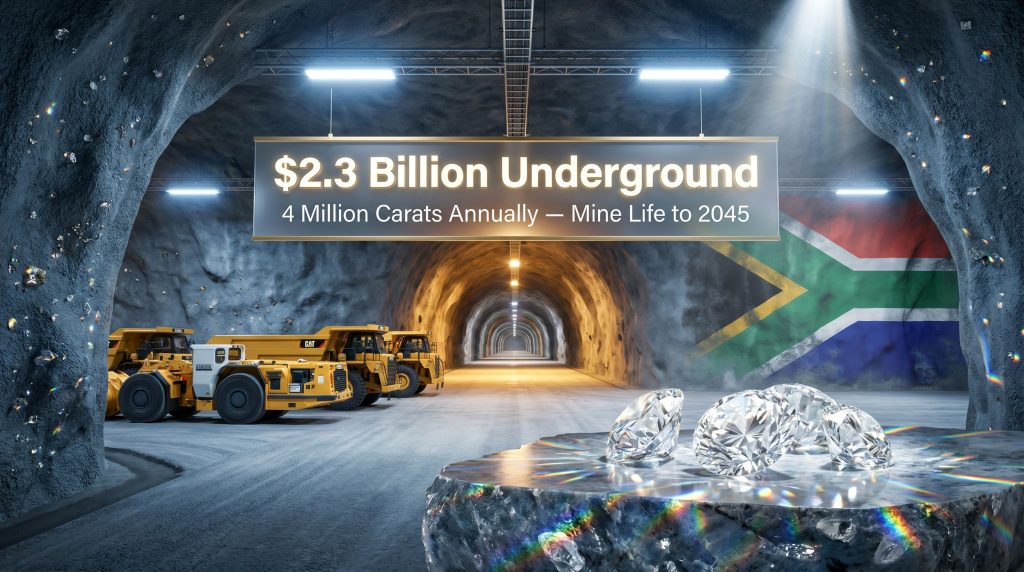
The mine has already undergone one of the most ambitious capital transformations in modern diamond mining history. Open-pit operations, which had defined the asset for decades, concluded in December 2022. The transition to underground extraction required a $2.3 billion capital investment, making it one of the largest underground diamond mine developments ever undertaken.
The underground facility delivered its first production in July 2023 and was engineered to deliver up to 4 million carats annually, with an operational life projected to extend through to at least 2045. That long asset life is a critical detail. It transforms the Venetia underground project from a simple production asset into a strategic optionality vehicle, one with decades of productive capacity that De Beers is deliberately choosing to preserve rather than prematurely exhaust.
Key Venetia Timeline at a Glance
| Milestone | Date / Figure |
|---|---|
| Open-pit mining concluded | December 2022 |
| Underground facility first production | July 2023 |
| Production pause announced | July 13, 2026 |
| Expected pause duration | Two years (approximately 2026–2028) |
| Underground design capacity | Up to 4 million carats per year |
| Projected mine life | At least 2045 |
| Total underground capital investment | $2.3 billion |
What the Production Pause Actually Involves
The term production pause requires careful interpretation in a mining context. There is a meaningful difference between three operational states that are sometimes conflated in market commentary:
- Permanent closure: The asset is wound down with no intention to restart. Infrastructure may be decommissioned or repurposed. Optionality is permanently destroyed.
- Care and maintenance: The mine is placed in a low-cost holding state with minimal spending, preserving the physical asset but deferring any restart decision indefinitely.
- Structured operational pause with concurrent investment: Production halts temporarily while capital is actively deployed to upgrade infrastructure, with a clearly stated intention to resume at enhanced capacity.
The De Beers Venetia mine production pause falls decisively into the third category. De Beers has confirmed the two-year halt will include critical infrastructure investment designed to improve both the capacity and efficiency of the underground operation ahead of a planned restart. This is not asset abandonment. It is a deliberate decision to accept short-term production forgone in exchange for a higher-quality, more cost-efficient production profile over the subsequent decades.
The distinction between a care-and-maintenance arrangement and a structured pause with active capital deployment is frequently misread by markets. One signals uncertainty about an asset's future; the other signals confidence in its long-term value, combined with a disciplined view on the timing of that value realisation.
Importantly, De Beers has confirmed that its overall production guidance remains unchanged, with output from its other global operations expected to compensate for the Venetia shortfall during the pause period.
Capex Rephasing: A Technical Term With Strategic Implications
Alongside the production pause, De Beers has announced a rephasing of capital expenditure on the Venetia underground project. For investors and industry analysts unfamiliar with the term, capex rephasing refers to the redistribution of planned spending across a longer timeframe, rather than the cancellation of investment commitments.
In practical terms, rephasing achieves several objectives simultaneously:
- It reduces near-term cash outflows, improving liquidity and financial resilience during a period of challenging trading conditions.
- It preserves the long-term production profile of the asset by maintaining investment in the infrastructure required for future output.
- It allows management to sequence capital deployment in alignment with expected market recovery, avoiding the trap of commissioning expensive new capacity into a weak pricing environment.
This approach is particularly well-suited to Venetia's situation given the mine's exceptionally long operational runway. With production viable through to at least 2045, there is no urgency to maximise output in the near term, especially when doing so would come at the cost of capital efficiency.
De Beers' Broader Restructuring: The Origins Strategy Explained
The Venetia pause cannot be fully understood in isolation. It is one component of a comprehensive business transformation that De Beers has been executing since 2024, centred on what the company refers to as its origins strategy. Consequently, mining project development decisions across the portfolio have been systematically re-evaluated against this strategic framework.
This multi-pillar framework encompasses three primary operational dimensions:
- Cost reduction: De Beers has already removed more than $100 million in annual overhead costs from its global business prior to the Venetia announcement, a substantial efficiency achievement for a company of its scale.
- Non-core asset divestment: The sale or closure of assets that do not contribute meaningfully to long-term value creation has been ongoing, freeing capital and management attention for higher-priority activities.
- Capital concentration in highest-value activities: Investment is being redirected toward operations and programmes that generate the greatest return per dollar deployed, including natural diamond marketing investment.
The Venetia pause and the earlier decision to suspend the Tuzo Phase 3 expansion at the Gahcho Kué joint venture mine in Canada are the most significant supply-side expressions of this strategy. Together, they establish a clear pattern of deliberate supply-side capital discipline rather than reactive cost-cutting.
Portfolio and Organisational Changes: A Coordinated Programme
Simultaneously with the Venetia announcement, De Beers outlined plans to reconfigure its global operating model, refocusing resources on its core operational businesses while reducing the central corporate cost base. This organisational restructuring suggests the transformation is comprehensive, reaching from asset-level operational decisions all the way through to corporate structure.
De Beers CEO Al Cook has articulated the dual objective of the programme: building resilience in the near term while enhancing competitive positioning for the long term. The company's framing explicitly retains optionality, the technical and financial capacity to scale production back up without incurring the full cost of a greenfield development when market conditions warrant.
The Supply-Side Shock: South Africa's Diamond Sector Under Pressure
The De Beers Venetia mine production pause does not occur in a vacuum. It arrives as part of a broader contraction in South African diamond production that is accelerating through 2026. Moreover, mining consolidation trends across the sector are compounding the supply-side pressure, as producers rationalise portfolios and reduce capital commitments to marginal assets.
Two Major Supply Events in a Single Year
| Producer | Asset | Development | Year |
|---|---|---|---|
| De Beers | Venetia Mine, South Africa | Two-year production pause announced | 2026 |
| De Beers | Gahcho Kué Mine (JV), Canada | Tuzo Phase 3 expansion suspended | 2026 |
| Petra Diamonds | Finsch Mine, South Africa | Entered business rescue | May 2026 |
The entry of Petra Diamonds' Finsch mine into business rescue in May 2026 represented the removal of another significant source of South African rough diamond supply. Combined with the Venetia pause, these two events compress South Africa's production capacity materially across the 2026–2028 period, affecting national output statistics, rough diamond trading volumes, employment, and government royalty revenues.
The Economics of Increasing Rarity
Elementary supply-side economics would suggest that declining rough diamond production should, over time, support price recovery. The relationship is not, however, mechanically straightforward in the diamond market. Several complicating factors are worth understanding:
- Near-term trading conditions remain challenging due to a combination of cyclical demand weakness and industry-specific pressures, including the ongoing competitive presence of lab-grown diamonds in certain market segments.
- Inventory dynamics in the diamond pipeline, from rough producers through polishers and dealers to retailers, mean that supply reductions at the mine level take time to translate into tighter availability at the retail end of the chain.
- Longer-term structural arguments for natural diamond value recovery are, however, meaningful. As mine closures and pauses reduce the replenishment rate of rough supply, the finite and irreplaceable nature of natural diamonds becomes a more powerful consumer narrative.
Falling mine supply does not immediately translate into higher prices. But it does progressively narrow the buffer between global production and underlying demand, reducing the market's ability to absorb future demand surges without significant price adjustment.
The next major ASX story will hit our subscribers first
Demand Recovery: US Market Signals and the Marketing Counter-Strategy
While the supply side contracts, there are genuine early signals of demand recovery worth monitoring closely. In addition, De Beers' own Q1 2026 performance data provides useful context for understanding how the company is navigating these conditions across its broader portfolio.
De Beers has reported that global consumer demand for natural diamond jewellery returned to growth in 2025. More specifically, natural diamond sales across US independent jewellers increased through 2025 and into the first quarter of 2026, with growth concentrated in higher-value diamonds and product categories supported by targeted marketing activity.
Independent jewellers are a particularly informative leading indicator in this context. Unlike major retail chains, which have the scale and purchasing flexibility to substitute product categories relatively easily, independent retailers are more closely attuned to genuine consumer preference. When independent jeweller sales grow, it tends to reflect authentic consumer demand for the specific product category rather than a retailer-driven merchandising decision.
The Role of Category Marketing in Demand Reconstruction
De Beers has deliberately reinvested in natural diamond category marketing as a strategic counter to the structural challenge posed by lab-grown alternatives. The company's Desert Diamonds marketing campaign has been specifically credited with driving increased demand for higher-value natural diamonds in the US market.
This two-sided competitive strategy, simultaneously compressing supply through capital discipline and stimulating demand through marketing investment, is relatively uncommon at this scale within the mining and gemstone industry. Most producers, including global mining leaders in other commodities, focus exclusively on one side of the equation.
Stakeholder and Community Obligations During the Pause
The Venetia mine is a significant employer in the Limpopo region, and the two-year production pause carries real consequences for the local workforce and surrounding communities. De Beers has committed to supporting affected employees through the transition period and to maintaining its social and labour plan (SLP) obligations and community investment programmes during the pause.
South Africa's Department of Mineral and Petroleum Resources will have direct regulatory oversight of the pause process, given its implications for mining rights compliance, employment obligations, and royalty-related revenue streams. The stakeholder engagement process described by De Beers is required to operate within South African mining law, including consultation with relevant authorities and affected communities.
The full detail of workforce support arrangements has not yet been publicly specified, and this represents an area that will require ongoing monitoring by labour unions, community organisations, and government stakeholders.
The Optionality Premium: Why Preserving Venetia Matters
Perhaps the most underappreciated aspect of the De Beers Venetia mine production pause is what it reveals about long-term asset strategy. By investing in infrastructure during the halt rather than simply mothballing the operation, De Beers is preserving and arguably enhancing the value of Venetia as a future production asset.
In mining finance, optionality refers to the value of maintaining the capability to restart or expand operations without incurring the full capital cost of a new development. Greenfield diamond mine development is extraordinarily capital-intensive and subject to extensive permitting, geological evaluation, and construction timelines measured in years or even decades.
An underground mine with a designed life through to 2045, upgraded infrastructure, and a clear restart pathway represents a qualitatively different asset from a closed mine that has been decommissioned. The former retains full optionality. The latter does not. As competitor assets exit the market permanently, De Beers' ability to bring Venetia back at scale positions it to capture disproportionate market share when demand conditions eventually strengthen.
This is the strategic logic that makes the De Beers Venetia mine production pause a long-term value-preservation move rather than a sign of distress.
This article is intended for informational and educational purposes only. It does not constitute financial advice. Readers considering investment decisions related to the diamond sector or companies mentioned should conduct independent research and seek professional financial guidance. Forward-looking statements and market projections involve inherent uncertainty and should not be relied upon as predictions of actual future outcomes.
Want to Track the Next Major Resource Discovery Before the Market Moves?
Discovery Alert's proprietary Discovery IQ model scans ASX announcements in real time, instantly identifying significant mineral discoveries across 30+ commodities — from diamonds to gold — and delivering actionable alerts directly to subscribers. Explore how historic discoveries have generated extraordinary returns on Discovery Alert's dedicated discoveries page, and begin your 14-day free trial today to position yourself ahead of the broader market.