
May 10, 2026
Understanding the De-Dollarization Revolution
Modern global financial architecture faces unprecedented pressures as traditional monetary frameworks confront systemic challenges that threaten established economic relationships. The convergence of mounting sovereign debt burdens, persistent inflationary pressures, and geopolitical fragmentation has created conditions reminiscent of previous monetary regime transitions. Furthermore, the de-dollarization trend in gold markets has emerged as a significant force reshaping how nations approach monetary sovereignty and reserve management. These structural forces operate independently of short-term market cycles, representing fundamental shifts in how nations manage currency reserves, conduct international trade, and maintain monetary sovereignty.
Central banking institutions worldwide have begun reassessing their reserve allocation strategies, moving beyond conventional frameworks that emerged from the Bretton Woods system collapse in the 1970s. This institutional repositioning reflects deeper concerns about currency concentration risks and the long-term sustainability of dollar-denominated reserve systems. The implications extend far beyond traditional foreign exchange markets, creating ripple effects across commodity markets, precious metals pricing, and global trade settlement mechanisms.
When big ASX news breaks, our subscribers know first
Understanding the Shift Away from Dollar Dependency
De-dollarization represents a systematic reduction in reliance on the United States dollar for international trade, central bank reserves, and cross-border financial transactions. This phenomenon differs fundamentally from historical currency substitutions, as it involves coordinated institutional behaviour rather than market-driven speculation. The process encompasses multiple dimensions: reserve currency diversification, alternative payment system development, and bilateral trade agreement restructuring to reduce dollar intermediation.
The historical context traces back to the 1971 collapse of the Bretton Woods system, when President Nixon suspended dollar-gold convertibility, creating the modern fiat currency framework. This transition established the dollar as the dominant reserve currency through institutional inertia and network effects rather than formal international agreement. However, the system's stability depended on continued confidence in U.S. monetary policy and fiscal discipline, conditions that have faced increasing scrutiny in recent years.
Current global reserve currency composition reveals the magnitude of potential shifts. According to Federal Reserve research, the U.S. dollar comprises approximately 60% of global foreign exchange reserves, down from over 70% in the early 2000s. This gradual decline accelerated following 2022 geopolitical events, when central banks began questioning the security of dollar-denominated assets held in Western financial institutions.
Gold's Role as the Universal Monetary Anchor
Gold's unique characteristics distinguish it from other potential reserve assets in ways that make it particularly attractive during periods of monetary uncertainty. Unlike sovereign bonds, gold carries no counterparty risk and remains unaffected by any single nation's fiscal or monetary policies. Unlike cryptocurrencies, gold possesses thousands of years of historical precedent as a store of value across diverse civilisations and economic systems. Unlike commodity baskets, gold requires no ongoing production or consumption, making it suitable for long-term strategic reserves.
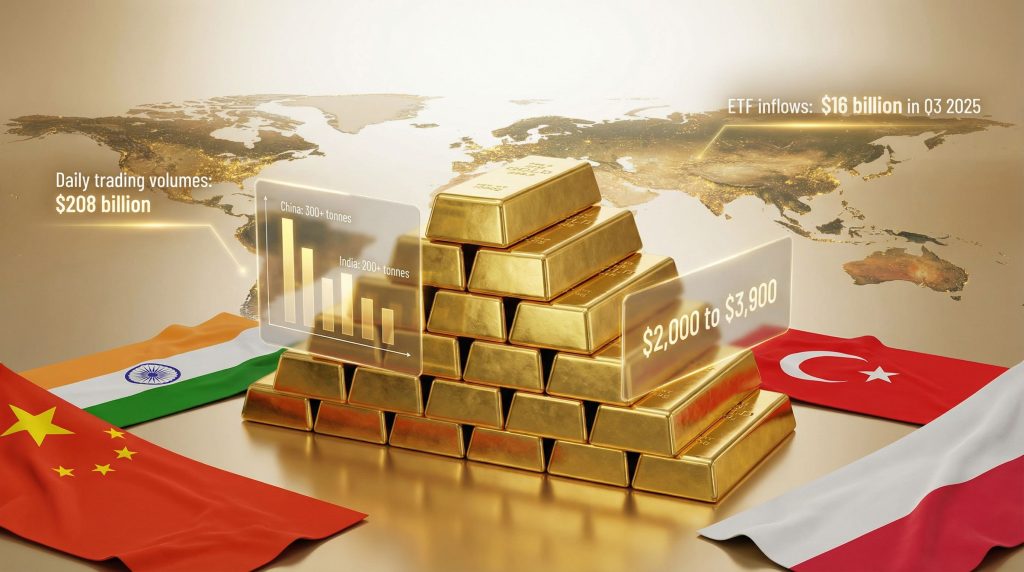
The metal's liquidity profile supports large institutional transactions without significant market disruption. Daily gold trading volumes reach approximately $208 billion during peak periods, enabling central banks to accumulate substantial positions whilst maintaining market stability. This liquidity advantage becomes crucial when institutions need to reposition reserves quickly in response to changing geopolitical conditions or currency crises.
Physical gold storage and custody arrangements provide geographical diversification benefits that electronic assets cannot match. Central banks can hold gold reserves domestically or in neutral jurisdictions like Switzerland, reducing exposure to potential sanctions or asset freezes. In addition, this tangible quality becomes increasingly valuable as financial systems fragment along geopolitical lines, creating what some analysts describe as separate monetary zones.
Asian Economic Powerhouses Drive Reserve Diversification
China's central bank accumulation strategy reflects broader concerns about dollar dependency in international trade and reserve management. The People's Bank of China has conducted steady gold purchases since 2022, with acquisition rates exceeding 300 tonnes annually according to World Gold Council data. This accumulation occurs alongside development of alternative payment systems and increased use of renminbi in bilateral trade agreements, suggesting a coordinated approach to reducing dollar reliance.
| Country | Annual Purchases (Tonnes) | Reserve Allocation % | Strategic Motivation |
|---|---|---|---|
| China | 300+ | 4.9% | Economic sovereignty |
| India | 200+ | 8.7% | Import diversification |
| Turkey | 150+ | 28.1% | Currency stability |
| Poland | 130+ | 11.2% | Geopolitical hedge |
India's approach combines traditional cultural affinity for gold with modern portfolio management principles. The Reserve Bank of India has increased gold holdings both as inflation hedge with gold protection and currency diversification, particularly relevant given India's substantial oil import requirements and exposure to dollar fluctuations. Indian demand also reflects concerns about Western sanctions precedents and the desire to maintain monetary policy independence.
Turkey's exceptionally high gold allocation percentage demonstrates how currency instability drives precious metals accumulation. The Central Bank of the Turkish Republic has used gold purchases to diversify away from currencies that have historically pressured the Turkish lira. This strategy provides a hedge against both domestic inflation and external currency pressures, though it also reflects Turkey's unique geopolitical position between Europe and Asia.
Poland's gold acquisition programme accelerated following the 2022 Russian invasion of Ukraine, reflecting European security concerns and questions about Western financial system stability. The National Bank of Poland's purchases represent both traditional safe-haven demand and strategic preparation for potential disruptions to European monetary cooperation frameworks.
Middle Eastern and Emerging Market Adaptations
Resource-rich nations possess unique advantages in converting commodity export revenues directly into gold reserves, bypassing dollar intermediation. This approach becomes particularly attractive when oil or gas exports face sanctions risks or when traditional banking channels experience restrictions. Several Middle Eastern central banks have quietly increased gold allocations, though official disclosure varies significantly across jurisdictions.
Regional monetary cooperation initiatives have begun exploring gold-backed settlement mechanisms for trade between participating nations. While these systems remain experimental, they represent practical applications of the de-dollarization trend in gold markets beyond simple reserve diversification. The success of such arrangements could influence broader adoption of alternative monetary frameworks.
Emerging market central banks face additional considerations regarding currency stability and capital flow management. Gold accumulation provides a buffer against sudden dollar strength that can destabilise local currencies and create inflationary pressures. This defensive positioning becomes crucial when Federal Reserve policy changes create spillover effects in emerging markets.
The Evolution from Institutional to Retail Demand
Central bank gold purchasing created remarkably stable price appreciation from approximately $2,000 per ounce in early 2022 to $3,500 per ounce by early 2024. This steady trajectory reflected the institutional nature of demand, as central banks typically purchase predetermined quantities regardless of short-term price movements. The consistent bidding from official sector participants provided what market professionals describe as a non-volatile price path during the initial phase of the current cycle.
Central banks operate with fundamentally different time horizons and risk parameters compared to private investors. These institutions maintain strategic objectives spanning decades rather than quarters, enabling them to accumulate positions without concern for temporary price fluctuations. Their participation provides genuine price support because their buying criteria focus on long-term diversification goals rather than technical or sentiment-driven factors.
The transition to broader investor participation began in 2024 as interest rates declined and institutional credibility questions expanded beyond currency concerns. Lower interest rates reduced the opportunity cost of holding non-yielding assets like gold, whilst persistent inflation above central bank targets raised questions about monetary policy effectiveness. These developments attracted retail and speculative investors who had previously avoided precious metals due to interest rate considerations.
Market Structure Transformation and Price Discovery
The shift from $3,500 to current levels above $4,200 per ounce reflects fundamentally different market dynamics compared to the earlier phase. Retail participation introduced greater price volatility, as individual investors respond more dramatically to short-term news and technical price movements. However, the underlying upward trend persisted because the structural factors driving de-dollarization remained intact and contributed to the historic gold surge.
Unlike previous gold rallies driven by inflation fears or currency crises, the 2022-2025 surge represents a structural shift in global monetary architecture. Central banks are treating gold as infrastructure, not speculation.
Daily trading volumes have expanded significantly during peak demand periods, reaching levels that strain traditional market infrastructure. Physical delivery demands have created bottlenecks in London and Zurich markets, with some institutional buyers experiencing delays in taking possession of purchased metal. These logistical constraints suggest genuine supply-demand imbalances rather than purely financial speculation.
Exchange-traded fund inflows accelerated during 2024-2025, with precious metals ETFs receiving approximately $16 billion in net inflows during Q3 2025 alone. This institutional vehicle participation indicates that professional money managers have begun adding gold exposure to client portfolios, extending demand beyond individual retail investors and contributing to the overall market performance surge.
Historical Precedents and Mathematical Frameworks
The 1979-1980 gold price surge provides the most relevant historical comparison for current market conditions. Gold appreciation from approximately $200 per ounce to $850 represented a 325% increase over roughly 24 months. The catalyst involved similar themes: currency instability, institutional credibility concerns, and geopolitical tensions that questioned existing monetary arrangements.
Applying comparable percentage gains to current price levels suggests mathematically feasible targets. From a $4,200 baseline, a 325% increase would yield approximately $17,850 per ounce, whilst more conservative 200-250% gains would reach $8,400-$14,700 ranges. The $10,000 target represents approximately 138% appreciation from current levels, well within historical precedent parameters.
| Scenario Speed | Timeline | Peak Gold Target | Key Catalysts |
|---|---|---|---|
| Rapid Shift | 5-10 years | $8,000-$12,000 | CBDC adoption, trade bloc formation |
| Moderate Pace | 15-20 years | $6,000-$8,000 | Gradual reserve rebalancing |
| Slow Evolution | 30+ years | $4,000-$6,000 | Incremental policy changes |
The timeline scenarios reflect different rates of institutional change rather than market speculation. Rapid shifts would require coordinated central bank actions and formal alternative monetary arrangements. Moderate pacing assumes gradual reserve rebalancing without dramatic policy announcements. Slow evolution represents incremental changes that maintain current system stability whilst reducing dollar dependency over generations.
Monetary Debasement and Debt Dynamics
Global debt-to-GDP ratios have reached unprecedented levels, with developed economies averaging over 100% and many emerging markets exceeding 60%. These debt burdens create incentives for monetary authorities to maintain accommodative policies that support asset prices and reduce real debt service costs through inflation. Such policies naturally support hard asset valuations, particularly gold, which serves as a hedge against currency debasement.
Central bank digital currencies (CBDCs) represent another potential catalyst for gold demand. As governments develop digital payment systems that enhance monetary control and reduce transaction privacy, some investors may seek assets that exist outside digital monitoring frameworks. Physical gold provides complete transaction privacy and cannot be frozen or confiscated through digital mechanisms.
The fragmentation of global payment systems creates additional demand for neutral settlement assets. As SWIFT alternatives like China's CIPS or Russia's SPFS gain adoption, cross-border transactions may increasingly require assets that all parties trust regardless of political relationships. Furthermore, the trade war impacts on global commerce emphasise gold's historical role as ultimate settlement asset, positioning it well for this potential development.
Portfolio Construction in a De-Dollarizing World
Conservative portfolio allocation models typically suggest 5-10% precious metals exposure as diversification and insurance against currency or inflation risks. However, the current environment may justify higher allocations for investors who believe the de-dollarization trend in gold markets will accelerate. Aggressive positioning might involve 25-45% gold-focused strategies, though such concentrations require careful consideration of volatility and liquidity needs.
The choice between physical gold, ETFs, mining equities, and derivatives depends on individual investment objectives and operational constraints:
-
Physical Gold: Provides direct ownership and eliminates counterparty risk, but involves storage costs, insurance requirements, and liquidity constraints during urgent liquidation needs
-
Gold ETFs: Offer market accessibility and daily liquidity, but introduce counterparty risks through fund management and custodial arrangements, plus ongoing expense ratios
-
Mining Equities: Provide leveraged exposure to gold price movements and potential dividend income, but add operational risks, management execution risks, and correlation with broader equity markets
-
Futures Contracts: Enable capital-efficient exposure and tactical positioning, but require ongoing rollover management, margin requirements, and sophisticated derivatives knowledge
Geographic Arbitrage and Currency Considerations
London and Shanghai gold markets occasionally trade at different premiums, creating arbitrage opportunities for sophisticated investors. These price differentials reflect regional supply-demand imbalances, capital flow restrictions, and currency hedging costs. Understanding these dynamics can enhance returns for investors willing to navigate cross-border precious metals transactions.
Currency hedging becomes crucial for international gold exposure, particularly when base currency fluctuations might offset gold price gains. European investors buying dollar-denominated gold face currency risk, whilst U.S. investors purchasing gold mining companies in other currencies face similar exposure. Professional currency hedging strategies can isolate pure gold price movement from foreign exchange effects.
Regional premiums in physical markets provide insights into underlying demand patterns. Asian markets typically trade at premiums during strong demand periods, whilst Western markets may discount during economic uncertainty. These premium structures offer tactical timing opportunities for patient investors willing to ship physical metal between regions.
The next major ASX story will hit our subscribers first
Silver's Amplified Response to De-Dollarization
Silver markets demonstrate significantly higher volatility than gold due to smaller market size and dual industrial-monetary characteristics. The silver market's dollar value represents approximately one-tenth of the gold market, meaning equivalent investment demand creates amplified price movements. Current silver prices around $61-62 per ounce reflect over 100% year-to-date gains, demonstrating this volatility advantage.
The gold-silver ratio provides a useful framework for understanding relative value between precious metals. This ratio compressed from approximately 100:1 during early 2024 to roughly 60:1 currently, suggesting silver outperformance during the retail investor participation phase. Historical averages around 80:1 indicate potential for further silver gains if the ratio continues normalising toward long-term averages.
Industrial demand adds complexity to silver's monetary role, as the metal serves essential functions in electronics, solar panels, and medical applications. This dual-purpose characteristic creates additional demand during economic growth periods whilst maintaining safe-haven appeal during uncertainty. The combination can produce explosive price movements when both demand sources activate simultaneously.
Platinum and Palladium Considerations
Platinum and palladium face different dynamics than gold and silver in de-dollarization scenarios. Both metals concentrate production in South Africa and Russia, creating geopolitical supply risks that could support prices independently of monetary factors. However, their primary industrial applications in automotive catalysts limit their role as pure monetary alternatives.
Investment demand patterns for platinum and palladium remain closely tied to industrial consumption expectations rather than currency concerns. During economic uncertainty, these metals may underperform gold and silver as investors prioritise pure monetary characteristics over industrial exposure. However, supply disruptions could create dramatic price movements regardless of de-dollarization trends.
The smaller market sizes of platinum and palladium create opportunities and risks similar to silver's volatility profile. Limited liquidity can produce severe price swings during demand surges or supply disruptions. Investors must carefully consider position sizing and liquidity requirements when including these metals in de-dollarization strategies.
Risk Management and Scenario Planning
De-dollarization investment strategies face several potential headwinds that could derail expected outcomes. U.S. government responses to dollar displacement might include capital controls, gold ownership restrictions, or international pressure on countries reducing dollar reserves. Historical precedents from the 1930s and 1970s demonstrate that governments can dramatically alter precious metals markets through regulatory changes.
Interest rate policy remains a critical variable affecting gold demand. If Federal Reserve policy shifts toward sustained higher rates to combat inflation or support the dollar, the opportunity cost of holding gold increases significantly. Professional investors must monitor yield curve developments and central bank communications for early indicators of policy direction changes.
Alternative scenarios that could reduce de-dollarization pressure include geopolitical reconciliation, successful U.S. fiscal consolidation, or technological innovations that strengthen dollar-based payment systems. Consequently, investors should develop contingency plans for environments where de-dollarization stalls or reverses, potentially causing precious metals corrections.
Market Timing and Volatility Management
Gold's historical boom-bust cycles suggest caution against assuming linear price appreciation. Previous precious metals bull markets have experienced 20-30% corrections even during overall upward trends. Investors should prepare for volatile price movements and avoid leverage that could force liquidation during temporary declines.
Dollar-cost averaging strategies can mitigate timing risks whilst building precious metals exposure over time. This approach reduces the impact of short-term volatility whilst ensuring participation in long-term trends. Regular rebalancing based on predetermined allocation targets helps maintain appropriate portfolio positioning regardless of price movements.
Options strategies can provide downside protection or enhanced returns for sophisticated investors. Protective puts limit downside risk whilst maintaining upside participation. Covered calls can generate additional income during sideways price movements. However, derivatives strategies require careful analysis of implied volatility levels and time decay factors.
Monitoring Economic Indicators for De-Dollarization Progress
Several key metrics provide insights into de-dollarization momentum and potential acceleration points. Central bank gold purchase volumes, reported monthly by the World Gold Council, offer direct measurement of official sector demand. Significant increases or decreases in these purchases can signal policy changes or strategic shifts among major economies, influencing the overall gold price forecast.
The U.S. Dollar Index (DXY) tracks dollar strength against major trading partners' currencies. Sustained DXY weakness could accelerate de-dollarization efforts as countries experience reduced pressure to maintain dollar reserves. However, dollar strength might slow the process as maintaining dollar reserves becomes more attractive.
Dashboard Metrics for De-Dollarization Progress:
-
Central bank gold purchase volumes (monthly data from World Gold Council)
-
Dollar Index (DXY) trend analysis and technical levels
-
International trade settlement currency breakdowns from SWIFT messaging data
-
Alternative payment system adoption rates (CIPS, SPFS, other bilateral arrangements)
-
Real yield differentials between major economies
-
Oil and commodity pricing in alternative currencies
Multi-Asset Positioning Beyond Precious Metals
Comprehensive de-dollarization strategies extend beyond precious metals to include other hard assets that benefit from currency debasement concerns. Base metals like copper and aluminium serve industrial functions whilst providing inflation protection. Energy commodities offer similar characteristics, though with different supply-demand dynamics and geopolitical considerations.
Real estate and infrastructure assets in strategically important geographic regions can complement precious metals exposure. These assets provide inflation protection through rental escalations and asset appreciation whilst generating ongoing income. However, real estate involves higher transaction costs and reduced liquidity compared to precious metals.
International diversification becomes crucial as currency relationships shift. Investments in countries with strong commodity exports, conservative fiscal policies, or strategic geographic positions may outperform during de-dollarization periods. However, political risks and currency controls require careful evaluation for each jurisdiction.
The intersection of technological advancement and commodity demand creates additional opportunities. Artificial intelligence infrastructure requires substantial copper, electricity, and specialised materials. Defence spending increases demand for aluminium, steel, and rare earth elements. Understanding these technological trends can enhance commodity investment strategies beyond pure monetary considerations, as highlighted in recent SSGA insights on gold market developments.
Disclaimer: This analysis is for educational purposes only and does not constitute investment advice. Precious metals markets involve significant risks, including price volatility, storage costs, and regulatory changes. Past performance does not guarantee future results. Investors should conduct their own research and consult qualified financial advisors before making investment decisions. The scenarios and price targets discussed represent speculative projections based on historical patterns and should not be considered guaranteed outcomes.
Could Gold Be Your Next Strategic Investment Opportunity?
Discovery Alert's proprietary Discovery IQ model delivers real-time alerts on significant ASX mineral discoveries, empowering subscribers to identify actionable investment opportunities in gold and precious metals companies ahead of the broader market. Explore our dedicated discoveries page to understand why major mineral discoveries have historically generated substantial returns, and begin your 30-day free trial today to position yourself at the forefront of the next precious metals boom.