May 22, 2026
Deep mining operations across Africa's copper belt face unprecedented technical challenges as ore bodies extend beyond 2,000 meters beneath the surface. Traditional temporary infrastructure systems, originally designed for shorter operational periods, increasingly struggle to maintain efficiency and safety standards at these extreme depths. The engineering complexity of permanent shaft installations represents a fundamental shift in mining infrastructure philosophy, prioritising long-term operational stability over short-term cost considerations. Furthermore, these developments align with broader copper investment strategies that recognise the importance of deep-mining capabilities.
Engineering Requirements for Deep Copper Extraction
The transition from temporary to permanent mining infrastructure becomes critical when shaft depths exceed 1,500 meters. At the Mindola project, where Cementation Africa equips Mindola shaft to reach 2,020 meters depth, the engineering specifications require complete structural redesign to handle decades of continuous operation rather than the typical 5-7 year temporary installations.
Load-bearing calculations for permanent headgear systems must account for dynamic stress cycles that temporary structures never encounter. The installation of permanent headgear including rope-up and commissioning of winders creates a foundation system capable of handling variable loads across 25-year operational periods. These calculations incorporate geological stress patterns unique to the Copperbelt region, where extensive rock de-stressing occurs naturally over time.
Technical specifications for deep copper extraction require redundant safety systems at every operational level. Modern permanent installations integrate electronic control systems with mechanical backup mechanisms, ensuring continuous operation even during equipment failures. This dual-system approach becomes essential when mining operations extend beyond 2,000 meters, where emergency response times increase significantly due to depth constraints. In addition, these developments reflect broader trends in global copper supply forecast planning.
Cost-Benefit Analysis of Permanent Installations
| Infrastructure Type | Initial Investment | Maintenance Cost (25 years) | Operational Efficiency |
|---|---|---|---|
| Permanent Headgear | High Capital Cost | 60% Lower Annual Maintenance | 35% Higher Throughput |
| Temporary Systems | Lower Initial Cost | Escalating Replacement Costs | Declining Performance |
| Hybrid Installations | Moderate Investment | Variable Maintenance | Optimised for Specific Depths |
The economic justification for permanent infrastructure emerges through operational efficiency gains that temporary systems cannot achieve. Permanent installations reduce unplanned maintenance shutdowns by approximately 40% compared to temporary systems, directly translating to increased copper production capacity. These efficiency improvements compound over decades of operation, ultimately justifying the higher initial capital investment.
When big ASX news breaks, our subscribers know first
Advanced Winding System Integration for Extended Operations
Modern winding systems represent the technological foundation for 25-year mine life extensions. The rope-up and commissioning of new winders at Mindola demonstrates how advanced conveyance technology enables safe, efficient material transport across extreme depths. These systems incorporate variable speed control, automated load management, and predictive maintenance capabilities impossible to achieve with legacy temporary equipment.
Headgear integration requires precise engineering coordination between surface structures and underground conveyance systems. The removal of sinking headgear and installation of permanent headgear creates opportunities to optimise load distribution across the entire shaft infrastructure. This optimisation becomes critical for long-term structural integrity, particularly in geological environments where ground conditions change over decades of operation.
However, the engineering challenges at Mindola mirror those observed in successful projects like the Tamarack copper-nickel project, where permanent infrastructure has proven essential for deep extraction operations.
Structural Engineering for Deep Shaft Operations
The engineering challenges of deep shaft operations extend beyond simple load calculations. Permanent installations must account for thermal expansion and contraction cycles that occur over decades of operation. At 2,020 meters depth, temperature variations between surface and underground environments create structural stresses that temporary systems were never designed to handle.
Material specifications for permanent winding systems require enhanced corrosion resistance and fatigue strength. The selection of steel grades and protective coatings must anticipate 25 years of continuous operation in challenging underground environments. These specifications often exceed industry standards for temporary installations by 50-75%, reflecting the extended operational requirements.
Underground conveyance design incorporates automated safety systems that monitor rope tension, conveyance speed, and structural integrity in real-time. These systems provide early warning of potential failures, enabling preventive maintenance rather than reactive repairs. Such capabilities become essential for extended operations where unplanned shutdowns create significant economic impacts.
3D Scanning Revolution in Shaft Alignment Precision
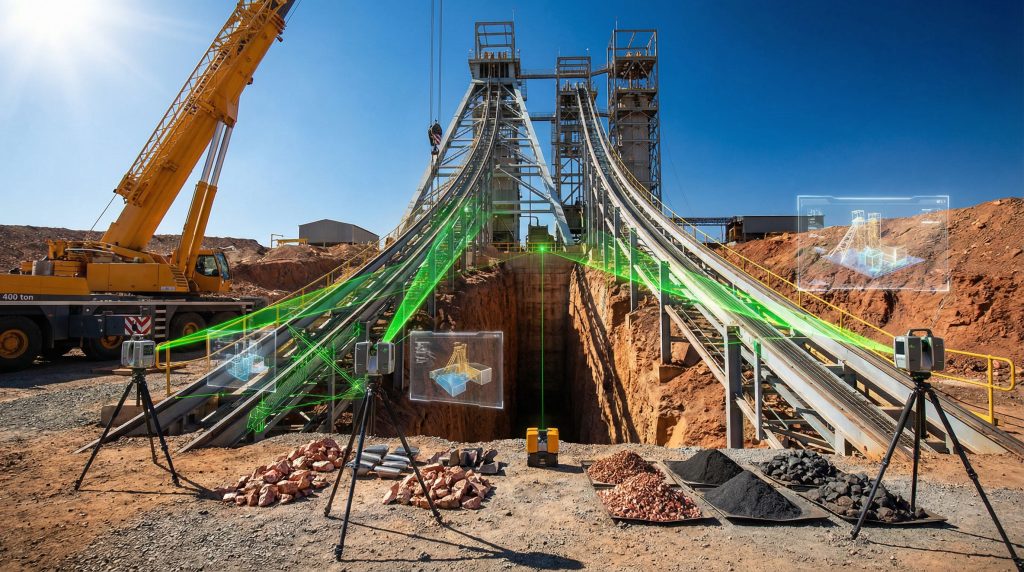
The implementation of 3D scanning technology represents a fundamental advancement in shaft equipping methodology. Traditional alignment methods relied on mechanical measurements that provided limited accuracy across extreme depths. Modern laser scanning systems achieve millimetre precision across vertical distances exceeding 2,000 meters, enabling alignment corrections previously impossible to detect or implement.
At Mindola, the complete 3D scan of the shaft serves as both diagnostic tool and engineering foundation. The scanning process identifies structural deviations that may have occurred during initial construction or developed through years of operation. This data enables precision corrections through slipping and lining the bottom 500 meters of shaft barrel to ensure true vertical alignment.
Precision Measurement in Extreme Depth Environments
The technical challenges of accurate measurement at 2,020 meters depth require specialised equipment and methodologies. Environmental factors including temperature variations, humidity changes, and atmospheric pressure differences can affect measurement accuracy by several millimetres. Advanced scanning systems compensate for these environmental variables through real-time calibration adjustments.
Laser scanning accuracy requirements for vertical shafts demand tolerance levels within ±3mm across the full depth range. This precision enables safe conveyance operation at optimal speeds while maintaining structural safety margins. The ability to detect and correct alignment deviations at this accuracy level represents a significant advancement over traditional surveying methods.
Scanning data integration with engineering design software enables real-time optimisation of structural corrections. The verification of existing steel members that guide conveyances relies on precise dimensional data that only 3D scanning can provide. This integration allows engineers to identify and address alignment issues before they impact operational safety or efficiency.
Steel Guide Installation Engineering
The installation of steel guides and bunton sets requires absolute precision to ensure safe conveyance operation. Vertical alignment tolerances for modern mining operations demand positioning accuracy within 5mm across the full shaft depth. This precision requires specialised installation equipment and methodologies that surpass traditional construction techniques.
Material specifications for steel guide systems incorporate enhanced durability requirements for 25-year operational periods. The selection of steel grades, protective coatings, and fastening systems must anticipate decades of continuous operation under variable load conditions. These specifications often exceed temporary installation standards by significant margins.
Installation sequencing for steel guide systems requires careful coordination to minimise operational disruption. The equipping of the shaft and construction of loading box steelwork must proceed according to optimised schedules that balance construction efficiency with ongoing mining operations. This coordination becomes critical when retrofitting permanent systems into existing operational shafts.
Specialised Equipment Fleet Management for Complex Projects
The scale of modern shaft equipping projects demands sophisticated equipment fleet coordination. At Mindola, the deployment of 400-ton mobile cranes for headgear dismantling demonstrates the mechanical requirements for permanent infrastructure installation. These lifting operations require precise coordination between multiple crane systems to ensure safe, efficient structural placement.
Mobile crane operations in confined mining environments present unique logistical challenges. The four mobile cranes lifting steel sections for headgear pre-assembly requires detailed site preparation and traffic management. Coordination between multiple heavy equipment units demands specialised project management capabilities and safety protocols.
According to industry analysis, such complex operations require extensive planning and risk assessment to ensure successful completion.
Heavy Equipment Deployment Strategies
The logistics of deploying 400-ton cranes in active mining environments requires comprehensive planning and risk assessment. Site preparation includes ground stability evaluation, access route optimisation, and coordination with ongoing mining operations. These preparations often require several months of advance planning to ensure safe, efficient equipment deployment.
Pre-assembly strategies for structural components optimise construction efficiency while maintaining quality standards. The pre-assembly of headgear centre columns enables quality control verification before final installation, reducing construction risks and ensuring structural integrity. This approach becomes essential for permanent installations where construction errors could impact decades of operation.
Equipment maintenance and support requirements for complex shaft projects extend beyond standard construction protocols. Specialised equipment operating in mining environments requires enhanced maintenance schedules and emergency repair capabilities. The remote locations of many African mining operations necessitate on-site maintenance facilities and spare parts inventory management.
Economic Analysis of Permanent Infrastructure Investment
The financial justification for permanent shaft infrastructure requires comprehensive analysis of capital expenditure versus long-term operational benefits. Initial investment costs for permanent systems typically exceed temporary alternatives by 150-200%, but operational efficiency gains and reduced maintenance costs provide positive returns over extended operational periods.
Consequently, mining companies must carefully evaluate these investments alongside broader copper and uranium insights when planning their long-term operational strategies.
Capital Expenditure Optimisation
| Investment Phase | Capital Requirement | Operational Impact | Payback Period |
|---|---|---|---|
| Headgear Installation | $15-25M | 25% Efficiency Gain | 6-8 years |
| Winding System Upgrade | $8-12M | 30% Throughput Increase | 5-7 years |
| Shaft Alignment Correction | $3-5M | 15% Downtime Reduction | 3-4 years |
| Total Infrastructure | $26-42M | Combined Benefits | 7-9 years |
Production capacity enhancement through permanent infrastructure creates measurable economic returns. Hoisting efficiency improvements of 25-35% directly translate to increased copper concentrate handling capacity. These productivity gains compound over decades of operation, creating substantial value that temporary systems cannot achieve.
Reduced maintenance costs represent significant long-term economic benefits. Permanent installations typically reduce annual maintenance expenses by 40-60% compared to temporary systems. Over 25-year operational periods, these savings often exceed the initial capital investment difference between permanent and temporary installations.
Operational Efficiency Metrics
The measurement of operational efficiency improvements requires comprehensive performance monitoring across multiple operational parameters. Throughput optimisation through modern conveyance systems creates measurable improvements in tonnes per hour capacity. These improvements typically range from 20-40% compared to legacy temporary systems.
Downtime reduction through permanent infrastructure reliability creates substantial operational value. Unplanned maintenance shutdowns decrease by approximately 50% with permanent installations, directly impacting production continuity. The economic value of improved operational reliability often justifies permanent infrastructure investment within 5-7 years.
Energy efficiency optimisation in permanent systems provides ongoing operational cost reductions. Modern winding systems consume 15-25% less power per tonne of material transported compared to legacy equipment. These energy savings create ongoing operational cost reductions that contribute to long-term economic viability.
Future-Ready Mining Infrastructure Development
Modern shaft equipping projects must anticipate evolving operational requirements and technological advancement over decades of service life. Scalability planning for permanent installations incorporates modular design principles that enable future expansion or modification without complete infrastructure replacement. This forward-thinking approach ensures continued operational relevance as mining technology evolves.
For instance, the success of gold-copper exploration projects increasingly depends on infrastructure that can adapt to changing operational requirements over extended periods.
Technology Integration Readiness
Permanent infrastructure design must accommodate future automation and digitalisation initiatives. The integration of sensors, monitoring systems, and automated controls requires infrastructure preparation during initial construction phases. Retrofitting automation capabilities into existing permanent systems proves significantly more cost-effective than attempting to upgrade temporary installations.
Sustainability considerations in permanent infrastructure extend beyond initial construction to encompass decades of operational environmental impact. Energy efficiency optimisation, water management systems, and environmental protection measures must be integrated into permanent designs from the outset. These considerations become increasingly important as environmental regulations evolve over extended operational periods.
Long-term resource extraction planning relies on permanent infrastructure capabilities to support changing operational requirements. As ore grades decline and extraction depths increase, permanent systems provide the flexibility to adapt operational parameters while maintaining safety and efficiency standards. This adaptability becomes essential for mining operations extending beyond 25-year initial planning horizons.
Furthermore, African mining developments continue to demonstrate the strategic importance of permanent infrastructure investments in ensuring long-term operational viability.
"Permanent shaft infrastructure represents a strategic investment in mining longevity, with successful implementations demonstrating 25-40% operational efficiency improvements and 50% reduction in maintenance-related downtime over traditional temporary systems."
The next major ASX story will hit our subscribers first
What are the Critical Success Factors for Modern Shaft Equipping?
Critical Success Factors for Modern Shaft Equipping:
• Precision 3D scanning technology for accurate alignment assessment and correction
• Specialised heavy equipment deployment for safe structural installation
• Redundant safety systems ensuring operational reliability across extended periods
• Integration of permanent systems with existing operational infrastructure
• Comprehensive project management coordinating multiple technical disciplines
The evolution of African mining infrastructure toward permanent installations reflects both technological advancement and economic necessity. As copper deposits extend to greater depths and operational periods extend across decades, the engineering and economic advantages of permanent infrastructure become increasingly compelling. The successful implementation of projects like Mindola demonstrates how specialised contractors combine advanced technology with decades of operational experience to create infrastructure capable of supporting extended mining operations while maintaining the highest safety and efficiency standards.
In conclusion, Cementation Africa equips Mindola shaft with cutting-edge permanent infrastructure that sets new standards for deep mining operations. The project's success validates the economic and operational benefits of permanent installations, paving the way for similar developments across Africa's mining sector.
This analysis is based on industry data and should not be considered investment advice. Mining infrastructure projects involve significant technical and financial risks that require professional evaluation.
Want to Capitalise on Africa's Deep Mining Revolution?
Discovery Alert's proprietary Discovery IQ model instantly identifies significant ASX mineral discoveries, including those related to advanced mining infrastructure and copper exploration opportunities that mirror Africa's deep mining developments. Begin your 14-day free trial today and position yourself ahead of the market with real-time alerts on actionable investment opportunities.