June 30, 2026
The Energy Transition's Uncomfortable Truth: We Need the Ocean Floor
The minerals required to power the clean energy revolution do not exist in a vacuum. Every electric vehicle battery, every offshore wind turbine foundation, every grid-scale storage system draws on a specific set of raw materials that must be extracted, refined, and transported before a single kilowatt of renewable electricity flows. The deep-sea mining and critical minerals paradox sits at the heart of this challenge. For decades, the assumption was that terrestrial mining could scale fast enough to keep pace. That assumption is now under serious strain.
Ore grades at many of the world's most significant land-based nickel and cobalt deposits have been declining for years. New mine development faces lengthening permitting timelines, rising capital intensity, and growing community resistance. At the same time, the concentration of critical mineral reserves in a small number of countries introduces geopolitical fragility into supply chains that the global economy increasingly depends on.
These are not temporary frictions. They are structural features of a land-based extraction model that was never designed to supply a full-scale energy transition. Furthermore, critical minerals demand continues to accelerate, placing additional pressure on already strained terrestrial supply chains.
This is where the deep-sea mining and critical minerals paradox comes into focus. Not as a fringe debate, but as one of the most consequential resource governance challenges of the next decade.
When big ASX news breaks, our subscribers know first
What the Ocean Floor Actually Holds
Three Deposit Categories With Very Different Profiles
Deep-sea mineral deposits are not a single category. Scientists and industry operators distinguish between three primary deposit types, each with distinct mineralogy, depth profiles, and extraction characteristics:
-
Polymetallic nodules form slowly over millions of years on the abyssal plain, accumulating manganese, nickel, cobalt, and copper in potato-sized concretions that rest on or just below the sediment surface. They are the most studied and commercially advanced category.
-
Seafloor massive sulphides (SMS) form at hydrothermal vents where mineral-rich fluids exit the earth's crust and precipitate metallic compounds. They are rich in copper, zinc, lead, gold, and silver, but their association with active vent ecosystems raises acute biodiversity concerns.
-
Cobalt-rich ferromanganese crusts coat the flanks of seamounts and are prized for their high cobalt content and rare earth element concentrations. Their extraction is technically more complex due to the hardness of the material and the geological sensitivity of seamount environments.
The Clarion-Clipperton Zone: A Case Study in Scale
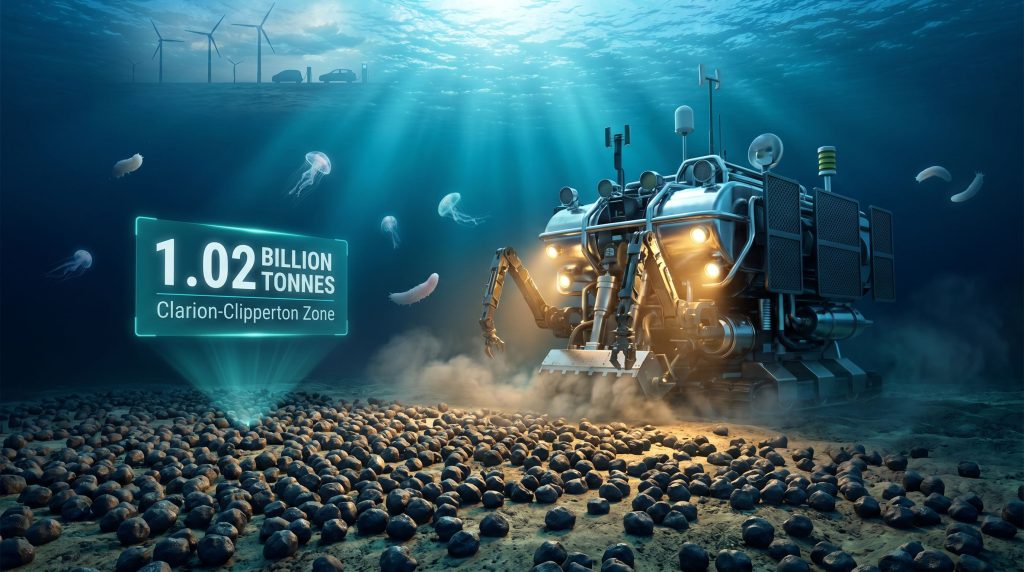
Of all known deep-sea mineral provinces, the Clarion-Clipperton Zone in the central Pacific Ocean attracts the most commercial and regulatory attention. The numbers are genuinely striking. The zone is estimated to contain approximately 1.02 billion tonnes of polymetallic nodules, within a licensed exploration area of roughly 122,000 km². The nodules host commercially relevant concentrations of nickel, cobalt, manganese, and copper.
To understand why these figures matter, consider the supply-demand arithmetic of the energy transition. Battery-grade nickel demand alone is projected by multiple commodity analysts to significantly outpace land-based production capacity before 2035. Cobalt, despite ongoing efforts to reduce its role in battery chemistry, remains essential in many high-performance formulations. The CCZ's resource base is not incrementally larger than land reserves in these metals. It is categorically different in scale.
The core strategic argument for deep-sea mining rests not on speculation but on measurable divergence between projected clean energy mineral demand and the realistic delivery capacity of terrestrial mining over the next decade.
Mapping the Paradox: Four Tensions That Cannot Be Easily Resolved
The deep-sea mining and critical minerals paradox is best understood not as a single problem but as a cluster of interlocking tensions. Each one has legitimate weight on both sides.
| Tension | The Case For Deep-Sea Mining | The Case Against Deep-Sea Mining |
|---|---|---|
| Supply security | Diversifies mineral sources beyond geopolitically concentrated land reserves | Regulatory uncertainty makes supply timelines unreliable |
| Carbon footprint | Lifecycle emissions for nickel estimated at ~6.2 kg CO₂/kg vs. 20-100 kg CO₂/kg for land-based operations | Carbon comparisons omit biodiversity and ecosystem service losses |
| Biodiversity risk | Nodule fields are low-diversity compared to SMS and seamount environments | The CCZ may contain 6,000-8,000 species, with only 436 formally described |
| Technological readiness | Rapid innovation in extraction and monitoring equipment | No operation has been conducted at commercial scale |
Is Deep-Sea Mining Actually Inevitable?
A more precise way to frame this question is to ask whether demand-side solutions can close the mineral supply gap without any new extraction. The honest answer, based on current trajectory, is that they cannot, at least not within the 2025-2035 window when clean energy infrastructure deployment is most intensive.
Advances in lithium iron phosphate and sodium-ion battery chemistries are gradually reducing dependence on cobalt and high-grade nickel. End-of-life battery recycling infrastructure is scaling, and regulatory mandates such as the EU Battery Regulation are beginning to structurally embed circular economy principles into product design. These are meaningful developments. However, they operate on timescales that do not align with the near-term deployment surge required to meet net-zero commitments.
Terrestrial mining is also not a consequence-free alternative. Land-based nickel and cobalt operations carry their own environmental and social costs, including deforestation, water contamination, community displacement, and in some producing regions, documented human rights concerns. Deep-sea mining is being evaluated against a realistic set of alternatives, not an idealised one. In addition, critical minerals for the energy transition face compounding pressure from both supply constraints and accelerating deployment timelines.
The Carbon Lifecycle Argument: Powerful but Incomplete
What the Numbers Say
The carbon intensity comparison between seabed and land-based nickel production is one of the most frequently cited arguments in favour of deep-sea extraction. Research associated with operations targeting the CCZ has indicated lifecycle emissions of approximately 6.2 kg CO₂ per kilogram of nickel, compared to a range of 20 to 100 kg CO₂ per kilogram for land-based nickel operations. That represents a potential emissions reduction of between 70% and 97% depending on the land-based operation being compared.
The primary driver of this differential is ore grade and processing intensity. Deep-sea nodules contain relatively high concentrations of multiple target metals in a form that does not require the same energy-intensive processing as low-grade laterite or sulphide ores on land. Consequently, fewer tonnes of material must be moved, crushed, and chemically treated to produce each tonne of finished metal.
Where the Carbon Argument Falls Short
Carbon footprint is one dimension of environmental impact, and arguably not the most important one when evaluating extraction in an ecosystem as poorly understood as the deep ocean. Several critical caveats apply:
-
Lifecycle comparisons must account for full operational scope, including processing, transportation, and waste streams, not extraction alone.
-
The carbon efficiency advantage does not translate directly into ecological sustainability. Biodiversity loss, habitat destruction, and disruption to deep-sea carbon sequestration functions are real costs that emissions accounting frameworks do not capture.
-
Long-term carbon cycle interactions in the deep ocean, including the role of benthic organisms in carbon burial, are not yet well enough understood to be reliably incorporated into lifecycle models.
A lower carbon footprint does not make an activity environmentally neutral. It makes it less carbon-intensive. Those are different claims, and conflating them weakens the credibility of the industry's environmental case.
The Scientific Knowledge Gap: Mining What We Have Not Yet Mapped
What Science Does and Does Not Know
Perhaps the most challenging dimension of the deep-sea mining and critical minerals paradox is the sheer depth of scientific uncertainty about the environments being considered for extraction. One research paper estimated that the CCZ alone contains between 6,000 and 8,000 distinct species. Of those, only 436 have been formally described and named by scientists. The majority of species living in one of the world's most mineral-rich seabed zones have never been characterised, let alone had their ecological roles or population dynamics studied.
This is not a minor data gap. Environmental impact assessments are calibrated against known baselines. Without credible species inventories, habitat maps, and ecosystem function studies, EIAs for deep-sea operations are being constructed on an incomplete foundation. For instance, the World Resources Institute's deep-sea mining overview highlights how limited baseline knowledge remains a central challenge for credible environmental assessment.
Categories of Environmental Risk
| Risk Category | Description | State of Knowledge |
|---|---|---|
| Sediment plume dispersion | Disturbed seafloor material suspended and transported through the water column | Modelling frameworks exist; real-world validation at scale is limited |
| Benthic habitat destruction | Physical removal of substrate and resident organisms | Largely unknown due to species identification gaps |
| Acoustic and light disturbance | Impact on deep-sea organisms sensitive to noise and light | Early-stage research; few established thresholds |
| Carbon cycle disruption | Interference with ocean floor carbon burial processes | Poorly quantified; emerging research area |
| Heavy metal mobilisation | Release of bound toxins from disturbed sediment | Site-specific; baseline data sparse |
Why This Gap Is a Governance Problem, Not Just a Scientific One
Regulatory frameworks for environmental protection in the mining sector are typically designed around known quantities: baseline species counts, habitat sensitivity classifications, and ecosystem service valuations. In the deep sea, those reference points are largely absent. This creates a structural problem: the permitting and oversight systems designed to protect marine environments may be operating with insufficient information to be effective.
The scientific community has consistently emphasised that environmental baseline research must be conducted before, not alongside or after, commercial extraction begins. The window for establishing those baselines in priority extraction zones is narrowing as commercial timelines accelerate.
Technology as a Mitigation Pathway
What Responsible Operators Are Deploying
The leading edge of the deep-sea mining sector is investing significantly in technologies designed to reduce operational environmental impact. Several of these represent genuine innovations in extraction methodology:
-
Seabed-resting extraction systems that operate directly on the ocean floor, eliminating the surface anchoring requirements that can disturb larger water column volumes.
-
Precision sampling equipment, including seabed box corers engineered to collect geological samples while minimising lateral disturbance to surrounding sediment and benthic organisms.
-
Real-time sediment plume monitoring using sensor arrays and predictive modelling to track the movement of disturbed material during operations, enabling dynamic operational responses rather than post-hoc assessment.
-
Digital twin platforms that aggregate continuous environmental monitoring streams, including biological, chemical, and physical data, to inform operational decisions in real time rather than through periodic reporting.
-
Acoustic insulation systems designed to reduce the transmission of operational noise through the water column, addressing one of the more poorly understood but potentially significant disturbance pathways.
ESG Accountability as a Commercial Imperative
Beyond regulatory compliance, operators are increasingly recognising that credible environmental stewardship is a commercial asset. Access to capital, customer offtake agreements, and insurance coverage in the mining sector are all increasingly conditioned on ESG performance. Companies that invest in independent, peer-reviewed environmental monitoring frameworks and commit to adaptive management — including genuine operational pause provisions if monitoring data indicates ecological harm — are positioned to set the reputational benchmark for an emerging industry.
The companies that establish this standard early will likely define what responsible deep-sea extraction looks like for regulators, investors, and the broader public for years to come.
The next major ASX story will hit our subscribers first
The Regulatory Landscape: Fragmented, Evolving, and High-Stakes
International Governance Under the ISA
Deep-sea mining regulations in international waters fall under the authority of the International Seabed Authority (ISA), a United Nations body established under the UN Convention on the Law of the Sea. The ISA has been developing a comprehensive Mining Code intended to provide a regulatory framework for commercial seabed operations. Its finalisation has been delayed by scientific disagreement, geopolitical tensions among member states, and calls from countries including Germany, France, Chile, and New Zealand for precautionary moratoriums pending stronger ecological consensus.
National Regulatory Dynamics
At the national level, regulatory postures vary considerably. The United States has moved to streamline domestic permitting, with the National Oceanic and Atmospheric Administration taking steps to process and certify exploration licence applications for operations in areas such as the CCZ. This signals a policy orientation that prioritises supply chain security considerations within the bounds of existing national authority.
This divergence between cautious multilateral governance and more permissive national frameworks creates a fragmented regulatory environment. Without harmonised international standards, there is a meaningful risk that the environmental protection benchmark is effectively set by the least cautious jurisdiction rather than the most rigorous. The broader deep-sea mining controversy reflects precisely this tension between commercial urgency and ecological precaution. Furthermore, Greenpeace's position on deep-sea mining underscores the depth of civil society concern about regulatory gaps and the pace of commercial development.
What Needs to Happen Before Commercial Operations Begin
-
Finalisation or provisional adoption of the ISA Mining Code with binding environmental standards.
-
Completion of comprehensive ecological baseline surveys across priority extraction zones.
-
Independent validation of sediment plume dispersion modelling at operational scale.
-
Establishment of environmental monitoring and reporting standards that satisfy regulators, investors, and civil society simultaneously.
-
Demonstrated commercial viability at pilot scale before full deployment.
Frequently Asked Questions
What minerals are found in deep-sea deposits?
Polymetallic nodules and other seabed deposits contain commercially relevant concentrations of nickel, cobalt, copper, manganese, zinc, and select rare earth elements. These are all materials with direct relevance to electric vehicle batteries, wind turbines, and grid storage systems.
How does deep-sea mining compare to land-based mining environmentally?
The carbon footprint comparison favours seabed extraction significantly, with nickel production from nodules estimated at roughly one-tenth of the emissions intensity of many land-based operations. However, biodiversity risks, habitat destruction, and disruption to ocean carbon cycles represent environmental costs that emissions figures do not capture.
When could the first commercial deep-sea mining operations begin?
Industry projections, based on current technological development and investment trajectories, suggest that the first commercial operations could be live as early as 2027, subject to regulatory approval and continued capital commitment.
Could recycling and battery chemistry improvements eliminate the need for deep-sea mining?
Demand-side interventions will reduce but are unlikely to eliminate the mineral supply gap during the peak infrastructure deployment phase of the energy transition. Deep-sea mining is being evaluated as one component of a broader supply strategy, not as a standalone replacement for land-based extraction.
Setting the Benchmark for a New Extractive Frontier
The deep-sea mining and critical minerals paradox is ultimately a question of institutional readiness. The mineral resources exist. The demand is real and growing. The technology to access those resources is advancing rapidly. What remains uncertain is whether the scientific, regulatory, and operational frameworks can be built with sufficient rigour and speed to ensure that the ocean floor is not treated as simply the next resource frontier to be exploited without adequate safeguards.
The next three to five years will be decisive. The industry has a genuine opportunity to demonstrate that extractive activity can be conducted responsibly in an environment that is simultaneously critical to global mineral supply and among the least understood ecosystems on the planet. That demonstration will require transparent data, independent verification, adaptive management commitments, and a willingness to prioritise long-term credibility over short-term extraction velocity.
Whether deep-sea mining becomes a responsible enabler of the energy transition or a cautionary tale about repeating extractive industry mistakes in a new frontier depends almost entirely on the governance choices made in this foundational period.
This article contains forward-looking projections regarding mineral demand, commercial timelines, and environmental outcomes. These are based on currently available research and industry analysis and should not be interpreted as investment advice or as certainty about future events. The deep-sea mining sector involves significant regulatory, environmental, and commercial uncertainties.
Want to Stay Ahead of the Next Major Critical Minerals Discovery?
Discovery Alert's proprietary Discovery IQ model scans ASX announcements in real time, instantly identifying significant mineral discoveries across nickel, cobalt, copper, and other critical minerals driving the energy transition — turning complex data into clear, actionable insights for investors at every level. Explore how historic mineral discoveries have delivered extraordinary returns, then start your 14-day free trial at Discovery Alert to position yourself ahead of the market.