June 13, 2026
The deep-sea mining sector represents one of the most contentious frontiers in global resource extraction, where economic promises collide with environmental uncertainties across some of the world's most vulnerable ocean ecosystems. As mining companies prepare to harvest polymetallic nodules importance from abyssal plains thousands of metres below the Pacific surface, the financial frameworks governing these operations reveal stark disparities between corporate profits and the compensation offered to Pacific Island nations whose territorial waters and sponsorship enable these ventures.
Economic Sovereignty Frameworks in Marine Resource Extraction
Pacific Island nations find themselves navigating complex economic trade-offs as they consider their role in facilitating deep sea mining impact on Pacific Islands through sponsorship agreements and territorial access arrangements. Current revenue-sharing models proposed by mining companies and the International Seabed Authority present financial returns that appear modest when compared to the scale of resource extraction and associated environmental risks.
Revenue Distribution Analysis reveals significant imbalances:
• Annual payments to sponsoring nations ranging from $46,000 to several million dollars
• Mining company CEO compensation packages typically valued between $2-15 million annually
• Administrative overhead consuming substantial portions of revenue-sharing funds
• Limited requirements for long-term economic development investment
The economic sovereignty implications extend beyond immediate financial returns to encompass broader questions of resource control and development pathway selection. Pacific Island nations with limited GDP bases face pressure to approve mining activities that may generate short-term revenues while potentially compromising long-term economic assets including tourism, fisheries, and marine ecosystem services.
However, the complexities surrounding mining permitting basics often remain poorly understood by smaller nations. Furthermore, Pacific Island states have expressed significant concerns about the environmental and social implications of deep-sea mining operations.
Alternative economic valuation models demonstrate the opportunity costs:
• Blue Economy sectors generating sustainable employment and export revenues
• Marine protected areas attracting international conservation funding and premium eco-tourism
• Sustainable fisheries management creating food security and market access opportunities
• Ocean renewable energy development providing energy independence pathways
When big ASX news breaks, our subscribers know first
Environmental Cost Assessment and Recovery Timelines
The environmental implications of deep sea mining impact on Pacific Islands extend far beyond the immediate extraction zones, with sediment plumes and ecosystem disruption affecting marine areas spanning hundreds of kilometres. Research indicates that deep-sea ecosystem recovery follows dramatically different timelines compared to terrestrial mining rehabilitation, creating long-term environmental liabilities that may exceed the economic benefits of extraction.
Sediment Plume Impact Modelling shows extensive geographic reach:
| Impact Zone | Distance from Source | Duration | Ecosystem Effects |
|---|---|---|---|
| Primary disturbance | 0-50 km | Permanent during operations | Complete habitat destruction |
| Secondary impacts | 50-200 km | 10-20 years | Severe biodiversity loss |
| Tertiary effects | 200-500 km | 5-15 years | Moderate species displacement |
| Regional consequences | 500-1,000 km | 2-10 years | Subtle food web disruption |
Deep-sea species recovery research indicates that benthic communities require 26+ years to show initial signs of recolonisation following major disturbance events. Consequently, full ecosystem recovery potentially requires centuries given the extreme environmental conditions and slow biological processes characteristic of abyssal environments.
Nevertheless, addressing these environmental challenges requires comprehensive waste management solutions that many current deep-sea mining proposals lack. Moreover, research has highlighted numerous environmental impacts that remain poorly understood and inadequately addressed.
Carbon sequestration disruption represents an additional environmental cost often overlooked in impact assessments:
• Deep-sea sediments store massive quantities of carbon accumulated over millennia
• Mining activities may release stored carbon whilst disrupting ongoing sequestration processes
• Methane hydrate destabilisation presents additional greenhouse gas emission risks
• Ocean acidification acceleration from mining waste and chemical processing
The cumulative environmental costs compound over time, potentially affecting climate regulation services that Pacific Island nations depend upon for their survival in an era of accelerating sea-level rise and ocean warming.
Strategic Positioning and Negotiating Leverage
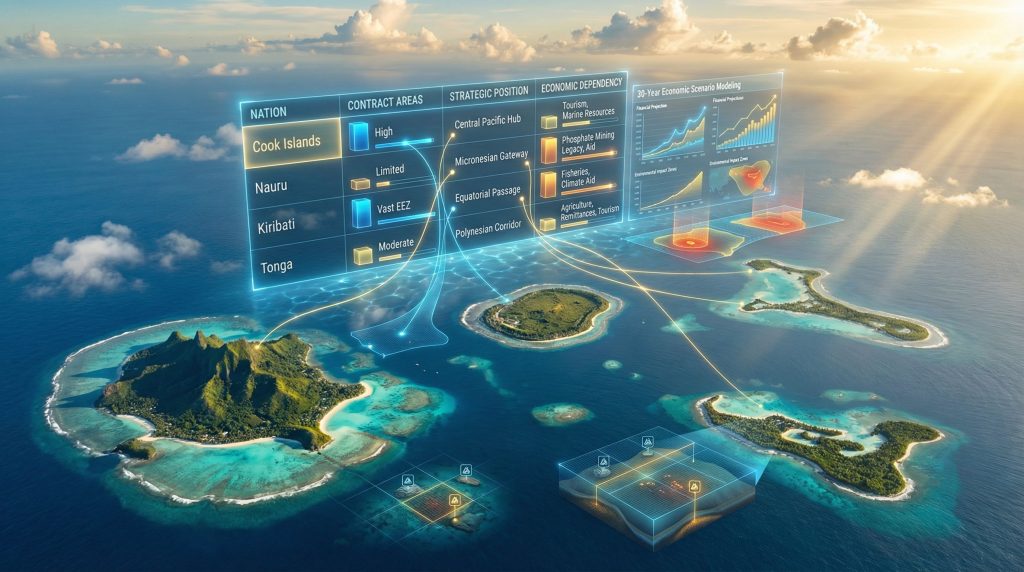
Pacific Island nations occupy varying positions of strategic leverage within the global deep-sea mining governance framework, with their negotiating power determined by factors including exploration contract portfolios, alliance relationships, and alternative economic opportunities.
Exploration Contract Distribution Analysis:
| Nation | ISA Contract Areas | Strategic Assets | Economic Vulnerabilities |
|---|---|---|---|
| Cook Islands | Clarion-Clipperton Zone | Tourism infrastructure | Climate change exposure |
| Nauru | Sponsoring state agreements | Post-mining experience | Limited economic diversification |
| Kiribati | Multiple exploration zones | Large EEZ territory | Extreme climate vulnerability |
| Tonga | Regional partnership agreements | Diaspora networks | Natural disaster exposure |
The most effective strategic positioning involves collective action frameworks that amplify individual nation leverage through regional coordination. Pacific Island Forum resolutions supporting deep-sea mining moratoriums demonstrate the potential for unified negotiating positions that can influence International Seabed Authority decision-making processes.
Geopolitical alliance building opportunities include:
• Partnership with major powers seeking to influence ocean governance frameworks
• Coalition leadership within UN climate change and sustainable development processes
• Environmental justice movement coordination with global civil society organisations
• Regional security cooperation agreements that include marine resource protection provisions
The timing of strategic positioning proves critical, as early-stage exploration contracts and governance framework development create windows of opportunity for influencing terms and conditions that may remain locked in for decades once commercial operations commence.
What regulatory gaps exist in current frameworks?
The International Seabed Authority's commercial mining code development reveals significant governance gaps that may disadvantage Pacific Island nations whilst favouring mining companies and developed nation interests. Current regulatory frameworks lack comprehensive environmental protection standards and fail to ensure equitable benefit distribution mechanisms.
Critical regulatory deficiencies include:
• Enforcement mechanisms lacking sufficient funding and technical capacity for deep-sea monitoring
• Environmental impact thresholds based on limited scientific understanding of deep-sea ecosystems
• Revenue distribution formulas favouring ISA administrative costs over community benefits
• Scientific research requirements creating barriers for developing nation participation
National sovereignty protection mechanisms offer Pacific Island nations tools for maintaining control over their marine resources despite international pressure for mining access. Domestic legislation establishing comprehensive mining bans in territorial waters provides legal frameworks that cannot be overridden by international agreements.
Successful regulatory protection strategies demonstrate:
• Environmental impact assessment mandatory requirements with independent scientific review
• Indigenous rights recognition in marine resource management decision-making processes
• Community benefit sharing extending beyond government revenue collection
• Regional cooperation agreements creating collective bargaining power in international negotiations
The regulatory landscape continues evolving rapidly, with Pacific Island nations facing pressure to establish positions before governance frameworks become entrenched in ways that may limit future policy flexibility.
Sustainable Development Alternative Models
Pacific Island nations possess significant opportunities to develop alternative economic models that maximise marine resource value whilst avoiding the environmental risks associated with deep-sea mining. Blue Economy frameworks offer pathways for sustainable development that align with climate adaptation needs and community priorities.
In addition, integrating renewable energy mining solutions demonstrates how modern industry innovation trends can be adapted for sustainable marine resource management.
Marine Protected Area Network Development provides multiple economic benefits:
| Strategy | Implementation Timeline | Investment Requirements | Projected Economic Returns |
|---|---|---|---|
| Sanctuary tourism | 5-10 years | $50-100 million | Premium eco-tourism revenue |
| Research partnerships | 2-3 years | $10-25 million | Knowledge economy development |
| Carbon credit programmes | 3-5 years | $20-50 million | Climate finance access |
| Sustainable fisheries | 3-5 years | $20-50 million | Food security + export markets |
Ocean renewable energy development represents a particularly promising alternative that addresses both economic development needs and climate change adaptation requirements. Offshore wind, wave, and thermal energy technologies offer pathways to energy independence whilst creating technical employment opportunities and export potential.
Regional cooperation models demonstrate how Pacific Island nations can pool resources and expertise to achieve development outcomes that individual countries cannot accomplish independently. Shared infrastructure projects, joint marketing initiatives, and coordinated policy development create economies of scale that improve project viability.
Technology transfer partnerships with developed nations provide access to advanced marine management tools and sustainable development technologies without the environmental risks associated with extractive industries. These partnerships often include capacity building components that develop local expertise and institutional capabilities.
Revenue Inequality and Economic Justice Analysis
Current compensation models for deep sea mining impact on Pacific Islands reflect fundamental inequities in how marine resource extraction benefits are distributed between corporations, developed nations, and the Pacific Island communities that bear environmental and social costs. Revenue-sharing calculations reveal that administrative overhead and corporate profits consume the majority of extraction value.
Economic inequality indicators demonstrate the scale of disparity:
• Mining company profit margins typically ranging from 30-60% of gross extraction value
• ISA administrative costs absorbing 20-40% of revenue-sharing funds before distribution
• Pacific Island nation payments representing less than 2-5% of total extraction value
• Community-level benefit sharing often limited to less than 0.5% of total project revenues
Alternative compensation frameworks based on economic justice principles would fundamentally restructure benefit distribution to reflect actual environmental costs and community impacts. Percentage-based revenue sharing tied directly to extraction volumes would ensure that Pacific Island nations receive compensation proportional to resource removal from their territorial waters.
Environmental bond systems represent another critical component of equitable compensation models, requiring mining companies to provide upfront funding for ecosystem restoration and community adaptation programmes. These bonds would need to account for the multi-decade timelines required for deep-sea ecosystem recovery.
Technology transfer requirements could ensure that Pacific Island nations receive long-term economic development benefits beyond immediate cash payments. Mandatory capacity building programmes, equipment sharing, and technical expertise development create lasting economic assets that continue generating value after mining operations conclude.
Long-term Strategic Risk Assessment
30-year economic modelling reveals that current deep-sea mining proposals may generate short-term revenues whilst creating long-term economic vulnerabilities that exceed immediate financial benefits. Tourism industry projections indicate potential revenue losses from environmental degradation that dwarf mining compensation payments over multi-decade timeframes.
Fisheries collapse scenarios present particularly severe risks for Pacific Island food security and economic stability. Deep-sea mining disruption of marine food webs could affect commercial fish populations across entire ocean basins, with recovery timelines extending beyond mining operation lifespans.
Climate adaptation cost projections indicate that Pacific Island nations will require substantial funding for sea-level rise protection, climate resilience infrastructure, and community relocation programmes. Mining revenues may prove insufficient to address these adaptation needs whilst environmental degradation from extraction activities could accelerate climate impacts.
Regional economic integration offers risk mitigation opportunities through diversified economic partnerships and shared infrastructure development. Collective investment in climate adaptation, renewable energy systems, and sustainable development programmes creates resilience that individual nations cannot achieve independently.
Brain drain acceleration represents an often-overlooked consequence of environmental degradation and economic instability. Young Pacific Islanders may increasingly migrate to larger nations if mining activities degrade the natural assets that support local livelihoods and cultural practices.
The next major ASX story will hit our subscribers first
Negotiating Position Optimisation Strategies
Pacific Island nations can maximise their influence over deep-sea mining decisions through coordinated strategies that leverage their collective territorial control over vast ocean areas and their moral authority on climate change and environmental protection issues.
Collective action frameworks prove most effective when they combine Pacific Island Forum coordination with broader international alliance building. United Nations climate change negotiations provide platforms for Pacific Island nations to link deep-sea mining governance with broader climate justice and sustainable development agendas.
Economic leverage optimisation requires developing credible alternatives to mining revenues through sustainable development partnerships with international donors, private sector investors, and technical assistance providers. Demonstrated success with alternative economic models strengthens negotiating positions by reducing dependence on mining revenues.
International court challenges to inadequate environmental protection standards offer legal pathways for influencing mining governance frameworks. Advisory opinions from international courts on environmental protection obligations could establish legal precedents that strengthen Pacific Island negotiating positions.
Civil society partnership development amplifies Pacific Island voices through global environmental movements and indigenous rights organisations. These partnerships provide technical expertise, media attention, and political support that individual nations cannot generate independently.
The timing of negotiating position establishment proves critical, as governance frameworks and contract terms established during early development phases may remain locked in for decades. Pacific Island nations must act decisively to influence these frameworks before they become entrenched.
How can Pacific Islands secure better outcomes?
The deep sea mining impact on Pacific Islands represents a defining moment for Pacific Island nations, where decisions made in the next few years will shape economic, environmental, and social outcomes for generations. Strategic scenario planning reveals that current compensation models fundamentally undervalue both environmental costs and alternative development opportunities.
Successful navigation of this challenge requires Pacific Island leaders to move beyond simple revenue calculations toward comprehensive assessments of long-term sustainability, climate resilience, and cultural preservation. The choice extends beyond mining versus no mining to encompass fundamental questions about development models, international relationships, and environmental stewardship responsibilities.
Regional coordination mechanisms offer the most promising pathway for maximising Pacific Island influence over deep-sea mining governance whilst developing sustainable alternatives that address development needs without compromising environmental assets. Collective action frameworks can leverage the moral authority and territorial control that Pacific Island nations possess.
The window of opportunity for influencing deep-sea mining governance frameworks remains open but may close rapidly as commercial operations approach. Pacific Island nations must establish clear strategic positions and build effective coalitions before international pressure and economic incentives make policy changes more difficult to achieve.
Climate change acceleration adds urgency to these decisions, as Pacific Island nations require immediate action on both climate adaptation and sustainable development. The environmental risks associated with deep-sea mining may prove particularly severe for nations already facing existential threats from sea-level rise and ocean warming.
This analysis is provided for educational purposes and does not constitute investment advice. Pacific Island policy decisions involve complex environmental, economic, and social considerations that require expert consultation and community engagement.
Looking to Invest in Marine Resource Development?
Discovery Alert's proprietary Discovery IQ model delivers real-time alerts on significant ASX mineral discoveries, including emerging marine and coastal resource opportunities that could transform the investment landscape. Explore how major mineral discoveries have historically generated substantial returns for early investors, and begin your 14-day free trial today to position yourself ahead of the market.