
June 13, 2026
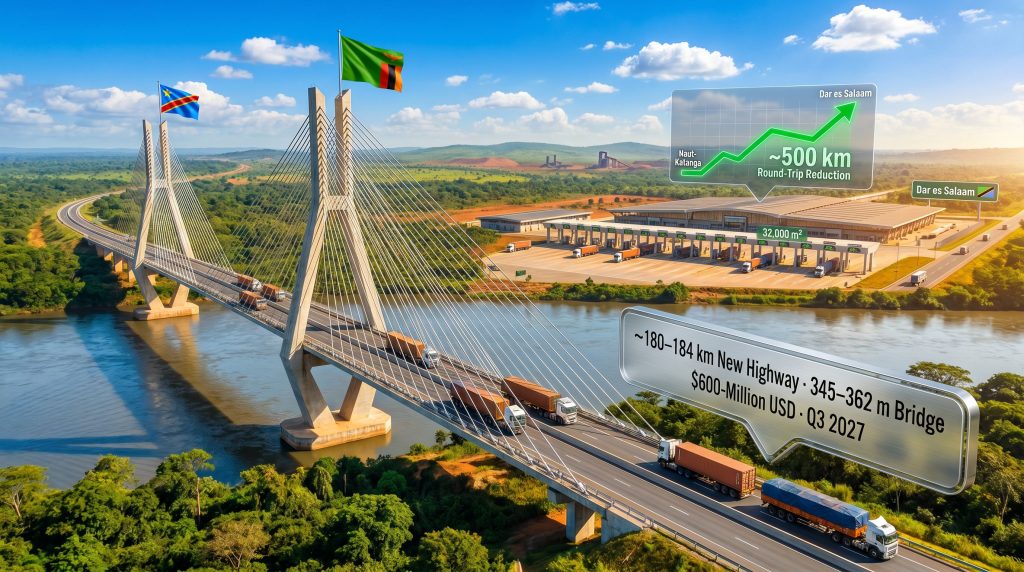
The Logistics Trap That Has Held the Copperbelt Back for Generations
For decades, the single most persistent constraint on the Copperbelt's economic potential has not been the ore beneath the ground. It has been the roads above it.
The DRC and Zambia together account for roughly 70% of the world's cobalt supply and a significant share of global copper production, yet both countries have historically been forced to rely on transport corridors that add hundreds of unnecessary kilometres to every export journey. In a commodity business where margins are measured in dollars per tonne, that inefficiency compounds into billions of dollars of lost value across the supply chain over time.
This is the structural problem that the Kasomeno-Mwenda infrastructure project between the Copperbelt and Tanzania is directly engineered to solve. Not by patching existing routes, but by introducing an entirely new corridor where none previously existed.
When big ASX news breaks, our subscribers know first
Why Existing Corridors Have Never Been Enough
Africa's Copperbelt sits at a geographic crossroads that should, in theory, make export logistics straightforward. In practice, the available corridors have consistently fallen short of what the region's mining economy demands.
The most widely used export routes from Haut-Katanga and Zambia's Northern Province require freight to travel south through Zambia before connecting to coastal terminals, or west toward Atlantic ports via the DRC's interior. Both paths involve significant detours, deteriorating road surfaces, and multi-day transit times through congested border posts operating under separate national customs frameworks. The cumulative effect is a logistics cost burden that makes Central African copper and cobalt systematically less competitive than it should be relative to its underlying quality and volume.
Furthermore, the economic arithmetic of this problem is stark. At average heavy freight rates of $0.08 to $0.12 per tonne-kilometre across sub-Saharan Africa, a 500-kilometre round-trip reduction on a 30-tonne payload produces an estimated saving of $1,200 to $1,800 per vehicle cycle. Multiply that figure across thousands of annual truck movements and the aggregate savings flowing back to mining operators reach tens of millions of dollars each year. For producers operating on thin margin cycles during commodity downturns, that saving is not marginal. It can determine whether a project remains economically viable.
What the Kasomeno-Mwenda Project Actually Involves
The Kasomeno-Mwenda infrastructure project is led by GED Africa Ltd, a developer with operational focus on Central African transport infrastructure, and is entirely funded by its Hungarian parent company Duna Aszfalt Zrt. The total project value is estimated at approximately $600-million USD, with financial returns structured around toll fees collected along the corridor rather than government revenue transfers.
The project creates a brand-new transport corridor connecting the DRC's Haut-Katanga province with Zambia's Mwenda border region, ultimately providing a direct route through to Tanzania's port of Dar es Salaam. This is a meaningful distinction. Previous infrastructure initiatives in the region generally focused on rehabilitating deteriorated existing roads. The Kasomeno-Mwenda project adds approximately 180 to 184 kilometres of entirely new two-lane highway, designed for a travel speed of 100 km/h.
The project structure operates under two separate 25-year public-private partnership agreements, one with the Government of Zambia and one with the Government of the DRC. This dual-sovereign arrangement is uncommon in African infrastructure finance and reflects the genuine complexity of building, owning, and operating a single integrated asset across two independent regulatory systems simultaneously.
Project Specifications at a Glance
| Parameter | Detail |
|---|---|
| New Road Length | ~180-184 km of two-lane highway |
| Design Speed | 100 km/h |
| Primary Bridge | 345-362 m cable-stayed/steel suspension |
| Bridge Location | Luapula River (Zambia-DRC border) |
| Pylon Height | 50 m A-shaped pylons |
| Cable Strand Length | Over 400 km of cable strands |
| OSBP Footprint | 32,000 m² under roof |
| Total Project Value | ~$600-million USD |
| PPP Structure | Two separate 25-year agreements |
| Construction Period | 3 years |
| Operation Period | 22 years |
| Groundbreaking | October 2, 2024 |
| Expected Completion | Q3 2027 |
| Lead Developer | GED Africa Ltd |
| Primary Funder | Duna Aszfalt Zrt (Hungary) |
The Luapula River Bridge: Engineering Significance in Context
The centrepiece of the corridor is a 345 to 362-metre cable-stayed steel suspension bridge crossing the Luapula River at the Zambia-DRC border. The bridge features a steel deck supported by striking 50-metre A-shaped pylons connected by over 400 kilometres of cable strands in total.
From a structural engineering perspective, this is a three-span cable-stayed design, a configuration that distributes load efficiently across the pylon anchors while minimising the need for mid-river support foundations. That matters significantly in a river environment like the Luapula, where seasonal flood levels and shifting riverbed conditions make conventional pier construction both technically challenging and potentially expensive to maintain over a 22-year operational window.
Construction of the Luapula River bridge is also designed to become a regional landmark in its own right. For a border region that has historically lacked permanent crossing infrastructure capable of handling heavy freight, the structure represents a transformation in physical connectivity rather than a simple engineering upgrade.
The One-Stop Border Post: A Systemic Redesign of Cross-Border Trade
If the road and bridge form the physical backbone of the project, the One-Stop Border Post at the Kasomeno-Mwenda crossing represents its operational intelligence layer.
Conventional African border crossings between two sovereign nations typically require freight vehicles to stop at separate national checkpoints on each side of the border, undergo duplicate document checks under different regulatory frameworks, and then wait while both customs authorities process the same shipment independently. For commercial freight, this duplication routinely adds hours to crossing times. At high-volume crossings during peak periods, it can stretch to days.
The Kasomeno-Mwenda OSBP eliminates this duplication by design. Key features of the facility include:
- Unified single-side processing, where all border procedures are conducted at one location rather than requiring vehicles to stop at two separate national posts
- Joint customs and security operations, with Zambian and Congolese personnel working side by side within a single integrated facility
- 12 high-speed weigh-in-motion devices that scan vehicles while they remain in motion, removing the need for stop-start weight checks that create queuing delays
- IT infrastructure provided and managed by GED Africa for both governments, creating a shared operational environment that does not rely on either government independently procuring or maintaining compatible systems
- Continuous truck flow architecture, where vehicles are scanned upon entry without stopping, maintaining traffic momentum through the crossing
At 32,000 square metres under roof, the completed facility will rank among the largest border post installations in Southern Africa. For context, most existing bilateral OSBPs on the continent operate with substantially smaller physical footprints and more limited throughput capacity.
Comparative OSBP Positioning
| OSBP Facility | Location | Processing Model | Notable Feature |
|---|---|---|---|
| Kasomeno-Mwenda | Zambia-DRC | Joint bilateral, in-motion scanning | 32,000 m² footprint, IT managed by developer |
| Chirundu | Zambia-Zimbabwe | Sequential bilateral | Established high-volume corridor |
| Malaba | Kenya-Uganda | Sequential bilateral | Busiest East African crossing |
| Kazungula | Zambia-Botswana | Quadrilateral (4 nations) | Bridge-integrated, multi-national |
BIM and Drone Technology: Construction Quality at the Frontier
One of the less widely discussed but technically significant aspects of the Kasomeno-Mwenda project is the application of Building Information Modelling (BIM) to a linear infrastructure corridor, something that has historically been far more common in vertical building construction than in road and bridge engineering.
BIM, in a conventional building context, creates a detailed three-dimensional digital model of a structure that allows engineers to detect design conflicts, monitor construction progress against specification, and coordinate across disciplines in real time. Applied to a 180-kilometre road corridor and a complex cable-stayed bridge, the technology enables:
- Detection of construction deviations as small as 2 to 3 millimetres, allowing early-stage intervention before minor misalignments become structural problems
- Remote progress verification, reducing the need for physical inspections across a geographically extensive and logistically challenging cross-border site
- Improved coordination across civil, structural, and mechanical engineering disciplines working simultaneously on different sections
- Faster, data-driven decision-making at site management level, reducing the lag between identifying a problem and resolving it
This BIM capability is complemented by drone-based monitoring that provides regular aerial documentation of site progress. Together, these tools represent a meaningful advancement in construction quality management for African infrastructure projects, where remote site conditions and the complexity of cross-border access have historically made real-time oversight difficult to sustain.
The combination of millimetre-precision BIM tracking and drone-based aerial monitoring on a cross-border African infrastructure project of this scale marks a genuine departure from conventional construction management approaches in the region, and sets a new benchmark for what private infrastructure developers can achieve without relying on traditional inspection models.
The next major ASX story will hit our subscribers first
The Financial Architecture: Why a Dual-Sovereign PPP Is Structurally Complex
The $600-million project financing provided entirely by Duna Aszfalt Zrt represents what has been described as the largest infrastructure investment by a single European company into Africa. That designation carries weight not just as a marketing point, but as a signal of the evolving risk appetite among European private capital for African infrastructure assets structured around commodity-linked traffic flows.
The dual-sovereign PPP structure is worth understanding in detail:
- Construction phase (Years 1-3): Fully funded by Duna Aszfalt Zrt, with no disclosed public capital contribution from either government
- Operational phase (Years 4-25): Revenue recovery through toll fees collected along the corridor, with GED Africa managing the operational environment
- Government obligations: Regulatory and legislative facilitation within each jurisdiction, rather than financial co-investment
- IT management: GED Africa retains management responsibility for the IT infrastructure and operational systems provided to both governments, creating a long-term service dependency that anchors the developer within the corridor's operational life
This structure means that the project's financial returns are fundamentally tied to traffic volumes, particularly freight volumes from mining operations in Haut-Katanga and the surrounding Copperbelt. If copper and cobalt output in the region grows in line with global energy transition demand forecasts, the corridor's economic viability strengthens considerably. If commodity cycles turn or mining operations face operational delays, toll revenue projections are exposed.
Three Scenarios for the Corridor's Economic Future
Scenario 1: Critical Minerals Supercycle Drives Maximum Utilisation
If critical minerals demand continues accelerating in line with electric vehicle adoption and grid storage deployment through the late 2020s and into the 2030s, the Kasomeno-Mwenda corridor could become one of the most intensively utilised freight routes in sub-Saharan Africa well before the PPP's midpoint. Under this scenario, toll revenues could significantly exceed base-case projections, and the corridor would likely catalyse additional investment in complementary logistics infrastructure along the route.
Scenario 2: Diversified Trade Flows Stabilise Revenue Base
Under a moderate commodity demand scenario, the corridor still achieves stable operational economics by attracting non-mining freight, including agricultural products, manufactured goods, and humanitarian logistics. The OSBP's capacity and efficiency advantages make it structurally attractive to any cross-border shipper, not solely mining operators. Revenue diversification in this scenario insulates the project against cyclical mining downturns.
Scenario 3: Sovereign Risk and Regulatory Divergence
Cross-border infrastructure operating under two sovereign agreements faces a risk profile that single-jurisdiction projects do not. Currency instability in either Zambia or the DRC, regulatory divergence between the two governments' customs frameworks, or political transitions that alter the terms of existing PPP commitments could each affect the corridor's operational continuity. The project's contractual architecture must anticipate these scenarios, and investors should assess how robustly the PPP agreements address force majeure and renegotiation clauses under each sovereign framework.
Regional and Social Dimensions: Beyond the Freight Numbers
Infrastructure of this scale generates economic effects that extend well beyond the logistics efficiency gains captured in freight cost models. During the three-year construction phase alone, the project creates direct employment across two countries in a region where formal employment opportunities remain structurally limited.
The longer-term social and economic multipliers include:
- Improved market access for smallholder agricultural producers along the corridor, who gain access to larger regional markets through faster and cheaper transport links
- Enhanced emergency and humanitarian logistics capacity in a region that has historically been difficult to access rapidly during health or disaster events
- A 22-year maintenance and operational employment base sustained through the PPP's service obligations
- Stimulus for ancillary commercial activity, including fuel retail, accommodation, freight forwarding, and trade services along the new route
The project also carries geopolitical significance for DRC-Zambia-Tanzania relations. DRC mineral wealth and the broader contest over the region's strategic resources have long shaped its political dynamics. Both Zambian President Hakainde Hichilema and DRC President Felix Tshisekedi provided formal endorsement at the project's groundbreaking on October 2, 2024. That level of bilateral presidential commitment materially de-risks the regulatory environment for a private developer operating across two sovereign jurisdictions, even if it does not constitute a formal government financial guarantee.
However, the geopolitical dimension runs deeper still. The Congolese cobalt rivalry between global powers adds a layer of strategic interest to any infrastructure that reshapes how the region's minerals reach international markets. In addition, the broader story of global cobalt supply chains increasingly runs through corridors exactly like this one, making the project's completion relevant well beyond the immediate region.
The Kasomeno-Mwenda project's role as a catalyst for national development has also been formally recognised at government level, with both the Zambian and Congolese administrations highlighting its transformative potential for regional trade beyond the mining sector.
Frequently Asked Questions
What is the Kasomeno-Mwenda infrastructure project?
It is a new transport corridor connecting the DRC's Haut-Katanga province with Zambia's Mwenda border region and onward to the Tanzanian port of Dar es Salaam, comprising approximately 180 to 184 kilometres of new two-lane highway, a major cable-stayed bridge across the Luapula River, and an integrated One-Stop Border Post.
Who is funding the project and how will returns be generated?
The project is entirely funded by Hungarian company Duna Aszfalt Zrt at an estimated cost of $600-million USD. Financial returns are structured around toll fees collected along the corridor over a 22-year operational window.
How much does the corridor reduce transport distances?
The corridor reduces the round-trip distance between Haut-Katanga and Dar es Salaam by approximately 500 kilometres, translating into meaningful per-vehicle savings of an estimated $1,200 to $1,800 per cycle at standard African heavy freight rates.
What makes the OSBP at Kasomeno-Mwenda different from conventional border posts?
The facility processes all customs and security procedures on a single side of the border, with Zambian and Congolese personnel operating jointly. Vehicles are scanned by weigh-in-motion devices while still moving, eliminating the stop-start delays that characterise conventional bilateral crossings. The 32,000-square-metre facility is among the largest of its kind in Southern Africa.
When is the project expected to be completed?
Completion is targeted for the third quarter of 2027, following a three-year construction phase that commenced with the October 2024 groundbreaking.
What commodities will primarily use the corridor?
Copper and cobalt concentrates from DRC and Zambian mining operations will form the primary freight base. The corridor also has capacity to serve agricultural, manufactured goods, and general commercial freight flows across the region.
Key Takeaways
- The Kasomeno-Mwenda infrastructure project between the Copperbelt and Tanzania introduces ~180 to 184 km of entirely new road infrastructure, not a renovation of existing routes
- The Luapula River bridge at 345 to 362 metres is a landmark cable-stayed engineering achievement at the Zambia-DRC border, featuring 50-metre A-shaped pylons and over 400 km of cable strands
- A ~500 km round-trip distance reduction to Dar es Salaam creates compounding logistics savings estimated at $1,200 to $1,800 per vehicle cycle for copper and cobalt exporters
- The $600-million project structured as two 25-year PPPs represents one of the most complex private infrastructure financing arrangements in recent African history and the largest single European company investment into African infrastructure
- BIM with 2 to 3 mm deviation detection and drone monitoring sets a new quality management benchmark for African linear infrastructure projects
- The 32,000 m² OSBP with in-motion scanning and joint bilateral processing positions this crossing as a model for future transnational trade facilitation
- Completion is targeted for Q3 2027, with the corridor positioned to become a critical artery for the critical minerals supply chains underpinning global energy transition demand
This article contains forward-looking scenario analysis and financial modelling based on publicly available freight cost benchmarks and project parameters. Actual outcomes will depend on commodity market conditions, regulatory environments, traffic volumes, and operational performance. Nothing in this article constitutes financial or investment advice.
Want to Stay Ahead of the Next Major Mineral Discovery Driving Demand for Copper and Cobalt?
As infrastructure like the Kasomeno-Mwenda corridor reshapes how critical minerals reach global markets, Discovery Alert's proprietary Discovery IQ model delivers real-time ASX alerts the moment significant copper, cobalt, and broader mineral discoveries are announced — transforming complex data across 30-plus commodities into clear, actionable insights. Explore historic discoveries and the exceptional returns they have generated, then begin your 14-day free trial at Discovery Alert to position yourself ahead of the market.