June 13, 2026
The Atlantic Basin Advantage: How Global Oil Chokepoints Are Redrawing PEMEX's Export Map
When a single waterway concentrates roughly 20% of the world's seaborne oil trade, the consequences of disruption ripple far beyond the immediate region. The Strait of Hormuz has long been the most structurally fragile point in global energy logistics, and when geopolitical escalation once again placed it under threat in early 2026, the knock-on effects were felt in refineries from Rotterdam to Tarragona. For PEMEX, Mexico's national oil company, PEMEX crude exports to Europe surged in ways that may outlast the crisis itself, fundamentally reshaping the company's commercial geography.
When big ASX news breaks, our subscribers know first
Europe Displaces the Americas: Understanding the Scale of the Shift
For most of PEMEX's modern export history, the Americas served as the gravitational centre of its crude shipments. U.S. Gulf Coast refineries, many of them purpose-configured for heavy Mexican grades like Maya crude, absorbed the dominant share of Mexico's seaborne oil output. That arrangement reflected both geographic proximity and decades of integrated refinery investment that made the U.S. the natural default buyer.
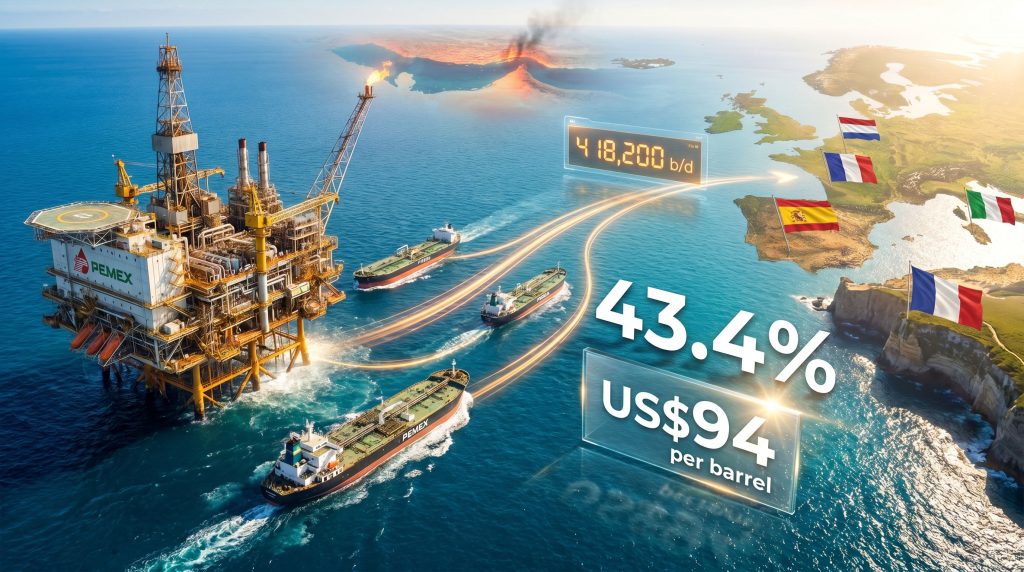
April 2026 marked a decisive departure from that model. Europe absorbed 43.4% of PEMEX's total crude exports during the month, displacing the Americas from the top position in a shift that analysts are describing as one of the most significant geographic realignments in the company's recent export history. Total crude export volumes reached 418,200 barrels per day (b/d) across all destinations, providing a substantial base against which that European share becomes even more striking in absolute terms.
Equally notable is what disappeared at the other end of the trade ledger. Far East flows, which historically included Chinese buyers with a strong appetite for heavy crude, reportedly halted in early 2026. That simultaneous collapse of Asian demand and surge in European absorption points to something more consequential than routine portfolio diversification. For context on how these flows sit within the broader global crude oil market overview, the scale of this reorientation becomes even clearer.
April 2026 PEMEX Crude Export Destination Overview
| Destination Bloc | Share of Total Exports | Key Context |
|---|---|---|
| Europe | 43.4% | Highest recorded share in recent history |
| The Americas | Below 43.4% | Displaced from dominant position |
| Far East / Asia | Minimal to zero | Flows reportedly ceased in early 2026 |
| India and Emerging Markets | Under active development | Identified as future growth targets |
"The simultaneous collapse of Far Eastern flows and the surge in European absorption suggests PEMEX is undergoing a forced reorientation, not a managed diversification. The distinction matters enormously for assessing how durable the shift will prove."
The Hormuz Premium: How a Chokepoint Became a Revenue Catalyst
The pricing dimension of this story is inseparable from the geographic one. The Mexican Mix export price averaged US$94 per barrel in April 2026, its highest monthly average since July 2022. That price level generated PEMEX's strongest export revenue performance since May 2025, despite no material increase in production volumes. The revenue gain was almost entirely a function of the pricing environment, not operational improvement.
The underlying driver was renewed military escalation between Iran and Israel, which placed sustained disruption risk on the Strait of Hormuz throughout the first half of 2026. The Strait is not merely a transit corridor; it is the single point through which the majority of Gulf crude reaches global markets. When credible disruption risk attaches to that corridor, buyers across Europe and Asia are forced to reassess their supply chains rapidly. These dynamics are well-documented across the oil logistics risk factors that have increasingly defined market behaviour.
Julio Trujillo, Director General of Bureau Soluciones Socioambientales, has argued through a systems theory lens that the U.S.-Israeli military framework applied in the Iran conflict was highly optimised but structurally brittle. In that analytical framework, highly optimised systems carry embedded fragility because they sacrifice redundancy for efficiency. Energy markets, by contrast, reward structural robustness over optimisation.
Mexican crude, positioned in the Atlantic Basin well outside any Hormuz disruption scenario, offered European buyers exactly the kind of supply-chain redundancy that a geopolitically stressed market prizes. This framing helps explain why the revenue spike was effectively a geopolitical dividend captured through strategic positioning rather than a production achievement. PEMEX did not produce its way to higher revenues in April 2026. It was simply located in the right place when the global oil map shifted.
Grade Segmentation: The Constraint Nobody Is Discussing
One of the less widely understood dimensions of PEMEX's European export surge is the role of crude grade compatibility in determining how far this trend can realistically extend. Not all Mexican crude travels equally well to European refineries.
Mexico's flagship heavy grade, Maya crude, has an API gravity of approximately 22 degrees and high sulphur content. It was designed, commercially speaking, for U.S. Gulf Coast refineries that invested billions of dollars in coking and desulphurisation units specifically to process this type of feedstock. European refineries, particularly those in Spain, Italy, France, and the Netherlands, are generally configured for lighter, sweeter crude grades.
This creates a structural ceiling on PEMEX's European market penetration. The expansion opportunity is most accessible for Mexico's lighter crude streams, not for the Maya grade that constitutes a large portion of the total production barrel. As U.S.-bound light crude exports declined amid trade policy uncertainties under the Trump administration's tariff environment, that displaced light crude became the natural candidate for European reallocation. Furthermore, the broader consequences of tariff-driven market disruption have accelerated this reallocation dynamic considerably.
Understanding this grade-based segmentation is essential for any investor or analyst assessing the sustainability of PEMEX's new export geography. The headline 43.4% European share captures a real and significant development, but the underlying barrel composition limits how far that share can grow without either European refinery configuration changes or a material shift in Mexico's production grade mix.
Key Drivers Behind the European Export Surge
- Geopolitical price spike driven by Strait of Hormuz disruption risk
- European buyers actively sourcing Atlantic Basin alternatives to reduce transit-risk exposure
- Active PEMEX and Mexican government policy push to diversify away from U.S. market dependence
- Reduction in U.S.-bound export volumes, freeing light crude for reallocation
- Compatibility between Mexican light crude grades and European refinery configurations
- Collapse of Far East flows creating reallocation pressure across the export portfolio
Spain, Italy, and the European Buyer Landscape
Within Europe, Spain has historically been and remains the largest single importer of Mexican crude. Spanish refineries operated by companies including Repsol have long-standing commercial relationships with PEMEX and processing configurations that accommodate Mexican grades. Italy, France, and the Netherlands round out the primary European buyer group, each taking smaller but commercially meaningful volumes.
The evolution of Europe-bound volumes illustrates the volatility that characterises PEMEX's export geography. In January 2024, Europe-bound flows reached approximately 258,000 b/d, before dropping sharply to around 156,000 b/d in February 2024. According to data published by Trading Economics, by April 2026 the European share had reached a record 43.4% of total exports on a percentage basis, reflecting both the absolute volume growth and the relative decline of other destination blocs.
Historical European Export Volume Reference Points
| Period | Europe-Bound Exports | Context |
|---|---|---|
| January 2024 | ~258,000 b/d | Near-term peak in recent data |
| February 2024 | ~156,000 b/d | Sharp month-on-month contraction |
| April 2026 | 43.4% of 418,200 b/d total | Record percentage share on record |
Mexico's Two-Track Strategy: Earning Abroad, Rebuilding at Home
The export geography story does not exist in isolation. On June 8, 2026, two announcements landed simultaneously that signal the Sheinbaum administration is treating the current geopolitical revenue windfall as financing for a longer-term industrial rebuilding programme.
Fermaca Dreams formally broke ground on the Fermachem Agro-Nitrogen Industrial Complex in Sapioris, in the municipality of Lerdo, Durango. On the same day, PEMEX announced a MX$93 billion petrochemical and fertiliser reactivation plan centred in Veracruz. Together, these commitments represent the largest single-day concentration of domestic fertiliser investment Mexico has seen in a generation.
The strategic logic is coherent: geopolitical conditions are generating elevated hard-currency export revenues from crude sales to Europe, while simultaneously the government is channelling investment into domestic petrochemical capacity that reduces Mexico's dependence on imported fertilisers and chemical feedstocks. The Veracruz plan positions PEMEX not merely as an export revenue generator but as an anchor of domestic industrial capability. However, the sustainability of this strategy depends heavily on how OPEC's market influence continues to shape global supply dynamics over the medium term.
"This two-track approach, earning geopolitical dividends externally while rebuilding industrial infrastructure domestically, reflects a deliberate effort to convert a temporary pricing windfall into durable structural capacity."
The next major ASX story will hit our subscribers first
Institutional Infrastructure: The IMP-UNAI Collaboration Agreement
Sustaining any improvement in export competitiveness ultimately depends on technical capability, and Mexico moved to formalise an institutional framework for this in June 2026. On June 3, the Mexican Petroleum Institute (IMP) and the National Engineer Associations Unit (UNAI) signed a General Collaboration Agreement. The agreement was formalised by Elizabeth Mar, Director General of IMP, and Pedro Sánchez, President of UNAI.
The framework operates across four operational pillars:
- Joint research programmes spanning energy disciplines relevant to both hydrocarbon production and transition technologies
- Technology development aligned with Mexico's evolving energy sector requirements
- Talent formation to develop the next generation of Mexican energy professionals and reduce reliance on external expertise
- Strategic project promotion supporting the broader energy sector across both conventional and transition-oriented activities
For PEMEX's European export ambitions specifically, the IMP partnership matters because sustained European market penetration requires more than favourable pricing. European buyers assessing long-term supply relationships will evaluate crude quality consistency, logistical reliability, and the technical depth of the supplying organisation. Domestic R&D investment and talent pipeline development directly support PEMEX's ability to deliver on those criteria over time.
Three Scenarios for PEMEX's European Export Trajectory
Investors and market participants should note that the following scenarios involve forward-looking analysis and inherent uncertainty. Actual outcomes will depend on geopolitical developments, production trends, and commercial negotiations that cannot be predicted with confidence.
| Scenario | Required Conditions | Probable Outcome |
|---|---|---|
| Sustained Expansion | Middle East tensions persist; PEMEX production volumes stabilise | Europe remains primary destination at 35–45% share |
| Partial Rebalancing | Hormuz risk eases; U.S. trade relations improve | Europe settles at 20–30% share; Americas partially recover |
| Structural Retreat | PEMEX production declines; European buyers shift to alternatives | European share falls below 15%; diversification strategy stalls |
The central scenario, partial rebalancing, is arguably the most analytically defensible baseline. The structural conditions that made European diversification attractive, U.S. trade policy uncertainty and refinery configuration compatibility for light grades, predate the current geopolitical pricing spike. Consequently, these conditions are unlikely to disappear entirely even if Hormuz risk moderates. However, the extreme 43.4% European share reflects conditions that are almost certainly cyclically elevated rather than structurally permanent.
In addition, the trade war impact on oil flows remains a persistent variable that could accelerate or reverse these trends depending on how U.S.-Mexico commercial relations evolve. According to reporting from Argus Media, PEMEX's export volumes have experienced significant volatility in recent years, which further underscores why the current European surge should be assessed against a longer historical baseline rather than treated as a new permanent norm.
FAQ: PEMEX Crude Exports to Europe
How much crude does PEMEX currently export to Europe?
In April 2026, Europe absorbed 43.4% of PEMEX's total crude shipments, representing a portion of the 418,200 b/d total export volume. Earlier 2024 data showed Europe-bound flows ranging between approximately 156,000 and 258,000 b/d depending on the month.
Why did PEMEX crude exports to Europe surge in 2026?
The primary catalyst was geopolitical disruption risk around the Strait of Hormuz stemming from renewed Iran-Israel military escalation. European buyers sought Atlantic Basin supply alternatives, while PEMEX simultaneously pursued active market diversification as U.S.-bound volumes declined amid trade policy uncertainties.
What price did PEMEX receive for crude in April 2026?
The Mexican Mix averaged US$94 per barrel in April 2026, the highest monthly average since July 2022, generating PEMEX's strongest export revenue performance since May 2025.
Which European countries import the most Mexican crude?
Spain is the largest European importer. Italy, France, and the Netherlands represent secondary markets, with demand concentrated in lighter Mexican crude grades compatible with European refinery configurations.
Can PEMEX sustain its European market share long-term?
Sustainability hinges on Middle East geopolitical conditions, PEMEX's domestic production trajectory, and whether commercial relationships formalised during the current pricing cycle translate into durable long-term supply agreements. Furthermore, the heavy/light crude grade segmentation creates a structural ceiling on the total addressable European market for PEMEX's full barrel mix.
Want To Stay Ahead of Major Commodity Shifts Like This One?
Discovery Alert's proprietary Discovery IQ model scans ASX announcements in real time, delivering instant alerts on significant mineral discoveries so investors can act before the broader market catches on — explore historic discovery returns that demonstrate just how transformative early positioning can be, and begin your 14-day free trial at Discovery Alert to secure your market-leading edge.