August 5, 2026
The Invisible Chokepoint: Understanding the True State of Strait of Hormuz Oil Traffic
Global energy systems are built on the assumption that oil moves. It moves through pipelines, across oceans, through refineries, and into the economies that depend on it. That assumption holds until a single geographic bottleneck breaks down. Right now, Strait of Hormuz oil traffic is operating at a fraction of its capacity, and the gap between what official sources report and what commercial tracking data shows is wider than most market participants realise.
When big ASX news breaks, our subscribers know first
Why Hormuz Is Unlike Any Other Maritime Chokepoint
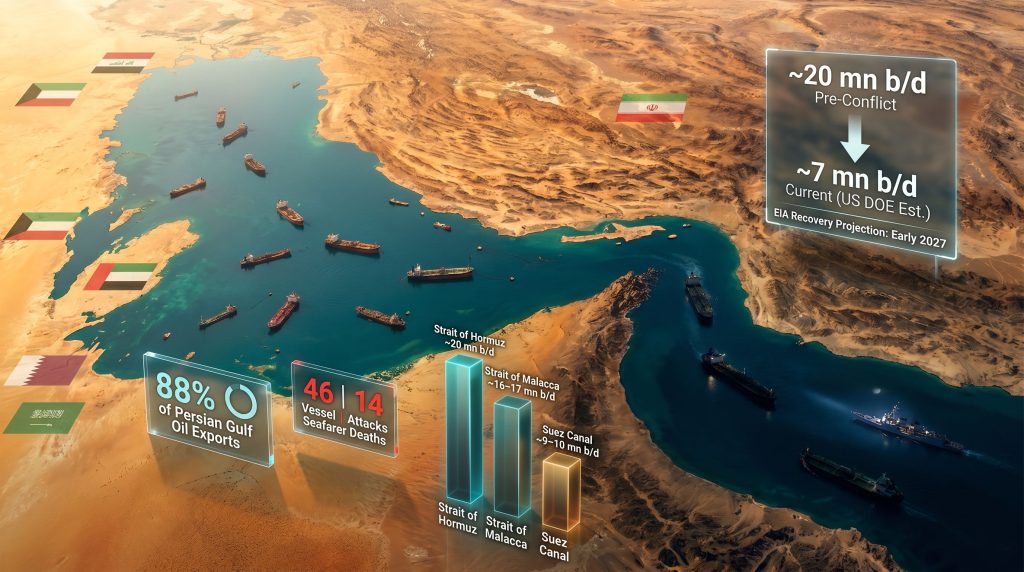
The Strait of Hormuz sits at the intersection of the Persian Gulf and the Gulf of Oman, forming the sole exit corridor for the world's most oil-dense basin. Its navigable shipping lane narrows to a few miles at its tightest point, yet under normal operating conditions this passage carried approximately 20 million barrels per day (b/d) of petroleum and crude oil in 2024, according to the US Energy Information Administration. That figure represents somewhere between 20 and 25 percent of all maritime oil traded globally.
What separates Hormuz from other chokepoints is the near-total absence of credible bypass infrastructure. The Strait of Malacca, by comparison, handles an estimated 16 to 17 million b/d but has partial rerouting alternatives. The Suez Canal and SUMED pipeline corridor, which together carry roughly 9 to 10 million b/d, can be partially substituted through Cape of Good Hope routings. Hormuz has no equivalent escape valve at scale.
| Chokepoint | Est. Daily Oil Flow | Share of Global Trade | Bypass Viability |
|---|---|---|---|
| Strait of Hormuz | ~20 mn b/d | ~20-25% | Very limited |
| Strait of Malacca | ~16-17 mn b/d | ~15-16% | Moderate |
| Suez Canal / SUMED | ~9-10 mn b/d | ~8-10% | Partial |
| Bab el-Mandeb | ~6-7 mn b/d | ~5-7% | Partial |
| Danish Straits | ~3 mn b/d | ~3% | Limited |
The Strauss Center has estimated that roughly 88 percent of all oil departing the Persian Gulf exits through this single passage, making concentration risk an inherent structural feature of the global oil supply chain rather than a temporary vulnerability.
The 7 Million Barrel Problem: What Is Actually Moving Through the Strait
Official Estimates vs. Commercial Tracking Reality
US Energy Secretary Chris Wright stated at the Bloomberg Energy Security Executive Briefing in Houston in June 2026 that approximately 7 million b/d of crude and oil products were transiting the strait, describing the figure as a rough average that was trending upward. That number implies the passage is currently handling roughly half the supply gap created by the effective closure of the waterway since the start of the conflict, with several million additional barrels being rerouted through regional pipeline infrastructure.
However, that estimate was publicly challenged at the same event by Chevron CEO Mike Wirth, who indicated the true figure was likely somewhat lower. Wirth noted that what traffic does move through the strait tends to do so with transponders switched off, primarily at night, and with involvement from the US military. This is not the profile of a normalising trade route. Furthermore, understanding the current crude oil prices in this context helps explain just how significantly this disruption is affecting global benchmarks.
Data Reliability Warning: Current Hormuz throughput estimates carry significant uncertainty across all sources. AIS suppression, military-facilitated transits, and nighttime-only operations structurally compromise real-time visibility. Analysts and market participants should cross-reference multiple tracking providers and treat any single estimate with caution.
Commercial vessel tracking firms Kpler and Vortexa recorded Mideast Gulf crude exports through the strait averaging just 226,000 to 330,000 b/d during June 2026. Both firms acknowledge that this substantially undercounts actual volumes due to widespread transponder deactivation. For live monitoring of vessel movements in the region, Hormuz Strait Monitor provides real-time tracking data that complements these commercial estimates.
Decoding the AIS Dark Transit Phenomenon
The Automatic Identification System (AIS) is the maritime equivalent of an aircraft transponder. Under normal conditions, vessels broadcast their identity, position, course, and speed to nearby ships and shore stations. When operators switch these systems off, the vessel disappears from commercial tracking platforms entirely.
Maritime consultancy Windward has tracked approximately four dark vessel transits per day across all cargo segments in recent weeks within the Hormuz zone. For context, prior to the conflict an average of 130 ships transited the strait each day, carrying 14 to 15 million b/d of Mideast Gulf crude and energy flows. The collapse in visible traffic is therefore not solely a reflection of reduced actual movement but also a product of deliberate signal suppression.
The practical implication for market analysis is significant. The enormous gap between tracker-visible flows (hundreds of thousands of barrels per day) and the US government's 7 million b/d estimate is explained almost entirely by dark transits, not by absent tankers. Yet even accepting the official figure at face value, current throughput remains roughly 65 percent below the 2024 baseline. Consequently, WTI and Brent futures have responded sharply to this supply constraint, with both benchmarks reflecting the prolonged uncertainty.
Breaking Down the Volumes in VLCC Terms
A Very Large Crude Carrier (VLCC) is the workhorse of long-haul crude transport, with a standard cargo capacity of approximately 2 million barrels. At the DOE's 7 million b/d estimate, the implied transit rate equates to roughly 3.5 VLCCs per day. Under pre-conflict conditions, the strait regularly handled the equivalent of 7 to 8 VLCCs per day in crude alone, plus substantial refined products and LNG volumes. The implied reduction in physical vessel activity is dramatic even before accounting for the possibility that the 7 million b/d figure may be overstated.
How the Conflict Restructured Tanker Operations
The Mechanics Behind the Effective Closure
Since the onset of the Iran conflict, Strait of Hormuz oil traffic has functioned under what amounts to an operational closure for standard commercial traffic. Iran has leveraged a combination of naval mine deployment threats and demonstrated vessel attack capabilities to systematically deter commercial shipping. The International Maritime Organization has recorded 46 vessel attacks since hostilities began, resulting in 14 seafarer deaths. These are not abstract statistical risks; they represent real incidents that have fundamentally altered how ship operators calculate risk-adjusted returns on Hormuz transits.
War risk insurance premiums for the strait have risen sharply, directly inflating the landed cost of Persian Gulf crude for importers. However, industry participants consistently point to crew safety as the binding constraint rather than insurance costs alone. No premium structure fully compensates for the irreversible outcomes seafarers have experienced in the region.
The US Military's Coaching Role and Its Limits
The US Navy is not conducting formal convoy escort operations through the strait. Instead, according to marine insurer Skuld, the military has been guiding vessels through an alternative corridor that runs south of the standard traffic separation scheme, passing through Omani territorial waters. This route reduces exposure to the most heavily contested zones within the strait itself.
The operational profile of these facilitated transits tells its own story:
- Vessels transit primarily at night
- AIS transponders are switched off throughout
- Routing follows a non-standard southern corridor through Omani waters
- Military guidance is described as coaching rather than active escort
This model cannot scale to pre-conflict throughput levels. Military-facilitated transits provide a pressure relief valve for critical cargoes but do not constitute commercial normalisation. In addition, the oil market disruption caused by these constraints has further complicated the already complex relationship between supply and pricing across global benchmarks.
Pipeline Diversions: The Pressure Relief That Cannot Fill the Gap
Several million barrels per day have been rerouted through overland pipeline infrastructure since the strait's effective closure. The principal routes are Saudi Arabia's Petroline (East-West Pipeline), which connects Eastern Province oil fields to the Red Sea terminal at Yanbu, and the Abu Dhabi Crude Oil Pipeline (ADCOP), which links UAE production to the Fujairah export terminal on the Gulf of Oman, bypassing the strait entirely.
The combined theoretical export capacity of these routes falls well short of the 14 to 15 million b/d that historically moved through Hormuz. Saudi Arabia and the UAE have partial bypass capability; Iraq and Kuwait have essentially none. For Iraq in particular, which exported an estimated 3.5 to 4 million b/d through the strait prior to the conflict, the closure represents a structural export crisis with no pipeline solution available.
Regional Exposure: Who Bears the Most Risk
Import-Side Vulnerability Across Asia
The countries most acutely exposed to suppressed Strait of Hormuz oil traffic are concentrated in the Asia-Pacific region.
- Japan relies on Persian Gulf crude for the majority of its import requirements and has limited domestic production capacity
- South Korea similarly depends on Middle Eastern supply for a large share of its refinery feedstock
- China, despite supply diversification efforts over the past decade, continues to route a substantial portion of its Middle Eastern crude purchases through the strait
- India has been expanding its Persian Gulf crude imports and faces feedstock substitution challenges during periods of disruption
European buyers have greater optionality through Atlantic Basin and North Sea supply alternatives, but remain exposed through LNG and refined product channels.
Supply-Side Structural Vulnerability
| Producer | Estimated Pre-Conflict Hormuz Exports | Pipeline Bypass | Structural Exposure |
|---|---|---|---|
| Saudi Arabia | ~6-7 mn b/d | Partial (Petroline) | Moderate |
| UAE | ~2.5-3 mn b/d | Partial (ADCOP) | Moderate |
| Iraq | ~3.5-4 mn b/d | Minimal | Very high |
| Kuwait | ~1.5-2 mn b/d | Minimal | High |
| Iran | ~1-1.5 mn b/d (sanctioned) | Limited | High |
| Qatar (LNG) | Major LNG exporter | None | Very high |
Iraq's structural exposure deserves particular emphasis. Without meaningful pipeline bypass capacity, Iraq's ability to monetise its oil production is almost entirely contingent on strait access. A prolonged closure disproportionately constrains global availability of Iraqi Basra crude, tightening medium-heavy crude differentials in Asian markets. Furthermore, OPEC market influence over production decisions has become increasingly constrained by the physical inability of member states to export through conventional routes.
The EIA Recovery Projection and What It Really Means
The US Energy Information Administration's most recent Short-Term Energy Outlook projects that Strait of Hormuz oil traffic will not recover to pre-conflict levels until at least early 2027. This represents a minimum 18 to 24 month recovery window from mid-2025 under what could reasonably be described as a constructive baseline scenario.
Three distinct recovery trajectories are plausible depending on diplomatic and operational developments:
Scenario 1: Accelerated Recovery
A comprehensive, verified agreement is implemented within 60 to 90 days. No further vessel incidents occur. Commercial traffic rebuilds to 60 to 70 percent of pre-conflict levels within 12 months. Oil markets price in moderately bearish supply outlook as constraints ease.
Scenario 2: Baseline Recovery (aligned with EIA projection)
A partial agreement reduces hostilities but does not eliminate residual risk. Operator confidence rebuilds over 18 to 24 months. Traffic returns to pre-conflict levels by early 2027. A risk premium of $5 to $10 per barrel persists through 2026.
Scenario 3: Prolonged Disruption
Negotiations stall or collapse. Intermittent attacks continue. Traffic remains structurally suppressed at 40 to 50 percent of pre-conflict volumes through 2027. Persistent supply tightness creates elevated price volatility during any escalation event.
The next major ASX story will hit our subscribers first
The Cascading Effects Beyond Crude Oil
LNG, Fertilizers, and Petrochemical Feedstocks
The disruption extends well beyond crude petroleum. Qatar, the world's largest exporter of liquefied natural gas, routes virtually all of its LNG volumes through the strait. A prolonged closure materially tightens global LNG supply, with compounding effects on European and Asian gas prices, particularly during peak seasonal demand periods.
Persian Gulf fertiliser exports have also been severely constrained. Saudi Arabia and Qatar are among the world's largest producers of urea and ammonia. Restricted access to these volumes during planting seasons creates measurable upward pressure on agricultural input costs across South and Southeast Asia, where food security is closely linked to fertiliser availability.
For Asian refiners, the sourcing challenge has triggered a structural reorientation toward alternative crude origins. West African grades, US crude exports, and in some cases Russian grades have been substituted for the medium-to-heavy Persian Gulf crudes that Asian refinery configurations were originally designed to process. This substitution has:
- Altered regional crude differentials, lifting premiums on non-Hormuz origin grades
- Reduced refinery utilisation rates in Japan, South Korea, and parts of Southeast Asia where feedstock specifications have tightened
- Increased logistics costs as average shipping distances from alternative origins extend significantly beyond Persian Gulf supply
The Long Reconstruction of Market Confidence
Why a Deal Alone Will Not Reopen the Strait
A diplomatic agreement, if and when reached, will mark the beginning of the recovery process rather than its conclusion. The restoration of full commercial throughput is a multi-variable problem with at least three independent time horizons running simultaneously.
First, war risk insurance premiums will take time to normalise. Underwriters recalibrate pricing based on demonstrated incident-free periods, not signed agreements. Second, crew welfare considerations will constrain operator decision-making independently of financial incentives. Seafarers and maritime unions retain meaningful influence over routing decisions when safety records are as stark as they are in the current environment. Third, vessel scheduling and cargo contract structures require lead time to rebuild, meaning even willing operators cannot immediately restore the volume and frequency of pre-conflict flows.
The EIA's early-2027 timeline accounts for this multi-layer reconstruction. Analysts and investors treating a diplomatic announcement as a binary normalisation event are likely to find the physical recovery disappoints their expectations significantly. For broader context on how these dynamics are shaping crude oil price trends beyond the strait itself, the evolving supply picture warrants close attention.
The Structural Energy Security Lesson
The current disruption has exposed with unusual clarity the concentration risk embedded in global oil logistics infrastructure. No combination of strategic petroleum reserve releases, pipeline rerouting, or supply substitution has been able to fully compensate for the suppression of Hormuz throughput. The strait's irreplaceability, once a background assumption in energy security analysis, has now been empirically demonstrated.
For energy planners, commodity traders, and investors with exposure to Asian refining margins or Persian Gulf producer economics, the current episode reinforces several enduring principles:
- Supply chain diversification reduces exposure to single-point failure events but requires sustained capital commitment over years
- Strategic reserve adequacy matters most when the disruption timeline is ambiguous, as it is now
- Demand-side flexibility in refinery configurations provides optionality that fixed-spec plants cannot access during feedstock dislocations
- Freight and insurance cost modelling must incorporate tail-risk scenarios for major chokepoints, not just central-case assumptions
The Strait of Hormuz has always been the world's most consequential energy chokepoint in theory. The conflict has confirmed that status in practice, and the path back to normalised Strait of Hormuz oil traffic will be measured in years, not weeks.
This article contains forward-looking projections and scenario analysis based on publicly available data from the US Energy Information Administration, the International Maritime Organization, vessel tracking firms Kpler and Vortexa, maritime consultancy Windward, and marine insurer Skuld. All forecasts involve inherent uncertainty. Nothing in this article constitutes financial or investment advice. Readers should conduct independent analysis before making decisions based on energy market conditions.
For regularly updated analysis on international petroleum infrastructure and trade flows, the US Energy Information Administration publishes Short-Term Energy Outlooks and related data at eia.gov.
Want To Capitalise on the Next Major Commodity Discovery Before the Market Catches On?
While the Strait of Hormuz disruption reshapes global energy flows and tightens commodity supply chains, Discovery Alert's proprietary Discovery IQ model delivers real-time alerts on significant ASX mineral discoveries — instantly translating complex data across 30-plus commodities into clear, actionable insights for traders and investors at every level. Explore how historic discoveries have generated substantial returns by visiting Discovery Alert's dedicated discoveries page, and begin your 14-day free trial today to position yourself ahead of the market.