June 13, 2026
The Chokepoint That Moves the World: Inside the US Iran Strait of Hormuz Peace Deal
Few geographic features on earth carry as much economic weight as a narrow strip of water roughly 33 kilometres wide at its most constrained point. The Strait of Hormuz, sitting between the southern coast of Iran and the northern tip of Oman, is not merely a shipping lane. It is the single most consequential maritime bottleneck in the global energy system, and its effective closure since early 2026 has sent shockwaves through oil markets, supply chains, and the inflation figures that governments around the world are scrambling to manage. The diplomatic activity now unfolding around a proposed US Iran Strait of Hormuz peace deal represents one of the most consequential geopolitical negotiations of the decade.
When big ASX news breaks, our subscribers know first
Why the Strait of Hormuz Cannot Be Replaced
Before assessing the diplomatic architecture currently being assembled, it helps to understand why this particular waterway commands such outsized attention from energy traders, central bankers, and naval strategists simultaneously.
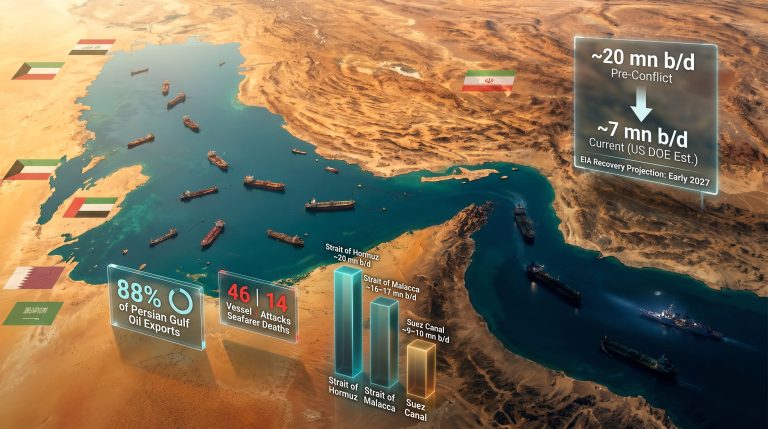
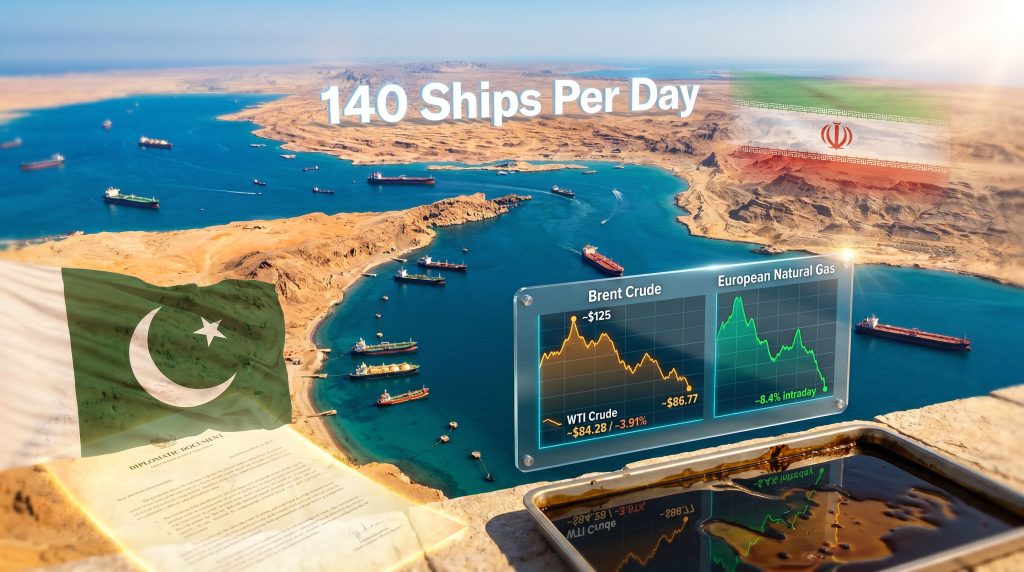
Approximately 20 to 30 percent of the world's seaborne oil and liquefied natural gas passes through the Strait of Hormuz on any given day. Before the conflict that erupted in late February 2026, roughly 140 vessels transited the strait daily, carrying crude oil, refined petroleum products, and LNG to markets across Asia, Europe, and beyond. There is no meaningful alternative route that can absorb this volume at comparable cost or speed.
When Iran effectively closed the strait by targeting commercial vessels with drone and missile attacks in the early weeks of the conflict, the consequences were immediate and severe. Furthermore, these disruptions directly influenced crude oil price trends across global benchmarks:
- Global Brent crude prices surged toward $125 per barrel by late April 2026, up roughly 50 percent year-to-date
- European natural gas markets experienced acute supply anxiety, with prices reflecting premium war-risk pricing
- Global shipping insurance premiums for vessels operating near the Persian Gulf escalated dramatically
- Inflation pressures intensified across import-dependent economies in Europe and Asia
The vessel count through the strait has crept upward in recent weeks but remains far below pre-conflict baselines, meaning the economic damage is ongoing and cumulative.
What Is the Islamabad Memorandum of Understanding?
At the centre of current diplomatic activity is a framework document being referred to as the Islamabad Memorandum of Understanding. This is not a final peace treaty. It is an interim arrangement designed to accomplish several immediate objectives while creating a structured negotiating window for longer-term resolution.
The MOU's diplomatic architecture is notably unusual. Rather than direct bilateral negotiations, the framework has been brokered through third-party intermediaries, with Qatar and Pakistan playing the most prominent facilitation roles. Qatar's established back-channel relationships with both Washington and Tehran made it a natural fit. Pakistan's role, however, has been particularly active.
Pakistan's Prime Minister Shehbaz Sharif publicly confirmed in mid-June 2026 that a final, agreed-upon text of the peace deal had been reached, with Islamabad actively coordinating next steps between the two parties. This positions Pakistan as a central diplomatic bridge in one of the most consequential geopolitical negotiations of 2026, a role that carries significant implications for Islamabad's regional influence and foreign policy standing.
The G7 summit in Evian, France, scheduled for June 15 to 17, has emerged as the probable horizon for a formal signing, with Geneva being discussed as a potential venue given its proximity and established status as a neutral diplomatic location.
Confirmed Facts Versus Unresolved Disputes
A critical challenge for anyone assessing the deal's prospects is separating confirmed developments from the considerable fog of contradictory messaging. The table below maps the key contested points as of mid-June 2026:
| Issue | US Position | Iranian Position |
|---|---|---|
| Strait of Hormuz Access | Full free passage for all commercial vessels | Degree of Iranian supervisory oversight retained |
| Frozen Asset Release | No funds released until Iran meets performance conditions | Iranian state media reports up to $24 billion in foreign-held funds |
| Nuclear Program | Dismantlement and uranium relinquishment required | Final decision pending Supreme Leader approval |
| Ceasefire Extension | Approximately 60-day extension proposed | Details under internal review |
| US Force Posture | Not confirmed by Washington | Iranian media reports US withdrawal from nearby areas |
| Reconstruction Commitment | Not confirmed | Iranian state media cites $300 billion US-led commitment |
The interpretive ambiguity embedded in the MOU's language is not accidental. Negotiators appear to have deliberately left certain terms open-ended to allow both sides to characterise the agreement favourably to their domestic audiences. Consequently, whilst the US has described Hormuz reopening as unrestricted commercial transit, reporting from Iranian media outlets suggests Tehran may retain meaningful oversight authority over the waterway.
Diplomats familiar with the negotiations have indicated the MOU will be open to interpretation in certain areas, particularly around what the reopening of the strait means in practice.
This ambiguity is simultaneously the deal's greatest diplomatic achievement and its most significant structural liability.
The Core Terms: A Performance-Based Architecture
Senior US officials have characterised the proposed agreement as explicitly performance-based, meaning Iran receives no economic relief until it fulfils defined conditions. The key components include:
- Hormuz reopening as the immediate operational objective
- Relinquishment or destruction of Iran's highly enriched uranium stockpiles
- Nuclear program dismantlement as a longer-term condition
- Ceasefire extension of approximately 60 days to create a negotiating bridge
- Lifting of the US blockade on Iranian ports as part of sanctions relief
- No monetary transfers to Tehran until performance benchmarks are verified
Iranian state media outlet Mehr News Agency has reported the agreement includes release of approximately $24 billion in Iranian funds held in foreign financial institutions and a $300 billion US-led reconstruction commitment. Both figures have been explicitly rejected by senior US officials and hawkish members of Congress, including Senator Lindsey Graham.
The 60-day ceasefire extension deserves particular attention. It functions less as a peace mechanism and more as a negotiating clock. Once it expires, both parties face renewed pressure to either formalise a comprehensive agreement or return to active hostilities, creating a hard deadline that concentrates diplomatic attention but also introduces significant binary risk.
The Supreme Leader Bottleneck
Perhaps the most underappreciated obstacle to finalisation is Iran's internal approval process. The proposed terms must receive authorisation from Supreme Leader Mojtaba Khamenei, who has been in an undisclosed location since the conflict began in February 2026.
This creates a genuine logistical and political complication. The primary mediators, Qatar and Pakistan, have found that reaching Khamenei can require multiple days of communication lag. Iran's Foreign Ministry has emphasised that all relevant authorities must reach internal consensus before any formal signing can proceed.
This is not merely procedural. In Iran's governance structure, the Supreme Leader holds ultimate authority on matters of national security and foreign policy. No foreign minister, no matter how empowered, can bind the Islamic Republic without that approval. According to reporting from The Guardian, the chain of authority runs directly through an individual who is physically inaccessible and whose communication timelines are unpredictable.
The next major ASX story will hit our subscribers first
Israel: The External Variable With Veto Power
Israel is not a party to the Islamabad MOU negotiations, and this exclusion carries significant strategic weight. Tel Aviv has made its concerns unambiguous on several dimensions:
- Lebanon and Hezbollah: Israel is actively resisting any ceasefire arrangement that would constrain its military operations in northern Lebanon against Iran-backed Hezbollah forces
- Enriched uranium: Israel's minimum threshold for accepting any deal is the verified physical removal of Iran's processed uranium stockpiles from Iranian territory
- Sanctions relief: Israeli officials have signalled that any agreement granting Iran economic relief without verified nuclear disarmament would be treated as a diplomatic failure
- Military preference: Prime Minister Benjamin Netanyahu has signalled a preference for continued military pressure over diplomatic settlement
Israel's position creates a structural tension within the US-led coalition. Washington must satisfy Israeli concerns sufficiently to avoid unilateral Israeli military action that could derail any diplomatic progress, while simultaneously offering Iran enough economic incentive to make the agreement worthwhile.
Energy Market Response: What the Price Action Reveals
Markets have responded with considerable sensitivity to each diplomatic signal, providing a real-time reading of how traders are pricing the probability and completeness of a deal. In addition, the interplay between oil prices and geopolitics has rarely been more visible than in recent weeks.
| Energy Metric | Peak Level (Late April 2026) | Level at Time of Reporting | Change |
|---|---|---|---|
| Brent Crude (per barrel) | ~$125 | ~$86.77 | ~30.6% decline from peak |
| WTI Crude (per barrel) | Elevated | ~$84.28 | -3.91% on the day |
| European Natural Gas | Elevated | Down 8.4% intraday | Significant single-session decline |
The 5.1% single-session decline in Brent crude following reports of diplomatic progress represents a market pricing in meaningful probability of deal completion. However, Brent remains approximately 50% higher year-to-date compared to pre-conflict levels, suggesting traders are not yet treating a full Hormuz restoration as a base case.
Notably, WTI and Brent futures have tracked each diplomatic headline closely, amplifying intraday swings. Meanwhile, European gas prices have also responded sharply, with the 8.4% intraday decline particularly instructive. European gas had been trading at a significant war-risk premium given the continent's dependence on LNG transiting Hormuz. A single diplomatic headline was sufficient to produce an outsized price response, indicating how tightly the market is coiled around this single geopolitical variable.
The Mine Clearance Problem: Why Restoration Takes Time
A deal being signed and the strait actually functioning are two different things. Multiple sources familiar with the negotiations have indicated that Iran has likely placed mines in the strait, and both the UK and France have been positioning naval assets to assist with clearance operations.
Mine clearance in active or recently contested waterways is technically demanding and time-consuming work. The assessment that normal shipping levels could be restored within approximately one month of a deal signing has been described by officials as an optimistic target. Realistically, a staged restoration is more probable:
- Initial diplomatic agreement and ceasefire confirmation
- Survey operations to identify and map mine locations
- Coordinated clearance operations by allied naval forces
- Phased resumption of commercial traffic under naval escort
- Full restoration of the 140-vessel daily transit baseline
Each phase carries its own risk of delay or disruption, and the involvement of UK and French naval assets adds a multilateral coordination layer that introduces additional complexity.
Domestic Political Calculus in Washington
The Trump administration's negotiating posture is shaped by a dual political audience. On one side sit Iran hawks within the Republican Party who view any deal granting Tehran relief as a capitulation. On the other side sits an American public increasingly weary of a conflict that has driven energy prices sharply higher and contributed to inflationary pressures ahead of November's midterm elections.
With Brent crude having risen nearly 50 percent year-to-date and that increase feeding directly into fuel costs, heating bills, and transportation expenses, the political cost of continued conflict is tangible and measurable. Furthermore, concerns about market volatility and safe havens have intensified among investors monitoring the situation. Vice President JD Vance has publicly defended the administration's diplomatic approach against Republican critics, signalling that the White House views a credible peace framework as politically preferable to continued military engagement.
The deliberate ambiguity in the MOU's language reflects this political reality. A deal that can be characterised as a strong outcome by Washington and simultaneously as a protective arrangement by Tehran is more likely to survive domestic political scrutiny on both sides than a document with precise, verifiable, and potentially uncomfortable terms.
Strategic Scenarios and Market Implications
Scenario A: Full Agreement Signed at G7
If a formal signing occurs between June 15 and 17, and Iran's Supreme Leader provides timely authorisation, markets would likely price in a rapid normalisation trajectory. Brent crude could retreat significantly toward pre-conflict levels over subsequent weeks as mine clearance progresses and vessel transit resumes. Shipping insurance premiums would begin normalising, and global inflation expectations would ease.
Scenario B: Partial Agreement With Ongoing Ambiguity
A signed MOU with deliberately vague Hormuz terms and contested financial provisions would produce continued price volatility. Markets would oscillate between optimism about incremental progress and concern about deal collapse. This scenario may see a gradual 60 to 90 day restoration of shipping rather than a rapid normalisation.
Scenario C: Negotiations Collapse Before Signing
Should the G7 window pass without agreement — whether due to Supreme Leader non-approval, Israeli intervention, or domestic US political pressure — Brent crude could test prior highs near $125 per barrel. Global equity markets would face meaningful downside, and as NBC News has reported, emerging market currencies would come under pressure from both energy cost increases and risk-off sentiment.
Frequently Asked Questions
Has the US Iran Strait of Hormuz peace deal been signed?
As of mid-June 2026, no formal agreement has been signed. The Islamabad Memorandum of Understanding has reportedly been agreed in principle, but Iran's Supreme Leader has not provided final authorisation and significant interpretive gaps remain between the two sides' characterisations of key terms.
What conditions must Iran meet before receiving economic relief?
According to senior US officials, Iran must relinquish or destroy its highly enriched uranium stockpiles, progress toward nuclear program dismantlement, and fulfil specific performance benchmarks before receiving any sanctions relief, asset unfreezing, or port blockade removal.
Why does Israeli opposition matter if Israel is not part of the deal?
Israel's ability to conduct independent military operations against Iranian and Hezbollah targets means it effectively holds a form of veto over the deal's durability. If Israel views the agreement as insufficient on nuclear terms, unilateral military action could destabilise any ceasefire arrangement regardless of what Washington and Tehran have agreed.
How long would it take for the Strait of Hormuz to fully reopen after a deal?
Officials have suggested normal shipping levels could potentially be restored within approximately one month of a deal, but this assumes successful mine clearance operations by allied naval forces and a cooperative security environment. A more conservative timeline of 60 to 90 days for full restoration appears more realistic given the technical and logistical challenges involved.
Disclaimer: This article contains forward-looking assessments, scenario analyses, and market projections based on information available as of mid-June 2026. Geopolitical situations are inherently unpredictable. Nothing in this article constitutes investment or financial advice. Readers should conduct their own independent research before making any financial decisions.
Want to Stay Ahead of the Commodity Discoveries Driven by Geopolitical Shifts?
When energy markets are this volatile, the ripple effects across resource and mining sectors can be swift and significant — Discovery Alert's proprietary Discovery IQ model delivers real-time alerts on major ASX mineral discoveries, ensuring subscribers are positioned ahead of the broader market. Explore historic discovery returns on Discovery Alert's discoveries page and start your 14-day free trial today to gain an immediate market edge.