
June 13, 2026
The Hidden Mechanics Behind a Market-Defining Event
Few moments in modern energy history carry the structural weight of the Strait of Hormuz reopening and oil supply recovery. Before examining what happens the day after shipping resumes, it is worth stepping back to understand why this particular waterway commands such disproportionate influence over global energy pricing, geopolitical risk premiums, and the investment calculus of every major oil consumer on earth.
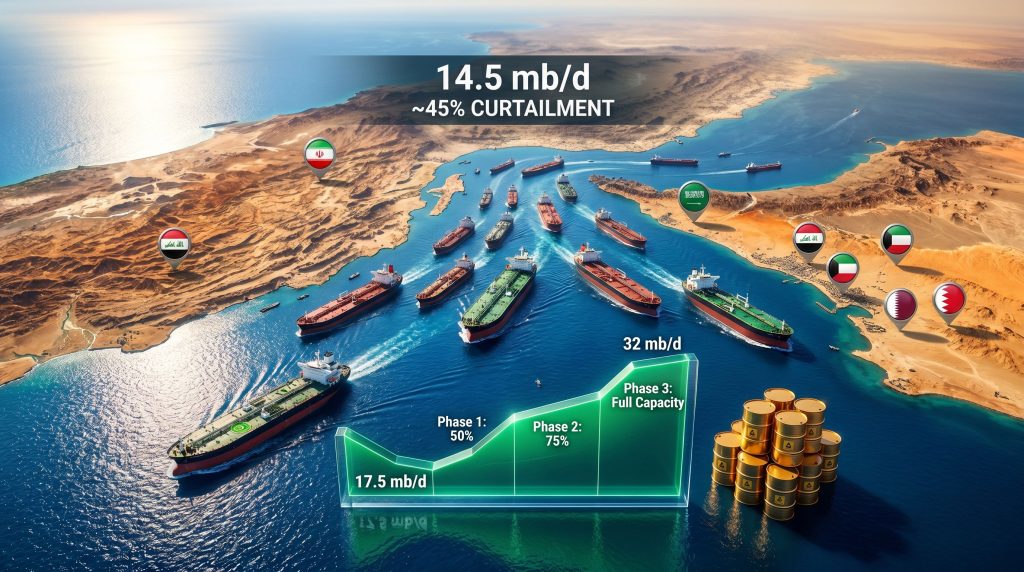
The Strait of Hormuz is not merely a geographic feature. It is the single most consequential pressure point in the global oil system, a 33-kilometre-wide navigable channel through which, under normal conditions, roughly 15% of total world oil production flows daily. Seven producing nations — Saudi Arabia, Iraq, Iran, the UAE, Kuwait, Qatar, and Bahrain — have no meaningful export alternative that can match the volume capacity of this route. Their combined pre-conflict output stood at approximately 32 million barrels per day (mb/d), making the Persian Gulf the undisputed centre of gravity for global crude supply.
When big ASX news breaks, our subscribers know first
Why the 2026 Closure Is Unlike Any Previous Oil Supply Shock
Historical Comparisons Reveal a Structural Difference
To understand the recovery potential, it helps to benchmark this event against every comparable disruption in the modern era. Consequently, crude oil price trends have already shifted markedly in response to the scale of this closure — far beyond anything seen in recent decades.
| Supply Disruption Event | Primary Cause | Duration | Estimated Output Loss |
|---|---|---|---|
| Kuwait Oil Well Fires (1991) | Gulf War sabotage | ~9 months | ~2 mb/d |
| Venezuelan Oil Strike (2002–2003) | Worker strike | ~2 months | ~3 mb/d |
| Libyan Civil War (2011) | Armed conflict | ~12 months | ~1.6 mb/d |
| Hormuz Closure (2026) | Geopolitical conflict | 100+ days (ongoing) | ~14.5 mb/d |
The numbers alone are striking, but the qualitative differences matter even more than the quantitative ones. During the closure period, collective output from Persian Gulf producers fell from approximately 32 mb/d to roughly 17.5 mb/d, a curtailment of approximately 45%, according to International Energy Agency data. This 14.5 mb/d production gap exceeds the total daily crude output of every non-OPEC producer in the Western Hemisphere combined.
The defining characteristic of the 2026 closure that separates it from every historical precedent is not its scale, but its managed nature. Unlike Kuwait in 1991, where deliberate sabotage left hundreds of wells burning for months, Persian Gulf producers in 2026 engineered a controlled, orderly shutdown specifically designed to preserve restart capability.
Three structural distinctions define this closure:
- No infrastructure destruction: Unlike the Kuwait scenario, oilfield assets including wellheads, gas-oil separation plants, storage terminals, and export pipelines have emerged with minimal structural damage.
- No disorderly shutdown: Unlike Venezuela's 2002 worker strike, where wells were shut abruptly over hours and sustained mechanical damage as a result, producers here managed a deliberate, phased wind-down.
- No active combat in oilfields: Unlike Libya in 2011, Persian Gulf oilfields were not battlegrounds, meaning maintenance engineers continued working throughout the closure period.
The Operational Preservation Strategy That Markets Are Underestimating
Keeping the Industry Warm, Not Cold
The single most underappreciated factor in the Strait of Hormuz reopening and oil supply recovery equation is what petroleum engineers have been doing during the closure period itself. Rather than simply switching off production and walking away, operators across the region deployed a sophisticated set of well management techniques designed to compress the eventual restart timeline.
Senior industry executives with direct knowledge of Gulf operations have characterised the approach as keeping the industry in a warm, rather than cold, state throughout the shutdown, with the deliberate goal of preserving mechanical and reservoir integrity pending a return to normal operations.
The specific techniques employed include:
- Rotational shutdown cycles: Wells were taken offline in staggered sequences, ensuring no individual well remained dormant for extended periods.
- Minimum flow maintenance: Rather than cutting output to zero, operators throttled production to minimal levels across many wells, maintaining just enough flow to prevent pressure loss, clogging, and reservoir damage.
- Prioritised well selection: Engineering teams systematically identified which wells posed the greatest restart risk if left dormant, and ensured those specific assets remained in continuous, if minimal, operation.
- Continuous maintenance access: Because oilfields were not active combat zones, routine engineering work, inspections, and preventative maintenance continued uninterrupted throughout the closure period.
Importantly, output never fell to zero across the region as a whole. Furthermore, Saudi Arabia and the UAE maintained partial flows using bypass pipeline infrastructure, while all producers sustained enough domestic production to meet internal energy demand. This operational continuity is precisely why industry insiders hold considerably more optimistic views on recovery speed than public market pricing currently implies.
The Phased Recovery Model: What the Data Actually Suggests
Bears vs. Bulls: A Market Sharply Divided
The energy trading community is deeply divided on how quickly supply can normalise following the Strait of Hormuz reopening and oil supply recovery. Understanding the range of views and their underlying assumptions is critical for investors and analysts attempting to model price trajectories. In addition, OPEC's market influence over production quotas adds a further layer of complexity to the recovery outlook.
| Perspective | Estimated Recovery Timeline | Key Assumptions |
|---|---|---|
| Optimistic (Bear on prices) | Days to weeks for initial surge; months for full capacity | Infrastructure intact; orderly shutdown; tankers pre-positioned |
| Consensus/Moderate | 1–2 months for normalised flow; late 2026 for stabilisation | Some bottlenecks; congestion clearing required |
| Pessimistic (Bull on prices) | 6–12 months; some wells may never restart | Assumes hidden infrastructure damage; reservoir complications |
| EIA Base Case | Late 2026–early 2027 for full trade pattern restoration | Accounts for inventory rebuild and demand adjustment |
Based on available operational intelligence and infrastructure assessments, the most analytically defensible scenario follows a phased trajectory:
- Phase 1 (Days 1–14 post-reopening): Approximately 50% of regional production capacity returns online as the most operationally ready wells resume output and initial tanker loading begins.
- Phase 2 (Weeks 2–6): Output climbs to approximately 75% of pre-conflict levels as secondary wells complete restart sequences and tanker logistics normalise across the strait.
- Phase 3 (Months 2–6): Full production capacity becomes technically achievable, though prevailing market demand conditions may not require it.
A critical and widely overlooked nuance shapes this entire recovery equation: Persian Gulf producers were not operating at full capacity even before the conflict began. Saudi Arabia, for instance, holds nameplate capacity of 12.5 mb/d but was producing only 10.4 mb/d, approximately 83% of capacity, due to OPEC+ quota constraints. This means a complete return to full capacity is not required to restore global supply-demand balance.
The Tanker Positioning Problem Is Less Severe Than Assumed
55 Supertankers, 110 Million Barrels of Ready Capacity
One of the most widely cited obstacles to a rapid supply recovery is tanker availability. Conventional market wisdom holds that vessels have been diverted to alternative trade routes during the closure, leaving insufficient shipping capacity near the Persian Gulf. However, the operational reality is considerably more encouraging.
Frontline Plc, one of the world's leading supertanker operators, has confirmed that approximately 55 large crude carriers are currently positioned empty within three to five days of navigation from the Strait of Hormuz. This pre-positioned fleet represents roughly 110 million barrels of transport capacity. According to recent analysis of the Hormuz oil flow recovery, the logistics picture is more favourable than many price models currently assume.
These vessels are not sitting idle by accident. According to Frontline's Chief Executive Officer Lars Barstad, the ships are contracted to major industrial buyers including refiners and oil majors — companies that have deliberately absorbed the opportunity cost of keeping vessels near Hormuz rather than deploying them on alternative routes. At prevailing charter rates of up to $100,000 per day per vessel, this represents a substantial, deliberate financial commitment to maintain logistics optionality.
The Two-Phase Assumption Is Wrong
A widely circulated assumption among market commentators holds that tanker traffic would resume in a sequential two-phase operation: laden vessels departing first, followed by empty ships entering to load. Operational logistics analysis suggests this model is incorrect.
The more likely scenario involves laden and ballast tankers moving simultaneously, with the most risk-tolerant shipowners leading the initial convoy. Historically, entrepreneurial vessel owners have been the first movers in post-conflict maritime reopenings, with more conservative operators following once the proof-of-concept is established. Greek independent shipowners, with a long history of operating in high-risk maritime environments, are particularly expected to be among the first movers.
War risk insurance availability is not the constraint markets have assumed. Coverage is currently accessible from multiple underwriters at commercially viable premium levels. The primary gating factor is not insurance but diplomatic confidence — specifically, market certainty that any US-Iran framework governing the strait will hold over time.
Bypass Pipelines: A Pressure Valve, Not a Solution
The Infrastructure That Partially Softened the Blow
Not all Persian Gulf crude exports are exclusively dependent on Hormuz transit. Two significant bypass pipeline systems have provided partial alternative routing throughout the closure period:
- Saudi Arabia's East-West Pipeline (Petroline): Approximately 5 mb/d of capacity, routing crude from the Eastern Province to the Red Sea port of Yanbu, entirely circumventing the strait.
- UAE's Abu Dhabi Crude Oil Pipeline (ADCOP): Approximately 1.5 mb/d of capacity, terminating at the port of Fujairah on the Gulf of Oman, also bypassing Hormuz entirely.
Combined, these systems offer roughly 6–7 mb/d of bypass capacity. That figure sounds substantial until it is measured against the approximately 17–20 mb/d that would normally transit Hormuz under pre-conflict conditions. Bypass infrastructure has functioned as a pressure valve, helping sustain minimum export revenues and domestic energy security, but it cannot come close to replacing strait access as the primary export artery.
The next major ASX story will hit our subscribers first
How Oil Prices Will Respond: A Multi-Stage Framework
The Price Recovery Will Not Be a Single Event
The oil price response to the Strait of Hormuz reopening and oil supply recovery will unfold across multiple stages, driven by the interaction of physical supply flows, futures market positioning, inventory dynamics, and investor psychology. Moreover, the oil price volatility experienced throughout the closure period has already reshaped commodity hedging strategies across the industry.
Stage 1: Announcement Effect
Futures markets will begin pricing in supply recovery before a single additional barrel reaches a refinery. Historical analogues from post-conflict maritime reopenings suggest an immediate downward price correction in the range of 10–20% upon credible diplomatic confirmation, as short positions accumulate and risk premiums compress rapidly.
Stage 2: Physical Flow Normalisation (Weeks 1–8)
As tankers begin loading and initial production volumes reach refineries, spot market differentials between crude grades will compress. The U.S. Energy Information Administration projects that oil prices will begin easing as flows gradually resume in the second half of 2026. Notably, the IEA has warned that export recovery will take months rather than weeks to fully materialise.
Stage 3: Inventory Rebuild (Months 3–12)
Global commercial inventories drawn down significantly during the closure will require sustained above-demand production to rebuild. The EIA projects that full inventory normalisation and a return to pre-conflict price structure may extend into late 2026 or early 2027.
Demand Destruction Has Already Shifted the Equilibrium
An important structural point frequently missed in supply-focused analysis is that the demand side of the equation has already adjusted materially during the closure period:
- Elevated oil prices have suppressed global demand growth, particularly in price-sensitive emerging markets across Asia and Africa.
- Non-Middle Eastern producers including the United States, Brazil, and Canada have meaningfully increased output in response to higher prices, partially filling the supply gap.
- The combination of demand destruction and non-OPEC supply growth means Persian Gulf production does not need to return to pre-conflict levels to restore global supply-demand balance.
The Diplomatic Architecture Required for Full Reopening
Politics, Not Engineering, Is the Binding Constraint
The physical reopening of the Strait of Hormuz is fundamentally a political event. The operational infrastructure is largely intact, the tankers are positioned, and the engineering teams are ready. What is missing is the diplomatic framework.
Key prerequisites for a functioning reopening include:
- A formal US-Iran agreement, likely structured as a memorandum of understanding, providing legal and security guarantees for commercial shipping.
- A defined transition timeline, with industry analysis suggesting a 30-day normalisation window back to pre-conflict shipping volumes as a workable framework.
- Resolution of unresolved jurisdictional questions, including which shipping lanes commercial vessels would use, whether Iran would levy transit fees, and what verification mechanisms would underpin market confidence in deal compliance.
The first tanker convoy to successfully transit the strait post-agreement will function as the single most important proof-of-concept signal for financial markets. Its safe passage will be the catalyst that triggers broader fleet mobilisation, compresses war risk premiums, and accelerates the production ramp-up across the region.
Long-Term Structural Implications for Global Energy Security
The Lessons That Will Reshape Investment and Policy
The 2026 Hormuz closure will leave a durable imprint on how energy policymakers, oil companies, and large consuming nations approach supply chain risk. Several structural changes are likely to accelerate, and energy transition pressures will further reinforce the case for diversifying away from single-chokepoint dependency.
- Strategic reserve policy revision: The rapid drawdown of strategic petroleum reserves during the closure will drive policy discussions around reserve adequacy targets and mandatory replenishment timelines in major consuming nations.
- Bypass infrastructure investment: Producing nations and transit states are likely to significantly accelerate investment in Hormuz-bypass pipeline capacity, with Saudi Arabia and the UAE both having strong economic incentives to reduce chokepoint dependency.
- Pre-positioning as standard practice: The strategy of keeping empty tankers near chokepoints at significant opportunity cost is likely to become institutionalised as a standard risk management tool for major oil buyers and refiners.
- Accelerated energy diversification: Consuming nations will face renewed political pressure to reduce Persian Gulf supply dependency, reinforcing existing investment rationales for domestic production capacity.
The OPEC+ Re-Entry Problem
One underappreciated post-reopening risk involves the challenge of reintegrating Persian Gulf production back into the OPEC+ quota framework. Producers that curtailed output under conflict conditions will need to negotiate re-entry — a process that creates its own incentive structures and political tensions.
The risk of a disorderly production ramp-up, with individual nations prioritising near-term revenue recovery over collective supply discipline, represents a meaningful downside scenario for oil price stability in the months immediately following reopening. Furthermore, commodity hedging strategies employed by large buyers will need to be revised substantially as physical flows normalise. History suggests that OPEC cohesion tends to weaken precisely when individual member finances are most stressed, which is exactly the condition all Persian Gulf producers will face upon return to normal operations.
Disclaimer: This article contains forward-looking projections, scenario analysis, and third-party forecasts including EIA base case estimates. These do not constitute financial advice. Oil market outcomes depend on geopolitical, diplomatic, and operational variables that remain highly uncertain. Readers should conduct independent research before making any investment decisions.
Want to Position Yourself Ahead of the Next Major Resource Discovery?
While geopolitical events like the Strait of Hormuz closure reshape global commodity markets, Discovery Alert's proprietary Discovery IQ model scans ASX announcements in real time, instantly identifying significant mineral discoveries and delivering actionable insights directly to subscribers — explore historic discoveries and their returns to understand the scale of opportunity, then begin a 14-day free trial at Discovery Alert to secure a market-leading edge before the broader market catches on.