June 13, 2026
The Structural Fault Lines Beneath Europe's Recycling Ambitions
Circular economy rhetoric has become a fixture of industrial policy across Europe, yet the aluminium sector reveals a troubling gap between stated ambition and operational reality. The popular narrative positions recycled aluminium as a near-complete solution to decarbonisation and resource security challenges. The less comfortable truth is that collection statistics and genuine circularity are not the same thing, and conflating them has allowed structural weaknesses to compound quietly beneath impressive headline figures.
Understanding Europe aluminium recycling challenges requires moving past recycling rate percentages and into the mechanics of where material actually goes, what condition it arrives in, and whether domestic infrastructure can absorb it at the quality and volume required. On all three counts, the system is under pressure. Furthermore, global aluminium market pressures are intensifying the urgency of addressing these systemic gaps before they become irreversible.
When big ASX news breaks, our subscribers know first
Why High Collection Rates Do Not Equal a Circular System
Europe maintains recycling rates above 80% across key aluminium sectors including automotive, packaging, and construction. At face value, this is a genuine achievement. However, the distinction between collection rate and true circular retention is one of the most underappreciated nuances in the entire aluminium industry debate.
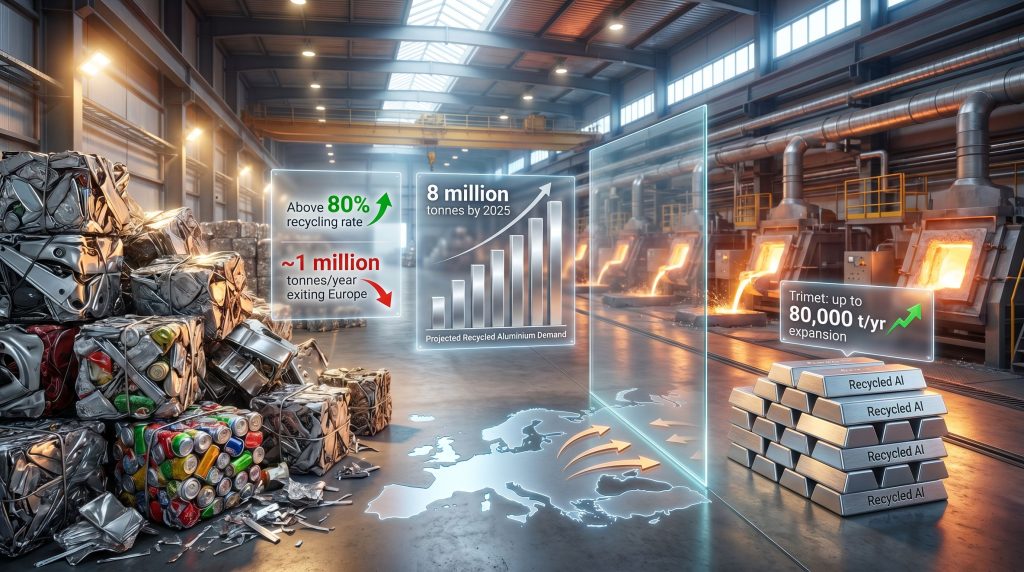
Recycling rate figures capture material that has been collected and processed. They do not necessarily capture whether that material remains within European industrial systems or has been exported to Asia, where it may be reprocessed under far less stringent environmental conditions. Approximately 1 million tonnes of aluminium scrap leaves Europe each year, and scrap exports have surged 66% since 2014.
This means Europe is simultaneously reporting strong recycling performance and hollowing out the feedstock base that its own remelters, secondary producers, and downstream manufacturers depend upon. The implication is counterintuitive but important: Europe may be collecting aluminium efficiently while recycling it ineffectively from an industrial sovereignty perspective. The metal is being recovered, but not necessarily retained where the economic and environmental value can be captured.
Critical Distinction: A nation can achieve an 80%+ collection rate while still undermining its own circular economy objectives if the collected material is exported before domestic value capture occurs. Collection is a precondition for circularity, not a substitute for it.
What Is Making Aluminium Scrap Harder to Recycle in Europe?
The Contamination and Alloy Mixing Problem
Not all aluminium scrap is created equal. The recycling industry operates across a spectrum of alloy types, and the mixing of incompatible alloys is one of the most technically challenging problems facing European remelters. Impurities including iron, silicon, copper, and magnesium become embedded within mixed-alloy scrap streams over time, degrading the quality of recovered metal and restricting the range of applications it can serve.
The most commercially significant consequence of this mixing problem is the contamination of wrought alloy streams with casting alloy material. Wrought alloys, used in aerospace, automotive body panels, and high-precision structural components, require very specific elemental compositions. Once contaminated with casting alloy content, the material can no longer re-enter those high-value applications without costly refining steps. The challenges of aluminium recycling at the technical level are well documented, yet investment in solutions has lagged significantly behind the scale of the problem.
End-of-Life Vehicle Streams: A Growing Complexity Problem
The automotive sector sits at the centre of this challenge. It is both the largest consumer of secondary aluminium in Europe and one of the most complex generators of mixed-alloy scrap. Germany's automotive industry alone accounts for close to half of domestic secondary aluminium demand, yet achieving effective alloy segregation at the end-of-life vehicle stage remains technically and economically difficult at scale.
The problem is set to intensify. Europe's automotive fleet electrification is driving aluminium consumption upward, with demand projected to reach 4.2 million tonnes per year by 2030. Electric vehicles contain significantly more aluminium than combustion-engine equivalents, particularly in battery enclosures, structural components, and thermal management systems. As these vehicles eventually reach end-of-life, the scrap streams they generate will be more complex, not less.
Sorting Technology Gaps and Remelting Capacity Shortfalls
| Challenge | Current Status | Impact on Circularity |
|---|---|---|
| Advanced alloy sorting | Underdeveloped across many EU regions | Limits wrought alloy recovery rates |
| Remelting capacity | Insufficient for projected 2030 demand volumes | Creates structural feedstock bottlenecks |
| Low-grade scrap processing | Often economically unviable without support | Drives material toward export channels |
| Collection enforcement | Inconsistent across EU member states | Reduces total recoverable domestic volume |
The technology gap in alloy sorting is particularly consequential. Sensor-based sorting systems, including X-ray fluorescence and laser-induced breakdown spectroscopy, can theoretically distinguish between alloy families with considerable precision. In practice, deployment of these technologies is patchy across the EU, concentrated in well-capitalised facilities in Germany and Scandinavia while remaining largely absent in lower-income member states where enforcement and investment incentives are weaker.
How Significant Is Europe's Aluminium Scrap Export Problem?
The Economic Logic Behind Outbound Scrap Flows
Understanding why scrap leaves Europe requires acknowledging the straightforward economic pressures on domestic remelters. European electricity prices create a structural cost disadvantage when competing against lower-cost processors in Asia. International buyers, particularly from Asian markets, frequently outbid domestic processors for high-quality scrap because they face lower operating costs and can absorb higher raw material prices while still maintaining margin.
The absence of robust export restriction mechanisms means market forces consistently override circular economy objectives. Scrap traders operate rationally within the incentive structures available to them. Without policy levers that alter those incentives, expecting the private sector to voluntarily forgo higher export prices in favour of domestic supply chains is unrealistic.
Policy Gap: Europe has developed sophisticated domestic recycling frameworks, but the absence of effective scrap retention mechanisms means that circularity gains achieved through improved collection can be directly offset by increased primary aluminium production in the countries receiving that exported scrap.
The UK's Strategic Resource Reframing
The United Kingdom's aluminium industry has adopted a more confrontational framing of this issue, calling for aluminium scrap to be formally reclassified not as a commodity waste product but as a strategic industrial resource. This distinction carries significant policy implications, including potential export licensing requirements, strategic reserve mechanisms, and priority access frameworks for domestic processors.
The UK debate reflects a broader shift across industrial policy thinking globally, where resource sovereignty, supply-chain resilience, and long-term industrial competitiveness are increasingly viewed as national security considerations rather than purely economic ones. Shifting global trade flows are already creating acute supply risks for British remelters and downstream manufacturers, giving urgency to what had previously been a theoretical policy discussion.
How Is Europe's Regulatory Framework Shaping the Recycling Landscape?
CBAM: Carbon Accountability Enters the Aluminium Supply Chain
The EU's Carbon Border Adjustment Mechanism represents the most structurally significant regulatory intervention in European aluminium markets in a generation. From 2028, CBAM is set to expand to approximately 180 downstream aluminium-intensive products, shifting compliance demands from metal supply to embedded carbon verification across entire supply chains.
For aluminium exporters targeting European markets, this means the competitive game is changing. It is no longer sufficient to supply compliant metal at competitive prices. Exporters must now demonstrate, through verifiable data and auditable reporting systems, the precise carbon footprint embedded in every tonne of aluminium across the value chain. The EU metals action plan also reinforces this direction, aligning carbon accountability with broader industrial resilience objectives.
The Carbon Leakage Loophole Problem
European Aluminium has formally raised concerns that the current CBAM framework contains structural loopholes that leave the sector exposed to carbon leakage despite the mechanism's design intent. The concern centres on the ability of carbon-intensive aluminium products to enter European markets through downstream product categories not yet covered under CBAM's scope.
EU finance ministers are under pressure to finalise a revised CBAM position that closes these gaps before the 2028 expansion takes effect. For European producers investing capital in low-carbon recycling capacity today, an unresolved loophole problem creates a genuine competitive risk: they bear the cost of decarbonisation while facing competition from imports that do not carry equivalent carbon costs.
What Effective Scrap Policy Would Need to Include
- Export licensing or restriction mechanisms to retain high-quality scrap within EU borders rather than allowing it to flow to the highest international bidder
- Mandatory alloy segregation standards at collection and early processing stages to preserve the value of wrought alloy streams
- Investment incentives for advanced sorting technology, alloy identification systems, and expanded remelting capacity at the regional level
- Harmonised collection enforcement across all EU member states to eliminate the performance gap between high-performing and low-performing regions
Which Industries and Companies Are Responding to Europe's Recycling Challenges?
Germany: Secondary Aluminium Infrastructure at Scale
Germany's secondary aluminium sector stands as Europe's most developed, underpinned by high beverage can collection rates, extensive remelting infrastructure, and a dominant automotive sector that creates consistent demand for recycled feedstock. The automotive industry's near-50% share of secondary aluminium demand in Germany provides both scale and strategic importance to the recycling system, though it also creates complexity given the alloy mixing challenges inherent in end-of-life vehicle streams.
Trimet, a German aluminium producer, has announced capacity expansions across facilities in Hamm, Gelsenkirchen, and Essen, targeting an increase of up to 80,000 tonnes per year in recycled aluminium output. The Gelsenkirchen expansion specifically involves the installation of new melting units at an existing recycling plant. This investment represents one of the most concrete responses to feedstock security concerns from a European producer, demonstrating that capital is beginning to flow toward the infrastructure gap.
Toyota's European-First Closed-Loop Model
Toyota Motor Manufacturing UK has established what the company describes as a European-first closed-loop aluminium recycling system at its Burnaston facility in Derbyshire, England. The system recovers aluminium from end-of-life vehicles and reintegrates it directly into new hybrid vehicle component production, bypassing the open-market scrap trading system that creates export leakage risks.
This model demonstrates that automotive-grade closed-loop recycling is technically achievable. The challenge, and it is a significant one, is scaling this approach across the broader European automotive sector, where supply chains are fragmented, end-of-life vehicle collection is dispersed, and alloy segregation requirements add cost and complexity at every stage. In addition, an aluminium recycling joint venture model, such as that being pursued by Alcoa and its partners, illustrates how collaborative industrial structures can help overcome the scale barriers that individual operators struggle to clear alone.
Packaging Sector: Measurable Carbon Reduction in Practice
Elopak, a paper-based packaging manufacturer, has begun using low-carbon aluminium produced with renewable electricity at facilities in the Netherlands, Denmark, and Ukraine. The practical result is a reduction in the carbon footprint of its standard aseptic Pure-Pak carton from 53 grams to 49 grams of CO₂ on a cradle-to-gate basis, representing a reduction of approximately 8%.
This example is instructive beyond the specific numbers. It illustrates how downstream manufacturers are beginning to embed low-carbon aluminium sourcing into product-level sustainability commitments rather than treating it as an abstract corporate goal. As more downstream producers make similar commitments, the commercial premium available to low-carbon aluminium suppliers strengthens, which in turn improves the economics of domestic recycling investment.
Rio Tinto's Global Low-Carbon Positioning
While not a European operation, Rio Tinto's strategic direction provides important context for the competitive environment European recyclers must navigate. The company is advancing a USD 1.5 billion project to expand a low-carbon aluminium operations site in Quebec, Canada, targeting growing global demand for green aluminium. Simultaneously, Rio Tinto is deploying automated drill rigs with data-driven operational systems to improve mining efficiency and reduce costs across its existing operations.
These moves signal that global majors are investing heavily in the low-carbon positioning that European buyers are increasingly demanding. European recyclers who fail to close the infrastructure and quality gaps may find themselves competing not just against each other but against well-capitalised global producers with hydropower cost advantages and significant capital behind their decarbonisation strategies.
The next major ASX story will hit our subscribers first
What Role Does Energy Play in Europe's Aluminium Recycling Competitiveness?
Electricity Cost as a Structural Disadvantage
Recycled aluminium requires only a fraction of the energy needed for primary production, making it inherently more energy-efficient and lower in carbon intensity. Despite this fundamental advantage, European electricity prices still create margin pressure for domestic remelters. Hydropower-rich regions such as Norway and Canada hold a structural cost advantage that no amount of operational efficiency can fully offset within the current energy pricing environment.
Coal-dependent aluminium producers globally face mounting decarbonisation pressure, but the transition is complicated by renewable intermittency, grid stability constraints, and storage technology limitations. A genuinely balanced energy mix remains critical for the industry's medium-term future, with recycled aluminium positioned as one of the most effective near-term tools for reducing energy consumption per tonne of metal produced.
Geopolitical Energy Risks Affecting the Broader Ecosystem
Escalating tensions in West Asia are creating ripple effects through the renewable energy supply chain in ways that directly affect aluminium market dynamics. Solar cell prices have risen by as much as 35% since early 2025, driven by higher aluminium, copper, and petrochemical input costs alongside supply-chain disruption. Overall solar project costs have increased by approximately 20%, creating downstream pressure on renewable energy deployment timelines.
For Europe's aluminium recycling sector, which depends on affordable renewable electricity to maintain its low-carbon credentials and cost competitiveness, energy market volatility represents an ongoing systemic risk. This risk operates independently of any policy or infrastructure improvements the industry can control, making it one of the most difficult variables to manage in long-term investment planning. Consequently, major aluminium producers are increasingly factoring energy price exposure into their strategic assessments of where to place recycling infrastructure.
Key Statistics: Europe Aluminium Recycling at a Glance
| Metric | Figure |
|---|---|
| European aluminium recycling rate (key sectors) | Above 80% |
| Projected recycled aluminium demand by 2025 | ~8 million tonnes |
| Aluminium scrap export surge since 2014 | 66% increase |
| Annual scrap leaving Europe (estimated) | ~1 million tonnes |
| Automotive aluminium demand by 2030 (Europe) | 4.2 million tonnes/year |
| Germany's automotive share of secondary aluminium demand | ~50% |
| Trimet capacity expansion (Hamm, Gelsenkirchen, Essen) | Up to 80,000 tonnes/year |
| Elopak carton CO₂ reduction via low-carbon aluminium | ~8% (53g to 49g per carton) |
| CBAM downstream product expansion target year | 2028 |
| Solar project cost increase from supply-chain disruption | ~20% |
| Solar cell price increase since early 2025 | Up to 35% |
| Rio Tinto low-carbon smelter expansion (Quebec) | USD 1.5 billion |
Frequently Asked Questions: Europe Aluminium Recycling Challenges
What is the biggest structural challenge facing aluminium recycling in Europe?
The most significant challenge is the combination of scrap export leakage and alloy contamination. Approximately 1 million tonnes of aluminium scrap leaves Europe annually, reducing domestic feedstock availability at a time when demand for recycled material is growing. Simultaneously, mixed-alloy scrap streams from end-of-life vehicles are difficult and costly to sort, limiting what can be reused in high-value applications without expensive refining interventions.
Why does Europe export so much aluminium scrap if it needs it domestically?
European remelters face high electricity costs and insufficient processing capacity relative to international competitors. Asian buyers frequently offer competitive prices for raw scrap, and without export restrictions or strategic retention mechanisms, market economics consistently favour outbound trade over domestic reprocessing. The incentive structure, rather than any lack of awareness, drives the export behaviour. Indeed, Europe's aluminium recycling industry has highlighted this dynamic repeatedly, with little coordinated policy response to date.
How does CBAM affect aluminium recycling competitiveness in Europe?
CBAM creates a carbon cost signal that should, in principle, favour low-carbon and recycled aluminium in European supply chains. However, current framework gaps mean carbon-intensive aluminium can still enter through downstream product categories not yet under CBAM's scope, undermining the level playing field that domestic recyclers need to justify capital investment in new processing infrastructure.
Which European country has the strongest aluminium recycling system?
Germany is widely regarded as having the most developed secondary aluminium infrastructure in Europe, with high collection rates for beverage cans and packaging, extensive remelting capacity, and a large automotive sector that drives consistent secondary aluminium demand. Scandinavian countries also perform strongly, particularly in renewable energy-powered remelting operations where hydropower availability reduces both cost and carbon intensity.
Building a Resilient European Aluminium Circular Economy
Europe possesses the recycling ambition, the regulatory architecture in development, and the industrial capability to construct a genuinely circular aluminium system. The missing elements are not technological possibilities but rather policy completeness, infrastructure scale, and the political will to treat aluminium scrap as a resource to be retained rather than a commodity to be traded away.
The three pillars that a resilient system requires are clear: scrap retention policy that reclassifies high-quality aluminium scrap as a critical industrial input; infrastructure investment that closes the sorting, segregation, and remelting capacity gaps evidenced by Trimet's expansion and Toyota's closed-loop model; and regulatory coherence that eliminates CBAM loopholes and harmonises collection standards across all EU member states.
The cost of inaction is not theoretical. Every tonne of high-quality scrap that leaves Europe represents a tonne of low-carbon feedstock that must be replaced by primary aluminium, increasing emissions, increasing energy consumption, and increasing dependence on supply chains that Europe has limited ability to control. The circular economy argument for aluminium is not just environmental — it is strategic, and Europe's industrial competitiveness in the decades ahead may depend on how quickly that distinction is acted upon.
This article is intended for informational purposes only and does not constitute financial or investment advice. Figures relating to market forecasts, demand projections, and price movements are subject to change and should be independently verified before being relied upon for commercial or investment decisions.
Want to Stay Ahead of the Next Major ASX Mineral Discovery?
While Europe grapples with aluminium supply chain vulnerabilities and resource sovereignty, savvy investors are positioning themselves at the front of the market through Discovery Alert's proprietary Discovery IQ model, which delivers real-time notifications on significant ASX mineral discoveries — explore the historic returns major discoveries have generated and begin your 14-day free trial at Discovery Alert to secure your market-leading advantage.