July 15, 2026
The Ocean Floor as a Strategic Frontier: Why Deep-Sea Robotics Is Rewriting the Critical Minerals Playbook
The global race for critical minerals has largely been framed around land-based geology, diplomatic trade agreements, and mine permitting timelines. But a quieter, more technically demanding competition has been unfolding several kilometres below the ocean's surface, where vast deposits of polymetallic nodules sit largely untouched on the abyssal plains. For investors and industrial strategists paying close attention, the emergence of AI-guided autonomous underwater vehicles (AUVs) as a credible recovery mechanism is beginning to reshape assumptions about where tomorrow's battery metals will actually come from.
It is within this context that the Impossible Metals Pittsburgh marine robotics hub announcement carries significant weight. Not merely as a real estate decision or a hiring milestone, but as a signal that deep-sea critical mineral recovery is graduating from theoretical ambition to operational infrastructure.
When big ASX news breaks, our subscribers know first
Critical Minerals, China, and the Supply Chain Vulnerability Driving Private Capital Into the Deep Ocean
Understanding why a Nevada-based marine technology company would establish an advanced engineering centre in a landlocked Pennsylvania city requires stepping back to examine the structural forces shaping Western industrial policy. The concentration of critical mineral processing capacity in China is not a recent development. Over several decades, China has systematically built dominance across the refining and processing stages of cobalt, manganese, nickel, and copper supply chains. This creates a vulnerability that extends well beyond procurement costs.
For manufacturers of electric vehicles, defense electronics, grid storage systems, and renewable energy infrastructure, dependence on Chinese-controlled processing introduces strategic fragility at precisely the point where critical minerals demand is accelerating most aggressively. Analysts broadly agree that land-based mining production, even with aggressive new project development, faces a structural lag in meeting projected demand growth through the 2030s. Permitting timelines, community opposition, ore grade depletion at existing operations, and capital intensity all constrain how quickly the terrestrial mining sector can respond.
This is where polymetallic nodules enter the strategic calculus in a compelling way. These naturally occurring mineral formations, roughly the size and shape of a potato, accumulate on the deep ocean floor over millions of years. They contain commercially significant concentrations of nickel, cobalt, copper, and manganese within a single formation type. Crucially, the total mineral content locked within known nodule fields is understood to substantially exceed the combined measured reserves of these materials across all land-based deposits combined, many times over. That single fact fundamentally changes the long-term resource security equation.
What the Impossible Metals Pittsburgh Marine Robotics Hub Actually Is
Impossible Metals, which emerged from the Y Combinator W22 cohort before focusing its engineering resources on deep-ocean mineral recovery, announced plans in July 2026 to establish its Advanced Marine Robotics Hub in Pittsburgh. The facility is designed to function as the central development engine for the company's next generation of autonomous underwater systems.
The hub will bring together a multidisciplinary team spanning three core technical domains:
- Roboticists specialising in autonomous systems architecture and mechanical design
- Autonomy engineers focused on AI-guided decision-making in complex, low-visibility subsea environments
- Marine systems specialists with expertise in deep-ocean operational challenges including pressure tolerance, communications, and navigation
The initial workforce commitment covers more than a dozen high-paying engineering and science positions, with the expectation that headcount will scale in parallel with the company's commercial programme. Beyond direct employment, Impossible Metals has outlined an academic engagement model involving collaborative research with faculty at local universities, practical engineering opportunities for students, and potentially an annual robotics competition structured around real-world challenges in ocean autonomy and responsible mineral recovery.
The hub announcement was made at the Pennsylvania Defense and Innovation Summit, a venue that signals alignment with state-level priorities around defense technology and innovation ecosystems, though no specific government funding or formal project designation has been confirmed.
The Technology Stack Being Developed in Pittsburgh
The Pittsburgh facility will advance several interconnected technology platforms that collectively define Impossible Metals' approach to seabed mineral recovery:
| Technology Platform | Core Function | Strategic Purpose |
|---|---|---|
| Eureka Autonomous Underwater Platform | AI-guided individual nodule collection | Precision extraction without seabed dredging |
| Smart Launch and Recovery Systems | Surface-to-seabed deployment logistics | Scalability across open-ocean environments |
| Swarm Robotics Architecture | Parallel multi-unit autonomous harvesting | High throughput with low ecosystem disturbance |
| Dual-Use Naval Capabilities | Subsea autonomy for defense applications | National security and maritime domain awareness |
Why Pittsburgh? The Structural Logic Behind a Landlocked Marine Technology Centre
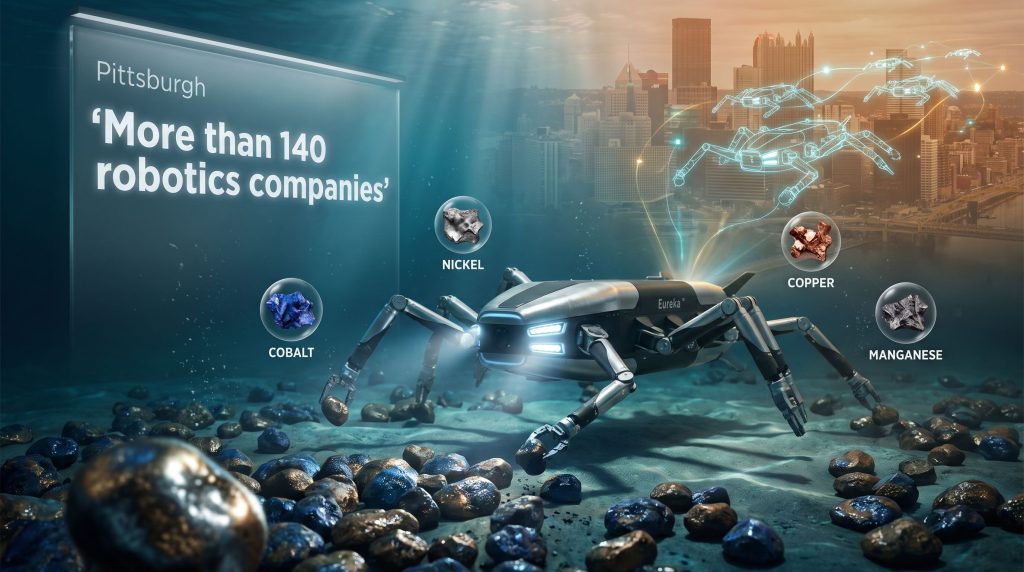
The apparent paradox of building an ocean technology hub far from any coastline dissolves quickly when Pittsburgh's robotics ecosystem is examined carefully. The city hosts more than 140 robotics companies and has a university research infrastructure widely credited with establishing the academic and commercial foundations of modern robotics as a discipline. Carnegie Mellon University's robotics institute, in particular, has been a generational producer of autonomous systems talent and foundational research that underpins commercial robotics globally.
Pittsburgh is also rapidly emerging as a national concentration point for defense autonomy development and what practitioners increasingly refer to as physical AI, the branch of artificial intelligence concerned with machines that perceive and act within the physical world rather than purely digital environments. For a company developing AI-guided robots that must navigate, identify, and selectively retrieve objects on the deep ocean floor, this talent ecosystem is directly applicable, regardless of proximity to salt water.
The core engineering challenges of deep-sea autonomous operation, perception under optical and acoustic constraints, real-time decision-making without surface communication, and manipulation of irregularly shaped objects in an unstructured environment, are fundamentally robotics problems. Pittsburgh's talent density addresses these challenges directly.
The university partnership strategy also reflects an understanding that the workforce required for commercial-scale deep-sea robotics does not yet exist at sufficient depth in any single geography. Building a recruitment and training pipeline through academic collaboration is a long-term play that positions the company to scale its technical team as the commercial programme matures.
How the Eureka System Works: Precision Over Volume
Most public discussion of seabed mining defaults to imagery of industrial-scale hydraulic dredging, a method that indiscriminately lifts large volumes of sediment along with target materials, generating sediment plumes with documented effects on benthic ecosystems extending significant distances from extraction sites. The deep-sea mining controversy surrounding conventional seabed dredging approaches is well established and represents a genuine regulatory and social licence risk for the sector broadly.
The Eureka system operates on a fundamentally different principle. Rather than bulk extraction, it uses AI-guided robotic arms to identify and retrieve individual polymetallic nodules based on positioning and mineral content, leaving the surrounding seabed substrate and its associated ecosystem largely undisturbed. This selective harvesting methodology, sometimes described within the industry as nodule picking as distinct from dredging, represents a meaningful technical departure from conventional approaches.
Key operational characteristics of the Eureka platform include:
- AI-guided visual and sensor identification of individual target nodules on the seabed surface
- Zero-dredge retrieval mechanics that avoid sediment suspension during collection
- Swarm deployment capability where multiple autonomous units operate simultaneously to increase throughput without proportional environmental footprint expansion
The next-generation Eureka III is a 16-arm robotic system currently progressing toward deep-water testing. It represents the bridge between validated proof-of-concept operation and commercially viable mineral recovery rates. The company is targeting commercial readiness around 2027, making the deep-water testing phase of Eureka III a near-term inflection point that investors and industry observers will be tracking closely.
The Minerals at Stake and Their Industrial Significance
The mineral suite contained within polymetallic nodules maps closely onto the materials most critical to both the energy transition and modern defense electronics manufacturing:
| Mineral | Primary Application | Why Supply Security Matters Now |
|---|---|---|
| Nickel | EV battery cathodes, stainless steel | High-grade nickel sulphide deposits in structural decline |
| Cobalt | Lithium-ion cathode chemistry, aerospace alloys | Concentrated in politically complex jurisdictions |
| Copper | Electrical infrastructure, wind and solar systems | Demand growth far exceeds new mine supply pipeline |
| Manganese | Steel production, emerging battery chemistries | Processing heavily concentrated outside Western control |
One dimension that receives insufficient attention in mainstream coverage is the grade consistency of polymetallic nodules relative to land-based ore. Because nodules form through slow accretion processes on the abyssal plain, they tend to exhibit relatively predictable mineral content within a given field, an attribute that simplifies processing planning compared to the grade variability that characterises many terrestrial ore bodies. This geological characteristic, while not eliminating processing complexity, represents a potential operational advantage for companies developing scalable recovery systems.
The Dual-Use Dimension: Where Deep-Sea Robotics Meets National Security
A dimension of the Impossible Metals Pittsburgh marine robotics hub that deserves explicit attention is the dual-use nature of the autonomous underwater technology being developed. Subsea autonomy capable of operating at depth, navigating complex terrain, and executing precise mechanical tasks has direct applications in naval defense, including underwater surveillance, mine countermeasures, infrastructure inspection, and maritime domain awareness. Furthermore, these capabilities place the company squarely within the growing landscape of defense-critical metals and associated technologies that Western governments are prioritising.
This dual-use characteristic creates a structural advantage that distinguishes deep-sea robotics from many other critical mineral investment categories. Technologies with simultaneous civilian and defense procurement pathways are generally more resilient to individual market cycle risks. Commercial mineral recovery and defense applications can provide complementary revenue and development funding streams, reducing dependency on any single pathway to commercialisation.
The selection of the Pennsylvania Defense and Innovation Summit as the announcement venue for the Pittsburgh hub reinforces this dual-use positioning, though it should be noted this reflects strategic alignment of interests rather than confirmed government procurement commitments.
The next major ASX story will hit our subscribers first
Impossible Metals in Competitive Context: What Differentiates the Approach
The deep-sea mining sector encompasses a range of companies with varying technical approaches, regulatory strategies, and commercial timelines. Understanding where Impossible Metals sits within this landscape requires examining the methodological distinctions:
| Dimension | Impossible Metals Approach | Conventional Deep-Sea Mining |
|---|---|---|
| Collection Method | AI-selective individual nodule picking | Bulk hydraulic dredging |
| Environmental Footprint | Minimal seabed disturbance | Significant sediment plume generation |
| Technology Foundation | Autonomous robotics and machine vision AI | Industrial hydraulic lifting systems |
| Regulatory Risk Profile | Designed for lower-impact standards | Subject to increasing international scrutiny |
| Commercial Target | Approximately 2027 readiness | Varies; multiple projects facing regulatory delays |
The sector-wide deep-sea mining regulations remain complex and evolving. The International Seabed Authority governs mineral extraction in international waters, and the legal and environmental framework governing commercial operations continues to develop. Companies whose extraction methodology is specifically designed to minimise ecological disturbance are generally better positioned to navigate this regulatory uncertainty, though no outcome is guaranteed and investors should treat all commercial timeline projections as subject to material change.
Key Strategic Takeaways for Industry Observers
The Impossible Metals Pittsburgh marine robotics hub crystallises several converging trends that extend well beyond a single company announcement:
| Strategic Theme | Broader Implication |
|---|---|
| Critical Mineral Security | AUV-based seabed recovery offers a domestically controllable supply pathway outside Chinese processing networks |
| Defense Technology Convergence | Dual-use subsea autonomy creates multiple development and revenue pathways |
| Workforce Development | Pittsburgh hub anchors a new engineering talent pipeline in a field with no established training infrastructure |
| Environmental Differentiation | Precision robotics positions selective harvesting favourably relative to conventional dredging under emerging ESG frameworks |
| Commercial Milestone Proximity | Eureka III deep-water testing and 2027 commercial readiness target represent near-term validation events |
This article contains forward-looking statements and projections regarding technology development timelines, commercial readiness targets, and market conditions. All such projections are inherently uncertain and should not be interpreted as guarantees of future outcomes. Readers considering investment decisions should conduct independent research and seek qualified financial advice.
Readers seeking further context on deep-sea critical mineral recovery and autonomous underwater vehicle technology can explore ongoing coverage at Mining Weekly via miningweekly.com.
Want to Stay Ahead of the Next Major Critical Minerals Discovery?
Discovery Alert's proprietary Discovery IQ model delivers real-time alerts on significant ASX mineral discoveries across more than 30 commodities, instantly translating complex data into actionable investment insights — explore historic discoveries and their exceptional returns, then begin your 14-day free trial at Discovery Alert to position yourself ahead of the broader market.