
August 5, 2026
When Geopolitics Rewrites Infrastructure Logic: The Red Sea Crude Corridor in 2026
Global oil markets operate on the assumption that established export corridors are stable, predictable, and effectively permanent. That assumption has been comprehensively dismantled in 2026. The escalation of conflict involving the United States, Israel, and Iran beginning in late February triggered disruptions to Strait of Hormuz shipping that have forced Saudi Arabia to compress what would normally be a decade-long infrastructure transition into a matter of weeks. The result is a real-time stress test of one of the world's most strategically significant pieces of energy infrastructure: the Red Sea export system anchored at Saudi Aramco Yanbu port crude shipments infrastructure.
Understanding what is unfolding at Yanbu requires more than tracking daily loading figures. It demands a structural examination of pipeline architecture, terminal physics, crude grade economics, and the cascading vulnerabilities now confronting global buyers dependent on Gulf-origin supply. Furthermore, broader crude oil price trends across 2025 and into 2026 provide essential context for understanding just how dramatically the current disruption has reshaped market dynamics.
When big ASX news breaks, our subscribers know first
Why the East-West Pipeline Was Built for Exactly This Moment
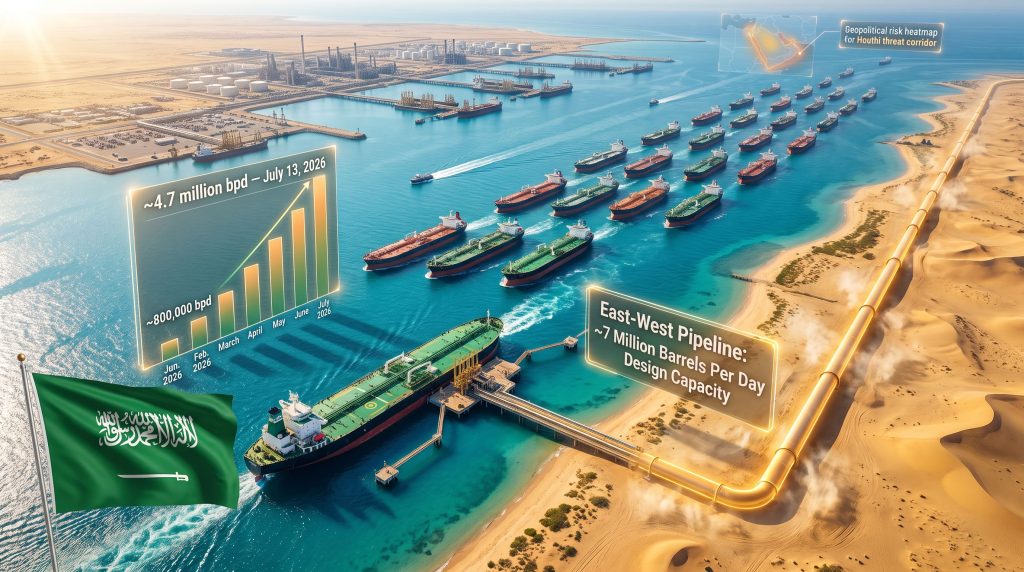
Saudi Arabia's dual-coast export architecture was never an accident of geography. The kingdom deliberately invested in a western corridor precisely because the Strait of Hormuz has always represented a single-point-of-failure risk for its energy revenues. The East-West Pipeline, stretching approximately 1,200 kilometres across the Arabian Peninsula from the oil-rich Eastern Province to the Red Sea coast, was engineered with a design throughput of roughly 7 million barrels per day at full capacity, making it one of the highest-capacity crude transit systems ever constructed.
This infrastructure was not built for convenience. It was built as strategic insurance, and 2026 is the first time in the pipeline's history that it has been called upon to perform its intended emergency function at full scale. In addition, Saudi Arabia's strategic ambitions beyond oil — encompassing critical minerals and economic diversification — make the resilience of its export infrastructure even more consequential for the kingdom's long-term development objectives.
The distinction between pipeline capacity and port loading capacity is critical and frequently misunderstood. Even if the East-West Pipeline can theoretically push 7 million bpd westward, Yanbu's physical terminal infrastructure cannot absorb and load that volume onto vessels simultaneously. This gap between supply capability and export execution capacity defines the operational ceiling that Aramco is now working against.
The Yanbu Terminal System: North, South, and the Physics of Loading
Yanbu's two principal loading facilities operate under different capacity profiles:
- Yanbu North Terminal carries a nominal loading capacity of approximately 1.5 million bpd
- Yanbu South Terminal carries a nominal loading capacity of approximately 3 million bpd
- Combined nominal ceiling sits at roughly 4.5 million bpd, though effective operational throughput is constrained to around 4 million bpd under real-world conditions
- Practical constraints including berth availability, loading arm scheduling, tanker positioning, and crew logistics consistently reduce achievable throughput below the design figure
The gap between nominal and effective capacity is not a trivial engineering footnote. It is the difference between what Saudi Arabia can theoretically export and what it can actually deliver to buyers on schedule.
A Data-Driven View of the Yanbu Surge: From Baseline to Near-Maximum Operations
The scale of the ramp-up at Yanbu since the conflict began is genuinely extraordinary. The following table illustrates how dramatically loading volumes have evolved since pre-conflict conditions:
| Time Period | Estimated Daily Loadings | Context |
|---|---|---|
| Pre-conflict baseline (Feb 2026) | ~800,000 bpd | Normal operating conditions |
| March 2026 average | ~3.3 million bpd | Post-Hormuz disruption ramp-up |
| Peak weekly loadings (late March 2026) | ~4.19-4.6 million bpd | Near-maximum terminal utilisation |
| April 2026 average | ~3.5 million bpd | Slight moderation, congestion pressures |
| June 2026 average | >4.0 million bpd | Sustained elevated throughput |
| July 10, 2026 | ~3.36 million bpd | Pre-surge baseline |
| July 13, 2026 | ~4.7 million bpd | Renewed surge amid escalating Houthi tensions |
| Comparable period 2025 | ~973,000 bpd | Pre-conflict reference point |
Source: Signal Ocean and Kpler shipping data, as reported by Reuters, July 2026.
The numbers are striking at multiple levels. Loadings have increased nearly fivefold compared with the same period in 2025. The July 13 reading of approximately 4.7 million bpd places the port at or marginally above its effective operational ceiling, suggesting Saudi Arabia is running its western export infrastructure at maximum sustainable intensity. According to Baird Maritime reporting on Yanbu crude loadings, the port surged to near 4.0 million bpd in a single week during this period, underscoring the extraordinary pace of the ramp-up.
What the Volume Recovery Actually Means
It is important to contextualise these figures against the scale of the disruption they are attempting to compensate for:
- Saudi Arabia's pre-conflict crude export capacity via the Strait of Hormuz was approximately 7 million bpd
- Hormuz disruptions have blocked an estimated 5.5 million bpd of Gulf-origin crude from reaching global markets
- Yanbu's ramp-up to approximately 4 million bpd has recovered roughly half of Saudi Arabia's pre-conflict export capacity
- An estimated 2 million bpd gap persists relative to pre-war export levels, representing a structural supply shortfall that global markets must absorb
"The volume surge at Yanbu represents one of the most rapid and large-scale redirections of crude export infrastructure in modern oil market history, compressing what would normally be a multi-year infrastructure transition into a matter of weeks."
The Tanker Congestion Problem: When Physical Limits Become Market Signals
Operating at or near the effective capacity ceiling creates secondary consequences that ripple well beyond Yanbu's berths. Industry sources have reported more than 30 tankers queuing at Yanbu at peak periods, with average delays of approximately five days before vessels can commence loading operations.
This congestion is not merely an operational inconvenience. It functions as a market signal in several important ways:
- Freight rate inflation: Extended waiting times inflate voyage economics, pushing freight premiums higher on Red Sea-routed crude relative to Hormuz-accessible supplies from other origins
- Supply timing uncertainty: Downstream buyers in Asia face delivery schedule uncertainty that complicates refinery run planning and crude procurement strategy
- Insurance premium escalation: Extended port waiting times increase vessel exposure in an already elevated-risk operating environment, with war risk insurance premiums reflecting this reality
- Indirect price signalling: Tanker congestion data has become a leading indicator of physical market tightness that sophisticated buyers monitor alongside official pricing mechanisms
An industry shipping source told Reuters in July 2026 that Yanbu had been fixing at maximum capacity in recent weeks, and there was limited headroom for further shipment increases, while flagging the risk of a potential new Houthi front.
Crude Grade Constraints: The Hidden Bottleneck That Data Tables Cannot Show
One dimension of the Yanbu situation that receives insufficient attention in market commentary is the crude grade limitation inherent in the East-West Pipeline's design. The pipeline primarily transports Arab Light crude, which is the grade available for loading at Yanbu. This creates a structural mismatch with the requirements of many major Asian refiners.
Arab Heavy and Arab Medium, which represent significant volumes of Saudi Arabia's export portfolio, are not readily transportable through the existing pipeline configuration to Yanbu. This matters enormously for the following reasons:
- Refinery compatibility: Chinese and Indian refineries representing the largest destinations for Saudi crude are frequently configured, through expensive upgrading investments, to process heavier and higher-sulphur crude grades efficiently. Substituting Arab Light for Arab Heavy changes refinery economics materially.
- Yield profile differences: Heavier crudes typically yield higher proportions of middle distillates and fuel oil relative to Arab Light, meaning refiners cannot simply swap grades without adjusting processing parameters and accepting different product output mixes.
- Long-term contractual implications: Saudi Aramco's term supply agreements with Asian buyers typically specify crude grades. Systematic grade substitution creates contract management complexity and potential commercial friction.
For buyers specifically contracted for Arab Heavy or Arab Medium volumes, the Yanbu rerouting offers only partial relief. Consequently, they must either reconfigure their processing operations, absorb margin losses from suboptimal crude slates, or seek alternative heavy crude supplies from West Africa, the Americas, or other Middle Eastern producers. The Argus Media analysis on Yanbu rerouting limitations confirms that these grade constraints give Aramco only limited options when redirecting volumes through its western corridor.
How the Houthi Threat Vector Transforms the Risk Calculus
The operational picture at Yanbu shifted in early July 2026 when Yemen's Houthi movement fired missiles at Saudi Arabia following accusations that the kingdom had bombed an airport under Houthi control. This action broke a four-year truce between Riyadh and the Iran-aligned group, introducing a materially new threat vector against the only high-volume Saudi export corridor currently functioning. Indeed, the geopolitical tensions reshaping trade across the region have created compounding risks that extend well beyond any single chokepoint.
The geopolitical escalation timeline reveals a concerning pattern of progressive risk accumulation:
| Date | Event | Export Impact |
|---|---|---|
| February 28, 2026 | U.S.-Israeli conflict with Iran commences | Hormuz disruptions begin; Yanbu ramp-up initiated |
| March 19, 2026 | Iranian strike near Yanbu port area | Approximately 24-hour loading halt; operations resume |
| March 2026 | Refinery near Yanbu attacked | Assessed as Iranian strike, not Houthi action |
| June-July 2026 | Sustained Yanbu loadings above 4 million bpd | Maximum capacity utilisation |
| Early July 2026 | Houthis fire missiles at Saudi Arabia | Truce breakdown; new threat vector emerges |
| July 13, 2026 | Yanbu loadings reach approximately 4.7 million bpd | Surge amid renewed escalation |
Scenario Analysis: Three Pathways Forward
Scenario A: Houthi Interdiction of Yanbu (Low-Probability, Extreme-Impact)
A sustained Houthi targeting campaign against Yanbu loading infrastructure would represent the most severe supply shock scenario currently identifiable in global oil markets. Removing 4+ million bpd from accessible supply simultaneously with the existing Hormuz blockage would create an aggregate supply disruption of historic proportions. Brent crude's sensitivity to even partial Red Sea supply disruption suggests price responses could be non-linear and rapid.
Scenario B: Continued Maximum Operations with Managed Geopolitical Risk
Saudi Arabia absorbs periodic threat activity while maintaining near-maximum Yanbu throughput. Tanker operators adjust routing protocols, extend voyage insurance coverage, and incorporate elevated freight premiums into pricing. This is the base case scenario as of mid-July 2026, with loadings in the 4 to 4.5 million bpd range representing a sustainable operational ceiling under active threat conditions.
Scenario C: Infrastructure Expansion Unlocks Additional Red Sea Capacity
Saudi Arabia advances plans to expand the western terminus capacity of the East-West Pipeline system. This scenario has the longest lead time but carries the most structural significance for Middle Eastern crude export architecture over a multi-year horizon.
The next major ASX story will hit our subscribers first
The Infrastructure Expansion Question: Converting Emergency Bypass to Permanent Corridor
Saudi Arabia is reportedly evaluating options to expand pipeline and terminal capacity at Yanbu, according to sources cited by Reuters. The strategic rationale is compelling: converting the Red Sea corridor from an emergency bypass mechanism into a permanent primary export route would fundamentally alter Saudi Arabia's vulnerability profile.
| Infrastructure Element | Current Capacity | Potential Expanded Capacity |
|---|---|---|
| East-West Pipeline | ~7 million bpd design | Under active review |
| Yanbu North Terminal | ~1.5 million bpd | Expansion feasibility under study |
| Yanbu South Terminal | ~3 million bpd | Expansion feasibility under study |
| Combined effective port capacity | ~4 million bpd | Target potentially 5+ million bpd |
Any meaningful capacity addition faces a series of practical constraints:
- Terminal berth additions and loading arm upgrades require capital expenditure running into billions of dollars at meaningful scale
- Construction and commissioning timelines for material capacity additions realistically span 18 to 36 months from investment commitment to operational readiness
- The current crisis creates political urgency but does not accelerate physical construction timelines or equipment procurement cycles
- Expanded capacity could theoretically serve neighbouring Gulf producers seeking Hormuz-free routing, creating a regional infrastructure utility function that extends well beyond Saudi Arabia's own export requirements
How Asian Buyers Are Adapting Their Supply Chain Architecture
China and India have emerged as the dominant recipients of redirected Yanbu crude volumes, with China's Sinopec identified among the largest individual lifters of Yanbu-origin crude under the current disruption regime. Asian buyers are deploying several adaptation strategies simultaneously:
- Refinery configuration adjustments: Shifting processing parameters to handle Arab Light grade dominance, accepting altered product yield profiles
- Freight cost absorption: Yanbu-to-Asia voyage distances are measurably longer than Persian Gulf routing, adding freight costs that either compress refinery margins or are passed through to product prices
- Diversification hedging: Increasing spot purchases from West African, Latin American, and other non-Gulf suppliers to offset both grade limitations and supply timing uncertainty
- Strategic reserve utilisation: Some importing nations have drawn on state petroleum reserves to buffer against the supply timing uncertainty created by tanker congestion and loading delays at Yanbu
Macro Market Implications: Price Discovery in a Bifurcated Supply Environment
The Hormuz blockage has effectively created two parallel pricing environments operating simultaneously. Crude accessible via non-Hormuz routing commands different freight economics and supply security premiums compared with crude theoretically available from Hormuz-dependent producers facing export disruptions. Understanding the interplay of oil trade and geopolitics is therefore essential for any buyer or analyst attempting to navigate this environment.
This bifurcation creates complexity for benchmark pricing mechanisms. The Brent-Dubai spread, which historically captures quality and location differentials between North Sea and Middle Eastern crude, now also absorbs a geopolitical routing premium that has no clean historical precedent. Furthermore, OPEC's market influence over production decisions adds another layer of uncertainty to an already volatile pricing landscape, as the group must balance member interests against the realities of a fundamentally disrupted export architecture.
For other OPEC producers including the UAE, Kuwait, and Iraq, the Saudi experience at Yanbu carries direct relevance. These producers lack comparable Hormuz-independent export infrastructure, meaning their export capacity remains more severely constrained by the same disruptions that Saudi Arabia is partially routing around through the East-West Pipeline system. Consequently, the burden of maintaining Saudi Aramco Yanbu port crude shipments at maximum intensity falls disproportionately on Saudi Arabia's own operational and logistical resources.
Disclaimer: This article contains forward-looking scenario analysis and market assessments based on publicly available data and reported information. It does not constitute financial or investment advice. Energy market conditions, geopolitical developments, and infrastructure capabilities are subject to rapid change. Readers should conduct their own due diligence before making any investment or commercial decisions based on the information contained herein.
Frequently Asked Questions: Saudi Aramco Yanbu Port Crude Shipments
What is the current crude loading capacity at Saudi Arabia's Yanbu port?
Yanbu's combined terminal infrastructure carries a nominal design capacity of approximately 4.5 million bpd, with effective operational throughput constrained to around 4 million bpd under real-world conditions. Loadings reached approximately 4.7 million bpd around July 13, 2026, suggesting the port was briefly operating above its sustainable effective ceiling.
Why has Saudi Arabia shifted crude exports to Yanbu?
Disruptions to Strait of Hormuz shipping following the escalation of the U.S.-Israeli conflict with Iran from February 28, 2026 blocked an estimated 5.5 million bpd of Gulf-origin crude from reaching global markets. The East-West Pipeline connecting Saudi Arabia's Eastern Province to the Red Sea provides a Hormuz-independent export pathway that Aramco has been maximising since the disruptions began.
What crude grades can move through Yanbu?
The East-West Pipeline primarily transports Arab Light crude. Arab Heavy and Arab Medium grades are not readily compatible with existing pipeline infrastructure, limiting buyer flexibility and creating refinery economics challenges for Asian refiners configured for heavier Saudi crude grades.
Is Yanbu at risk of Houthi attack?
Industry sources have expressed concern about Yanbu becoming a potential Houthi target following the truce breakdown in early July 2026. A refinery near Yanbu was struck in March 2026, though that incident was attributed to Iranian rather than Houthi action. The distinction matters operationally, but the risk profile has elevated following the July missile launches by Houthi forces against Saudi territory.
How much of Saudi Arabia's pre-conflict export capacity has been recovered through Yanbu?
Current Yanbu throughput of approximately 4 million bpd represents recovery of roughly half of Saudi Arabia's pre-conflict export capacity of approximately 7 million bpd via the Strait of Hormuz. An estimated 2 million bpd gap persists relative to pre-war export levels, and Saudi Aramco Yanbu port crude shipments continue to operate at or near maximum sustainable intensity to minimise this shortfall.
Is Saudi Arabia planning to expand Yanbu's capacity?
Saudi Arabia is reportedly evaluating options to expand both pipeline and terminal capacity at Yanbu, according to sources cited by Reuters. No formal investment commitment or construction timeline has been publicly confirmed. Realistic timelines for meaningful capacity additions are estimated at 18 to 36 months from any investment decision to operational readiness.
Want to Stay Ahead of the Commodity Disruptions Reshaping Global Markets?
When geopolitical shocks compress decades of infrastructure change into weeks — as the Red Sea crude crisis demonstrates — the ability to act on emerging resource opportunities ahead of the broader market becomes decisive. Discovery Alert's proprietary Discovery IQ model delivers real-time ASX mineral discovery alerts, transforming complex commodity data across more than 30 resources into clear, actionable insights — start your 14-day free trial today, or explore Discovery Alert's discoveries page to see how historic mineral discoveries have generated substantial market returns.