
August 14, 2026
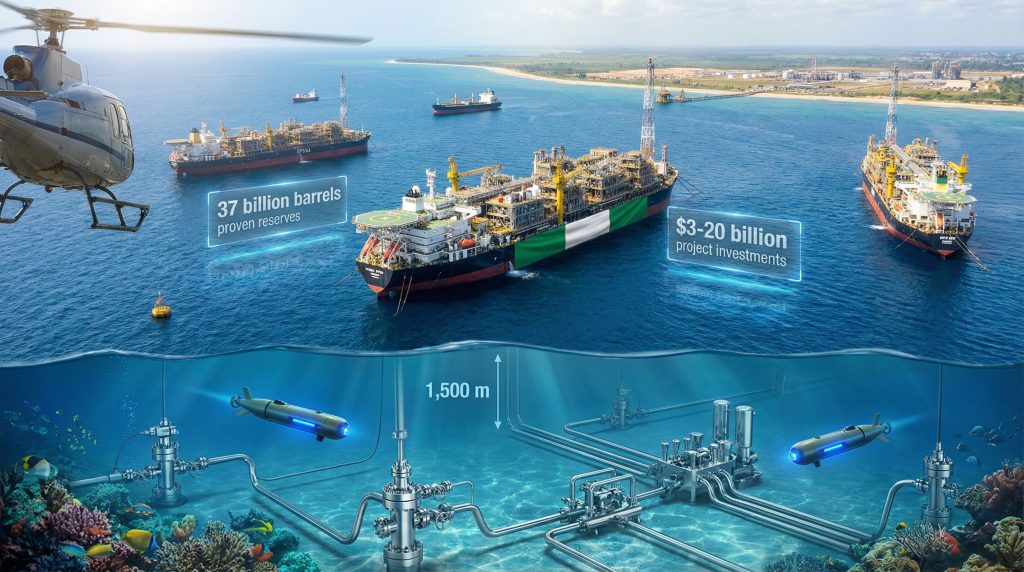
Nigeria's deepwater hydrocarbon potential continues to attract significant international investment as operators advance complex exploration programs across West Africa's most promising energy frontier. Deepwater exploration in Nigeria represents a critical component of global energy supply diversification, with technological advances enabling access to previously unreachable reserves beneath thousands of metres of ocean water.
Nigeria's Deepwater Resource Foundation
West Africa's hydrocarbon province extends far beyond conventional shallow-water operations, with Nigeria's offshore basins representing one of the continent's most significant untapped energy resources. The Niger Delta offshore region encompasses multiple geological formations spanning extensive deepwater acreage, where oil-bearing structures remain largely unexplored despite decades of onshore production activity.
Nigeria maintains approximately 37 billion barrels of proven crude oil reserves according to BP's Statistical Review of World Energy, positioning the nation among Africa's largest reserve holders. However, this figure represents combined onshore and offshore resources, with substantial deepwater potential remaining unquantified due to limited exploration activity in frontier zones beyond current operational areas.
Industry classifications divide Nigeria's offshore regions into distinct operational categories:
- Deepwater zones (400-1,500 metres): Established operational areas with proven commercial viability
- Ultra-deepwater territories (1,500+ metres): Emerging exploration targets requiring advanced technological solutions
- Frontier basins: Unexplored regions beyond current seismic coverage and geological modelling
The technical complexity of deepwater exploration increases exponentially with water depth and distance from existing infrastructure. Geological surveys indicate thick, high-permeability formations that could support large-scale commercial production, though exploration costs rise significantly compared to conventional onshore development.
Nigeria's established onshore processing infrastructure provides competitive advantages over greenfield deepwater provinces in other regions. Export terminals, refineries, and pipeline networks reduce incremental development costs for offshore discoveries that can leverage existing facilities through subsea tie-backs or dedicated export systems.
When big ASX news breaks, our subscribers know first
International Partnership Strategies
Major energy companies approach Nigerian deepwater opportunities through carefully structured partnership models that balance technical expertise, capital requirements, and regulatory compliance. Eni's expansion of Nigeria deepwater plans demonstrates how international operators leverage technological capabilities whilst addressing local regulatory frameworks.
Under agreements finalised in 2026, OPL 245 has been converted into multiple development and exploration permits following settlement of International Centre for Settlement of Investment Disputes (ICSID) arbitration proceedings. Nigerian Agip Exploration Limited now operates the converted licences alongside Nigerian National Petroleum Company Limited (NNPC) and Shell Nigeria Exploration and Production Company Limited (SNEPCO).
The licence conversion created distinct operational categories:
- Petroleum Mining Leases (PML 102 and 103): Development-ready acreage for immediate commercial activity
- Petroleum Prospecting Leases (PPL 2011 and 2012): Continued exploration rights for unproven prospects
This multi-phase approach allows operators to advance proven discoveries toward production whilst maintaining exploration rights over adjacent prospects. The structure reflects industry recognition that deepwater basins typically contain multiple reservoir targets requiring phased development strategies.
Partnership arrangements in Nigerian deepwater projects typically involve technology transfer commitments, local workforce development programmes, and procurement preferences for domestic service providers. These requirements create additional operational complexity but can reduce political risk and ensure sustainable community relationships throughout project lifecycles.
Similarly, Saudi Arabia exploration licenses demonstrate how international partnerships can unlock complex energy resources through structured cooperation frameworks.
Critical Development Insight: The successful resolution of the OPL 245 dispute through ICSID settlement and licence conversion represents a significant precedent for investment confidence, as long-standing legal uncertainties had previously deterred capital allocation to Nigerian deepwater opportunities.
Project Economics and Infrastructure Requirements
Deepwater development projects in Nigeria require substantial capital investments across multiple infrastructure categories, with costs varying significantly based on water depth, reservoir characteristics, and proximity to existing facilities. Industry analysis indicates Nigerian deepwater projects maintain competitive economics compared to other global deepwater provinces.
Infrastructure Investment Requirements:
| Infrastructure Component | Investment Range | Development Timeline |
|---|---|---|
| FPSO Facilities | $2-5 billion | 4-6 years |
| Subsea Systems | $500M-1.5B | 3-4 years |
| Export Pipelines | $200-800M | 2-3 years |
| Onshore Processing | $300M-1B | 3-5 years |
The Zabazaba-Etan project exemplifies modern deepwater development economics, with estimated reserves of approximately 500 million barrels of oil equivalent planned around a 150,000 barrel-per-day FPSO facility. Associated gas production of up to 200 million standard cubic feet per day will be directed to Nigeria LNG export systems, demonstrating integrated hydrocarbon monetisation strategies.
Cost structure analysis reveals Nigerian deepwater development costs of $15-35 per barrel compared to $40-60 per barrel for North Sea projects. These advantages stem from geological factors including thicker reservoir sections, higher permeability formations, and reduced drilling complexity relative to ultra-deepwater or Arctic operations.
Furthermore, operating expenses for established Nigerian deepwater fields typically range from $8-15 per barrel, with break-even oil prices of $45-55 for most commercial developments. However, individual project economics vary substantially based on reservoir quality, infrastructure sharing opportunities, and fiscal regime terms.
Production profile modelling indicates typical ramp-up periods of 2-3 years to reach peak output, followed by 8-12 years of sustained high production before natural decline rates of 5-8% annually. These extended production plateaus support project financing structures and provide operators with substantial cash generation periods.
Gas Monetisation and Revenue Optimisation
Associated gas production represents a critical component of deepwater project economics, with modern developments increasingly designed around dual-commodity revenue streams. Nigeria's established LNG infrastructure provides clear monetisation pathways for gas volumes that might be flared or reinjected in other provinces.
The integration of 200 MMscf/d of associated gas from the Zabazaba-Etan project into Nigeria LNG export systems demonstrates how operators maximise field economics through multi-commodity strategies. Gas sales provide secondary revenue streams whilst supporting Nigeria's energy transition objectives and reducing environmental impact through flaring elimination.
Nigeria LNG operates liquefaction facilities with significant nameplate capacity, though operational challenges have periodically impacted utilisation rates. Long-term gas supply contracts typically span 15-20 years with pricing mechanisms indexed to oil price movements and regional market conditions, providing revenue stability throughout project lifecycles.
Revenue optimisation strategies for Nigerian deepwater projects include:
- Dual commodity production: Simultaneous oil and gas sales maximising reservoir value
- Infrastructure sharing: Multiple field developments utilising common FPSO and export facilities
- Phased development: Sequential reservoir targeting extending field life and capital efficiency
- Enhanced recovery: Advanced completion techniques and artificial lift systems maintaining production rates
Domestic gas market opportunities continue expanding as Nigeria develops industrial capacity and power generation infrastructure. Gas-to-power initiatives and petrochemical development create additional demand centres beyond LNG export, potentially supporting premium pricing for domestic gas sales.
In addition, natural gas price trends influence project economics and investment timing for gas-rich deepwater discoveries.
Technology Evolution and Operational Excellence
Deepwater exploration in Nigeria benefits from continuous technological advancement in subsea systems, drilling techniques, and production optimisation. Digital transformation initiatives enable remote operations, predictive maintenance, and enhanced reservoir management that reduce operational costs whilst improving safety performance.
Subsea processing technologies allow seafloor separation and boosting systems that extend economic field life and enable development of marginal accumulations. Extended reach drilling techniques access larger reservoir areas from fewer surface locations, reducing environmental footprint and infrastructure requirements.
Advanced completion systems including intelligent wells, downhole monitoring, and autonomous control systems optimise production profiles and reservoir management. These technologies prove particularly valuable in complex deepwater reservoirs where intervention costs are substantial and production optimisation significantly impacts project economics.
Next-generation exploration techniques including advanced seismic imaging, machine learning interpretation, and integrated geological modelling improve prospect identification and reduce exploration risk. These capabilities become increasingly important as operators target deeper water and more complex geological structures.
Regulatory Framework and Investment Climate
Nigeria's regulatory environment for deepwater exploration has evolved significantly following successful dispute resolution and licence conversion processes. The transformation of exploration licences to production leases through established legal mechanisms demonstrates clear pathways for project advancement.
Key regulatory considerations for deepwater exploration in Nigeria include:
- Licensing processes: Converting exploration rights to development leases following commercial discovery
- Fiscal terms: Petroleum profit tax, royalty structures, and government participation requirements
- Local content: Nigerian workforce development and domestic procurement preferences
- Environmental compliance: Meeting international ESG standards and domestic regulatory requirements
The Nigerian Upstream Regulatory Commission (NURC) oversees technical and commercial aspects of project development, whilst the Nigerian National Petroleum Company Limited maintains government participation through equity stakes and production sharing arrangements.
International arbitration mechanisms provide dispute resolution pathways that protect foreign investment whilst ensuring compliance with Nigerian law. The successful ICSID settlement demonstrates how complex investment disputes can be resolved through negotiation and legal frameworks that benefit all parties.
The next major ASX story will hit our subscribers first
Risk Assessment and Investment Scenarios
Investment in Nigerian deepwater exploration involves multiple risk categories that require comprehensive assessment and mitigation strategies. Technical risks include geological uncertainty, reservoir complexity, and operational challenges in harsh deepwater environments.
Commercial risks encompass oil price movements, currency fluctuation, and market access for production volumes. Political and regulatory risks involve government stability, policy continuity, and fiscal regime changes that could impact project economics.
Consequently, sophisticated investment strategy components must account for these multifaceted risk profiles when evaluating deepwater opportunities.
Investment Scenario Analysis:
Base Case Development (2025-2035):
- 3-5 major new projects reaching production
- 200,000-300,000 additional barrels per day capacity
- $15-25 billion total investment commitment
Accelerated Growth Scenario:
- 8-12 major developments with expedited timelines
- 500,000+ additional barrels per day potential
- $40-60 billion capital requirements
Conservative Approach:
- Selective development of highest-return opportunities
- Phased expansion based on market conditions
- $8-12 billion in targeted investments
Each scenario reflects different assumptions about oil price environments, regulatory stability, and technological advancement rates. Investors must evaluate these scenarios against their risk tolerance and portfolio objectives, particularly when considering market volatility hedging strategies.
Environmental and Social Governance
Modern deepwater exploration projects in Nigeria incorporate comprehensive environmental management frameworks that address marine ecosystem protection, emissions reduction, and community engagement. Operators implement biodiversity impact assessments and mitigation measures that meet international standards whilst supporting local environmental objectives.
Carbon management initiatives include flaring minimisation through associated gas sales, energy efficiency optimisation, and evaluation of carbon capture technologies. These measures align with global climate commitments whilst potentially creating additional revenue streams through carbon credit mechanisms.
Social governance frameworks emphasise local workforce development, community investment programmes, and revenue transparency initiatives. Nigerian content requirements create opportunities for domestic capacity building whilst ensuring equitable distribution of economic benefits from hydrocarbon development.
Strategic Market Positioning
Deepwater exploration in Nigeria represents a distinctive opportunity within global energy markets, combining established geological knowledge with emerging technological capabilities and resolved regulatory frameworks. However, recent developments by TotalEnergies' deepwater partnership agreements highlight the continuing international interest in Nigeria's offshore potential.
Competitive advantages include proximity to established infrastructure, favourable geological conditions, and comprehensive regulatory frameworks that protect both investor interests and national resource objectives. These factors position Nigerian deepwater resources favourably compared to frontier provinces with higher regulatory uncertainty or limited infrastructure support.
Future development success will depend on continued technological advancement, effective partnership structures between international operators and Nigerian stakeholders, and stable fiscal regimes that balance investment attraction with resource value maximisation.
This analysis is based on publicly available information and industry data. Investment decisions should consider comprehensive due diligence, professional advice, and careful evaluation of all risk factors. Projections and forecasts involve inherent uncertainty and should not be considered investment recommendations.
Ready to Capitalise on Global Energy Investment Opportunities?
Discovery Alert's proprietary Discovery IQ model delivers real-time alerts on significant ASX mineral discoveries, helping investors identify actionable opportunities in the resources sector before the broader market. With Nigeria's deepwater success demonstrating how strategic partnerships unlock complex energy resources, explore how major mineral discoveries can generate substantial returns and begin your 14-day free trial today to position yourself ahead of emerging opportunities.