June 5, 2026
The Forgotten Bottleneck: Why West Coast Coal Export Infrastructure Has Shaped U.S. Energy Trade for Decades
For generations, the structural geography of American energy export capacity has quietly dictated the limits of U.S. influence in Pacific energy markets. Defense Production Act funding for coal plants and export infrastructure is now at the centre of a significant federal effort to address what has long been a persistent chokepoint. While Gulf Coast and East Coast terminals have long served Atlantic-facing trade routes, the West Coast has remained a structural constraint, limiting the volume of American coal and bulk commodities reaching Japan, South Korea, Taiwan, and Southeast Asia. That calculus appears to be shifting decisively in 2026.
Understanding the current wave of federal coal infrastructure investment requires looking beyond individual project announcements. Furthermore, it demands examining the deeper mechanics of the financing instruments, the strategic rationale, and the real-world limitations shaping what these commitments can and cannot deliver.
When big ASX news breaks, our subscribers know first
Defense Production Act Title III: A Financing Tool Built for Industrial Emergencies
Most people associate the Defense Production Act with wartime manufacturing mobilisation, and historically that association is accurate. The DPA was enacted in 1950 during the Korean War as a mechanism to direct private industry toward national defence priorities. Title III specifically authorises the federal government to make purchases, purchase commitments, and financial investments in industrial capacity deemed critical to national security.
What has changed in the 21st century is how broadly the definition of "critical industrial capacity" has been applied. Over recent decades, defense production act Title III authority has been extended to semiconductor supply chains, rare earth processing, and now energy infrastructure. The legal architecture has not fundamentally changed, however the strategic aperture has widened considerably.
How Title III Works as a Financial Instrument
A critical distinction that often gets lost in coverage of DPA announcements is the difference between authorisation and appropriation. When the DOE invokes DPA Title III authority, it is not automatically releasing a pre-existing pool of money. Instead, it is activating a legal framework that permits the deployment of specific financial instruments, including:
- Direct purchase commitments that provide revenue certainty to industrial producers
- Loan guarantees that reduce private borrowing costs for qualifying projects
- Capacity investment agreements that fund physical infrastructure expansion
- Coordination mechanisms that align DPA activity with other DOE financing authorities
The actual movement of capital depends on available appropriations or subsequent congressional funding actions. This is not a technicality to be glossed over. Projects selected under a DPA determination face real implementation risk if appropriations do not materialise at the levels anticipated.
Investor and Policy Note: DPA Title III authorisation enables the legal pathway for federal financial support, but it does not independently guarantee that every dollar committed in an announcement will flow to projects on the announced timeline. Congressional appropriations and administrative execution remain critical variables.
The June 4, 2026 DOE Announcement: Structure and Scope
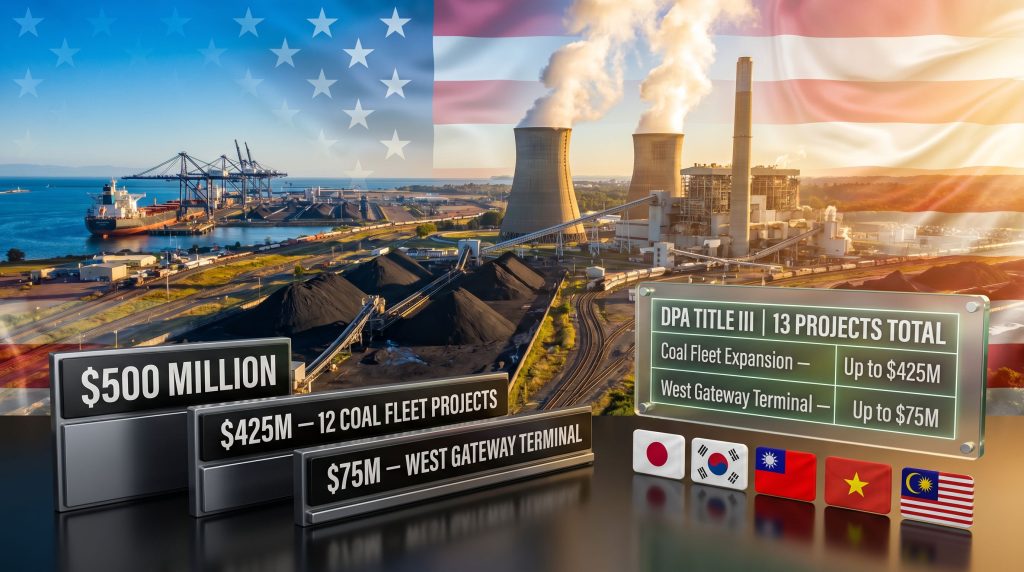
The Department of Energy's June 4, 2026 announcement committed up to $500 million in DPA Title III funding across 13 projects, structured in two distinct categories.
| Allocation Category | Funding Amount | Number of Projects |
|---|---|---|
| Coal Fleet Expansion and Reinvigoration | Up to $425 million | 12 projects |
| West Gateway Terminal Export Infrastructure | Up to $75 million | 1 project |
| Total DPA Commitment | Up to $500 million | 13 projects total |
The 12 coal fleet projects span a range of operational priorities designed to extend the productive life and reliability of existing coal generation assets. Categories of eligible work include:
- Generating-unit life extensions that push operational timelines beyond previously planned retirement dates
- Reliability upgrades targeting equipment modernisation at aging facilities
- On-site coal stockpile development to reduce supply chain vulnerability during demand spikes
- Rail and barge logistics reinforcement to harden domestic fuel delivery chains
- Domestic terminal improvements supporting inland distribution capacity
The 13th project, the West Gateway Terminal in Oakland, California, occupies a distinct strategic position in the announcement. Designed as a rail-served marine export terminal, it is engineered to handle more than 10 million tons of bulk commodities annually, making it a significant addition to U.S. West Coast bulk export infrastructure.
West Coast Infrastructure: Closing a Structural Gap in Pacific Energy Trade
The West Coast infrastructure deficit in bulk commodity exports is not a new problem. For more than a decade, proposed coal export terminals in Washington and Oregon faced sustained legal and regulatory opposition that prevented their development. That left California, despite its own complex regulatory environment, as the focal point for alternative routing options.
The West Gateway Terminal's Oakland location provides a key advantage: rail connectivity to interior coal-producing regions that would otherwise face prohibitively expensive overland transport to Pacific ports. A rail-served terminal design means coal can move from Wyoming's Powder River Basin or Colorado's mountain coal regions directly to a vessel-loading facility without requiring intermediate transshipment.
Target Export Markets for West Gateway Terminal
The DOE announcement identified five primary allied nations as target export destinations:
- Japan — which remains one of the world's largest thermal coal importers despite active energy transition programmes
- South Korea — a major industrial coal consumer with significant steelmaking and power generation demand
- Taiwan — heavily reliant on imported energy with constrained domestic generation alternatives
- Vietnam — a rapidly industrialising economy with growing electricity demand
- Malaysia — an emerging industrial base with expanding power infrastructure needs
What unites these markets is their geographic positioning within the Indo-Pacific trade zone and their ongoing dependence on seaborne coal imports. Expanded U.S. West Coast export capacity introduces an alternative supply vector that carries diplomatic and economic diversification value for importing nations. In addition, these resource export challenges highlight how competing nations are also vying for influence in precisely the same markets.
The Strategic Logic Behind Federal Coal Investment in 2026
The policy context for this announcement extends well beyond coal-specific concerns. The American mineral production order framing positions the coal investment not as an isolated sector preference but as one component of a broader fossil fuel infrastructure strategy. In April 2026, a White House energy determination extended DPA coverage to include natural gas, LNG, and petroleum export infrastructure alongside coal.
Several intersecting forces are driving the policy calculus:
Baseload reliability under demand pressure. The rapid proliferation of AI data centres has created a well-documented surge in electricity demand that grid planners had not fully anticipated. Coal plants, regardless of their carbon profiles, provide dispatchable baseload generation that cannot be immediately replicated by intermittent renewables or storage at the required scale.
Supply chain resilience arguments. Secretary of Energy Chris Wright has consistently argued that national security mineral production logic extends to maintaining domestic coal production infrastructure and export capacity. This ensures the industrial capacity exists to supply both domestic power needs and allied nations in scenarios where other supply chains face disruption.
Energy diplomacy in the Indo-Pacific. The five target export markets for the West Gateway Terminal are not randomly selected. Japan, South Korea, and Taiwan in particular are close security allies with significant dependence on imported energy. Consequently, the ability to supply coal to these nations from U.S. West Coast terminals reduces their dependence on other suppliers and deepens bilateral energy relationships.
Full Supply Chain Coverage: How DPA Authority Maps to Coal Infrastructure
One analytically important dimension of the DPA framework as applied to coal is its supply-chain-spanning reach. The determination does not focus solely on power plant operations but covers the full value chain from extraction to export. As the Baker Institute notes, the expanding role of DPA in energy reflects a fundamental shift in how policymakers conceptualise industrial security.
| Supply Chain Segment | DPA Coverage Scope |
|---|---|
| Coal Mining Operations | Industrial capacity provisions |
| Rail and Barge Logistics | Critical supply chain infrastructure |
| Domestic Terminals | Eligible for financial support and upgrades |
| Export Terminals | Explicitly included in White House determination |
| Power Plant Operations | Life extensions and reliability upgrades |
This vertical integration of policy support is significant because coal's economic viability depends on cost-competitive logistics as much as on commodity prices. Rail freight rates, port handling fees, and vessel scheduling constraints can make the difference between a profitable export trade and an uncompetitive one. Federal investment in logistics infrastructure, therefore, addresses a structural cost disadvantage that market forces alone have not resolved.
The next major ASX story will hit our subscribers first
Parallel Federal Actions: The $350 Million Coal Plant Modernisation Initiative
The June 4, 2026 DOE announcement did not stand alone. On the same date, the department separately announced $350 million allocated to build, modernise, and restart coal-fired generating capacity. These coal revival executive orders signal a coordinated multi-instrument federal approach to coal infrastructure rather than a single-track policy intervention.
| Policy Instrument | Funding | Target Sector | Stated Objective |
|---|---|---|---|
| DPA Title III | Up to $500 million | Coal fleet + export terminals | National security and baseload reliability |
| DOE Direct Investment | $350 million | Coal plant modernisation and restarts | Grid capacity and energy affordability |
| LNG Export Determinations | Variable | Natural gas infrastructure | Allied energy supply and export capacity |
The combined signal from these concurrent announcements is that the current administration views coal infrastructure investment as a multi-decade commitment rather than a transitional measure. Furthermore, Pillsbury Law's analysis of these DPA determinations confirms their unprecedented breadth across the U.S. energy sector.
Key Limitations and Implementation Uncertainties
Balanced analysis of this policy requires honest engagement with its limitations:
The appropriations gap. DPA Title III authorisation opens a legal pathway but does not independently create funded accounts. Projects selected under the determination will require actual capital deployment through congressional appropriations or existing DOE financing facilities. Delays in appropriations processes could push project timelines significantly.
Legal exposure. The use of DPA Title III for civilian energy infrastructure rather than purely defence-related industrial capacity represents a relatively novel application of the statute. Legal challenges to this interpretation remain a credible risk, particularly for the export terminal component, which serves commercial rather than exclusively military purposes.
Regulatory complexity at the project level. Coal export terminals, particularly in California, face permitting processes that are among the most demanding in the country. Environmental review requirements, air quality regulations, and local land use constraints could materially affect the West Gateway Terminal's development timeline regardless of federal financial commitments.
Market dynamics. Long-term coal demand in Asia, while currently robust, faces structural headwinds from renewable energy buildout in Japan, South Korea, and Taiwan. Projects with 20 to 30 year asset lives must be evaluated against scenarios where demand growth decelerates before infrastructure investment costs are fully recovered.
Frequently Asked Questions
What is DPA Title III and how does it function as a funding mechanism?
DPA Title III authorises the federal government to invest in domestic industrial capacity deemed essential to national security. It enables purchase commitments, loan guarantees, and direct capacity investments but requires appropriations to deploy actual capital.
How many coal plants are covered in the June 2026 announcement?
Twelve coal-fired power plant projects are included, receiving a combined allocation of up to $425 million for fleet expansion, life extensions, and reliability improvements.
Does DPA authorisation guarantee project funding?
No. Authorisation establishes legal eligibility for financial support but does not independently appropriate funds. Actual capital deployment depends on congressional action and available DOE financing resources.
What makes the West Gateway Terminal strategically significant?
Its rail-served design connects interior coal-producing regions directly to Pacific vessel-loading infrastructure, addressing a long-standing bottleneck in U.S. West Coast bulk commodity export capacity, with a design throughput exceeding 10 million tons of bulk commodities annually.
What This Policy Signals for U.S. Energy Infrastructure
The June 2026 Defense Production Act funding for coal plants and export infrastructure represents more than a coal-specific funding decision. It reflects a broader recalibration of how the federal government defines energy infrastructure as a national security asset. By extending DPA authority across the full coal supply chain — from mining through export terminal development — and coupling that with parallel direct investment programmes, the current policy framework is attempting to reverse a decade-long trend of coal asset retirement and underinvestment.
Whether that attempt succeeds will depend on factors well beyond the announcement itself: appropriations follow-through, permitting outcomes, legal durability of the DPA application, and the trajectory of global coal demand in the Indo-Pacific markets the West Gateway Terminal is designed to serve.
What is clear is that the infrastructure gap this policy targets is real, the strategic rationale is coherent within its own framework, and the financial instruments being deployed are substantial enough to meaningfully influence private capital allocation decisions in the coal sector for years to come.
Disclaimer: This article contains forward-looking analysis regarding energy policy, federal funding timelines, and market projections. These represent informed assessments based on publicly available information and should not be construed as financial or investment advice. Actual policy outcomes, funding deployment, and market conditions may differ materially from projections discussed here. Readers should consult qualified advisers before making investment decisions related to energy sector assets.
Want to Stay Ahead of Major Commodity and Resource Discoveries on the ASX?
Discovery Alert's proprietary Discovery IQ model delivers real-time alerts on significant ASX mineral discoveries — including bulk commodities central to global energy trade — ensuring subscribers can identify actionable opportunities the moment they are announced. Explore how historic discoveries have generated substantial returns on Discovery Alert's dedicated discoveries page, and begin a 14-day free trial to position yourself ahead of the broader market.