June 4, 2026
The Engineering Architecture Behind America's First Offshore LNG Export Facility
The global LNG industry has spent decades refining a single dominant model: build onshore liquefaction trains at coastal terminals, pipe in gas from inland fields, and load conventional LNG carriers at fixed jetties. That model has worked. It has also hit a ceiling. Permitting timelines stretching beyond a decade, coastal land constraints, and the sheer capital weight of onshore civil infrastructure have created a structural bottleneck for developers. Floating LNG technology offers a fundamentally different engineering pathway, and the recent final investment decision on the Delfin first US floating LNG terminal marks the point at which that pathway became commercially real in American waters.
When big ASX news breaks, our subscribers know first
Redefining the Export Infrastructure Model: Why Offshore Liquefaction Changes the Equation
Conventional onshore LNG terminals require the convergence of multiple regulatory processes simultaneously. In the United States, that typically means Federal Energy Regulatory Commission (FERC) jurisdiction over the onshore facility, state-level environmental approvals, coastal zone management reviews, and Department of Energy export authorisations. Each layer adds time and uncertainty.
Offshore liquefaction through a floating LNG vessel operates under a structurally different regulatory architecture. The US Maritime Administration (MARAD) holds jurisdiction over deepwater port licensing, a framework originally designed for offshore oil import terminals but adapted to cover offshore LNG export infrastructure. This pathway bypasses the FERC onshore permitting process for the liquefaction asset itself, opening a distinct corridor through which developers can advance offshore LNG projects without the same regulatory sequencing constraints that govern land-based terminals.
Delfin Midstream's Port Delfin project, positioned approximately 37 to 41 nautical miles offshore in the Gulf of Mexico near Cameron Parish, Louisiana, received its MARAD deepwater port licence in March 2025. Combined with a Department of Energy non-free trade agreement export authorisation, the project now holds the complete regulatory stack required to liquefy and export US natural gas to buyers anywhere in the world. No prior US LNG developer had obtained this combination for an offshore floating liquefaction facility before Delfin.
How a Floating LNG Vessel Actually Works: From Pipeline Inlet to Export Cargo
Understanding why the Delfin project matters requires understanding the mechanical logic of floating LNG technology. An FLNG vessel is essentially a complete liquefaction plant, storage system, and loading terminal built onto a purpose-designed hull, moored at a fixed offshore location.
The operational sequence works as follows:
- Gas intake: Dry natural gas is delivered to the FLNG vessel via subsea pipeline from onshore gas supply networks. In Delfin's case, this means connecting to the existing Gulf Coast pipeline grid and ultimately drawing on Henry Hub-linked supply from prolific US gas basins.
- Pre-treatment: The incoming gas stream undergoes processing to remove water, carbon dioxide, and heavier hydrocarbon fractions that would interfere with the liquefaction process or affect LNG quality specifications.
- Liquefaction: Processed gas passes through heat exchangers where it is chilled to approximately -162 degrees Celsius, reducing its volume by a factor of roughly 600 and converting it to liquid form.
- Storage: Liquefied gas is held in insulated cryogenic tanks integrated into the vessel's hull, maintaining temperature and pressure conditions throughout the storage period.
- Ship-to-ship transfer: LNG carrier vessels moor alongside or astern of the FLNG unit for loading operations, transferring cargo via cryogenic loading arms before departing for destination markets.
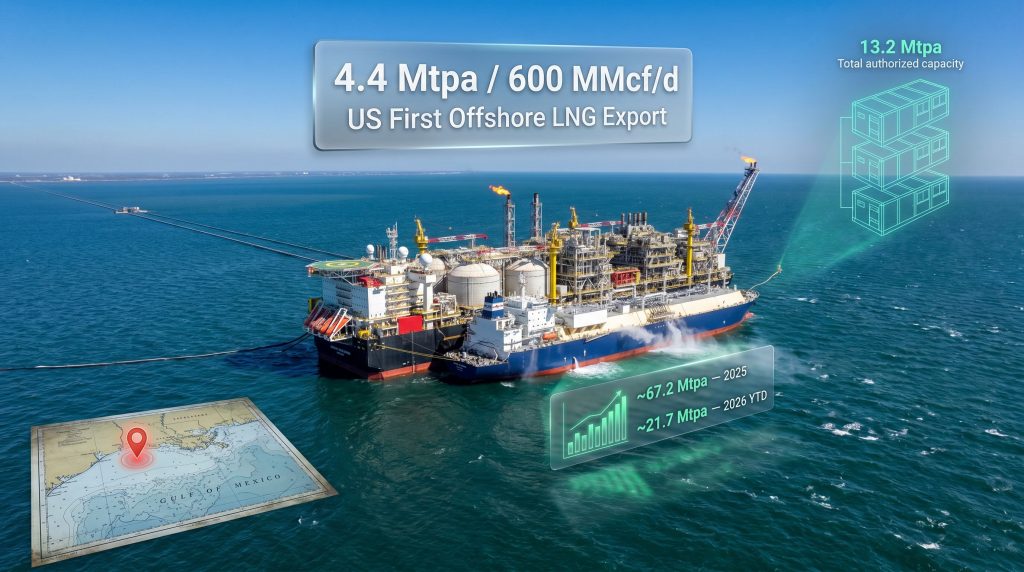
Each of Delfin's FLNG units is designed to process 600 million cubic feet per day (MMcf/d) of natural gas, producing 4.4 million tonnes per annum (Mtpa) of LNG. To put that in context, 4.4 Mtpa is roughly equivalent to the annual gas consumption of a mid-sized European country's residential heating sector.
Comparing FLNG and Conventional Onshore LNG Terminals
| Feature | Floating LNG (FLNG) | Conventional Onshore LNG |
|---|---|---|
| Location | Offshore deepwater | Coastal or inland |
| Construction timeline | Potentially faster | Longer permitting and build |
| Capital intensity | High (vessel and mooring) | High (civil and infrastructure) |
| Environmental footprint | Reduced coastal disruption | Larger onshore footprint |
| Scalability | Modular, unit by unit | Train-based expansion |
| Regulatory pathway | MARAD deepwater port licence | FERC plus state approvals |
The Capital Stack: Assembling $5 Billion for a First-of-Its-Kind Project
Financing the first US FLNG project presented a fundamentally different challenge from financing an incremental expansion at an established onshore terminal. Lenders and equity investors evaluating Delfin faced the absence of any domestic precedent against which to benchmark construction risk, schedule assumptions, or operational performance. The international track record of floating LNG projects, including Shell's Prelude facility offshore Western Australia, provides some reference points but also carries cautionary signals around cost escalation and schedule extension.
Despite these complexities, Delfin finalised $5 billion in project financing in June 2026, assembling an investor consortium with notable strategic depth:
- Global Infrastructure Partners (backed by BlackRock): provides the infrastructure equity anchor and access to institutional capital at scale
- Mitsui OSK Lines (MOL): Japan's major shipping and energy logistics group, bringing both LNG vessel expertise and direct exposure to Asian gas demand markets
- Vitol: the world's largest independent energy trading house, participating as both equity investor and offtake counterparty, creating an unusual alignment of financial and commercial interest
- Diameter Capital Partners: a structured credit specialist adding a financing architecture dimension not typically seen in LNG project capital stacks
The composition of this consortium is analytically significant. The simultaneous presence of a commodity trading house (Vitol) and a Japanese maritime logistics operator (MOL) in the same equity structure reflects a broader pattern emerging in floating LNG development. Furthermore, capital increasingly comes from participants who benefit from multiple points along the supply chain, not just from the infrastructure asset itself.
This vertical integration of investor interest differs from the pension fund and infrastructure fund-dominated capital structures common in established onshore LNG terminals. In addition, the natural gas supply outlook for 2025 and beyond continues to underpin investor confidence in long-dated US export infrastructure commitments.
Structural Insight: When an offtaker and an investor are the same entity, the economics of the project become self-reinforcing. Vitol's dual role as equity holder and LNG buyer means its return profile is partially insulated from pure commodity price risk, since losses on one side of the trade can be partially offset by gains on the other. This structure reduces the project's dependence on purely merchant LNG market upside.
The final investment decision had originally been targeted for November 2025 but was delayed as the capital formation process took longer than anticipated. A separate operational setback occurred in February 2026, when a section of onshore pipeline infrastructure exploded during a maintenance restart of a previously inactive line segment, injecting additional uncertainty into the project's timeline and investor confidence at a critical juncture.
Who Has Committed to Buying Delfin's LNG: The Contracted Offtake Portfolio
The commercial foundation for the first FLNG unit rests on 3.55 Mtpa of binding, long-term contracted capacity as of the FID announcement, against a total unit capacity of 4.4 Mtpa. The contract book draws from a deliberately diverse mix of buyer profiles.
| Counterparty | Volume (Mtpa) | Profile |
|---|---|---|
| Expand Energy | 1.15 | US domestic gas producer |
| Centrica | 1.00 | UK utility and energy retailer |
| Gunvor | 0.90 | Swiss-based commodity trader |
| Vitol | 0.50 | Global energy trading house |
A previously contracted volume of 0.6 Mtpa with Hartree was terminated in late April 2026, with that cancellation recorded in a DOE filing dated 29 May 2026. This termination partially explains the gap between contracted volumes and full unit capacity.
Beyond the standard DOE customer filings, Vitol signed a separate 1.0 Mtpa agreement in November 2025 structured to deliver LNG to the UAE's International Resources Holding under a long-term contract. This volume sits outside Delfin's standard DOE customer submissions, raising questions within the industry about whether the DOE's 30-day filing requirement was triggered and how this volume relates to Vitol's equity investment in the project.
Germany's Securing Energy for Europe (SEFE) added a further dimension in March 2025 with a non-binding heads of agreement for 1.5 Mtpa, representing one of the most strategically significant buyer signals in the entire contract book given Europe's ongoing effort to reduce pipeline gas dependence.
What the Buyer Mix Reveals About Structural LNG Demand
The composition of Delfin's offtake portfolio is not random. It reflects several converging demand-side dynamics:
- European utility exposure (Centrica, SEFE) reflects long-term structural demand from buyers seeking to lock in non-Russian supply chains through the 2030s and beyond
- Trading house participation (Gunvor, Vitol) signals that portfolio LNG trading desks view US Gulf Coast supply as a flexible, liquid source of globally re-deployable volumes
- Middle East re-export structures via the Vitol-IRH delivery arrangement represent an emerging model in which UAE-based entities aggregate LNG from multiple sources for onward distribution into Asian and African markets
- US producer integration through Expand Energy creates a vertically aligned dynamic where a gas producer gains predictable off-take for its own output at a pricing structure tied to Henry Hub plus a liquefaction tolling fee
However, Asian LNG tariff pressures remain a complicating factor for buyers in that region seeking to commit to long-term US supply agreements, particularly given evolving trade policy dynamics.
Development Timeline: Phase-by-Phase Execution Roadmap
Delfin's build-out plan follows a modular, sequenced capital deployment model that distinguishes it from the large-scale, single-tranche construction programmes typical of onshore LNG megaprojects.
Phase 1 – First FLNG Unit:
- FID confirmed: June 2026
- Target first LNG production: 2030
- Target commercial operations: first half of 2031
- Capacity: 4.4 Mtpa / 600 MMcf/d
Phase 2 and 3 – Second and Third FLNG Units:
- FID decisions expected within approximately 12 months of the first unit's greenlight
- Each additional unit: 4.4 Mtpa capacity
- Combined maximum authorised capacity at full build-out: 13.2 Mtpa
The unit-by-unit sequencing allows capital commitments to be staged based on evolving market conditions, offtake contract coverage, and lessons learned from the first unit's construction and commissioning. Consequently, this is a structurally more conservative approach than committing to full three-unit capacity upfront, and it reduces the project's exposure to a single catastrophic cost overrun scenario.
The next major ASX story will hit our subscribers first
Delfin Within the Broader US LNG Construction Surge
The Delfin first US floating LNG terminal FID does not exist in isolation. It is the most recent greenlight in what has become an accelerating wave of US LNG capacity additions.
| Metric | Volume |
|---|---|
| New LNG capacity greenlit in 2025 | ~67.2 Mtpa |
| New capacity entering construction in 2026 (YTD) | ~21.7 Mtpa |
| Delfin Phase 1 contribution | 4.4 Mtpa |
| Delfin full authorised capacity | 13.2 Mtpa |
One additional project, Glenfarne's Texas LNG facility targeting 4 Mtpa of capacity in south Texas, was aiming for its own investment decision by the end of June 2026, suggesting the pace of new FIDs may continue through mid-2026.
The scale of capacity additions across 2025 and 2026 reflects a structural reorientation of US energy infrastructure priorities. Furthermore, the US natural gas price forecast indicates that Henry Hub pricing is expected to remain competitive against alternative liquefaction feedstocks globally, underpinning the commercial logic of new capacity commitments.
Key Risk Factors Investors and Analysts Should Understand
The Delfin project carries a set of material risks that deserve clear-eyed analysis alongside the strategic opportunity narrative.
- Pipeline infrastructure vulnerability: The February 2026 explosion during a maintenance restart of a previously mothballed onshore pipeline segment raises structural questions about the reliability of ageing Gulf Coast midstream infrastructure as a gas supply pathway to an offshore FLNG unit. Additional capital investment in onshore pipeline redundancy may be required before first production.
- Offtake coverage gap: With 3.55 Mtpa contracted against a 4.4 Mtpa unit capacity, approximately 0.85 Mtpa remains uncommitted. This residual exposure represents either a future contracting opportunity or a merchant risk position depending on LNG spot market conditions in the late 2020s.
- FLNG technology execution risk: Delfin has no US precedent against which to benchmark construction schedule or cost. Shell's Prelude FLNG in Australia, while ultimately operational, experienced multi-year commissioning delays and significant cost escalation, providing a cautionary reference point for floating LNG's execution complexity.
- Regulatory continuity: The project depends on sustained DOE export authorisation and MARAD deepwater port licence conditions remaining stable across a multi-year construction window, during which US energy policy frameworks could evolve.
- European buyer concentration risk: Both Centrica and SEFE operate in markets where domestic energy policy and political priorities around the energy transition could affect the durability of their long-term LNG import strategies. In addition, monitoring natural gas price trends will remain essential for assessing whether contracted pricing structures remain commercially attractive for European buyers through to 2031.
Frequently Asked Questions: Delfin Floating LNG Terminal
What is the Delfin floating LNG terminal?
Port Delfin is the first licensed offshore LNG export facility in the United States, developed by Delfin Midstream. It is built around floating LNG vessels moored approximately 37 to 41 nautical miles offshore in the Gulf of Mexico near Cameron Parish, Louisiana.
How much LNG can the Delfin terminal export?
The first FLNG unit has a nameplate capacity of 4.4 Mtpa. The full deepwater port authorisation covers up to 13.2 Mtpa across three FLNG units.
When will operations begin?
First LNG production is targeted for 2030, with full commercial operations serving long-term contracted customers expected in the first half of 2031.
Who is investing in the project?
The investment consortium includes Global Infrastructure Partners (backed by BlackRock), Mitsui OSK Lines, Vitol, and Diameter Capital Partners, collectively financing $5 billion in project capital.
How does a floating LNG terminal differ from a conventional facility?
A floating LNG terminal performs gas liquefaction, LNG storage, and export loading on a purpose-built offshore vessel rather than through fixed onshore infrastructure. This reduces coastal land use, changes the regulatory pathway from FERC to MARAD jurisdiction, and allows modular capacity additions through sequential unit deployments rather than single large-scale construction programmes.
Why is Delfin's offshore status significant?
No US LNG developer had previously obtained a MARAD deepwater port licence for offshore liquefaction and export before Delfin. The project establishes a new regulatory and technical precedent for US offshore LNG infrastructure and demonstrates that the deepwater port licensing pathway is viable for FLNG applications. Furthermore, the LNG import tax structure in key receiving markets such as India will influence how cost-competitive US FLNG supply ultimately proves to be.
Strategic Significance: What the Delfin FID Signals for Global LNG Markets
The broader implication of the Delfin first US floating LNG terminal reaching its final investment decision extends beyond one project's construction schedule. It validates floating LNG as a commercially bankable export mechanism within the US regulatory environment, opening a template that other developers could seek to replicate.
The project's modular structure, diversified investor base, and geographically varied offtake portfolio collectively suggest that offshore liquefaction can attract sophisticated institutional capital when the regulatory, commercial, and technical conditions align. Whether that template proves replicable will depend heavily on how Delfin's own construction and commissioning performance unfolds between now and 2030.
For European utilities, Middle Eastern trading hubs, and Asian energy security planners, the emergence of US FLNG capacity adds a new dimension to the global LNG supply picture. It expands the range of viable US export infrastructure beyond the Gulf Coast's onshore terminal footprint, potentially deepening the liquidity and geographic diversity of the global LNG market through the early 2030s.
This article contains forward-looking statements and projections regarding project timelines, production targets, and market conditions. These reflect available information at the time of writing and are subject to material change. Nothing in this article constitutes financial or investment advice. Readers should conduct independent due diligence before making investment decisions related to LNG infrastructure or energy markets.
Want To Catch The Next Major Energy Discovery Before The Market Does?
Discovery Alert's proprietary Discovery IQ model scans ASX announcements in real time, instantly identifying high-potential mineral and energy discoveries across more than 30 commodities — so subscribers can act on actionable opportunities ahead of the broader market. Explore historic examples of exceptional discovery returns or start your 14-day free trial today to position yourself at the front of the market.