July 10, 2026
Australia's East Coast Gas Market Is Running Out of Headroom
The structural tension underpinning Australia's east coast gas market has been building for more than a decade. When three liquefied natural gas export terminals began operations at Gladstone between 2014 and 2016, they fundamentally rewired the domestic supply equation. Volumes that once flowed primarily into Queensland homes and factories were increasingly redirected toward international buyers, and domestic prices climbed sharply in response. The market has been searching for a corrective supply injection ever since.
Against that backdrop, the confirmation of a major tight gas discovery in Central Queensland's Denison Trough is attracting serious attention from energy analysts, industrial gas buyers, and investors alike. The Denison Gas Queensland gas discovery at Baffle Creek field represents one of the more consequential onshore resource announcements the region has seen this decade, and its implications extend well beyond the immediate exploration result. Furthermore, understanding the broader LNG supply outlook helps contextualise why this discovery carries such strategic weight.
When big ASX news breaks, our subscribers know first
What the Baffle Creek Discovery Actually Represents
Location, Geology, and Why the Denison Trough Matters
The Baffle Creek field sits within the Denison Trough, a structurally distinct sub-basin nested within the broader Bowen Basin of Central Queensland. The Bowen Basin is one of Australia's most historically productive onshore hydrocarbon provinces, and the Denison Trough occupies a geologically active portion of it characterised by deep sandstone sequences capable of hosting substantial tight gas accumulations.
The field's position north of Roma is commercially significant in a way that goes beyond mere geography. Roma sits at the heart of Queensland's established gas production corridor, with direct pipeline connectivity to the Eastern Australian gas transmission grid. This means any gas produced at Baffle Creek does not require the construction of entirely new long-haul infrastructure to reach its market, a factor that materially improves project economics relative to more isolated discoveries.
The reservoirs themselves are deep sandstone formations hosting tight gas, a resource type that requires more technical sophistication to produce than conventional gas but has become increasingly economic as horizontal drilling and fracture stimulation technology have matured.
The 566 PJ Resource Estimate: Putting the Numbers in Context
The initial resource estimate for the Baffle Creek discovery stands at 566 petajoules (PJ) of recoverable tight gas. To appreciate what that figure means in practice, consider that Australia's east coast gas market collectively consumes somewhere between 600 and 700 PJ per year across residential, commercial, industrial, and LNG-linked demand categories.
A single field discovery carrying an initial estimate equivalent to roughly one full year of east coast gas consumption is not a routine exploration result. It is the kind of number that reshapes development timelines and attracts institutional scrutiny.
It is important to note that initial resource estimates in tight gas plays are characteristically preliminary. Flow testing data, extended production history, and refined reservoir modelling will all influence how the 566 PJ figure evolves over time, either upward or downward. The fracture stimulation and testing program planned for Baffle Creek 7 in Q3 2026 will be a pivotal milestone in building resource confidence.
How Tight Gas Is Different, and Why That Matters for Baffle Creek
The Technical Mechanics of Tight Gas Extraction
Understanding the significance of the Denison Gas Queensland gas discovery requires a grasp of what separates tight gas from the conventional natural gas most people are familiar with. In a conventional reservoir, gas occupies the pore spaces of highly permeable rock and flows freely toward a wellbore when pressure is released. Tight gas, by contrast, is trapped within sandstone formations where permeability is extremely low, meaning the gas has virtually no natural pathway to move through the rock.
Unlocking tight gas requires a two-stage engineering approach:
- Horizontal drilling extends the wellbore laterally through the reservoir, dramatically increasing the contact area between the well and the gas-bearing formation.
- Multi-stage hydraulic fracture stimulation pumps fluid into the formation at high pressure, creating a network of fractures that act as flow pathways connecting the reservoir to the wellbore.
The combination of these two techniques has transformed previously uneconomic tight gas accumulations into viable commercial targets across North America, and the same technology transfer is now being applied systematically across Queensland's deep sandstone sequences.
Baffle Creek 7: Queensland's Longest Tight Gas Horizontal Well
The most technically advanced well in the current program, Baffle Creek 7, has completed drilling and is positioned as one of Queensland's longest tight gas horizontal wells. Its extended lateral length maximises reservoir contact and, if stimulation results confirm strong flow rates, it will serve as a template for further development drilling across the field.
Fracture stimulation and flow testing are scheduled for Q3 2026. The results of this program will determine whether the 566 PJ initial estimate can be upgraded in both confidence classification and magnitude. Upon successful testing, the well is planned for connection to nearby pipeline infrastructure serving the east coast market.
| Well Reference | Current Status | Next Milestone | Target Market |
|---|---|---|---|
| Baffle Creek Wells 1 and 2 | Active production | Ongoing | Boyne Island aluminium smelter |
| Baffle Creek Wells 3 and 4 | Drilled | Resource confirmation | East coast grid |
| Baffle Creek 7 | Drilling complete | Stimulation and testing Q3 2026 | East coast pipeline network |
Gas Quality and the Condensate Upside
Gas quality is a frequently overlooked factor in tight gas economics, but it carries real commercial weight. Analogous tight formations within the Denison Trough, including the Westgrove Deeps project, have yielded gas characterised by a methane concentration of approximately 97%, with the remaining fraction consisting of inert gases. Gas of this purity requires minimal processing before entering commercial pipeline networks, reducing both capital expenditure on treatment facilities and ongoing operating costs.
Beyond the gas itself, the Baffle Creek field has also been confirmed as producing high-quality crude oil, adding a condensate and liquids revenue stream that materially improves overall project economics. In tight gas plays, condensate liquids often carry significantly higher per-unit value than dry gas and can substantially alter field-level financial returns.
Denison's Operational Platform: Infrastructure as Competitive Advantage
A 14-Field, 315-Kilometre Network Already in Place
One of the less-discussed but arguably most important aspects of the Denison Gas Queensland gas discovery is the infrastructure platform that already exists to monetise it. Denison Gas operates across 14 gas fields in the Denison Trough, supported by:
- 76 wells across the production portfolio
- 10 Production Leases and 2 Pipeline Completion Agreements
- A proprietary 315-kilometre gas pipeline network connecting fields to the eastern transmission grid
For a new discovery, this existing network removes one of the most capital-intensive and time-consuming barriers to production: infrastructure construction. Where a greenfield operator might spend years and hundreds of millions of dollars building gathering systems and pipeline connections, Denison can direct capital toward well drilling and completion because the gathering and transmission backbone is already operational.
The Westgrove Deeps Project: A Second Major Tight Gas Target
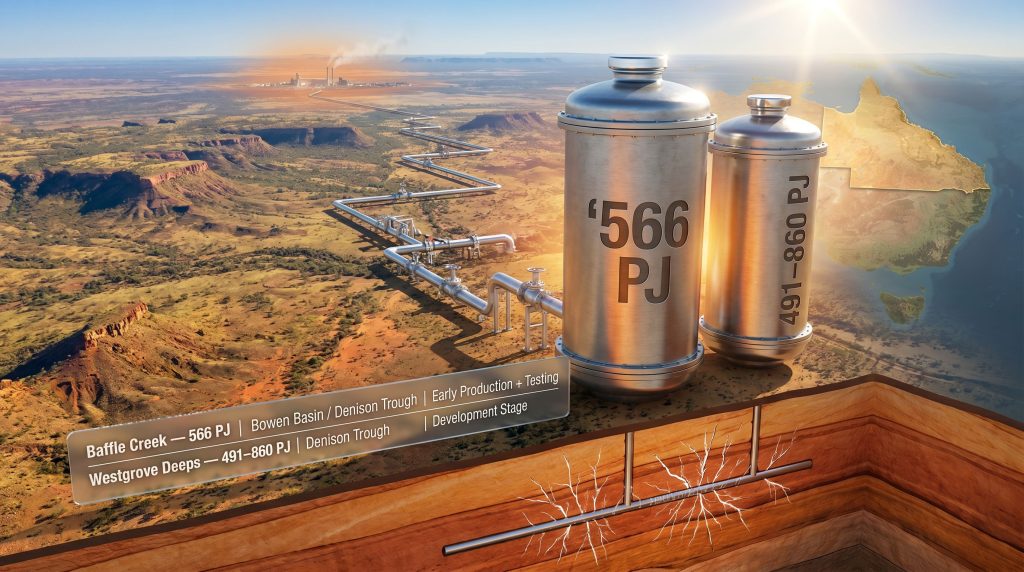
Running parallel to the Baffle Creek development is the Westgrove Deeps project, which targets the lower Reids Dome Beds formation within the same Denison Trough geology. Westgrove Deeps carries an estimated recoverable resource of 491 PJ on a P90 basis, with the P50 case extending to 860 PJ.
When these two projects are evaluated together, Denison's total unrisked tight gas resource inventory across the Denison Trough begins to approach and potentially exceed 1,000 PJ. That threshold carries specific significance in the investment community, as assets crossing it tend to attract attention from larger energy companies evaluating acquisition targets, joint venture partners, or long-term offtake arrangements.
The combination of Baffle Creek and Westgrove Deeps positions the Denison Trough as a multi-field tight gas province rather than a single-discovery story, which changes how institutional investors and strategic partners frame their risk assessment.
Dual-Market Access: Domestic Pipeline and LNG Export Linkage
Denison's pipeline network connects to the Eastern Australian gas transmission grid, which in turn serves all major east coast states: Queensland, New South Wales, Victoria, and South Australia. Critically, the same grid also links to the three LNG export terminals at Gladstone, being QCLNG, APLNG, and GLNG.
This dual-market access is an underappreciated structural advantage. Denison can, in principle, direct gas volumes toward either domestic industrial buyers or LNG-linked offtake arrangements depending on prevailing price signals. Indeed, Australia's energy export challenges make this kind of pricing flexibility increasingly valuable. Landlocked producers without this connectivity are constrained to a single market and lack the pricing optionality that comes from access to internationally benchmarked LNG netback pricing.
Early Revenue: The Boyne Island Connection
Industrial Offtake as Proof of Commercial Viability
Perhaps the clearest signal that the Baffle Creek discovery has moved beyond exploration into real commercial territory is the confirmation that gas from two wells in the four-well program is already flowing to the Boyne Island aluminium smelter in Queensland. Aluminium smelting is among the most energy-intensive industrial processes in the Australian economy, and the Boyne Island facility represents a major and consistent gas demand anchor.
Securing an industrial offtake customer of this scale during the exploration phase does several things simultaneously:
- It generates early revenue that can offset exploration and appraisal costs
- It demonstrates that the gas meets commercial pipeline quality specifications
- It provides management with production data that can refine reservoir models ahead of broader development decisions
- It reduces the investment risk profile of the project by establishing demand before field-scale capital commitments are made
The No-Flare Exploration Model: Regulatory and ESG Dimensions
Connecting Pilot Wells to Pipeline Instead of Burning Gas
Denison has positioned itself as an early adopter of a practice that is gaining traction as environmental scrutiny of upstream oil and gas operations intensifies. Rather than flaring gas during exploration and pilot production phases, a standard industry practice that combusts economically stranded gas volumes and generates Scope 1 greenhouse gas emissions, Denison has connected its pilot wells directly to commercial pipeline infrastructure.
This approach is technically complex. It requires pipeline access agreements, metering infrastructure, and gas quality compliance to be established earlier in the project lifecycle than is typical. The operational effort involved is non-trivial, but the benefits are measurable:
- Elimination of routine flaring reduces Scope 1 methane and CO2 emissions from operations
- Earlier pipeline connectivity means exploration gas volumes generate revenue rather than being wasted
- Regulatory alignment positions the company favourably as Australian authorities tighten methane management requirements for onshore operators
For institutional investors applying ESG screening frameworks, the no-flare model is increasingly a differentiating factor when evaluating upstream energy assets in Australia. In addition, these sustainability transformation strategies are becoming a de-facto expectation across the broader resources sector.
The next major ASX story will hit our subscribers first
Expansion Plans and the Capacity Doubling Program
What Doubling Processing Capacity Signals to the Market
The scale of the Baffle Creek discovery has prompted Denison to commit to doubling its gas processing plant capacity and expanding its condensate storage infrastructure within 12 months of the discovery announcement. Capital commitments of this nature, made at the appraisal stage before full field development decisions are finalised, reflect a high degree of management confidence in the commercial outcomes of the ongoing testing program.
From an investor perspective, this kind of infrastructure pre-investment is a leading indicator of conviction. Management teams that expand processing capacity ahead of confirmed production ramp-up are signalling that their internal resource models are sufficiently robust to justify fixed capital expenditure before the market has fully priced the discovery.
Key Risk Factors That Investors and Analysts Should Monitor
Technical Uncertainty in Tight Gas Plays
Tight gas reservoirs carry inherent variability in production outcomes that conventional gas plays generally do not. The 566 PJ initial estimate will be refined significantly as more well data becomes available. Key risk variables include:
- Natural fracture intensity within the deep sandstone formations, which strongly influences how effectively hydraulic stimulation creates productive flow networks
- Reservoir pressure at depth, which drives initial production rates following stimulation
- Stimulation design effectiveness, particularly in the extended horizontal section of Baffle Creek 7
- Decline rate characteristics, which determine how quickly individual well production falls after initial peak rates and thus how many wells are required to sustain field-level output
Regulatory Requirements for Onshore Gas in Queensland
Onshore gas development in Queensland operates under the Petroleum and Gas (Production and Safety) Act 2004, with associated environmental authority conditions governing well construction, water management, and land access. Hydraulic fracture stimulation requires specific regulatory approval, and groundwater protection conditions are a material compliance consideration given the agricultural character of Queensland's Bowen Basin farming regions.
Community and landowner engagement also remains a practical consideration for onshore operators. The history of coal seam gas development in Queensland has made some regional communities sensitive to new hydrocarbon development activity, and proactive stakeholder management is increasingly a de-facto requirement alongside formal regulatory compliance.
Market Pricing Dynamics
East coast natural gas price trends are influenced by a complex interplay of LNG netback pricing, seasonal industrial demand, renewable energy penetration affecting gas-fired power generation, and competitive supply dynamics between coal seam gas and emerging tight gas producers. Furthermore, gas price forecasts across the east coast suggest that as Baffle Creek production ramps up into a market gradually adding new supply from multiple Queensland sources, the pricing environment will need to be monitored carefully.
Disclaimer: This article contains references to resource estimates, market projections, and development timelines that are inherently forward-looking and subject to material uncertainty. Nothing in this article constitutes financial advice. Readers considering investment decisions should conduct independent due diligence and consult qualified financial advisers.
Comparing Queensland's Significant Gas Resources
| Gas Field or Project | Estimated Resource | Basin or Formation | Development Stage |
|---|---|---|---|
| Baffle Creek (Denison Gas) | 566 PJ initial estimate | Bowen Basin, Denison Trough | Early production and testing |
| Westgrove Deeps (Denison Gas) | 491 PJ (P90) to 860 PJ (P50) | Denison Trough | Development stage |
| Surat Basin CSG portfolio (major operators) | Multi-trillion cubic feet combined | Surat Basin | Mature, LNG-linked production |
Note: Direct resource comparisons across different gas types, including tight gas and coal seam gas, require methodological caution. Recovery factors, development costs, and production profiles differ substantially across these categories.
What the Baffle Creek Discovery Signals for Queensland's Energy Future
The Denison Gas Queensland gas discovery at Baffle Creek does not exist in isolation. It arrives at a moment when the structural tension between east coast domestic gas demand and LNG export volumes is creating sustained pressure on both industrial users and policymakers to identify new supply sources. Discoveries of this scale, particularly those with existing infrastructure connectivity and early production revenue, carry strategic weight that goes beyond their immediate resource estimate.
Several dimensions of this story deserve ongoing attention:
- The Q3 2026 fracture stimulation and testing program at Baffle Creek 7 will be the most significant near-term data point for refining the resource estimate and production outlook
- The combined Denison Trough resource inventory spanning Baffle Creek and Westgrove Deeps is approaching a scale that typically attracts strategic partnership interest from larger energy companies
- The no-flare operational model being implemented at Baffle Creek may influence regulatory expectations and industry practice for future tight gas exploration in Queensland
- The Boyne Island industrial offtake demonstrates that the discovery is already generating commercial gas deliveries, removing one layer of development risk from the investment thesis
The Denison Trough has historically been viewed as a secondary hydrocarbon province relative to Queensland's dominant Surat Basin coal seam gas fields. However, the Baffle Creek discovery, alongside the advancing Westgrove Deeps project, is beginning to reframe how the industry and the investment community evaluate the tight gas potential of this underexplored formation.
For further reading on Australia's east coast gas market and onshore Queensland exploration activity, the Oil & Gas Journal provides ongoing coverage of upstream exploration and development across Australian and global energy markets.
Want to Stay Ahead of Significant ASX Energy and Resource Discoveries?
Discovery Alert's proprietary Discovery IQ model delivers real-time alerts the moment significant mineral and resource discoveries are announced on the ASX, giving subscribers an immediate edge in identifying actionable opportunities — start your 14-day free trial today and see why understanding the historic returns of major discoveries can be so compelling.