May 21, 2026
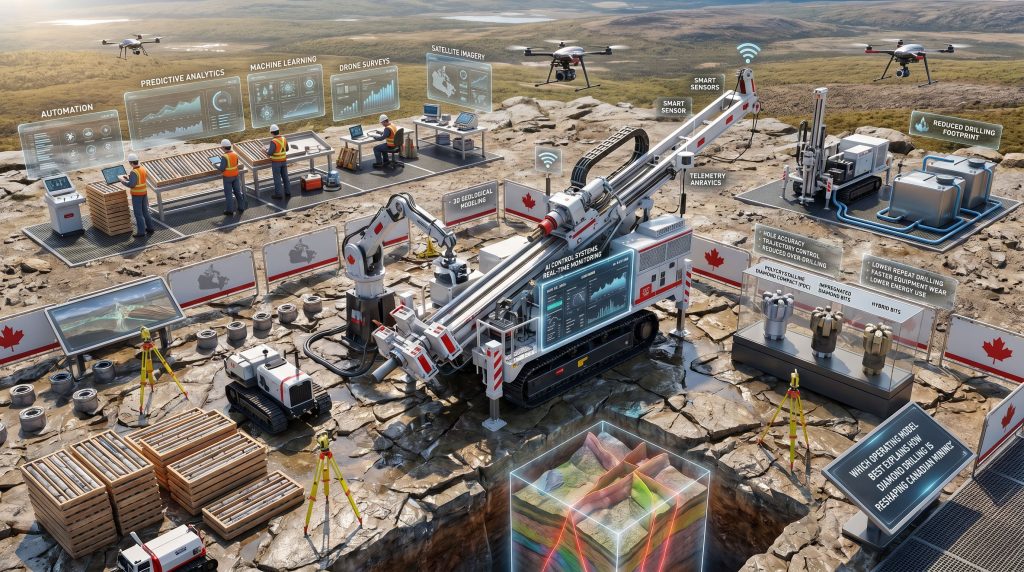
Diamond drilling has moved far beyond the old idea of simply cutting rock and waiting for assays. In Canadian mining, it increasingly functions as a decision engine that links geology, engineering, safety, logistics, and environmental performance. That shift matters because Canada combines difficult terrain, long mobilisation distances, deep targets, and complex orebody geometry, all of which make bad drilling decisions expensive.
When mining teams discuss how diamond drilling is reshaping canadian mining, the real story is not just faster penetration or tougher bits. It is the rise of a more precise operating model built around digital planning, real-time sensing, better core quality, tighter geological interpretation, and reduced field waste.
For remote projects in particular, the value of each useful metre drilled can be far more important than the headline number of metres completed. Furthermore, industry coverage on Canadian diamond drilling shows how strongly innovation is now tied to exploration efficiency.
When big ASX news breaks, our subscribers know first
Why diamond drilling has become a systems-level advantage in Canada
Diamond drilling is the process of cutting cylindrical rock core with diamond-based tooling so geologists and engineers can study the subsurface in detail. It matters in Canada because the country’s mineral endowment includes gold, base metals, uranium, and critical minerals often hosted in structurally complicated or remote settings where uncertainty is costly.
Modern drilling programmes now combine:
- Higher-accuracy hole placement
- Automated or semi-automated rig controls
- Sensor-driven monitoring
- Digital geological logging
- 3D geological modelling
- Lower-impact field practices such as compact rig layouts and water recycling
The result is a better match between drilling spend and geological learning. In practical terms, that can mean fewer unnecessary holes, stronger confidence in resource estimation, lower repeat drilling, and less worker exposure around rotating equipment or unstable ground.
Key point: a good programme should be judged by decision quality, not drilling activity alone.
How modern diamond drilling works in a Canadian mining workflow
The workflow usually begins long before a hole is collared. Exploration and mine-site teams use geophysics, geochemistry, mapping, historic drilling, and surface models to prioritise targets. After that, drill planners define collar position, azimuth, dip, depth, and alternate scenarios if ground conditions or geology differ from expectations.
Once drilling begins, a diamond bit cuts intact core that is brought to surface in runs. The core is then oriented where possible, measured for recovery, photographed, logged, sampled, and stored. Data from geology, structure, geotechnical observations, and assays is then integrated into 3D models.
These models inform the next decision cycle: expand the campaign, tighten spacing with infill drilling, pause a target, or redesign the programme. In addition, tools such as downhole geophysics can sharpen targeting between holes and reduce guesswork.
Workflow comparison
| Workflow stage | Traditional approach | Modern digital approach | Operational impact |
|---|---|---|---|
| Planning | Static targeting from legacy maps and sections | Integrated geophysics, drone topography, GIS, and 3D modelling | Better collar accuracy and fewer low-value holes |
| Drilling | Heavy reliance on operator feel | Parameter control assisted by automation and rig telemetry | More consistent trajectory and repeatability |
| Maintenance | Reactive repairs after failure | Predictive maintenance using sensor data | Lower downtime and reduced field interventions |
| Logging | Paper-based descriptions and manual transcription | Digital logging platforms, photos, orientation data | Fewer errors and faster interpretation |
| Modelling | Periodic updates after assay batches | Ongoing model revisions as data arrives | Faster target reprioritisation |
| Environmental management | Broad disturbance footprint | Smarter pad design, fewer repeat holes, water management | Lower site impact per useful metre |
Which technologies are changing drilling performance fastest
Automation and robotic controls
Semi-automated systems can regulate feed pressure, rotation speed, and other drilling parameters with more consistency than manual operation alone. This does not eliminate skilled drillers. Instead, it reduces shift-to-shift variability and helps maintain steadier performance through changing ground conditions.
In Canadian conditions, partial automation may be more realistic near term than fully autonomous fleets because connectivity, camp logistics, and maintenance support can limit advanced deployments. Even so, semi-automation can improve hole straightness, bit life, and parameter consistency before full autonomy becomes viable.
Real-time monitoring and smart sensors
Rig-based and downhole systems can track torque, vibration, fluid conditions, penetration behaviour, and equipment health. When combined with live dashboards, these inputs help crews adjust before small deviations become expensive problems.
Predictive maintenance is one of the most practical gains because remote repairs are slow and costly in northern programmes. Likewise, formal standards promoted by the Canadian Diamond Drilling Association highlight the importance of safe and disciplined operating practice.
Advanced bit engineering
Bit selection remains one of the least glamorous but most financially important drilling decisions.
| Bit type | Best suited for | Main advantage | Key trade-off |
|---|---|---|---|
| Impregnated diamond bit | Hard, abrasive formations | Durable in tough rock and common in mineral exploration | May be slower in some ground conditions |
| PDC bit | Certain softer to medium formations with suitable conditions | Faster penetration in the right geology | Performance can fall off in highly variable or very abrasive rock |
| Hybrid bit | Mixed formations | Balances speed and durability | Requires careful matching to lithology and depth |
The wrong bit is not just a consumables problem. It can degrade recovery, increase deviation, and raise cost per useful metre drilled.
Why precision matters in exploration and mine development
Accurate hole placement reduces wasted metres. That is especially important when a target is narrow, steeply dipping, fault-offset, or deeply buried. Missing such zones by a small margin can produce misleading geology and trigger unnecessary step-out drilling.
Better core recovery also improves far more than grade interpretation. High-quality core supports:
- Structural geology and vein orientation work
- Geotechnical analysis for slope or underground stability
- Geometallurgical studies linked to processing behaviour
- Resource estimation with stronger confidence in continuity
For Canadian operations moving from early-stage exploration to resource definition, the quality of the subsurface dataset often matters more than sheer metres drilled. For instance, investors benefit from interpreting drill results correctly, especially when assessing infill campaigns and continuity.
Infill drilling is designed to tighten spacing and support classification gains from inferred towards indicated and measured categories under NI 43-101 reporting frameworks. However, outcomes always depend on the specific geology, spacing, QA/QC, and competent person judgement.
How drilling data is becoming more valuable than drilling metres alone
Core by itself has limited value until it is transformed into decision-grade geological intelligence. Modern programmes increasingly integrate core photos, orientation data, assays, alteration logging, geotechnical measurements, and structural interpretations into a continuously updated 3D model.
Drone surveys and satellite data can improve surface control and terrain understanding, while subsurface modelling helps refine the next round of targeting. Moreover, understanding true vs apparent widths is essential when translating intercepts into realistic geological expectations.
This is where machine learning and predictive analytics are gaining attention. In practice, their strongest current use cases are usually:
- Maintenance prediction
- Pattern recognition across large historic drilling datasets
- Target ranking support
- Operational anomaly detection
The realistic framing is important. These tools are usually best viewed as decision support, not a substitute for geologists, drill supervisors, or geotechnical specialists. In that context, AI in mineral exploration is most useful when it reduces uncertainty rather than simply adding more data layers.
Operational takeaway: the best digital drilling programmes reduce uncertainty faster, not merely generate more files.
The next major ASX story will hit our subscribers first
Safety gains from next-generation drilling
One of the clearest benefits of modern diamond drilling is lower human exposure in hazardous zones. Remote-controlled or semi-autonomous rigs can reduce time spent near rotating rods, unstable drill setups, or severe weather conditions.
That matters most in fly-in camps, deep winter programmes, and difficult terrain where emergency response complexity is higher. Consequently, safety improvement is broader than automation alone. It comes from fewer emergency interventions, less manual inconsistency, and better visibility into equipment condition.
Predictive maintenance adds another safety layer. A planned intervention is generally safer than a sudden breakdown requiring reactive field repairs under pressure.
Lower-impact drilling and ESG relevance
More precise targeting can reduce disturbance by lowering the number of unnecessary holes and avoiding duplicated work. Smaller rig footprints, compact mobilisation strategies, and stronger drill planning can also reduce fuel burn and material consumption for the same geological outcome.
Electric or lower-emission rigs are being introduced in parts of the market, although results depend heavily on site power source, logistics, climate, and economics. Water management is another practical lever. Closed-loop systems and water recycling can reduce freshwater demand and drilling waste, particularly where access and environmental sensitivity are major issues.
Canadian operators also work within a framework that places strong emphasis on environmental assessment, reclamation obligations, and Indigenous engagement. That does not mean any specific project has official support. It does mean drilling contractors and project owners are under growing pressure to show that field programmes are efficient, well-managed, and lower impact.
Metrics mining teams should track
Teams trying to understand how diamond drilling is reshaping canadian mining should watch a mix of operational, geological, safety, and environmental KPIs.
Core drilling KPIs
- Core recovery percentage
- Deviation from planned trajectory
- Penetration rate by lithology
- Bit life and consumable usage
- Cost per metre
- Cost per useful metre
- Downtime hours and maintenance frequency
Geological and project KPIs
- Percentage of holes that achieve target objectives
- Repeat drilling rate
- Time from drilling to modelled interpretation
- Assay integration time
- Resource confidence improvement after infill drilling
ESG and safety KPIs
- Energy use per metre drilled
- Water reuse rate
- Exposure hours in higher-risk zones
- Site disturbance per completed campaign
- Emission intensity where measurable
FAQ
What is diamond drilling in mining?
It is a drilling method that cuts cylindrical rock core using diamond-based bits so teams can study rock type, structure, mineralisation, and ground conditions below surface.
Why is diamond drilling important in Canada?
Canada’s deposits are often remote, deep, or geologically complex, so reliable subsurface data is essential for exploration, resource estimation, geotechnical design, and mine development.
How does automation improve diamond drilling?
Automation can reduce operator variability, improve consistency, support remote operation, and help optimise drilling parameters in real time.
Does better drilling reduce environmental impact?
It can, particularly when improved targeting leads to fewer unnecessary holes, less duplicated work, better water management, and lower disturbance per useful metre drilled.
Final perspective
The most important change in Canadian diamond drilling is not simply more advanced hardware. It is the emergence of a connected drilling workflow where rigs, sensors, geologists, modellers, and planners operate as part of one system. That is the clearest explanation for how diamond drilling is reshaping canadian mining.
Companies and contractors that modernise the full workflow, from target generation to modelled interpretation, are more likely to drill fewer wasteful metres, make faster decisions, improve safety performance, and build stronger technical confidence. Ultimately, how diamond drilling is reshaping canadian mining is best measured through verified field results rather than promotional claims alone.
Could the Next Major Discovery Be Spotted Early?
Investors following evolving exploration methods can use Discovery Alert’s proprietary Discovery IQ model to receive real-time alerts on significant ASX mineral discoveries, turning complex drilling and geological data into actionable opportunities. To see how major discoveries have delivered exceptional returns in the past, explore Discovery Alert’s discoveries page and start a 14-day free trial today.