June 14, 2026
The Permian Basin's Hidden Superpower: Speed
Most oil-producing regions on earth share a fundamental constraint that rarely appears in headlines: time. Building a deepwater platform from final investment decision to first oil typically consumes five to seven years. Sanctioning a new LNG liquefaction train requires three to five years of engineering, procurement, and construction before a single molecule reaches market. Even conventional onshore developments in frontier basins demand twelve to twenty-four months of drilling and infrastructure buildout before meaningful volumes flow.
The Permian Basin operates by entirely different physics. When global supply tightens sharply enough, operators holding inventory of drilled but uncompleted wells can begin converting dormant wellbores into producing assets within weeks. This structural speed advantage sits at the centre of the Diamondback Permian production increase announced in May 2026, and it explains why events unfolding inside a single Texas operator's completion schedule carry consequences that ripple across global crude balances.
When big ASX news breaks, our subscribers know first
A Market That Reversed Course at Historic Speed
Understanding why Diamondback made this particular move at this particular moment requires stepping back from company-level detail and examining the macro environment that created the opening.
Earlier in 2025 and into early 2026, the dominant expectation across most major energy forecasting organisations was a gradual supply surplus building through mid-2026. Demand growth projections had moderated, OPEC's market influence appeared to be softening at the margins, and non-OPEC supply growth from Guyana, Brazil, and the U.S. looked set to comfortably cover consumption increases. The forward curve reflected this: futures prices were priced in modest contango, signalling adequate near-term supply.
Then physical reality diverged sharply from paper markets.
Global production fell by more than 8 million barrels per day in March 2026, with additional declines recorded through April, according to reporting by World Oil (May 4, 2026). To calibrate the severity of that figure, a contraction exceeding 8 MMbpd is comparable in scale to removing the entire output of a mid-sized OPEC member nation from global supply simultaneously, sustained across a full month. Middle East supply disruptions accelerated an imbalance that was already beginning to form, acting as an amplifier to underlying structural tightness rather than its sole cause.
The consequence was a price signal that futures markets alone did not capture. Physical delivery prices for crude oil and refined products began rising independently of futures, and in certain regions, localised shortages of specific crude grades and petroleum products began emerging. This phenomenon, known in trading circles as a physical market premium or cash-futures basis blowout, is a particularly powerful signal for shale operators because it reflects genuine near-term scarcity rather than speculative positioning.
Furthermore, the crude oil price trends observed throughout this period reinforced just how swiftly sentiment had shifted from oversupply anxiety to genuine scarcity concern.
When physical delivery prices detach from futures and move higher, the market is communicating an unambiguous message: supply is genuinely short right now, not just forecast to be short later. That distinction matters enormously for operators deciding whether to commit capital.
What the Diamondback Permian Production Increase Actually Involves
The DUC Well: The Oil Industry's Most Underappreciated Asset
Before examining the strategic logic of the Diamondback Permian production increase, it is worth explaining precisely what a drilled but uncompleted well is and why it functions as such a powerful production lever.
When an oil company drills a horizontal well in the Permian Basin, the process involves two distinct phases. The first phase, drilling, involves boring a wellbore from surface to total depth, typically thousands of feet vertically and then extending horizontally through the target formation for a mile or more. This phase is capital-intensive and time-consuming, but it produces no oil.
The second phase, completion, involves perforating the wellbore casing and pumping millions of gallons of pressurised fluid and proppant (typically sand) into the formation in a process called hydraulic fracturing. Only after completion does the well begin producing hydrocarbons.
A DUC well has completed phase one but not phase two. It represents pre-invested capital sitting dormant, awaiting the economic signal that justifies committing the additional completion expenditure. In a low-price environment, operators may hold DUCs in inventory rather than complete them at thin margins. When prices recover, DUC conversion becomes the fastest available path to incremental production because the drilling phase, which constitutes roughly 50–60% of total well cost, is already behind them.
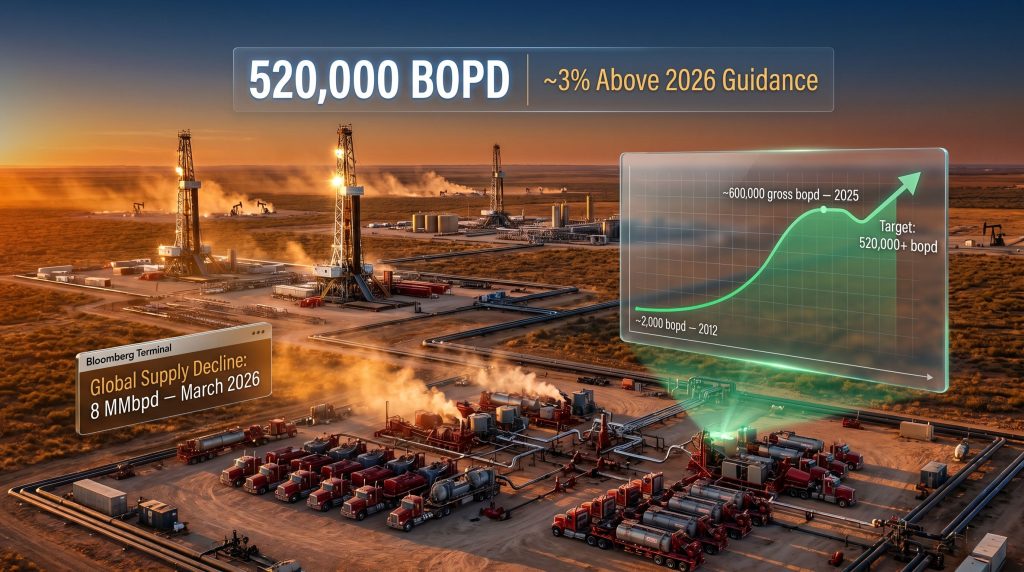
Diamondback's strategy involves deploying five hydraulic fracturing and completion crews to work down its DUC inventory, targeting output above 520,000 barrels of oil per day — a level approximately 3% above its original 2026 guidance. The company also plans to add two to three drilling rigs to sustain longer-term activity and preserve flexibility as market conditions evolve, per World Oil's May 2026 reporting.
Operational Scale and What Five Completion Crews Actually Means
The number five deserves particular attention. Large Permian Basin operators typically run one to three completion crews during normalised activity periods. Five simultaneous crews represents an elevated operational tempo that carries significant logistical implications.
Each completion crew requires:
- A hydraulic fracturing spread (the physical pump equipment and blending systems)
- A dedicated water supply and handling system, as modern Permian completions consume millions of gallons per well
- A crew of specialised personnel including engineers, pump operators, and field supervisors
- Coordination with midstream infrastructure teams to ensure gathering systems can handle incremental production volumes as wells come online
Running five crews simultaneously requires orchestrating all of these elements in parallel across multiple well pads, often with different geology, different well designs, and different infrastructure readiness states. The fact that Diamondback is committing to this tempo signals management's confidence that its DUC inventory is of sufficient quality to justify the operational intensity.
| Operational Metric | Detail |
|---|---|
| Production Target (2026) | Above 520,000 bopd |
| Premium to Original Guidance | Approximately 3% |
| Completion Crews Deployed | Five crews for remainder of 2026 |
| Rig Additions Planned | Two to three additional rigs |
| Global Supply Decline (March 2026) | More than 8 MMbpd |
| Q1 2026 EPS Change (est.) | Approximately 21.8% decline year-over-year |
| 2025 Production Scale | Approximately 1 million BOE/day (~600,000 gross bopd) |
| Production at IPO (2012) | Approximately 2,000 bopd |
From 2,000 Barrels to 600,000: The Architecture of a Permian Giant
How Diamondback Built Its Basin-Dominant Position
Diamondback Energy entered public markets in 2012 producing approximately 2,000 barrels of oil per day. By 2025, the company had scaled to roughly 1 million barrels of oil equivalent per day in gross terms, with approximately 600,000 gross barrels per day of oil production, according to company disclosures. That trajectory represents one of the most dramatic production growth stories in the history of U.S. onshore oil development, accomplished through a disciplined combination of organic drilling and strategic acquisition.
The company's growth model, sometimes described in industry circles as an "acquire and exploit" approach, differs from explorers who take greenfield risk. Diamondback has typically purchased acreage with known geology and existing production, then applied operational efficiency improvements, modern completion designs, and pad-based development to extract more value per acre than prior operators achieved. This basin-concentration philosophy creates meaningful advantages: integrated infrastructure, predictable subsurface behaviour informed by dense well data, and the organisational muscle memory that comes from repeating similar operations at scale.
It also creates a form of strategic concentration risk. Diamondback's fortunes are almost entirely tied to Permian Basin commodity prices and operating conditions. When the Permian performs well, Diamondback captures the full benefit. When basin-specific challenges arise — such as pipeline takeaway constraints, produced water disposal limitations, or regional labour shortages — there is no other geographic exposure to buffer the impact.
The Post-Acquisition Growth Reset
The aggressive acquisition activity of 2024 and 2025 meaningfully expanded Diamondback's asset base but simultaneously reset the growth baseline against which analysts measure performance. Post-merger integration periods typically involve elevated per-unit costs, operational complexity, and a period of normalising production rates across newly acquired assets.
First-quarter 2026 earnings per share are projected to reflect a decline of approximately 21.8% year-over-year, driven by lower realised commodity prices during that period combined with this post-acquisition normalisation dynamic. The current crude oil prices environment will consequently prove critical to whether Diamondback can reverse that earnings trend through the remainder of the year.
The tension Diamondback faces is a familiar one in the shale industry: demonstrating that production growth and capital efficiency are not mutually exclusive. Accelerating output in response to price signals must translate into improved per-barrel returns, or analysts will interpret the activity increase as capital inefficiency rather than strategic opportunism.
Capital Discipline vs. Market Opportunity: The Core Investor Question
Why This Balance Is Being Watched Closely in 2026
The U.S. shale industry spent most of the period from 2015 to 2021 rebuilding investor credibility after a decade of growing production at the expense of returns. Capital discipline frameworks — in which operators commit to spending within cash flow and returning excess capital to shareholders rather than chasing volume growth — became the dominant philosophy across the sector. Investors who previously rewarded production growth per share shifted their preference decisively toward free cash flow generation and shareholder returns.
The May 2026 environment tests that framework in an important way. When physical markets tighten sharply and short-cycle production economics improve materially, the rational response for a Permian operator sitting on DUC inventory is to accelerate completions. However, the US shale drilling slowdown context of preceding months makes this acceleration all the more strategically notable. The DUC conversion strategy partially resolves the capital discipline tension because it deploys already-sunk drilling capital rather than authorising entirely new well programmes.
The key metrics analysts are monitoring through the remainder of 2026 include:
- Whether Diamondback achieves and sustains output above the 520,000 bopd floor
- Per-unit operating costs as completion activity ramps, since five-crew operations can create temporary inefficiencies if pad logistics are not optimised
- Free cash flow generation relative to the incremental capital committed to completions and rig additions
- Realised price per barrel relative to benchmark WTI, since localised physical market premiums can improve netback economics beyond headline crude prices
Three Scenarios for the Remainder of 2026
How Different Market Trajectories Change the Equation
The Diamondback Permian production increase is being executed against a backdrop of genuine uncertainty about whether current tightness is durable or transient. Three distinct scenarios carry different implications for the company's strategy and financial outcomes.
Scenario A: The Deficit Stabilises at Current Levels. Diamondback's DUC programme delivers above-guidance volumes through Q2 and Q3 2026. Physical prices remain elevated relative to forward curves. The company captures a short-cycle production premium, free cash flow improves, and the completion programme winds down naturally as DUC inventory is drawn to optimal levels. This represents the base case implicit in management's current strategic framing.
Scenario B: The Global Deficit Deepens Further. Supply disruptions prove more persistent than initially anticipated, or demand surprises to the upside. Diamondback adds additional rigs beyond the two to three currently planned, full-year guidance is revised upward, and the broader Permian operator community follows with similar expansions. The basin becomes the global swing producer of last resort, drawing down DUC inventory across multiple operators simultaneously. This scenario would likely push per-unit costs higher across the industry due to service sector capacity constraints.
Scenario C: Market Conditions Reverse. OPEC+ production restoration, demand softening from macro headwinds, or resolution of supply disruptions compresses physical premiums. In addition, the trade war impact on oil could further compound downward pressure on commodity prices in this outcome. Operators who accelerated activity find themselves with elevated cost structures in a lower-price environment, and companies that over-committed operationally during the price spike face margin compression.
The next major ASX story will hit our subscribers first
The Permian's Structural Role as Global Swing Supplier
Why No Other Basin Can Match This Response Capability
The strategic significance of the Diamondback Permian production increase extends well beyond a single company's quarterly volume targets. The Permian Basin's combination of geological quality, operational maturity, and midstream infrastructure density creates a supply response capability that no other major producing region can replicate at equivalent speed.
The geological characteristics are foundational. The Permian contains multiple stacked pay intervals — including the Wolfcamp, Bone Spring, Spraberry, and Dean formations — meaning operators can often select from several target zones on the same well pad depending on which offers the best current economics. Decades of conventional production and fifteen-plus years of horizontal shale development have generated a subsurface dataset of extraordinary density, reducing geological uncertainty to levels far below frontier basin averages.
The infrastructure ecosystem amplifies this advantage. The Permian Basin is served by an extensive network of crude oil gathering systems, long-haul pipelines to Gulf Coast export terminals, natural gas processing plants, and produced water disposal infrastructure. This midstream density means that when a completion crew finishes a well, the path from wellbore to tanker is typically already in place. New production volumes can enter the global market within days of first oil rather than waiting for infrastructure construction.
The DUC-to-barrel conversion process itself, when executed at the scale Diamondback is now undertaking, follows a defined operational sequence:
- Well inventory assessment, identifying which DUCs are technically ready for completion without remediation
- Crew and equipment mobilisation, positioning hydraulic fracturing spreads at designated pad locations
- Stimulation operations, perforating target intervals and executing multi-stage hydraulic fracturing programmes
- Flowback management, controlling initial high-rate production to optimise reservoir pressure drawdown
- Artificial lift installation, deploying rod pumps or electric submersible pumps as natural reservoir pressure declines
- Midstream integration, connecting completed wells to gathering systems and confirming sales line capacity
- Volume recognition, reporting incremental barrels against guidance benchmarks in quarterly disclosures
Furthermore, Diamondback's Permian edge — built through years of basin-concentrated investment — means the company can execute this sequence more efficiently than most peers, compressing the timeline from DUC identification to first saleable barrel.
Frequently Asked Questions
What exactly is the Diamondback Energy Permian production increase targeting?
Diamondback is targeting output above 520,000 barrels of oil per day, a level roughly 3% above the company's original 2026 production guidance. The increase is being achieved primarily through accelerated conversion of drilled but uncompleted wells rather than new drilling starts.
Why did the company choose this moment to accelerate production?
Global oil supply fell by more than 8 million barrels per day in March 2026, with further declines in April, according to World Oil. Physical crude and product prices rose above futures market levels, with some regions beginning to experience localised shortages. These conditions represent the market signal that Diamondback's management characterised as justification for immediately bringing incremental production to market.
What is the difference between a DUC well and a new drilled well for production growth purposes?
A DUC well has already incurred drilling costs, which typically represent 50–60% of total well expenditure. Converting it to production requires only the completion phase expenditure. This makes DUC conversion substantially faster and cheaper per incremental barrel than drilling a new well from scratch, with first oil achievable in weeks rather than months.
How does Diamondback's current scale compare to its origins?
The company produced approximately 2,000 barrels per day when it went public in 2012. By 2025 it had reached approximately 600,000 gross barrels per day of oil production, representing roughly a 300-fold expansion over thirteen years through acquisitions and organic development.
What are the primary risks to this strategy?
The central risks include commodity price reversal if OPEC+ restores supply or demand softens, integration complexity from recent acquisitions elevating near-term unit costs, and the possibility that accelerating volume growth proves difficult to reconcile with maintaining the capital efficiency standards that Permian Basin investors now expect as a baseline requirement.
This article contains forward-looking statements and scenario projections based on publicly available information. Commodity prices, production outcomes, and market conditions are inherently uncertain. Nothing in this article constitutes financial or investment advice. Readers should conduct independent research before making investment decisions.
Want To Catch The Next Major Mineral Discovery Before The Market Does?
While the Permian Basin's speed advantage reshapes global oil supply, Discovery Alert's proprietary Discovery IQ model delivers real-time alerts on significant ASX mineral discoveries — instantly turning complex data into actionable insights for investors at every level. Explore historic discoveries and their remarkable returns, then begin your 14-day free trial to position yourself ahead of the market.