
May 12, 2026
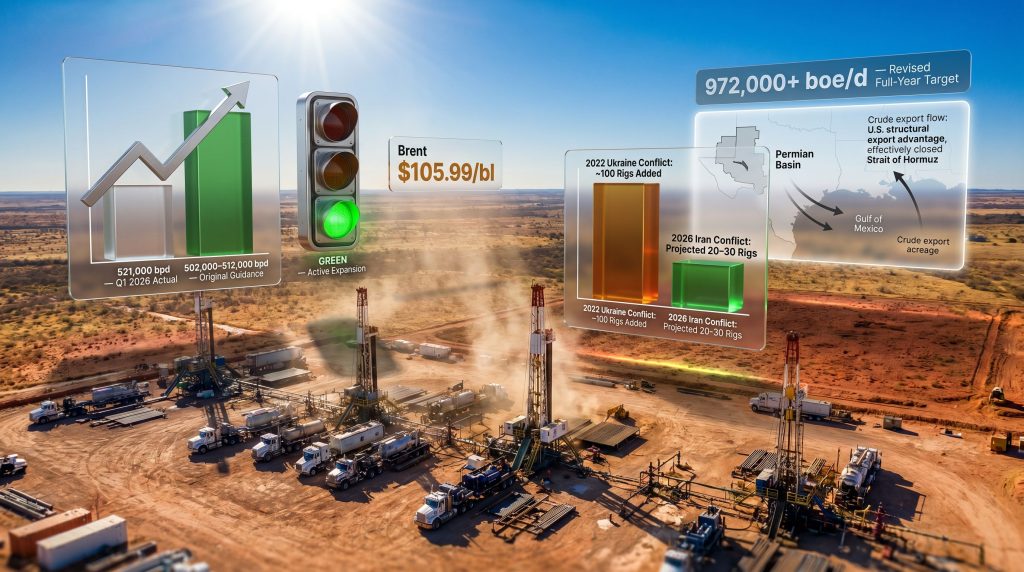
When Geopolitics Overrides Capital Discipline: What the Diamondback Shale Production Increase Tells Us About the New Oil Order
The modern shale industry was not built on abundance alone. It was rebuilt, after a decade of painful trial and error, on restraint. Following the catastrophic price collapse of 2014 to 2016 and the demand destruction of 2020, U.S. operators renegotiated the unspoken contract with investors: capital efficiency and shareholder returns would take precedence over chasing barrels. That philosophy held firm through price recoveries, geopolitical tremors, and White House pressure campaigns alike.
Which makes the Diamondback shale production increase of May 2026 genuinely significant. It is not simply a company adding rigs during a price rally. It represents one of the first deliberate reversals of the post-boom operating model by a major pure-play Permian Basin independent, triggered by conditions specific enough, and durable enough, to clear the very high bar that capital-disciplined operators had set for themselves.
Understanding why that bar was cleared, and why others have not yet crossed it, illuminates far more than one company's quarterly production beat.
When big ASX news breaks, our subscribers know first
The Architecture of the "Returns Before Barrels" Era
From 2022 onward, U.S. shale operators broadly adopted a framework that prioritised distributing free cash flow to shareholders over maximising production volumes. This was not a passive or accidental shift. It was a direct institutional response to two catastrophic cycles that erased billions in investor capital and drove dozens of shale-focused companies into bankruptcy.
The structure of this discipline involved several interlocking commitments:
- Capping reinvestment rates at defined percentages of operating cash flow, regardless of prevailing prices
- Returning surplus capital through dividends and buybacks rather than reinvesting into growth
- Setting production targets based on free cash flow generation rather than technical upside potential
- Refusing to add rigs speculatively during price rallies without defined, visible demand signals
This framework transformed the shale industry from a volume-growth machine into something closer to a cash distribution vehicle, fundamentally altering how operators communicate with markets and how they define success.
The practical implication was that any deliberate production acceleration, when it came, would carry a heavier strategic signal than in prior cycles. An operator choosing to grow volumes under this framework is explicitly saying that conditions have crossed a clearly defined threshold, not merely that prices are high.
Why the Strait of Hormuz Closure Changed the Calculus
Short-term crude price spikes, even dramatic ones, have become structurally insufficient to shift capital-disciplined shale operators into expansion mode. The 2022 rally following Russia's invasion of Ukraine pushed WTI above $100 per barrel and attracted approximately 100 additional rigs to the Permian Basin. That response, followed by a relatively rapid price normalisation, reinforced the industry's caution about committing long-cycle capital to cyclical price signals.
The 2026 environment differs in a critical structural dimension: the disruption is not merely a price event. The effective closure of the Strait of Hormuz for over two months as of May 2026, driven by the Iran conflict, has removed a persistent volume of crude from global markets in a way that does not self-correct through diplomacy alone. The role of oil in the global economy makes such disruptions particularly consequential.
The scale of the supply disruption is staggering when examined through OPEC+ production data. According to Argus Media estimates, OPEC+ crude output fell by 1.59 million barrels per day in April 2026 alone, leaving group production approximately 11 million barrels per day below pre-war levels. The following table illustrates the depth of the shortfall among individual members:
| OPEC+ Member | April 2026 Output (mn b/d) | Target (mn b/d) | Shortfall (mn b/d) |
|---|---|---|---|
| Saudi Arabia | 6.32 | 10.17 | -3.85 |
| Iraq | 1.40 | 4.30 | -2.90 |
| Kuwait | 0.56 | 2.60 | -2.04 |
| UAE | 2.02 | 3.43 | -1.41 |
| Russia | 9.00 | 9.64 | -0.64 |
| Total OPEC+ | 31.34 | ~36.94 | ~-10.95 |
Source: Argus Media, May 2026
The pattern is not coincidental. Saudi Arabia, Iraq, Kuwait, and Bahrain are among the members most dependent on the Strait of Hormuz as their sole export corridor. When that waterway closes, their ability to move product collapses regardless of production capacity or quota frameworks. Furthermore, the OPEC influence on oil markets has rarely been more visible than in this current disruption cycle.
Diplomatic stalemate has further extended the disruption horizon. Iran's foreign ministry characterised its latest negotiating position as reasonable and constructive, while the U.S. administration described the Iranian proposal as entirely unacceptable and noted that the ceasefire was under severe strain as of May 11, 2026, according to Argus Media reporting. This visible deadlock has provided operators with the confidence that elevated prices and restricted supply are not a temporary phenomenon likely to resolve within weeks.
It was this combination of sustained crude prices above $100 per barrel, the Brent front-month contract reaching an intraday peak of $105.99/bl on May 11, 2026, and the structural durability of the supply disruption that cleared Diamondback's internal threshold for action.
Diamondback's Stoplight Framework and What the Green Light Means
Over the past year, Diamondback Energy has communicated its drilling intentions to investors through a colour-coded signalling system. The framework uses a traffic-light analogy: a red condition indicates restraint and production discipline; yellow indicates active monitoring of market conditions; and green signals explicit authorisation for production expansion. The simplicity of the model belies its strategic sophistication.
By making the trigger conditions publicly observable, the framework accomplishes two things simultaneously. First, it removes ambiguity for investors about when and why the company will shift capital allocation. Second, it commits management to a defined decision process rather than discretionary judgements that could be perceived as reactive or inconsistent.
CEO Kaes Van't Hof communicated through Argus Media that the light had definitively turned green, stating that a combination of growing worldwide supply disruptions and sustained prices above $100/bl constituted precisely the kind of signal that justified accelerating production from an advantaged basin position. The framing is careful and deliberate: this is not opportunistic barrel chasing. It is a planned strategic response to observable, structural market conditions that crossed pre-defined thresholds. According to Diamondback's own reporting, the company's first-quarter 2026 results confirmed both the production beat and the upward revision to full-year guidance.
Diamondback's Q1 2026 Production Numbers: A Closer Look
The specific figures behind the Diamondback shale production increase reveal a measured, capital-efficient acceleration rather than an unconstrained ramp:
| Metric | Original 2026 Guidance | Q1 2026 Actual | Revised Full-Year Target |
|---|---|---|---|
| Oil Production | 502,000–512,000 b/d | 521,000 b/d | 520,000+ b/d |
| Total Production (BOE/d) | ~960,000 boe/d | Exceeded guidance | 972,000+ boe/d |
| Capital Expenditure | $3.75 billion | N/A | $3.90 billion |
| Completion Crews | N/A | N/A | 5 consistent crews |
| Rig Additions | N/A | N/A | +2 to 3 rigs |
Source: Argus Media, May 2026
The 3 percent upside beat to original 2026 guidance translates to approximately 9,000 to 19,000 additional barrels per day at the midpoint, a meaningful but controlled increment rather than an aggressive step-change. The capital expenditure increase from $3.75 billion to $3.90 billion, a 4 percent budget uplift, reflects the cost of five completion crews and additional rigs without blowing out the underlying capital framework.
Critically, the primary mechanism for near-term production growth is the drawdown of drilled-but-uncompleted (DUC) wells. This is a strategically important distinction from new drilling campaigns. DUC wells have already absorbed their drilling capital costs. Completing them requires only the hydraulic fracturing and completion expenditure, typically a fraction of total well cost, which means incremental production can be achieved at lower marginal cost and on faster timelines than new drilling would allow.
Van't Hof also noted through Argus Media that the company retains the capacity to grow output further beyond its revised targets if conditions warrant, indicating the 520,000+ b/d figure represents a deliberate constraint rather than a technical ceiling. Notably, Diamondback beat first-quarter profit estimates, reinforcing investor confidence in the company's disciplined approach to expansion.
Why the Permian Basin Is the Logical Hub for Any U.S. Response
Not all shale basins are created equal in terms of rapid scalability. The Permian Basin's structural advantages over the Bakken, Eagle Ford, and other producing regions explain why it anchors the U.S. shale expansion response:
- Stacked pay zones: Multiple productive geological intervals within the same aerial footprint allow operators to develop incremental volumes from existing leasehold without proportional infrastructure additions
- Infrastructure density: Decades of development have created an extensive network of midstream gathering, processing, and transportation infrastructure that new incremental production can access without greenfield construction timelines
- Gulf of Mexico export access: Permian crude can reach major export terminals efficiently, positioning it competitively against disrupted Middle East supplies in international markets
- Cost structure: The combination of mature service networks, established supply chains, and operational experience keeps per-barrel development costs lower than in less-developed basins
- Existing workforce and equipment: Unlike frontier regions, the Permian has a resident workforce and established equipment fleets that reduce the lead time for accelerating completion activity
Van't Hof projected a total industry addition of 20 to 30 rigs across the Permian Basin in response to the current price environment, with privately held operators expected to lead the acceleration. This is a dramatically smaller response than the approximately 100 rigs added during the 2022 Ukraine-driven price rally, and the explanation matters enormously for understanding the volume impact.
The key factor is consolidation. The intervening years have seen significant merger and acquisition activity among shale operators, reducing the number of independent companies capable of rapid, discretionary scaling. Private firms, which historically drove the fastest rig additions due to fewer shareholder return obligations and disclosure requirements, have also declined in number. The result is a more concentrated industry with fewer actors capable of responding, even when the economics clearly support expansion.
The next major ASX story will hit our subscribers first
How the Broader Sector Is Responding: The Independent vs. Major Divide
The divergence between independent operators and integrated majors in response to the current price environment is one of the most structurally revealing features of the 2026 cycle. The table below captures the key strategic positions:
| Operator Type | Response to Price Rally | Key Rationale |
|---|---|---|
| Diamondback Energy | Accelerating: adding rigs and crews | Supply disruption signals; Permian cost advantage |
| Continental Resources | Reversed 20% budget cuts; increasing CapEx from $2.5B | Price confidence; private operator flexibility |
| BP/bpX Energy | ~8% U.S. shale growth planned for 2026 | Moderate growth within portfolio strategy |
| ExxonMobil | Maintaining pre-conflict pace; 12% Permian growth to 1.8mn boe/d | Long-cycle planning; global portfolio management |
| Chevron | Prioritising asset reliability and cash flow over volume growth | Operational efficiency focus; uncertainty over conflict duration |
| EOG Resources | Modest reallocation from gas to liquids; no rig additions confirmed | Cautious; insufficient visibility for longer-term commitment |
Source: Argus Media, May 2026
ExxonMobil is executing a 12 percent planned growth in Permian output for 2026, bringing production to 1.8 million boe/d, with CEO Darren Woods reiterating through Argus Media that the company intends to continue operating at full speed. However, this expansion was planned before the conflict, making it a continuation of prior strategy rather than a conflict-driven acceleration.
Chevron's position illustrates the tension facing large integrated operators. CEO Mike Wirth acknowledged through Argus Media reporting that the company has the operational capacity to accelerate Permian growth but chose to prioritise improved asset reliability and reduced downtime, noting that a rapid pivot toward volume growth could dilute the operational discipline generating tangible cash flow improvements.
EOG Resources represents the most cautious posture among independents. CEO Ezra Yacob noted through Argus Media that conditions were insufficient to justify committing to rig or frac fleet additions with a longer-term investment horizon, describing the current environment as too early to make definitive forward production calls.
The independent vs. major divide is not simply a risk appetite difference. It reflects fundamentally different capital allocation frameworks, planning horizons, and investor mandate structures. Majors managing global portfolios cannot pivot production strategy in response to regional price signals the way that pure-play basin operators can.
The Competitive Landscape: Non-OPEC Producers Positioning for Market Share
The Strait of Hormuz closure has created a strategic opportunity that extends well beyond the Permian Basin. At the Offshore Technology Conference in Houston in May 2026, Latin American producers made their case explicitly. Brazil, Guyana, and Argentina collectively produced approximately 6 million barrels per day as of May 2026, with Brazil setting a national production record of 4.2 million b/d in March 2026.
Brazilian oil regulator ANP director-general Artur Watt directly leveraged the Hormuz disruption in investor presentations, emphasising that Brazilian crude exports do not transit any geopolitically contested strait, offering buyers a structurally lower-risk supply alternative. Guyana exceeded 900,000 b/d and Argentina approached a similar level, with both countries actively seeking additional upstream investment to extend their growth trajectories.
However, the broader investment environment constrains how rapidly any non-OPEC producer can scale. The International Energy Agency forecast that approximately two-thirds of global energy investment in 2026 is directed toward renewable energy, leaving a shrinking pool of upstream capital competing across multiple jurisdictions. Baker Hughes projected a low single-digit decline in global upstream investment for the year, even as Latin American producers sought to attract a larger share of a contracting funding pool.
This constraint on global capital availability is a structural moderator on how quickly even advantaged non-OPEC producers can respond to the supply gap created by the Hormuz closure.
Why Industry Hasn't Simply Answered the White House's Call to Produce More
The Trump administration deployed multiple policy levers to encourage production increases, including a 90-day extension of Jones Act domestic shipping waivers and the invocation of Korean War-era defence production legislation to encourage oil production and refining expansion. These measures have had limited traction with the industry for reasons that are structural rather than political.
The institutional memory of boom-bust cycles runs deep in the shale patch. Operators that ramped aggressively during the 2014 price peak faced financial distress as prices collapsed to below $30/bl by early 2016. Those that survived and rebuilt after 2020 demand destruction did so by making shareholder return commitments that are now legally and reputationally binding.
Furthermore, the broader context of trade war oil prices has added another layer of uncertainty that makes long-cycle capital commitments even harder to justify for operators already navigating geopolitical complexity.
The federal excise tax situation adds a further layer of complexity to the consumer-facing price problem. The U.S. collects 18.4 cents per gallon on gasoline and 24.4 cents per gallon on diesel. President Trump indicated on May 11, 2026, through Argus Media reporting, that he wants to suspend the gasoline tax until it becomes appropriate to reinstate it.
With U.S. consumers paying an average of $4.45 per gallon for regular grade gasoline as of the week ending May 4, 2026, according to the U.S. Energy Information Administration, the political pressure is significant. However, suspending both fuel taxes would cost $39 billion annually and would cause the U.S. Highway Trust Fund to exhaust its funding 14 months ahead of schedule, depleting in June 2027, according to the Committee for a Responsible Federal Budget.
How Does the US Oil Production Decline Factor In?
In addition to the geopolitical pressures outlined above, the US oil production decline in certain basins has reinforced the strategic importance of maintaining and growing Permian output. Consequently, operators like Diamondback that hold large, low-cost Permian positions are uniquely placed to fill the gap left by declining production elsewhere.
Three Scenarios for U.S. Shale Through 2028
The future trajectory of U.S. production growth depends heavily on how the Iran conflict and Strait of Hormuz situation evolve. Three distinct scenarios frame the range of outcomes:
Scenario 1: Sustained Conflict and Elevated Prices
Continued Hormuz disruption keeps crude above $100/bl through late 2026. Additional pure-play independents follow Diamondback's lead. Private operators accelerate faster than the public company peer group. U.S. shale adds a projected 815,000 b/d by 2028 under sustained price conditions, and the Permian becomes the de facto global swing supplier. The Permian Basin overall grows approximately 2.7 percent in 2026, led by ExxonMobil's planned expansion toward 2.5 million b/d by 2030.
Scenario 2: Diplomatic Resolution and Price Normalisation
A negotiated settlement reopens the Strait of Hormuz and crude retreats toward the $75 to $85/bl range. Operators who accelerated on DUC drawdowns maintain near-term output without committing to new drilling. Rig additions stall or partially reverse. The Diamondback shale production increase represents a short cycle of opportunity rather than a structural inflection.
Scenario 3: Prolonged Uncertainty Without Resolution
A fragile ceasefire holds but full commercial navigation does not resume. Price volatility prevents the long-cycle investment commitments that genuine production scale-up requires. Only pure-play Permian operators with low-cost acreage and fully funded completion programmes continue incremental expansion. The volume impact on global markets remains modest relative to the OPEC+ shortfall.
The arithmetic of the current supply gap is sobering regardless of scenario. Even an optimistic U.S. shale response delivering 815,000 additional b/d by 2028 represents less than eight percent of the approximately 11 million b/d that OPEC+ production is currently running below pre-war levels. No realistic shale acceleration trajectory fully offsets Mideast Gulf supply disruption at current scale.
The Historical Context: How 2026 Compares to Prior Shale Cycles
| Growth Cycle | Price Trigger | Rig Response | Volume Impact | Duration of Rally |
|---|---|---|---|---|
| 2014 Pre-Bust | WTI above $90-$100/bl | Massive expansion | Oversupply; price collapse | ~2 years |
| 2022 Ukraine Conflict | WTI above $100/bl | ~100 rigs added to Permian | Significant volume growth | ~6 months sustained |
| 2026 Iran Conflict | Brent above $100/bl | Projected 20-30 rigs | Moderate near-term growth | Uncertain |
The comparison underscores how profoundly consolidation has reshaped the shale industry's response capacity. In 2022, a fragmented landscape of independents and private operators could collectively add 100 rigs with relative speed. In 2026, the same price signal is expected to generate 20 to 30 rigs at most, despite comparable per-barrel economics. The industry that produces more is not the same industry that existed three years ago.
This structural evolution carries a deeper implication for energy market participants: the shale sector's ability to function as a global supply buffer has diminished even as its individual operators have become financially stronger. Fewer, larger, more disciplined companies produce more oil per dollar of capital than their predecessors, but they respond more slowly and more selectively to price signals.
The Diamondback shale production increase of May 2026 is best understood within this context. It is the action of a well-capitalised, acreage-advantaged operator that has met its own clearly defined threshold for expansion. Whether the broader industry follows at scale depends less on the price of crude than on how long the Strait of Hormuz remains closed. Interestingly, how rival energy nations respond is also relevant; for instance, the Canada energy superpower ambitions under Mark Carney's government could shape North American supply dynamics in ways that complement or compete with U.S. shale expansion through the remainder of the decade. Furthermore, whether that duration provides enough visibility to justify the multi-year capital commitments that meaningful production growth requires remains the central unanswered question facing the industry.
This article contains forward-looking statements and scenario projections based on publicly available data and Argus Media reporting as of May 11, 2026. Production forecasts, price projections, and geopolitical scenarios involve inherent uncertainty. Readers should conduct independent research before making investment decisions. Past production cycles are not necessarily indicative of future outcomes.
Want to Capitalise on the Next Major Resource Discovery Before the Market Moves?
While geopolitical disruptions reshape global oil supply, Discovery Alert's proprietary Discovery IQ model delivers real-time alerts on significant ASX mineral discoveries — instantly transforming complex resource data into actionable investment insights for both short-term traders and long-term investors. Explore how historic discoveries have generated substantial returns and begin your 14-day free trial today to position yourself ahead of the market.