June 5, 2026
The Mechanics of Commodity Leverage and What They Mean for Resource Investors
Few financial dynamics in the equity market are as misunderstood as operating leverage in mining. For investors accustomed to evaluating consumer businesses or technology companies, where revenue growth translates gradually into margin expansion, the arithmetic of iron ore production can be jarring in both directions. When a commodity producer maintains a relatively stable cost base, every incremental dollar of revenue from a rising commodity price flows almost entirely into earnings. The inverse is equally brutal. Understanding this mechanism is the essential starting point for any serious evaluation of whether the Fortescue share price could be a buy in the current environment.
When big ASX news breaks, our subscribers know first
Why Fortescue Sits at a Strategic Crossroads in 2026
The Structural Tension Between Commodity Dependency and Diversification
Fortescue Ltd (ASX: FMG) occupies an unusual position among the world’s major mining companies. It has built one of the most efficient large-scale iron ore operations on the planet, generating substantial cash flows from its Pilbara assets. Yet approximately 90% of its total revenue remains anchored to a single commodity in a single region, creating a concentration risk that has grown harder to ignore as iron ore price trends continue to evolve.
The company is now navigating a deliberate strategic pivot toward copper, a metal with fundamentally different demand drivers and a market structure shaped by entirely separate forces. This creates a dual narrative for investors: a profitable, yield-generating iron ore business generating cash in the near term, running alongside a nascent copper strategy that offers long-term optionality but minimal immediate earnings contribution.
This tension is not unusual for large resource companies in transition. BHP Group undertook a multi-decade diversification journey, and the Rio Tinto copper expansion developed gradually over years. However, Fortescue is executing this pivot from a position of relative commodity concentration, which means the quality of timing and capital allocation decisions carries heightened significance.
How ASX Iron Ore Majors Are Being Repriced in a Shifting Global Economy
The broader repricing of ASX iron ore companies reflects competing forces. On one hand, elevated near-term iron ore prices are generating strong earnings and dividend flows. On the other, the market is applying a degree of structural discount to single-commodity producers, recognising that the China steel demand outlook is not unambiguously upward. The result is a valuation environment where forward earnings multiples remain compressed relative to diversified peers, even when current profitability is strong.
Where Fortescue Fits in the Broader ASX Resources Landscape
Within the ASX resources sector, Fortescue is simultaneously one of the most profitable and one of the more concentrated major producers. Its operational efficiency is widely recognised, yet its earnings sensitivity to a single commodity price variable distinguishes it from BHP and Rio Tinto. A Rio versus BHP comparison illustrates how both have established copper, aluminium, and other commodity streams that provide natural hedging across cycles.
What Does the Iron Ore Price Actually Mean for Fortescue’s Profitability?
Understanding Operating Leverage in Low-Cost Iron Ore Production
The concept of operating leverage is central to evaluating iron ore miners. When production costs remain relatively stable from month to month, a rise in the commodity price converts with high efficiency into net profit. Conversely, a price decline of equal magnitude strips earnings at the same rate. For Fortescue, with its low-cost Pilbara operations and large production volumes, this dynamic amplifies both upside and downside scenarios far beyond what a fixed-margin business would experience.
Operating leverage in iron ore mining means that each additional dollar earned from a higher commodity price flows disproportionately into net profit, since production costs don’t typically change significantly month to month. This mechanism works powerfully in both directions.
Iron Ore at US$110/tonne: What the Numbers Reveal
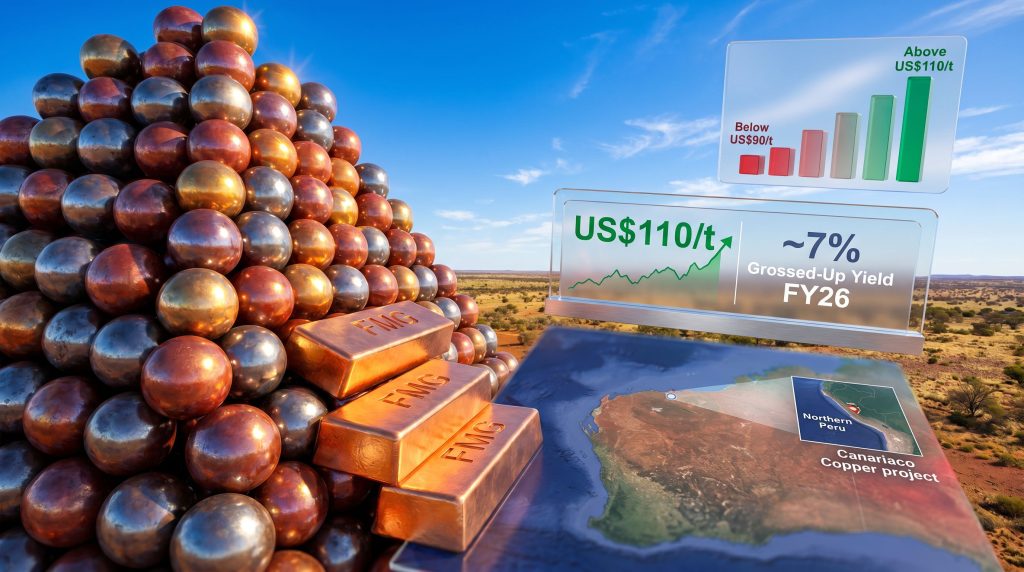
As of early May 2026, iron ore was trading at approximately US$110 per tonne, according to data from Trading Economics. This level was considered by many market participants to be more resilient than earlier forecasts had anticipated, given concerns surrounding Chinese economic demand and increasing supply pressure from developing African and South American producer nations.
The profit implications across different price scenarios can be mapped as follows:
| Iron Ore Price Scenario | Earnings Environment | Analyst Sentiment |
|---|---|---|
| Below US$90/tonne | Significant margin compression | Bearish |
| US$90 to US$100/tonne | Moderate profitability maintained | Cautious to Neutral |
| US$100 to US$110/tonne | Strong cash generation | Neutral to Bullish |
| Above US$110/tonne | Exceptional earnings potential | Bullish |
With prices sitting at the upper end of this framework, the case can be made that the market may be underestimating the near-term profit generation capacity of Fortescue’s operations, particularly if prices remain elevated through the second half of the financial year.
Why the Market May Be Underpricing Near-Term Earnings
Several factors contribute to the potential mispricing argument. Analyst models often embed conservative iron ore price assumptions for forward periods, which can cause consensus earnings estimates to lag actual performance when prices prove more resilient than expected. A sustained period above US$100 per tonne creates a meaningful positive earnings surprise risk against conservative forecasts.
Furthermore, the operating leverage mechanism means that even moderate outperformance relative to consensus price assumptions can produce disproportionately large earnings beats at the net profit line.
Chinese Demand and African Supply: The Two Variables That Matter Most
Two macro variables dominate the iron ore price outlook. Chinese steel production, which absorbs the majority of seaborne iron ore, remains sensitive to property sector conditions, infrastructure investment levels, and broader economic policy settings. A sustained contraction in Chinese steel demand would be the single most significant bearish catalyst for iron ore prices.
On the supply side, emerging production from African and South American sources represents a longer-dated risk. New large-scale supply additions from regions including West Africa have been anticipated for several years, and any meaningful acceleration in these projects reaching production would add to global supply, exerting downward pressure on prices.
How Does Fortescue’s Copper Strategy Change the Investment Thesis?
From Single-Commodity Miner to Diversified Resources Platform
Fortescue has formally designated copper as a core pillar of its growth and diversification strategy. This strategic framing signals management’s recognition that long-term dependence on iron ore revenue, which currently accounts for roughly 90% of total earnings, creates vulnerability to a single commodity cycle. In addition, broader copper market trends suggest that diversification into this metal offers a fundamentally different demand profile that may not always align with iron ore cycles.
Unlike iron ore, which is almost entirely consumed in steel production and therefore directly tied to Chinese industrial output, copper demand is distributed across a wider range of end-use applications, many of which are growing independently of Chinese economic cycles.
The Alta Copper Acquisition: What Investors Need to Know
The completion of the Alta Copper acquisition in March 2026 brought the Canariaco Copper project in Northern Peru into Fortescue’s portfolio. This transaction secured a collection of exploration-stage copper assets within a recognised mining jurisdiction. Key details investors should understand:
- Completion date: March 2026
- Primary asset: Canariaco Copper project portfolio in Northern Peru
- Development stage: Exploration-stage assets; not yet in production
- Near-term earnings impact: Minimal; the strategic value is optionality rather than immediate cash generation
- Strategic rationale: Reduces long-term reliance on iron ore by establishing a copper growth platform
It is important for investors to calibrate expectations appropriately. The Canariaco project and associated assets are not expected to contribute meaningfully to earnings in the near term. Capital expenditure requirements to advance these projects toward production, permitting timelines, and geological development work will all be required before copper contributes materially to the earnings base.
Why Copper Demand Fundamentals Support a Long-Term Thesis
The structural arguments supporting copper demand growth over the coming decade are well established across the industry and worth understanding in detail:
- Electrification of transport: Electric vehicles require approximately three to four times more copper than conventional internal combustion engine vehicles, creating substantial incremental demand as fleet electrification accelerates globally.
- Renewable energy infrastructure: Both solar photovoltaic installations and wind energy systems are copper-intensive, requiring the metal in wiring, transformers, and generation equipment.
- Data centre expansion: The rapid growth of artificial intelligence and cloud computing infrastructure is driving substantial demand for copper in electrical systems, cooling infrastructure, and connectivity hardware.
- Power grid modernisation: Ageing transmission and distribution infrastructure across many major economies requires significant capital investment in grid upgrades, most of which are copper-dependent.
- Decarbonisation pathways: Broader policy commitments to emissions reduction are accelerating investment timelines across all of the above categories simultaneously.
Comparing Fortescue’s Copper Exposure to ASX Peers
Relative to established diversified miners, Fortescue’s copper exposure remains at an early stage of development:
| Company | Primary Commodity | Copper Development Stage | Diversification Maturity |
|---|---|---|---|
| Fortescue (FMG) | Iron Ore (~90% revenue) | Early exploration phase | Strategic pivot underway |
| BHP Group (BHP) | Diversified | Mature (Olympic Dam, Escondida) | Fully established |
| Rio Tinto (RIO) | Diversified | Advanced (Oyu Tolgoi) | Well advanced |
| South32 (S32) | Diversified | Moderate exposure | Established |
This comparison illustrates both the opportunity and the gap. Fortescue is at the beginning of a journey that peers have been on for decades, which means the upside optionality is real but the near-term earnings contribution is correspondingly limited.
What Is the Fortescue Dividend Yield and Is It Sustainable?
Dissecting the Dividend Forecasts for FY26 and FY27
Fortescue’s dividend profile is one of its most compelling attributes for income-oriented investors, particularly within the Australian tax system where fully franked dividends carry substantial additional value.
*Fortescue’s projected grossed-up dividend yield for FY26 is forecast at approximately 7% including franking credits, with FY27 estimates pointing to a grossed-up yield of around 5.4%, based on a projected annual dividend of approximately 80 cents per share.*
| Financial Year | Forecast Dividend Per Share | Grossed-Up Yield (est.) | Price Environment Assumed |
|---|---|---|---|
| FY26 | ~AU$1.22 (UBS estimate) | ~7% | US$100 to US$110/tonne |
| FY27 | ~AU$0.80 | ~5.4% | Lower price environment |
The significant step-down from FY26 to FY27 forecasts deserves careful attention. A reduction of approximately 34% in projected distributions reflects analyst expectations that iron ore prices will moderate from current levels, compressing margins and reducing the cash available for shareholder returns.
How Franking Credits Amplify the Real Return for Australian Investors
For Australian resident investors, particularly those investing through self-managed superannuation funds or other tax-advantaged structures, the franking credit system transforms an already attractive yield into something considerably more compelling. A grossed-up yield of 7% represents the effective pre-tax return once the corporate tax credits are factored in, meaningfully exceeding what most fixed-income alternatives are delivering in the current rate environment.
Investors in the accumulation phase of superannuation benefit most directly, as the franking credits can offset tax liabilities at the fund level, effectively delivering a materially higher net return than the headline dividend yield alone suggests.
The Relationship Between Iron Ore Prices and Dividend Sustainability
The core sustainability question is straightforward: Fortescue’s dividend capacity is directly linked to iron ore prices. If prices remain above US$100 per tonne, the business generates substantial free cash flow that can support generous distributions. If prices decline toward or below US$90 per tonne, margin compression will inevitably feed through to reduced distributions.
The step-down from FY26 to FY27 in analyst forecasts is itself a signal that the current yield is partially a function of an elevated commodity price environment that may not persist indefinitely.
What Do Analysts Actually Think About the Fortescue Share Price?
Consensus Ratings: A Divided Analyst Community
The analyst community covering Fortescue is notably cautious in aggregate. A majority of covering analysts are positioned at hold or sell rather than buy, reflecting a view that the current share price adequately or fully captures the near-term earnings upside from elevated iron ore prices. According to Morningstar’s valuation analysis, this cautious stance is broadly supported by fundamental modelling.
| Analyst or Source | Rating | 12-Month Price Target (AUD) | Implied Move from ~$20 |
|---|---|---|---|
| UBS | Sell | $17.40 | -13% |
| Citi | Hold | $18.40 | -8% |
| Consensus (16 analysts) | Mixed | $18.85 | -6% |
| Simply Wall St | Cautious | $17.20 to $19.70 | -14% to -2% |
| Stockopedia | Neutral | $19.02 | -5% |
The majority of institutional analyst price targets sit below the current trading price, suggesting consensus expectations lean toward modest downside rather than meaningful upside over a 12-month horizon.
Why Analyst Targets and Market Prices Diverge: Key Considerations
Several factors explain the divergence between conservative analyst price targets and market pricing:
- Earnings cyclicality: Forward estimates are highly sensitive to iron ore price assumptions embedded in models, and analysts frequently use conservative commodity price decks
- Copper optionality not yet modelled: The long-term value of Fortescue’s copper expansion is not yet meaningfully incorporated into most institutional analyst frameworks
- Dividend yield support: Income-focused investor demand can sustain share prices above levels implied by pure fundamental analysis
- Technical momentum: Short-term price signals have recently been constructive, attracting momentum-driven buyers who are less focused on 12-month fundamental price targets
Bull vs. Bear: The Core Arguments Side by Side
| Dimension | Bull Case | Bear Case |
|---|---|---|
| Iron Ore Price | Resilience above US$100/tonne | Structural supply growth risk |
| Copper Strategy | Long-term earnings diversification | No near-term earnings contribution |
| Dividend | 5 to 7% grossed-up yield is compelling | Significant cuts possible if iron ore weakens |
| Valuation | P/E of ~11 to 15x appears undemanding | Forward earnings decline could erode the discount |
| China Demand | Policy stimulus could support prices | Property sector weakness remains a structural headwind |
The next major ASX story will hit our subscribers first
How Has the Fortescue Share Price Performed and What Are the Technical Signals?
Price Performance: 12-Month Trajectory vs. Year-to-Date Movement
Fortescue’s share price trajectory tells a story of strong medium-term recovery followed by near-term consolidation:
- 12-month performance: Approximately +24% gain, driven by iron ore price resilience and an upward re-rating from prior lows
- Year-to-date 2026: Down approximately 7%, reflecting commodity price uncertainty in the early months of the year
- 52-week trading range: Approximately AU$15.96 to AU$21.27
- Recent trading levels: In the range of approximately AU$20.01 to AU$21.27 as of early May 2026
The 12-month gain of 24% is notable given that many analysts had projected weaker iron ore pricing. Investors who positioned during the sub-AU$16 period captured meaningful returns, while those evaluating entry at current levels face a more balanced risk-reward proposition.
What Moving Averages Are Signalling
Short and long-term moving average indicators have recently produced buy signals for Fortescue. Technical analysis suggests a 3-month forecast of approximately 6.45% potential upside, with a 90% probability range spanning AU$15.96 to AU$20.26. It is important to note, however, that technical signals are most useful when considered alongside fundamental analysis rather than as standalone decision tools. Short-term price momentum does not alter the underlying commodity price sensitivity that drives earnings outcomes.
Is the Fortescue Share Price a Buy, Hold, or Sell? A Framework for Decision-Making
Three Investor Profiles and How Fortescue Fits Each
The appropriate evaluation of Fortescue depends substantially on what an investor is trying to achieve. Different objectives lead to meaningfully different conclusions about the current risk-reward proposition. Furthermore, a recent analysis of FMG’s value prospects highlights how varied investor expectations can lead to contrasting assessments of the same stock.
1. Income-Focused Investors
Fortescue’s grossed-up dividend yield of approximately 5 to 7% makes it a genuinely competitive consideration for yield-oriented portfolios. Within a superannuation context, franking credits deliver maximum benefit, and the income stream from iron ore operations can support substantial distributions as long as commodity prices remain supportive. The primary risk for income investors is the potential for dividend reductions if iron ore prices decline toward the US$90 per tonne range.
2. Growth-Oriented Investors
The copper diversification strategy introduces genuine long-term optionality, but with Canariaco and associated assets still at exploration stage, meaningful earnings contribution lies years away. Growth investors seeking near-term capital appreciation from the copper thesis may find more direct exposure elsewhere on the ASX among established copper producers. For patient growth investors with a multi-year horizon, Fortescue’s copper platform could become more relevant as development milestones are reached.
3. Value Investors
At a price-to-earnings multiple of approximately 11 to 15 times, Fortescue screens as inexpensive relative to many ASX sectors. The critical caveat is that FY27 earnings estimates point to a meaningful decline, which means the apparent valuation discount may narrow or disappear on a forward basis if commodity prices moderate as analysts anticipate.
Key Risks to Monitor Before Investing
Any investment thesis for Fortescue requires clear-eyed acknowledgment of the key risks:
- Iron ore prices falling below US$90 per tonne, the approximate threshold at which margin compression becomes materially significant
- Continued deterioration in Chinese property sector demand reducing steel consumption
- Capital expenditure requirements for copper project advancement placing pressure on free cash flow and dividend capacity
- Currency movements in the AUD/USD exchange rate, which affect the translated value of USD-denominated iron ore revenue
- Geopolitical and regulatory risks in Peru that could affect the Canariaco Copper project’s development timeline
This article contains general information only and does not constitute financial advice. Past performance is not indicative of future returns. Investors should consider their own financial circumstances and consult a licensed financial adviser before making investment decisions. Commodity price forecasts, dividend estimates, and analyst price targets are subject to change and involve significant uncertainty.
Frequently Asked Questions: Fortescue Share Price
What is the current Fortescue (ASX: FMG) share price?
As of early May 2026, Fortescue shares were trading in the range of approximately AU$20.01 to AU$21.27, reflecting a 24% gain over the prior 12 months but a modest year-to-date decline of approximately 7%.
What dividend does Fortescue pay?
UBS forecasts a FY26 dividend of approximately AU$1.22 per share, translating to a grossed-up yield of approximately 7% including franking credits. FY27 estimates are materially lower, with projections pointing to approximately 80 cents per share and a grossed-up yield of around 5.4%.
Why is Fortescue expanding into copper?
The copper strategy is designed to reduce Fortescue’s near-total dependence on iron ore, which accounts for roughly 90% of current revenue. Copper demand is expected to expand substantially over the next decade, driven by electric vehicle adoption, renewable energy deployment, data centre growth, and power grid investment.
What is the analyst consensus on Fortescue shares?
The majority of analysts covering Fortescue hold a neutral to cautious view. The consensus 12-month price target of approximately AU$18.85 implies modest downside from current trading levels, with a meaningful proportion of analysts rated at hold or sell.
Is Fortescue a good dividend stock?
For Australian investors, particularly those in superannuation structures, Fortescue’s fully franked dividend and grossed-up yield of 5 to 7% makes it one of the more attractive income options among ASX resources majors, provided iron ore prices remain above approximately US$100 per tonne to sustain current distribution levels.
What is the biggest risk to the Fortescue investment thesis?
The primary risk is a sustained decline in the iron ore price, driven by weakening Chinese steel demand or accelerating new supply from African and South American producers. A material price decline would compress earnings and likely result in dividend reductions. Consequently, the question of whether the Fortescue share price could be a buy depends heavily on one’s conviction regarding commodity price trajectories.
Key Takeaways: Fortescue Investment Summary
- Iron ore at approximately US$110 per tonne provides a supportive near-term earnings environment, with operating leverage amplifying profitability across every dollar above the breakeven threshold
- Copper diversification via the completed Alta Copper acquisition introduces genuine long-term strategic optionality, though earnings contribution from the Canariaco project remains minimal in the near term
- A grossed-up dividend yield of approximately 7% in FY26 represents a compelling income proposition for Australian investors, particularly within tax-advantaged superannuation structures
- Analyst consensus leans cautious, with most institutional 12-month price targets sitting below current trading levels, suggesting limited near-term upside in the consensus view
- The investment case is strongest for income and value-oriented investors rather than growth-focused portfolios at current valuations
- Three variables to watch closely: the trajectory of iron ore prices relative to the US$90 per tonne threshold, Chinese demand signals from steel production data, and development milestones at the Canariaco Copper project in Peru
Want to Catch the Next Major ASX Mineral Discovery Before the Market Does?
While Fortescue’s iron ore leverage and copper diversification offer one path into ASX resources, the most explosive returns in the sector have historically come from early-stage mineral discoveries — and Discovery Alert’s proprietary Discovery IQ model delivers real-time alerts the moment significant ASX discoveries are announced, turning complex geological data into actionable opportunities. Explore historic discovery returns to see what early positioning can mean, or start your 14-day free trial today to stay ahead of the market.