August 20, 2026

When Refining Margins Rewrite the History Books
Few metrics in global energy markets carry the diagnostic power of the crack spread. While retail fuel prices dominate headlines and political debates, the spread between crude oil input costs and refined product values tells a more fundamental story about the health of the entire downstream energy system. It reveals whether refiners are swimming in profit or drowning in margin compression, and it signals supply stress long before petrol station signs reflect it.
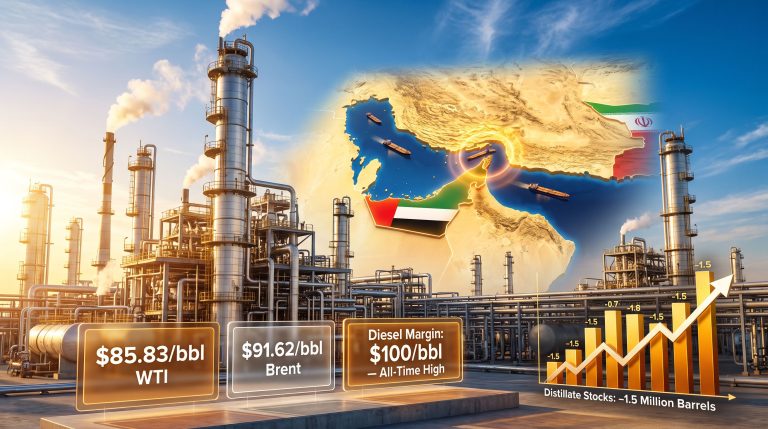
In August 2026, that signal became deafening. The diesel crack spread record high shattered every benchmark in the dataset, crossing $100 per barrel for the first time in recorded market history and forcing energy analysts, logistics executives, and policymakers to confront a set of supply conditions unlike anything seen in the modern refining era. Understanding this event requires examining both crude oil price trends and the downstream refining dynamics that amplify them.
When big ASX news breaks, our subscribers know first
What the Diesel Crack Spread Actually Measures
Before examining why the number is historic, it helps to understand precisely what the diesel crack spread records. The calculation is straightforward in arithmetic terms: take the current market price of diesel fuel futures and subtract the prevailing cost of crude oil futures. The resulting figure, expressed in dollars per barrel, represents the gross refining margin available to processors converting raw crude into usable distillate fuel.
This is not a retail price indicator. It does not directly measure what consumers pay at fuel stations or what fleet operators budget for logistics. Instead, it captures the economics at the wholesale refining level, making it one of the clearest windows into whether the world's processing infrastructure is keeping pace with demand for finished products.
Why Traders and Economists Watch It So Closely
- Supply stress detection: A widening crack spread signals that refined product supply is tightening faster than crude availability, often reflecting refinery outages, logistics bottlenecks, or inventory depletion.
- Inflation early warning: Because diesel powers freight networks, agriculture, and heating systems, elevated refining margins feed into consumer prices across dozens of sectors simultaneously.
- Refiner profitability gauge: Integrated oil companies with significant refining exposure see earnings move dramatically with crack spread fluctuations, making this metric central to equity analysis in the energy sector.
- Geopolitical stress proxy: Historically, crack spread spikes have closely tracked periods of major geopolitical disruption to either crude supply chains or refining infrastructure.
"The diesel crack spread is not a retail price signal. It is a wholesale refining profitability gauge. When this margin expands dramatically, it reflects a structural mismatch between crude oil availability and the downstream capacity or willingness to convert it into usable distillate fuel."
The Historical Baseline and Why August 2026 Is Different
What Normal Looks Like
Under stable market conditions, diesel crack spreads typically trade in a range of roughly $20 to $40 per barrel. These margins reflect the ordinary economics of refining: meaningful enough to justify capital investment in complex processing infrastructure, but not so extreme as to signal systemic stress.
The 2022 Russia-Ukraine war produced the previous benchmark for market disruption. European diesel markets faced acute shortages as Russian supply chains fractured, driving crack spreads into the high $80s before reaching approximately $89 per barrel in October 2022, a figure that stood as the all-time record for nearly four years.
The early months of 2026 began showing signs of mounting pressure. By March 2026, spreads had climbed to approximately $97 to $98 per barrel, signalling that underlying supply conditions were deteriorating faster than markets had anticipated. Then came August.
The August 2026 Record: Key Metrics
| Metric | Value |
|---|---|
| Intraday peak (August 17, 2026) | $102.20 per barrel |
| First triple-digit settlement | Monday, August 18, 2026 |
| Spread level on August 19, 2026 | ~$100 per barrel |
| Prior all-time record (October 2022) | ~$89 per barrel |
| Previous 2026 interim high (March 2026) | ~$97–$98 per barrel |
| Percentage increase vs. 2022 record | ~+15% above prior all-time high |
The diesel crack spread record high of $102.20 per barrel on August 17, 2026 marked the first occasion in history that refining margins for distillate fuel exceeded triple digits. According to Reuters, the settlement in triple-digit territory on August 18 confirmed this was not a momentary intraday aberration but a sustained structural condition.
The Convergence of Forces: Why Five Disruptions Struck Simultaneously
The U.S.-Iran Conflict and Strait of Hormuz Pressure
The outbreak of armed conflict between the United States and Iran triggered an immediate shock to diesel markets in its opening weeks. The Strait of Hormuz, through which an estimated 20 to 21 million barrels of oil and refined products transit daily under normal conditions, became a point of acute vulnerability. Disrupted flows through this chokepoint created a dual shock mechanism: crude oil supplies to downstream markets were constrained at the same time that refined product inventories became effectively trapped on the wrong side of the bottleneck.
Diesel is particularly sensitive to Hormuz disruptions relative to other refined products because Middle Eastern refineries produce significant volumes of distillate that ordinarily flow westward to European and Asian consumers. When that supply chain fractures, the gap cannot be filled quickly from alternative sources. Furthermore, the oil price market impact of sustained chokepoint disruptions compounds across multiple trading regions simultaneously.
Ukrainian Strikes on Russian Refining Infrastructure
Simultaneously, Ukrainian drone campaigns accelerated their targeting of Russian refinery capacity. The strategic logic is clear: degrading Russia's ability to process crude reduces the financial resources available to sustain military operations while also disrupting global diesel supply chains. Russia responded to these attacks by implementing temporary export restrictions on diesel fuel to protect domestic availability, removing a significant volume of supply from global markets and forcing buyers across Europe and Asia to scramble for replacement sources.
The volume displacement created by Russian export restrictions compounded an already fragile market balance, adding urgency to procurement decisions and pushing spot prices sharply higher across multiple trading hubs.
Libyan and Saudi Arabian Refinery Disruptions
Further layering onto these pressures, drone strikes on Libyan refinery infrastructure reduced capacity in a North African market already operating under significant political instability. Separately, Houthi rebel forces claimed repeated attacks on Saudi Aramco's Jazan refinery complex, one of the newer and more strategically significant refining facilities in the Arabian Peninsula.
The compounding effect of simultaneous outages across Libya, Saudi Arabia, Russia, and the constraints imposed by the Hormuz situation created a multi-front supply crisis with no historical parallel in its geographic breadth. In addition, OPEC market influence over production decisions added another layer of complexity to an already volatile supply picture.
U.S. Domestic Inventories at a 30-Year Low
Underlying all of these geopolitical triggers was a structural domestic vulnerability. U.S. diesel inventories entering late August 2026 stood at their lowest level since 1996, a 30-year trough that dramatically amplified the market's price response to each supply disruption. American refiners, already running record export volumes to fill international supply gaps, found themselves simultaneously depleting domestic buffers that offered no cushion against further shocks.
This inventory position meant that even a modest additional supply disruption carried outsized price implications. Markets with thin inventory buffers are inherently more volatile because there is no reserve capacity to absorb unexpected demand spikes or supply shortfalls.
The Refiner Incentive Paradox and Systemic Risk
Why Record Margins Create Hidden Dangers
One of the least discussed consequences of extreme crack spread levels involves the behaviour they incentivise among refinery operators. At margins exceeding $100 per barrel, the financial case for deferring scheduled maintenance shutdowns becomes almost overwhelming. Every day of additional throughput generates extraordinary revenue, while every day of planned downtime represents a foregone profit opportunity that would normally take months to recover.
The problem is structural: refineries are complex mechanical systems operating under immense thermal and chemical stress. Scheduled maintenance exists precisely because these facilities accumulate wear that must be addressed before it becomes catastrophic. When financial incentives encourage operators to defer this work, the probability of unplanned outages increases materially.
"Analysts warn that the same profit incentive driving refiners to maximise throughput is simultaneously increasing the probability of catastrophic mechanical failure. An unplanned outage at a major refining complex during a period of 30-year-low inventories could trigger a secondary price shock that eclipses even the current record highs."
The Feedback Loop Scenario
The systemic risk here is a self-reinforcing feedback loop. Consequently, understanding market volatility risks becomes essential for operators navigating this environment:
- Record crack spreads incentivise maximum throughput and maintenance deferral.
- Deferred maintenance elevates mechanical failure probability at major facilities.
- An unplanned outage at a major U.S. Gulf Coast refinery removes significant processing capacity from an already stressed market.
- Diesel inventories, already at 30-year lows, fall further.
- Crack spreads spike to levels that could exceed the August 2026 record.
This scenario is not speculative in any extreme sense. It follows directly from the incentive structures created by current margin levels and the documented condition of U.S. refinery utilisation rates.
Economic Consequences Extending Well Beyond the Fuel Tank
Heating Costs and Winter 2026–2027
Diesel and heating oil share the same distillate production stream, meaning that record crack spreads translate directly into elevated heating costs for the upcoming winter season. Households in the northeastern United States and across Northern Europe that depend on heating oil rather than natural gas face a particularly difficult cost environment entering the 2026 to 2027 winter. Lower-income households with limited ability to switch fuel sources or improve insulation carry a disproportionate share of this burden.
Freight, Logistics, and Inflationary Cascades
Diesel powers the physical movement of virtually every product in the modern economy. Long-haul trucking, rail freight, maritime shipping, and agricultural machinery all run on distillate fuel. The sectors facing the most acute cost escalation exposure include:
- Agriculture: Planting, harvesting, irrigation, and distribution equipment are almost universally diesel-dependent. Higher fuel costs compound directly into food production expenses.
- Construction: Heavy equipment operation and materials transport face simultaneous cost pressure.
- Mining and resources: Extraction operations, particularly in remote locations, carry very high diesel intensity per unit of output.
- Retail logistics: Last-mile delivery networks, already operating on thin margins, face cost compression that ultimately passes through to consumer goods prices.
The inflationary transmission mechanism is well-documented: higher diesel costs raise freight costs, which raise delivered goods costs across virtually every retail and industrial category. Furthermore, commodity volatility hedging strategies are becoming increasingly critical for businesses seeking to manage exposure to sustained distillate price pressure. With crack spreads at record levels entering a period of peak seasonal demand, the inflationary impulse heading into winter 2026 is significant.
The next major ASX story will hit our subscribers first
Three Scenarios: Where Do Diesel Crack Spreads Go From Here?
| Scenario | Key Conditions | Crack Spread Outlook |
|---|---|---|
| Rapid De-escalation | Ceasefire in U.S.-Iran conflict; Hormuz reopens; Russian export restrictions lifted | Spreads retreat toward $50–$70 range within 60–90 days |
| Prolonged Disruption | Geopolitical conflicts persist; no major new refinery capacity online | Spreads remain above $80 through Q1 2027 |
| Escalation Cascade | Additional unplanned refinery outages; further MENA infrastructure attacks | Spreads push toward $120–$130 per barrel |
The structural constraints on a rapid supply-side response deserve emphasis. New refinery construction carries multi-year lead times under even favourable conditions, and the current investment climate for large-scale refining infrastructure is shaped by capital allocation pressures that have reduced appetite for long-duration fossil fuel projects. Bringing idled capacity back online is faster but still measured in weeks to months, not days.
Demand destruction represents the market's natural corrective mechanism, however diesel demand has historically demonstrated relatively low price elasticity in transportation and industrial applications. As Bloomberg reports, meaningful demand contraction typically requires sustained elevated prices over multiple quarters, suggesting the corrective process will be slow relative to the speed of the supply shock.
Frequently Asked Questions
What is the diesel crack spread and how is it calculated?
The diesel crack spread measures the gross refining margin available when processing crude oil into diesel fuel. It is calculated by subtracting the price of crude oil futures from the price of diesel fuel futures, with the result expressed in dollars per barrel. A higher number indicates greater refining profitability and, in most cases, greater downstream supply stress.
Why did the diesel crack spread hit a record high in August 2026?
Five overlapping supply disruptions converged simultaneously: the U.S.-Iran military conflict disrupting Strait of Hormuz flows, Ukrainian drone strikes on Russian refineries prompting export bans, attacks on Libyan refinery infrastructure, repeated Houthi strikes on Saudi Aramco facilities, and U.S. domestic diesel inventories falling to their lowest point since 1996. Each factor alone would have elevated prices; together they produced an unprecedented market stress event.
Has the diesel crack spread ever been this high before?
| Period | Approximate Peak Crack Spread | Primary Driver |
|---|---|---|
| October 2022 | ~$89/bbl | Russia-Ukraine war; European diesel shortage |
| March 2026 | ~$97–$98/bbl | Early U.S.-Iran conflict escalation |
| August 17, 2026 | $102.20/bbl (all-time record) | Multi-front geopolitical disruptions plus 30-year-low inventories |
What happens to refiners when crack spreads are this high?
Refining-heavy integrated energy companies generate extraordinary margins during crack spread supercycles. However, the incentive to maximise throughput creates operational risks through maintenance deferral. Historically, high-utilisation periods have been followed by elevated rates of unplanned outages, which can partially offset the financial gains from elevated margins while creating additional market volatility.
Could the diesel crack spread go even higher?
Under an escalation cascade scenario involving additional unplanned refinery outages or further deterioration of MENA refining infrastructure, spreads approaching $120 to $130 per barrel are plausible. The natural ceiling is imposed by demand destruction, which begins to reduce diesel consumption meaningfully at sustained high price levels, and by potential policy responses including strategic reserve releases. However, given 30-year-low inventory conditions, the upside risk cannot be dismissed.
Key Takeaways
- The diesel crack spread record high of $102.20 per barrel was reached on August 17, 2026, the first triple-digit refining margin in recorded market history.
- The previous all-time record of approximately $89 per barrel, set in October 2022, has been surpassed by roughly 15%.
- Five simultaneous geopolitical and infrastructure disruptions created a supply shock with no modern historical parallel in its geographic breadth.
- U.S. diesel inventories at a 30-year low entering late August 2026 amplified price sensitivity to each incremental supply disruption.
- The refiner incentive to defer maintenance at record margins creates systemic downside risk through elevated unplanned outage probability.
- Economic consequences span heating costs, food prices, freight inflation, and broader consumer price pressures heading into winter 2026 to 2027.
- The path back to normalised crack spreads depends primarily on geopolitical resolution rather than supply-side production responses, which operate on longer timescales.
Disclaimer: This article contains forward-looking statements, scenario projections, and market analysis that involve inherent uncertainty. The scenarios described do not constitute financial advice. Energy commodity markets are subject to rapid and unpredictable change, and past price behaviour does not guarantee future outcomes. Readers making financial or operational decisions based on commodity market conditions should consult qualified professional advisers.
Want to Position Yourself Ahead of the Next Major Resource Discovery?
While diesel crack spreads and energy market disruptions reshape commodity economics globally, the ripple effects create compelling opportunities across the broader resources sector — including ASX-listed mining and exploration companies exposed to energy-intensive commodities. Discovery Alert's proprietary Discovery IQ model scans ASX announcements in real time, instantly identifying significant mineral discoveries and translating complex data into actionable insights for investors at every experience level — explore historic discovery returns to see what early positioning can deliver, and begin your 14-day free trial today to secure a market-leading edge.