August 20, 2026
When Inventory Data Lies: Decoding the Real Drivers Behind Oil's Sustained Rally
Most commodity markets follow a predictable logic: rising stockpiles push prices down, and tightening supplies push them higher. Oil, however, has long resisted simple frameworks, and the dynamics playing out across energy markets right now illustrate exactly why reading crude prices through a single data lens can mislead even experienced traders.
Understanding why oil gains as refinery demand surges requires looking beyond headline inventory numbers toward the structural forces reshaping how crude is consumed, processed, and priced at a global level. The interaction between refinery throughput, product market tightness, and oil geopolitics analysis is producing a market environment that defies conventional assumptions.
When big ASX news breaks, our subscribers know first
The Inventory Paradox: Why a 4.4 Million Barrel Build Did Not Sink Prices
In a textbook commodity market, a weekly crude inventory build of 4.4 million barrels would apply meaningful downward pressure on prices. That is precisely the kind of data point bearish traders look for to justify short positioning. Yet when the U.S. Energy Information Administration released its latest weekly report, crude prices moved higher rather than lower.
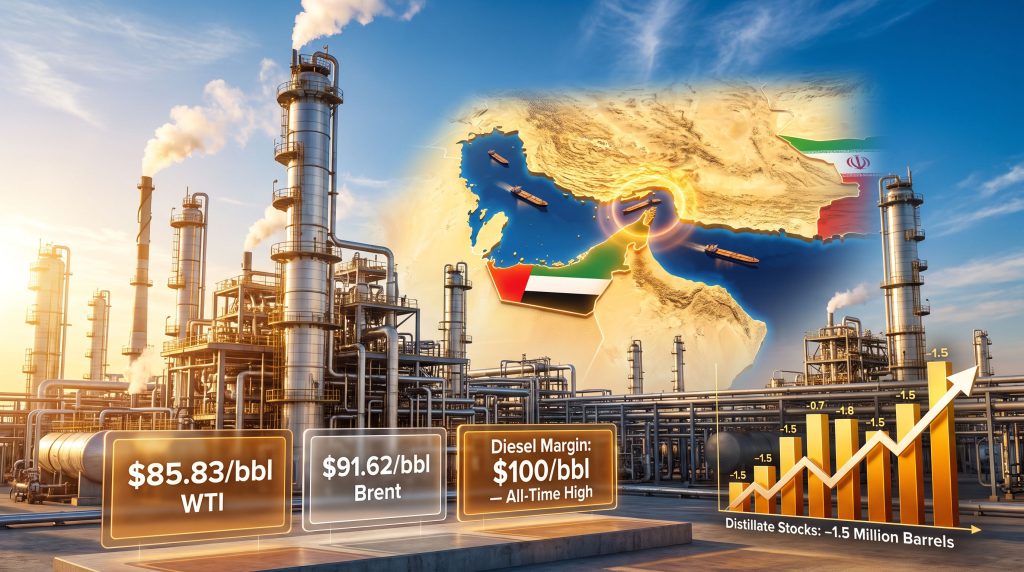
The explanation lies in what the rest of the report revealed. While domestic crude stocks expanded, distillate inventories simultaneously declined by 1.5 million barrels, dropping to their lowest level in more than a month. Refinery run rates, measured by crude throughput, climbed to their highest point since September 2019, with Gulf Coast operations leading the national increase.
The market was not ignoring the crude build. It was correctly assessing that an accelerating refinery system was absorbing crude at a pace that would render the stock increase temporary, while the real tightness was downstream in the products barrel.
This distinction matters enormously for how professional traders interpret EIA data. When refinery utilization is running at multi-year highs, the forward-looking signal from product inventories typically overrides the backward-looking crude stock number. The market priced accordingly.
How Refinery Utilization Becomes a Crude Demand Signal
Refinery utilization is not just an operational metric. It functions as a leading indicator for crude feedstock consumption. When refiners push throughput toward capacity limits, they are committing to sustained crude purchases across the near-term forward curve. This creates a structural demand floor that inventory builds alone cannot easily displace.
The Gulf Coast refining complex is particularly significant here. Concentrated along the Texas and Louisiana coastlines, this cluster of high-complexity refineries represents the largest single refining hub in the world. When Gulf Coast utilization surges, the knock-on effects for crude pricing along the WTI benchmark are amplified compared to throughput increases in other regions.
Historically, utilization rates exceeding approximately 90% to 92% of nameplate capacity have preceded periods of sustained crude price support, because at those levels, incremental crude demand becomes highly inelastic. Refiners cannot easily substitute away from feedstock requirements, and any supply disruption becomes disproportionately impactful.
Diesel at the Centre: What a $100 Crack Spread Actually Signals
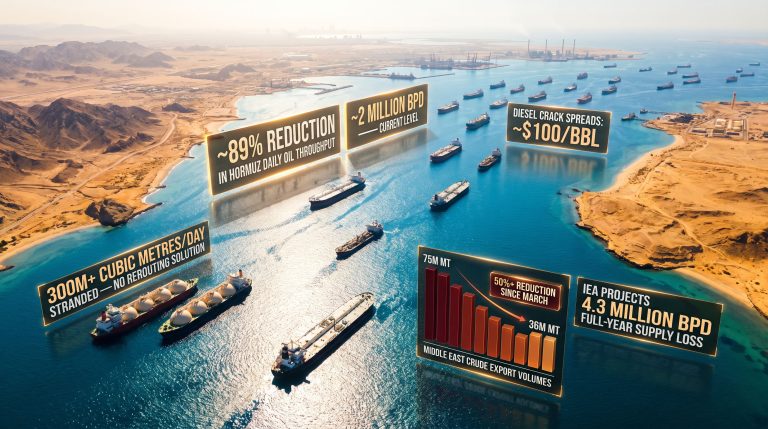
The diesel crack spread, which measures the gross refining margin earned from converting a barrel of crude into distillate fuel, briefly exceeded $100 per barrel in the U.S. — an all-time high by a considerable margin. European gasoil futures more than doubled within the same calendar year. These are not minor market fluctuations. They represent a fundamental repricing of energy risk across the entire refined products complex.
A crack spread at this level sends a powerful signal: the market is pricing in a structural shortfall in distillate supply that refiners are being financially incentivised to correct by maximising throughput. Furthermore, refinery margins surging alongside product market tightness is the self-reinforcing mechanism at the heart of the current rally.
| Sector | Primary Diesel Exposure | Consequence of Elevated Margins |
|---|---|---|
| Road Freight and Logistics | Direct fuel cost | Higher shipping rates passed to consumers |
| Agricultural Operations | Machinery, irrigation, transport | Increased food production costs |
| Industrial Manufacturing | Process heat, heavy machinery | Energy input cost inflation |
| Construction | Plant and equipment | Project cost escalation |
| Consumer Goods | Upstream freight costs | Retail price pressure across categories |
The real economy implications of a sustained crack spread at these levels extend well beyond energy markets. Diesel is the fuel of physical commerce, powering freight networks, farm machinery, construction equipment, and industrial operations. When diesel margins stay elevated for extended periods, cost inflation transmits broadly across supply chains in ways that monetary policy cannot easily address.
Why Diesel Has Outrun Crude in This Cycle
The disproportionate rally in diesel relative to crude reflects the convergence of several independent supply shocks hitting the distillate market simultaneously:
- Attacks on refining infrastructure within the Russia-Ukraine conflict have reduced European refining capacity and tightened regional distillate supply
- Global distillate inventory buffers were already below seasonal norms entering the current demand cycle
- Agricultural and industrial demand for diesel has remained structurally robust despite broader macroeconomic uncertainty
- The loss of Russian refined product exports to European markets has created a physical supply gap that alternative suppliers have only partially filled
The result is a product market that is pricing risk far more aggressively than crude itself, with crack spreads acting as the pressure valve for accumulated supply stress.
Geopolitical Architecture: The Gulf Fault Lines Reshaping Price Risk
Beyond the domestic refinery demand story, geopolitical developments in the Persian Gulf have added a structural risk premium to crude pricing that fundamentally alters the downside scenarios traders are willing to price. In addition, the trade war impact on oil has further complicated the global supply and demand calculus for energy markets.
The escalation between the UAE and Iran, including the UAE severing all economic ties with Tehran following accusations of ballistic missile attacks on its territory, introduced a new and credible disruption scenario into market calculations. Senior energy market analysts noted that traders were increasingly positioning for a prolonged conflict environment rather than assuming a near-term diplomatic resolution. This framework, sometimes described as a closed for longer scenario, reflects a market posture where the base case is sustained disruption rather than imminent normalisation.
Critically, this is distinct from a simple war premium. A war premium typically reflects the immediate spike in risk sentiment at the onset of conflict. A closed for longer scenario is more nuanced: it represents the market's assessment that structural supply disruption will persist across multiple quarters, embedding a higher floor price even when physical supplies remain relatively intact.
The Strait of Hormuz: Chokepoint Economics
The Strait of Hormuz remains the world's single most consequential energy transit corridor. Roughly 20% to 21% of global seaborne crude exports pass through this narrow waterway between the Arabian Peninsula and Iran. Any credible threat to transit security through the strait carries outsized price implications relative to the actual volume immediately at risk.
The reversal of three supertankers with Chinese operator links within the strait, combined with a vessel being struck by a projectile near the strait's exit, illustrated how kinetic risk in this corridor can rapidly reshape shipping logistics and crude flow patterns. Even when physical supplies continue moving, as Persian Gulf producers have maintained covert shuttle operations to keep exports flowing, the insurance costs, rerouting risks, and positioning uncertainty for traders elevates the effective cost of crude delivery.
It is worth noting that the continuation of covert oil movements through Hormuz has acted as a partial price moderator. Prices, while elevated, have remained well below the extreme levels some analysts feared at the conflict's onset, precisely because physical supply continuity has been maintained. This creates an interesting market dynamic where geopolitical risk is priced in, but not at the catastrophic premium that a full Hormuz closure would demand.
Ceasefire Expiry and Trader Positioning Dynamics
The expiry of a 60-day ceasefire window between the U.S. and Iran introduced a specific positioning dynamic worth understanding. As the ceasefire lapsed without renewal, some traders who had accumulated long positions as a hedge against escalation chose to reduce exposure. This is a rational risk management response: a sudden diplomatic breakthrough following ceasefire expiry would trigger rapid price declines, punishing those holding large long positions.
This position unwinding created a natural dampening effect on price volatility even as the underlying geopolitical risk remained elevated. Consequently, this partially explains why Brent settled just below the psychologically significant $92 per barrel level rather than breaking through it decisively.
Benchmark Pricing: Reading the WTI-Brent Structure
| Benchmark | Contract | Settlement Price | Session Change |
|---|---|---|---|
| Brent Crude | October Settlement | $91.62/bbl | +0.7% |
| WTI Crude | September Delivery | $85.83/bbl | +1.1% |
| WTI Crude | October Contract | $84.39/bbl | Prompt month |
The stronger percentage gain in WTI's front-month contract relative to Brent reflects localised U.S. supply tightness, consistent with the surge in domestic refinery demand absorbing crude stocks faster than imports can replenish them. WTI-Brent oil futures and the structure of the forward curves across both benchmarks are worth monitoring closely, as they encode market expectations about near-term supply adequacy versus longer-term balance.
Structural Versus Cyclical: Can the Rally Hold?
The current price environment rests on three reinforcing pillars:
- Refinery throughput at a post-2019 peak creating sustained feedstock demand that buffers crude against inventory builds
- Distillate and diesel market tightness maintaining downstream price pressure and incentivising continued high utilisation
- Persian Gulf geopolitical risk premium establishing a structural price floor that recalibrates trader downside assumptions
Each of these factors has its own reversal risk. A diplomatic breakthrough between the UAE and Iran could rapidly deflate the geopolitical premium. Sustained high diesel prices carry demand destruction potential as businesses and consumers adapt. A significant deterioration in global economic conditions would reduce fuel consumption across all categories.
What makes the current environment particularly complex is that these risks are not independent. A geopolitical resolution that eases Gulf tensions might also free up refining capacity currently operating under supply constraints, simultaneously removing both the risk premium and the throughput incentive. However, the oil price trends suggest that traders pricing the market must weigh the probability and sequencing of these potential reversals with care.
Disclaimer: This article is intended for informational purposes only and does not constitute financial or investment advice. Oil markets involve significant risk and price volatility. Readers should conduct independent research and consult qualified financial professionals before making investment decisions.
The next major ASX story will hit our subscribers first
Key Takeaways for Energy Market Participants
- Refinery throughput reaching a post-2019 high is a leading demand signal that can override headline crude inventory data
- The $100+ diesel crack spread represents a generational extreme with significant real economy cost implications across freight, agriculture, and manufacturing
- The UAE-Iran escalation and Hormuz transit risks have introduced a closed for longer pricing framework that restructures downside scenarios
- WTI's stronger session gain relative to Brent reflects localised U.S. tightness driven by elevated domestic refinery consumption
- Persian Gulf producers maintaining covert export flows has moderated price upside while geopolitical risk premiums persist
- Understanding EIA weekly data requires reading product inventory movements alongside crude stock changes, not treating the headline crude number in isolation
- OPEC's market influence continues to serve as an additional variable shaping how supply decisions interact with the broader price environment
Furthermore, oil gains as refinery demand surges has been well documented across energy markets, reinforcing that the dynamics outlined in this article reflect a sustained structural shift rather than a transient price spike. For further analysis on refinery economics and global crude supply dynamics, the U.S. Energy Information Administration publishes detailed weekly petroleum data at eia.gov, and energy market coverage from Rigzone is available at rigzone.com.
Want to Stay Ahead of the Next Major Resource Discovery?
While energy markets reward those who read structural signals early, the same principle applies to ASX mineral discoveries — and Discovery Alert's proprietary Discovery IQ model delivers real-time alerts the moment significant discoveries hit the exchange, transforming complex geological data into actionable investment insights. Explore how historic discoveries have generated exceptional returns and begin your 14-day free trial today to position yourself ahead of the broader market.