May 14, 2026
When Fuel Becomes the Binding Constraint on Civilisation
Throughout history, the limits of energy supply have determined the limits of empire, trade, and prosperity. Rome could not sustain its legions without grain and timber. Britain could not industrialise without coal. The modern globalised economy cannot function without one specific category of fuel: distillate fuel oil, the collective name for diesel and jet fuel. These two products are not interchangeable with anything else at scale, and their quiet, accelerating decline on a per-capita basis may be the most consequential and under-reported story in global economics today.
The diesel and jet fuel shortage reshaping global trade is not a crisis born purely of geopolitics. It has structural roots stretching back nearly two decades, and the current Middle East conflict has simply accelerated what long-run resource data was already signalling. Understanding the crude oil price trends that preceded this moment is essential context for what comes next.
When big ASX news breaks, our subscribers know first
What Distillate Fuel Oil Actually Is and Why Nothing Else Compares
The Two Fuels That Move Everything
Distillate fuel oil is the industry term for diesel and jet fuel, both derived from the middle fraction of a crude oil barrel during the refining process. The term is technical but the implications are universal: every commercial truck on every highway, every freight locomotive, every ocean cargo vessel, every tractor turning a field, and virtually every commercial aircraft depends on these fuels to operate.
- Diesel powers heavy trucking, freight rail, agricultural machinery, construction equipment, and maritime shipping
- Jet fuel underpins global aviation, including the belly-cargo networks that move approximately 35% of global trade by value
- Both fuels are produced from the same crude oil fraction, meaning a shortage of crude feedstock compresses the supply of both simultaneously
- Unlike gasoline, which has partial substitution pathways through electrification for passenger vehicles, distillates have no near-term scalable replacement in heavy transport applications
This distinction matters enormously. Policymakers and investors who conflate the energy transition in passenger transport with a transition in heavy transport are operating on a fundamentally flawed premise. Battery technology that works adequately in a sedan is categorically unsuited to a container ship crossing the Pacific or a combine harvester working a wheat field in adverse conditions.
A Two-Decade Trend Most Analysts Are Missing
Data from the 2025 Statistical Review of World Energy, published by the Energy Institute, reveals a trajectory that should reshape every forecast model dependent on sustained trade growth. Combined diesel and jet fuel supply, measured on a per-capita basis, began declining at the time of the 2007–2009 Global Financial Crisis. The pandemic in 2020 caused a further structural step down from which full recovery never materialised. The ongoing Middle East conflict beginning in 2026 has removed additional crude oil supply for an indeterminate period, compressing distillate availability further.
| Period | Per Capita Distillate Trend | Primary Driver |
|---|---|---|
| Pre-2007 | Rising steadily | Global trade expansion post-WTO |
| 2007-2009 | Sharp decline | Global Financial Crisis |
| 2010-2019 | Partial recovery, flattening | Demand growth vs. refinery constraints |
| 2020 | Significant structural step-down | COVID-19 pandemic |
| 2021-2025 | Incomplete recovery | Supply tightening, geopolitical instability |
| 2026 | Accelerating decline | Middle East conflict, Strait of Hormuz disruption |
Each step down in this progression has left a lower baseline than the previous one. The pattern is not cyclical recovery; it is structural ratcheting downward.
How the Strait of Hormuz Became the World's Most Dangerous Bottleneck
Forty Percent of Jet Fuel Through a Single Chokepoint
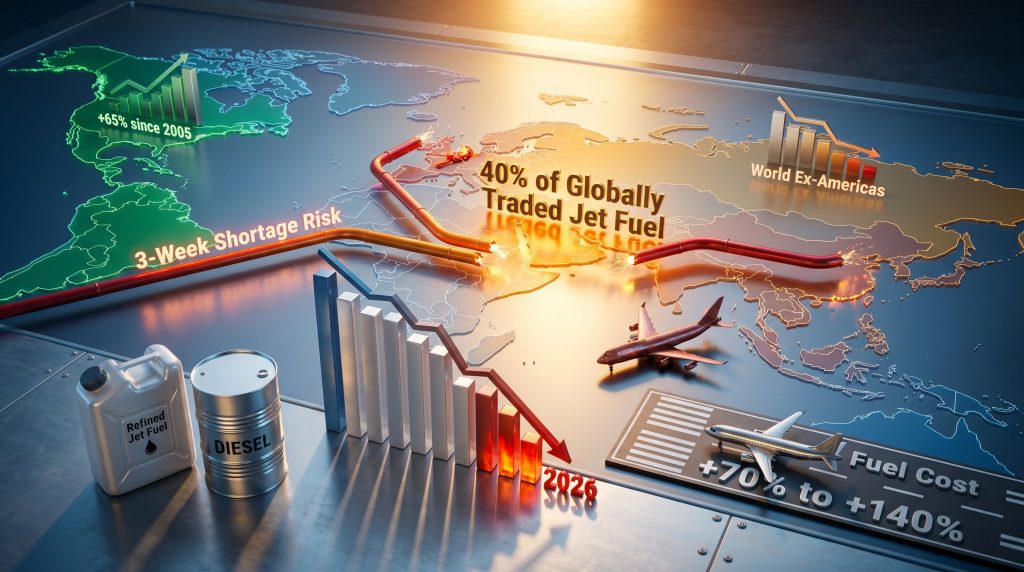
The Strait of Hormuz, a narrow waterway between Iran and Oman, carries approximately 40% of globally traded jet fuel and a substantial share of the world's crude oil exports. Roughly two-thirds of Europe's jet fuel imports transit this corridor. When this passage becomes effectively restricted, the consequences propagate across refining, aviation, agriculture, and logistics simultaneously, not sequentially.
The disruption is not merely about price. It is about physical unavailability. Refineries optimised to process Middle Eastern medium-sour crude grades now face feedstock scarcity. Their output of middle distillates compresses regardless of how high prices rise, because crude simply does not arrive. Higher prices signal scarcity but cannot conjure barrels that are not flowing. The IEA's analysis of Middle East energy markets provides useful context for understanding the scale of this dependency.
Regional Transmission: How the Shock Spread
The crisis has not been confined to the Middle East. Its transmission across regions has followed the architecture of global import dependency. Furthermore, the oil markets under trade stress that analysts had already flagged are now experiencing compounding pressure from physical supply constraints:
- Asia: Vietnam has cut domestic flights, Thailand and China suspended jet fuel exports, the Philippines declared a national energy emergency, and multiple Southeast Asian carriers reduced capacity by up to 30% on domestic routes
- Europe: Airport operators flagged potential shortages within three weeks without Strait reopening; Scandinavian Airlines cancelled routes; diesel shortages in industrial supply chains compounded aviation disruptions
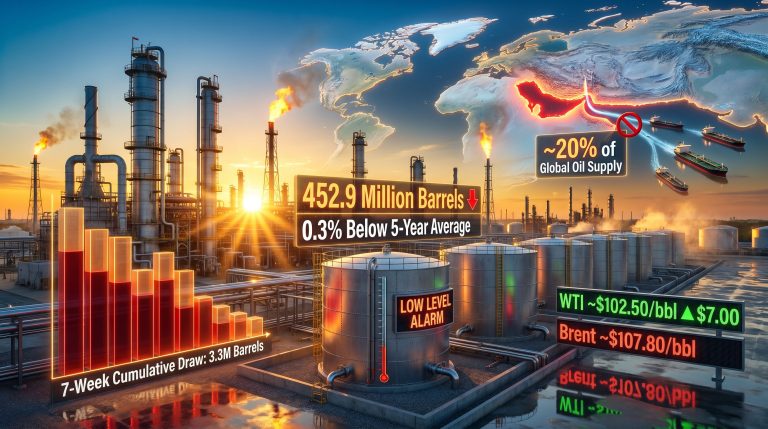
- United States: Indirect exposure through depleted domestic inventories, with diesel stocks running approximately 11% below seasonal averages and gasoline approximately 2% below average
- Africa and Latin America: Elevated fuel costs feeding through to fare increases, flight cancellations, and emerging trade flow disruptions across freight corridors
Jet Fuel Price Escalation Since Conflict Onset
| Region | Pre-Conflict Baseline | Post-Conflict Price Movement | Current Status |
|---|---|---|---|
| Global Average | Baseline | +70% to +140% | Near-record levels |
| Asia-Pacific | Baseline | Severe shortage premium | Key exporters suspended exports |
| Europe | Baseline | +40% to +60% | Three-week shortage risk flagged |
| United States/Latin America | Baseline | Moderate increase | Freighter route cuts emerging |
Diesel prices in constrained markets have spiked to approximately $1,400 per tonne in some regions, compared to forward contract pricing of $700–$800 per tonne, a near-doubling that renders broad categories of logistics operations uneconomical at current volumes. Japan's refinery utilisation rate has risen to approximately 73% as strategic oil stocks are drawn down to maintain domestic supply, while China's independent refiners have slashed output as margin compression makes processing unviable.
Is This a Geopolitical Accident or the Culmination of Structural Decline?
The Long Production Decline That Predates Any War
One of the most consequential and least-discussed analytical frameworks in energy economics is the regional disaggregation of crude oil production on a per-capita basis. When the global average is used, the underlying divergence between the Americas and the rest of the world is masked. The data from the US Energy Information Administration, when examined by region, tells a starkly different story:
- Europe's crude oil production entered permanent decline in 2001
- Asia-Pacific crude output peaked in 2010 and has trended downward since
- Africa's peak oil production occurred in 2008, with mostly declining output thereafter
- Russia and surrounding former Soviet states began their production decline in 1989, two years before the Soviet Union's collapse in 1991, suggesting energy scarcity as a systemic destabiliser of political structures rather than a consequence of them
- Middle Eastern production hit dual peaks in 2016 and 2018, with output lower in subsequent years
The Russian production data carries a particularly sobering implication: when an energy exporter can no longer generate sufficient export revenue from declining production, the internal fiscal pressures that result can make military engagement appear economically rational. Energy scarcity may be a cause of geopolitical conflict rather than merely its consequence.
The Americas Exception and Why It Matters
Against the backdrop of declining production across Europe, Russia, Africa, Asia-Pacific, and potentially the Middle East, the Americas represent a genuinely different trajectory. Oil production across the Americas has increased by approximately 65% since 2005, driven by US tight oil, Canadian oil sands, Brazilian deepwater production, Argentine unconventional resources, and emerging Guyanese offshore fields.
On a per-capita basis, the Americas are both higher in absolute terms and trending upward, while the rest of the world is flat to declining. The importance of oil to this regional advantage cannot be overstated; it underpins virtually every structural benefit the Americas currently hold.
| Metric | The Americas | World Ex-Americas |
|---|---|---|
| Crude oil production trend (post-2005) | +65% increase | Flat to declining since 2005; declining since 2019 |
| Per capita crude oil production | Rising and outperforming | Declining |
| Population growth (2021-2024 average) | ~0.6% per year | ~0.9% per year |
| Energy consumption trend | Flat (efficiency-driven) | Rapidly rising via coal and gas-led industrialisation |
| Manufacturing base | Significantly hollowed out post-1973 | Substantially expanded post-2001 |
One structural constraint limiting the World ex-Americas from accessing unconventional oil resources is population density. Tight oil and shale development requires land use and surface disruption at scales that are simply not viable in densely populated regions of Asia, Europe, and the Middle East without displacing enormous numbers of residents. This constraint does not apply in the same way across much of North America, Canada, or South America, where land availability relative to population permits unconventional development.
Aviation Under Pressure: Capacity Cuts, Insolvencies, and the Cargo Crisis
Airlines Are Already Restructuring Around the Shortage
The impact of the diesel and jet fuel shortage reshaping global trade is most visibly concentrated in the aviation sector, which has essentially zero substitution options and operates on razor-thin margins at normal fuel prices. The current environment represents an existential threat for many carriers. As reported analysis of the jet fuel supply crunch confirms, airlines are being forced to balance cost absorption against demand retention with very little room to manoeuvre:
- Major carriers have cut between 5% and 20% of capacity on routes where fuel costs render operations unprofitable
- Southeast Asian domestic aviation has experienced cuts of approximately 30% in some markets
- Fuel costs now represent more than 30% of total air cargo operating costs, with some operators reporting increases exceeding 100%
- Airline insolvencies are accelerating, with Spirit Airlines in the US among those already in bankruptcy proceedings, and carriers across Southeast Asia and Africa facing similar pressures
- Air cargo rates have reached peak-season levels despite the crisis falling outside traditional peak demand windows, reflecting supply compression rather than demand surge
The Belly Cargo Collapse No One Is Talking About
Approximately half of all air freight globally moves not in dedicated freighter aircraft but in the cargo holds beneath passenger seats, known in the industry as belly cargo capacity. As passenger airlines reduce routes, suspend services, and ground aircraft, this belly capacity disappears simultaneously.
Time-sensitive supply chains for pharmaceuticals, fresh produce, electronics components, and medical devices are directly exposed to this collapse in ways that aggregate freight statistics tend to obscure. Freighter operators are cutting routes, particularly US-Latin America corridors, where the economics of fuel absorption have become unsustainable. The compounding effect of passenger belly cargo loss and dedicated freighter route cuts creates a non-linear deterioration in air freight capacity that significantly exceeds what either trend would produce independently.
A World Reorganising Around Energy Geography
Why Trade Routes Are Getting Shorter
The economic logic driving trade route compression is straightforward: long-distance transoceanic shipping consumes disproportionate volumes of distillate fuel per unit of goods transported. As fuel becomes both more expensive and physically scarcer, the economics of the longest trade routes deteriorate first. The routes most at risk are precisely those that underpinned the post-2001 globalisation boom: transpacific container shipping and transatlantic cargo flows.
Energy analysts who study long-run resource depletion have argued that geopolitical conflict in resource-constrained regions is frequently a symptom of underlying energy scarcity rather than an independent cause. The observation that Russia's crude oil production began declining two years before the Soviet Union's political collapse offers a historically grounded example of energy contraction as a systemic precursor to political restructuring.
The 100-Year Transition Nobody Wants to Acknowledge
Full reconfiguration of global trade architecture from its current integrated structure toward a model built around shorter, more fuel-efficient regional trade networks is not a matter of years. Credible analysis suggests such a transition could require well over 100 years to complete, for several interconnected reasons:
- Supply chain networks for manufactured goods typically run through dozens of countries; rebuilding them regionally requires new industrial facilities, skilled workforces, and years of investment
- The energy transition challenges involved are compounded by the fact that critical minerals demand for green technologies is concentrated in regions with deteriorating energy access
- Infrastructure, including roads, bridges, pipelines, and long-distance electricity transmission, represents the most energy-intensive component of any economy to build and maintain. As distillate availability contracts, infrastructure maintenance becomes the first victim
- The Americas, despite their energy production advantage, face a significant manufacturing deficit having transferred industrial capacity to Southeast Asia following the post-1973 rise in oil prices
Infrastructure is the skeleton of an economy, and it requires enormous energy to maintain. Historical precedent suggests that when fossil fuel availability declines, infrastructure is among the first systems to experience sustained deterioration, beginning at the periphery and contracting toward energy-rich cores.
The next major ASX story will hit our subscribers first
Which Regions Face the Greatest Exposure
Mapping Vulnerability by Energy Geography
| Region | Fuel Import Dependency | Proximity to Domestic Production | Vulnerability Rating |
|---|---|---|---|
| Southeast Asia | Very High | Low | Critical |
| Western Europe | High | Low | High |
| East Africa | Very High | Very Low | Critical |
| South Asia | High | Moderate | High |
| Latin America | Moderate | Moderate to High | Moderate |
| North America | Low to Moderate | High | Low to Moderate |
| Gulf States (non-conflict zones) | Low | High | Low |
An underappreciated dimension of regional vulnerability is the relationship between population density and energy access. Densely populated regions outside the Americas face a compounding challenge: their large and faster-growing populations require proportionally more energy for food production, transport, and industry, yet per-capita energy availability is declining and unconventional resource development is constrained by land use realities.
Between 2021 and 2024, population in the World ex-Americas grew at an average of approximately 0.9% per year, compared to roughly 0.6% per year in the Americas, according to Energy Institute data. This widening demographic gap compounds the energy per-capita disadvantage that production data already shows. Population centres located near domestic oil production and refining infrastructure hold a structural advantage that will become increasingly apparent as shortages intensify.
Scenarios, Strategy, and the Investment Implications
Three Futures for the Global Distillate Market
Disclaimer: The following scenarios involve forward-looking analysis and contain inherent uncertainty. They should not be construed as investment advice. Readers should conduct independent analysis before making any financial decisions.
Scenario A: Hormuz Reopens Within 3-6 Months
Distillate prices partially normalise but remain structurally elevated above pre-conflict baselines. Airlines recover capacity but with permanently higher base operating costs. Supply chain diversification accelerates regardless. Energy infrastructure, regional logistics, and domestic manufacturing benefit disproportionately over a 3-5 year horizon.
Scenario B: Extended Disruption Lasting 6-18 Months
Multiple airline insolvencies and permanent route eliminations. Diesel rationing in import-dependent economies. Accelerated regionalisation of supply chains becomes irreversible rather than precautionary. Americas-based energy producers, agricultural input suppliers, and nearshoring beneficiaries outperform.
Scenario C: Structural Multi-Year Realignment
Global trade architecture reorganises fundamentally around two dominant regional blocs. Long-distance transoceanic trade contracts measurably over a decade. Domestic energy production, critical mineral processing capability, and regional infrastructure become generational investment themes.
Industries Most Exposed to Prolonged Shortages
- Aviation: Highest direct exposure with margin compression and insolvency risk at current fuel prices
- Air Freight: Profitability model deteriorates sharply above 30% fuel cost share
- Ocean Shipping: Diesel-dependent route economics deteriorate across long-haul corridors
- Agriculture: Food security risk if diesel rationing reaches farming operations at scale
- Retail and Consumer Goods: Supply chain disruption feeds directly into inflation and product unavailability
- Mining and Resources: Heavy diesel dependency for extraction, haulage, and processing operations
Frequently Asked Questions: The Diesel and Jet Fuel Shortage
What is causing the current diesel and jet fuel shortage?
The immediate trigger is disruption to Middle Eastern crude supply and the effective restriction of the Strait of Hormuz, through which approximately 40% of globally traded jet fuel flows. However, the underlying structural factors — including declining per-capita crude production across Europe, Africa, Asia-Pacific, and Russia since their respective peaks — mean the conflict is amplifying a pre-existing long-run tightening trend rather than creating it from scratch.
How long could this shortage last?
Near-term recovery depends primarily on whether and when the Strait of Hormuz reopens and Middle Eastern crude production resumes. In Asia and Europe, acute shortages could persist for weeks to months. The structural per-capita decline in distillate availability, driven by production trends across multiple regions, is likely to persist regardless of geopolitical resolution in the near term.
Why can't renewable energy or batteries solve this problem?
Battery electric technology remains impractical for long-haul trucking, ocean freight, and commercial aviation at current energy densities. Hydrogen and sustainable aviation fuel remain developmental at commercial scale. The absence of near-term substitutes for heavy transport distillates is precisely why shortages in this category carry consequences that shortages in other energy categories do not. Electricity can supplement, but it cannot fully substitute for oil in paving roads, powering ships, or running harvest machinery under adverse field conditions.
Which countries are best positioned in a fuel-scarce world?
Countries within the Americas that combine domestic crude oil production with refining infrastructure are structurally advantaged. Population centres located near oil fields and refineries retain access to fuel even when global models project shortfalls elsewhere. Nations in Southeast Asia, Western Europe, and import-dependent parts of Africa face the most acute structural exposure.
How does this affect food prices?
Diesel powers virtually every stage of industrialised food production, from field preparation through harvest, processing, and refrigerated distribution. Sustained shortages or sharp price increases translate directly into higher agricultural production costs, potential reductions in cultivated area in fuel-dependent farming systems, and elevated consumer food prices. The 2026–2027 crop cycles face particular risk if diesel rationing reaches farming operations in heavily import-dependent agricultural regions. Consequently, the diesel and jet fuel shortage reshaping global trade carries food security implications that extend well beyond transport and logistics alone.
Want To Track The Mineral Discoveries Emerging From A World In Energy Transition?
As distillate scarcity reshapes global trade routes and accelerates the hunt for critical minerals, Discovery Alert's proprietary Discovery IQ model delivers real-time ASX mineral discovery alerts, turning complex geological announcements into actionable investment insights — explore how historic discoveries have generated substantial returns and begin a 14-day free trial to position ahead of the market.