June 18, 2026
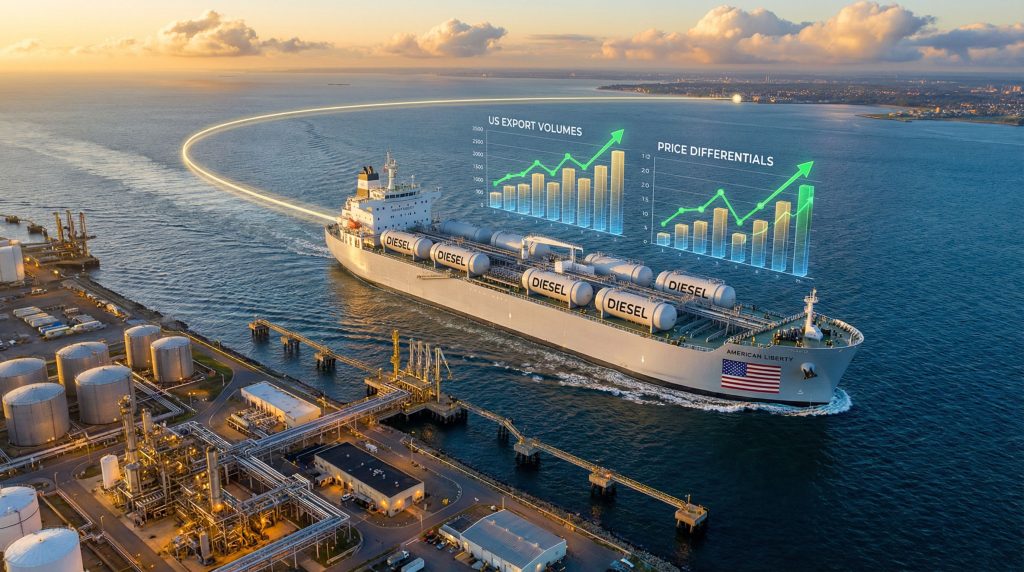
Transatlantic energy dynamics have fundamentally shifted as global supply chains adapt to evolving market pressures. The refined products sector, particularly diesel markets, demonstrates how quickly trade flows can reconfigure when oil price rally 2025 opportunities emerge. Understanding these patterns requires examining the complex interplay between regional supply balances, shipping economics, and geopolitical influences that drive commodity movements across ocean basins.
Atlantic Diesel Trade Transformation Mechanisms
The Atlantic basin diesel trade has undergone substantial restructuring since early 2022, driven primarily by European supply disruptions and subsequent market realignments. Northeast US diesel exports to Europe represent a strategic pivot from traditional Gulf Coast dominance in transatlantic refined product flows.
Historical Supply Chain Dependencies
Prior to 2022, European diesel imports followed established patterns heavily reliant on Russian refined products, which accounted for approximately 40% of European diesel consumption. This dependency created structural vulnerabilities that became apparent when geopolitical tensions disrupted traditional supply arrangements.
The US Gulf Coast historically dominated American refined product exports due to several advantages:
- Refining capacity concentration: Over 50% of US refining capacity located along the Gulf Coast
- Infrastructure advantages: Dedicated export terminals and deep-water port access
- Pipeline connectivity: Extensive pipeline networks connecting refineries to export facilities
- Cargo economics: Ability to load larger vessels for international shipments
Northeast Refinery Repositioning
Northeast US refineries traditionally focused on heating oil production and regional gasoline supply, with limited export orientation. The region's refining infrastructure was designed primarily for winter heating oil demand serving New England markets, gasoline production for high-density population centers, and industrial diesel for regional manufacturing and transportation.
Recent market developments have prompted operational adjustments enabling increased diesel production for export markets. This shift reflects refineries' ability to optimise product slates based on margin opportunities rather than traditional seasonal patterns.
When big ASX news breaks, our subscribers know first
Economic Arbitrage Drivers Fuelling Trade Flows
The emergence of profitable northeast US diesel exports to Europe stems from specific price differentials and cost structures that favour shorter Atlantic crossing routes over traditional supply sources.
Price Differential Mathematics
Recent market data reveals significant arbitrage opportunities when European diesel prices exceed US Northeast values by sufficient margins to cover transportation costs. Furthermore, market volatility hedging strategies have become essential for traders managing these cross-Atlantic arbitrage positions.
| Market | Price ($/USG) | Date |
|---|---|---|
| German-Rotterdam FOB Barge | $4.60 | March 31, 2026 |
| New York Harbor ULSD | $4.36 | March 31, 2026 |
| Premium Differential | $0.24 | 24¢/USG advantage |
Transportation economics for northeast US diesel exports to Europe benefit from shorter transit times of approximately 7-10 days versus 14-18 days from Gulf Coast, reduced freight costs, cargo size flexibility, and improved port efficiency.
Seasonal Demand Balancing
Northeast diesel exports capitalise on demand timing mismatches between US and European markets. Key seasonal factors include European heating season peak demand during October-March, US Northeast heating oil focus, spring transition periods, and industrial demand cycles.
In addition, tariff impact on markets considerations may influence future trade patterns as policy changes reshape global commodity flows.
Regional Supply Infrastructure Capabilities
The northeast US diesel export surge requires sophisticated infrastructure coordination between refineries, terminals, and shipping facilities to manage the approximately 2 million barrel volume movements observed in recent weeks.
Terminal Infrastructure Analysis
New York Harbor serves as the primary export hub for northeast US diesel exports to Europe, offering storage capacity exceeding 50 million barrels, blending facilities, loading efficiency for Aframax-sized vessels, and quality control capabilities.
The Colonial Pipeline system provides critical supply connectivity, delivering refined products from Gulf Coast refineries to Northeast terminals when regional production proves insufficient for both domestic consumption and export commitments.
Vessel Traffic Patterns
Recent shipping data indicates a notable increase in transatlantic diesel movements from Northeast US terminals. Vessel tracking reveals six ULSD cargoes departed New York Harbor over six business days ending March 31, 2026, with cargo sizes averaging 330,000 barrels per vessel for optimal economics.
However, global diesel flows have been reshuffling significantly as supply chains adapt to geopolitical pressures and changing trade dynamics.
Market Signal Analysis for Trade Sustainability
Evaluating the longevity of northeast US diesel exports to Europe requires examining multiple market indicators that influence arbitrage profitability and trade flow persistence.
Premium Sustainability Thresholds
Profitable arbitrage requires European diesel prices to maintain premiums sufficient to cover vessel charter costs of 8-12¢/USG, insurance and bunkers of 3-5¢/USG, port charges of 2-3¢/USG, and working capital of 1-2¢/USG.
Current premiums of 24¢/USG provide comfortable margins, but sustainability depends on maintaining spreads above minimum threshold levels of approximately 15¢/USG.
Volume Growth Trajectory
The current export surge represents the highest northeast diesel export activity since September 2024, suggesting a meaningful shift in trade patterns rather than temporary arbitrage exploitation. Consequently, US–China trade impact considerations also influence global energy flows as supply chains continue to evolve.
Global Market Redistribution Effects
The emergence of significant northeast US diesel exports to Europe creates ripple effects throughout global refined product markets, influencing traditional trade flows and supply chain strategies.
Supply Chain Reconfiguration
Traditional diesel trade patterns face disruption as northeast US exports capture European market share. Middle Eastern suppliers redirect cargoes to Asian markets previously supplied by US Gulf Coast, whilst Latin American refiners compete for Caribbean and South American markets with displaced Gulf Coast volumes.
This redistribution demonstrates the dynamic nature of global commodity flows and the speed at which supply chains adapt to new arbitrage opportunities.
Strategic Energy Security Implications
For European buyers, northeast US diesel imports offer supply source diversification, shorter supply chains with lower geopolitical risk, reliable counterparty relationships, and quality consistency meeting European requirements.
Operational Risk Factors and Mitigation
Several challenges could potentially disrupt northeast US diesel exports to Europe, requiring careful risk assessment and management strategies.
Weather and Logistics Constraints
Winter weather conditions in the North Atlantic can significantly impact shipping economics and schedule reliability through increased storm frequency, ice conditions, and vessel routing challenges. Terminal capacity constraints represent another operational risk factor as New York Harbor terminals must balance export cargo requirements with domestic supply obligations.
Market Volatility Considerations
Crude oil price movements directly impact refining margins and diesel arbitrage economics. As noted by industry analysts, Northeast US diesel exports surge to Europe represents a significant shift in traditional trade patterns.
"Diesel export arbitrage relies heavily on relative price movements between regions. Sudden crude oil price spikes or collapses can quickly eliminate profitable trading opportunities, requiring sophisticated hedging strategies to manage exposure."
The next major ASX story will hit our subscribers first
What Factors Will Shape Future Market Structure Evolution?
The sustainability of northeast US diesel exports to Europe depends on long-term structural changes in both regional markets and global energy transition patterns.
Infrastructure Investment Requirements
Sustained export growth may require infrastructure enhancements including terminal expansion, pipeline modifications, and vessel optimisation. These investments must consider critical raw materials availability and supply chain resilience.
European Energy Transition Impact
European diesel demand faces long-term pressure from electrification and renewable energy adoption across transportation sectors, industrial applications, and power generation. These demand trends suggest that current diesel import levels may peak within the next decade, influencing long-term investment decisions for export infrastructure.
Investment and Strategic Planning Implications
The emergence of northeast US diesel exports to Europe creates several investment themes and strategic considerations for market participants.
Infrastructure Development Opportunities
Investors may consider opportunities in terminal infrastructure expansion, shipping assets optimised for transatlantic refined product transport, and strategic petroleum product storage in key trading hubs.
Risk Management Frameworks
Energy traders and suppliers should develop comprehensive risk management approaches addressing price risk through hedging strategies, operational risk via contingency planning, credit risk through counterparty assessment, and regulatory risk compliance.
The dynamic nature of northeast US diesel exports to Europe illustrates how quickly global energy markets can adapt to changing supply and demand fundamentals, creating both opportunities and risks for market participants across the Atlantic basin.
Disclaimer: This analysis is based on publicly available market data and should not be considered as investment advice. Commodity trading involves substantial risk, and market conditions can change rapidly. Readers should conduct their own research and consult with qualified professionals before making investment decisions.
Looking to Capitalise on Energy Market Shifts?
Discovery Alert's proprietary Discovery IQ model delivers real-time alerts on significant mineral discoveries across the ASX, helping investors identify actionable opportunities in the evolving commodities landscape. Stay ahead of market movements and explore how major mineral discoveries can generate substantial returns whilst positioning yourself for success in today's dynamic energy and resources sector.