June 12, 2026
The difference between rare metals and rare earth elements represents more than academic terminology; it reflects fundamental variations in extraction methods, supply chain structures, and market dynamics that shape global manufacturing capabilities. Modern industrial economies depend heavily on specialized materials that fall into distinctly different categories, yet these distinctions often blur in public discourse.
Industry professionals recognise that classification systems operate across multiple frameworks simultaneously. Market-driven terminology emphasises economic importance and supply vulnerability, while scientific classification follows periodic table organisation and chemical properties. These parallel systems create complexity when assessing investment opportunities and supply chain risks. Moreover, developments in the strategic antimony outlook demonstrate how geopolitical factors increasingly influence critical materials markets.
Industrial vs. Scientific Classification Frameworks
The International Organisation for Standardisation does not formally distinguish rare metals from rare earth elements in standardised nomenclature. Instead, industry practitioners use market-driven terminology where rare metals or minor metals reflects production scale and supply concentration rather than elemental scarcity or periodic table position.
This distinction matters operationally because supply risk assessment for cobalt (a minor metal) differs fundamentally from supply risk for neodymium (a rare earth element) despite both being classified as critical materials in national supply chain reviews. The U.S. Department of Energy's Critical Materials Institute categorises materials by supply vulnerability and functional importance to clean energy technology, rather than by scientific properties.
Economic classification recognises that gallium (a minor metal) poses similar supply chain challenges to terbium (a rare earth element) despite occupying different positions in the periodic table. This practical approach reflects real-world procurement and manufacturing concerns, particularly as initiatives like the european CRM facility aim to address supply vulnerabilities across both material categories.
When big ASX news breaks, our subscribers know first
Global Production Scale Comparisons
Production volumes reveal stark differences between material categories. Global rare earth oxide production reaches approximately 200,000-250,000 tonnes annually, primarily concentrated in China at roughly 70% of light rare earth output. In contrast, minor metals production scales vary dramatically across individual materials.
Annual Production Comparison (2023)
| Material Category | Example Element | Annual Output | Market Concentration |
|---|---|---|---|
| Rare Earth Elements | Neodymium | 12,000-15,000 tonnes | China 95% |
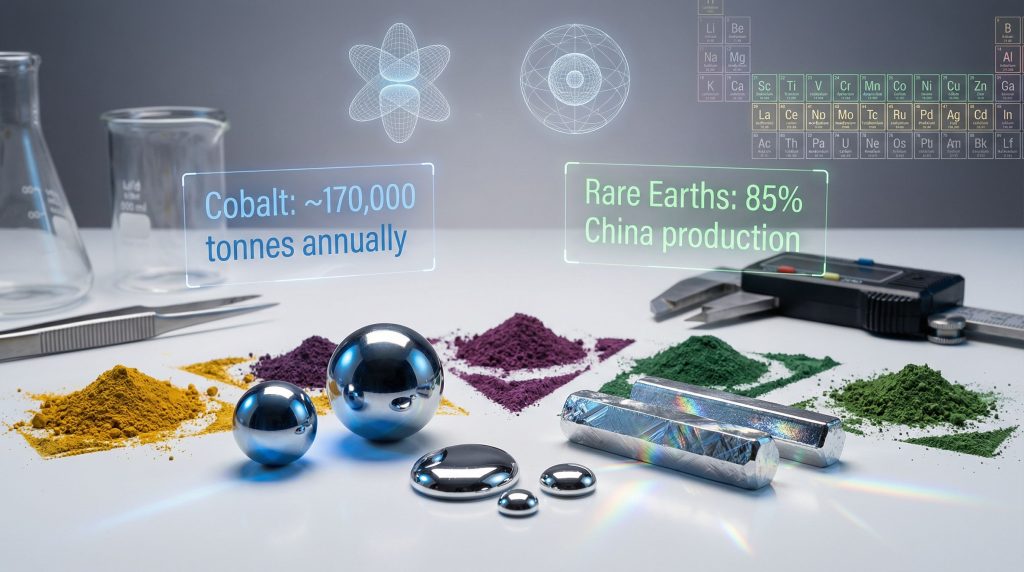
| Minor Metals | Cobalt | ~170,000 tonnes | DRC 62% |
| Minor Metals | Gallium | 400-420 tonnes | China 95% refined |
| Minor Metals | Rhenium | 50-80 tonnes | USA, Chile, Peru |
Market capitalisation context further illustrates these differences. The global rare earth oxide market reaches approximately $6.5-7 billion USD annually, while battery-grade cobalt alone represents $12-15 billion USD annually, reflecting higher value concentration in minor metals serving specific applications. Furthermore, geopolitical developments such as the DRC cobalt export ban highlight how policy decisions can dramatically impact minor metals availability.
Strategic Importance Metrics by Industry Sector
Different industries prioritise materials based on functional requirements rather than classification systems. Defence applications demand rhenium for jet engine superalloys and dysprosium for high-temperature permanent magnets. Electronics manufacturing requires gallium for power semiconductors and indium for display panels.
Clean energy technology creates distinct demand patterns. Wind turbine generators utilise neodymium-iron-boron magnets enhanced with dysprosium for temperature resistance. Electric vehicle motors similarly depend on rare earth permanent magnets, while battery systems require cobalt and lithium for electrochemical performance. These applications underscore the critical role of minerals energy transition in global decarbonisation efforts.
How Do Rare Metals Function in Modern Supply Chains?
Minor metals operate within fundamentally different supply structures compared to base metals or rare earth elements. Their production characteristics create unique vulnerabilities and opportunities that investors and manufacturers must understand when developing sourcing strategies.
Minor Metals Production Architecture
The by-product dependency structure defines minor metal supply chains. Unlike primary metals where increased demand can stimulate additional production, by-product metals respond to primary metal mining economics rather than their own market signals.
Key By-Product Relationships:
• Cobalt: 95% derived from copper and nickel mining operations
• Gallium: Extracted from primary aluminium production (1 tonne per 500,000 tonnes aluminium)
• Rhenium: 95% recovered from molybdenum ore processing
• Indium: By-product of zinc processing operations
• Germanium: Recovered from zinc and copper residues
This structure creates supply inelasticity. When copper prices decline, copper mining operations reduce output, directly constraining cobalt availability regardless of cobalt price levels. The decoupling between demand and supply signals prevents normal market equilibrium mechanisms from functioning effectively.
Extraction Ratios and Production Economics:
• Copper → Cobalt: 0.002-0.003 cobalt per tonne copper produced
• Zinc → Indium: 0.00015-0.0002 indium per tonne zinc produced
• Aluminium → Gallium: 0.000001-0.000002 gallium per tonne aluminium produced
Critical Applications Across Industries
Minor metals enable technologies that cannot function with substitute materials. Cobalt provides electrochemical stability in lithium-ion battery cathodes, while gallium arsenide semiconductors offer superior efficiency compared to silicon alternatives in power electronics applications.
Application-Specific Requirements
| Metal | Primary Application | Annual Production | Supply Risk Level |
|---|---|---|---|
| Cobalt | Battery cathodes | ~170,000 tonnes | High |
| Gallium | Power semiconductors | ~400 tonnes | High |
| Indium | Transparent conductors | ~800 tonnes | Medium-High |
| Tantalum | Electronic capacitors | ~1,200 tonnes | Medium |
| Rhenium | Jet engine alloys | ~60 tonnes | High |
Gallium enables gallium nitride (GaN) power semiconductors that operate at higher frequencies and temperatures than silicon devices. This performance advantage makes gallium irreplaceable in 5G infrastructure and electric vehicle charging systems, despite limited annual production of approximately 400-420 tonnes globally.
Tantalum capacitors provide superior performance in compact electronic devices due to high capacitance-to-volume ratios. While alternative materials exist, tantalum's combination of electrical properties and reliability makes it preferred for aerospace and medical applications.
Price Volatility and Market Dynamics
Minor metals exhibit extreme price volatility due to supply concentration and demand inflexibility. China's gallium export restrictions, implemented in August 2022, caused refined gallium prices to increase from $300/kg to over $500/kg within three months, despite abundant global bauxite reserves.
Supply disruption impacts cascade through manufacturing networks. Congo's cobalt production declined approximately 20% in 2020 due to artisanal mining disruptions, causing lithium-ion battery costs to increase 15-20% and forcing EV manufacturers to negotiate forward contracts at premium prices.
Structural Price Factors:
• Limited number of qualified suppliers
• Long lead times for capacity expansion
• Technical barriers to market entry
• Geopolitical concentration risks
• Inventory management complexities
Recycling provides limited supply relief for most minor metals. Indium recycling from display panel manufacturing captures 20-30% of potential supply, while cobalt recycling from battery end-of-life remains below 10% as of 2023. However, innovations such as the battery recycling breakthrough may significantly improve recovery rates.
What Makes Rare Earth Elements Scientifically Unique?
Rare earth elements represent a scientifically defined group with distinctive chemical properties that create both processing challenges and unique industrial applications. Understanding these characteristics explains why rare earth supply chains operate differently from minor metals markets.
The 17-Element Group Definition
The rare earth elements comprise 15 lanthanides (Lanthanum through Lutetium), plus Scandium and Yttrium. This classification reflects chemical behaviour and historical mining practices rather than geological abundance. Total abundance in Earth's crust reaches approximately 100-200 parts per million, with cerium alone representing roughly 60 ppm.
Rare Earth Elements by Category:
Light Rare Earths (LREE):
• Lanthanum (La) – 8,000-10,000 tonnes annually
• Cerium (Ce) – 20,000-25,000 tonnes annually
• Praseodymium (Pr) – 4,000-5,000 tonnes annually
• Neodymium (Nd) – 12,000-15,000 tonnes annually
Heavy Rare Earths (HREE):
• Dysprosium (Dy) – 1,500-2,000 tonnes annually
• Terbium (Tb) – 300-400 tonnes annually
• Yttrium (Y) – 1,200-1,500 tonnes annually
Scandium and Yttrium Inclusion:
While scandium and yttrium occupy non-lanthanide positions in the periodic table, their inclusion reflects historical mining practices and chemical behaviour. Both elements frequently co-occur with lanthanides in xenotime and other minerals, exhibiting +3 oxidation states similar to lanthanides.
Chemical Properties and Behaviour Patterns
Lanthanide contraction creates the fundamental challenge in rare earth processing. Progressive reduction in ionic radius across the lanthanide series results in nearly identical chemical properties despite sequential atomic numbers. Lanthanum and cerium differ by only 0.02 Ångströms in ionic radius, making them chemically indistinguishable in most conventional separation processes.
Ion Exchange Characteristics:
The systematic reduction in ionic radius from La³⁺ = 1.06 Å to Lu³⁺ = 0.86 Å creates separation opportunities using solvent extraction. However, this requires precisely calibrated organic extractants, typically phosphonic acids like D2EHPA, to exploit minor differences in distribution coefficients. For more detailed information on the fundamental properties of rare earth elements, chemical behaviour patterns remain consistent across the lanthanide series.
Chemical Similarities:
• All lanthanides prefer +3 oxidation states
• Similar electronegativity values
• Comparable ionic radii within 0.2 Ångström range
• Co-occurrence in mineral deposits
• Identical separation chemistry requirements
Industrial Processing Requirements
Commercial rare earth separation requires multi-stage solvent extraction using organic acids. Achieving 99.9% purity for magnet-grade neodymium typically demands 15-20+ separation stages with processing duration extending 6-12 months from raw ore to separated rare earth oxides.
Processing Infrastructure Requirements:
• Capital investment: $200-500 million USD for commercial-scale facilities
• Technical expertise: Specialised chemical engineering capabilities
• Environmental compliance: Radioactive waste management systems
• Quality control: Analytical laboratories for purity verification
Unlike minor metals, rare earths are extracted as primary products from dedicated mining operations targeting rare earth-bearing minerals like bastnäsite, monazite, and xenotime. However, separation and refining require specialised infrastructure, creating a two-stage supply chain from mining through processing and separation.
Global Processing Capacity Distribution:
China controls approximately 85% of rare earth separation capacity globally, despite other countries possessing significant rare earth deposits. This processing bottleneck, rather than geological scarcity, creates supply vulnerability for manufacturers requiring separated rare earth oxides. Similarly, understanding the distinction between rare metals and rare earth elements becomes crucial for investors evaluating market opportunities.
Which Materials Drive Clean Energy Technology?
Clean energy transformation depends critically on both rare earth elements and minor metals, each serving distinct functions that enable renewable energy generation, energy storage, and electric transportation systems. Understanding these material requirements helps investors identify supply chain bottlenecks and market opportunities.
Permanent Magnet Manufacturing
High-performance permanent magnets represent the most strategically important rare earth application. Neodymium-iron-boron (NdFeB) magnets provide superior magnetic energy density compared to ferrite or samarium-cobalt alternatives, making them essential for efficient electric motors and generators.
Magnet Composition Requirements:
• Neodymium: 25-35% by weight (primary magnetic component)
• Dysprosium: 2-12% by weight (high-temperature performance enhancement)
• Praseodymium: Partial neodymium substitute (cost optimisation)
• Terbium: Specialised applications requiring extreme temperature resistance
Wind Turbine Specifications:
Modern 3MW wind turbines require approximately 600-1,000 kg of permanent magnets containing 150-300 kg of rare earth elements. Direct-drive generators eliminate gearboxes but increase rare earth content per MW of capacity. Offshore wind installations prefer permanent magnet generators for reliability advantages despite higher rare earth requirements.
Electric Vehicle Motor Applications:
EV traction motors utilise interior permanent magnet (IPM) designs requiring 2-5 kg of rare earth content per vehicle. High-performance models and luxury vehicles typically specify dysprosium-enhanced magnets for thermal stability, while mass-market vehicles optimise for neodymium-praseodymium blends to control costs.
Battery Technology Material Requirements
Energy storage systems create demand for minor metals rather than rare earth elements. Cobalt enables lithium-ion battery cathode stability, while lithium, nickel, and graphite provide additional electrochemical functions.
"Cobalt (rare metal) enables lithium-ion battery cathodes, while rare earth elements like lanthanum improve nickel-metal hydride battery performance. These materials serve different electrochemical functions despite both being classified as critical materials."
Battery Chemistry Evolution:
• Lithium Cobalt Oxide (LCO): Consumer electronics – 60% cobalt content
• Lithium Iron Phosphate (LFP): Entry-level EVs – zero cobalt requirement
• Lithium Nickel Manganese Cobalt (NMC): Performance EVs – 10-20% cobalt content
• Lithium Nickel Cobalt Aluminium (NCA): High-energy applications – 15% cobalt content
Battery manufacturers actively reduce cobalt content through chemistry optimisation. Tesla's 4680 cells target zero cobalt cathode chemistry, while CATL's Qilin battery reduces cobalt content to below 5% while maintaining energy density performance.
Rare Earth Battery Applications:
Lanthanum improves nickel-metal hydride battery capacity and cycle life. Hybrid vehicles utilise NiMH batteries containing 10-15 kg of lanthanum per vehicle. However, lithium-ion technology displacement reduces lanthanum battery demand in automotive applications.
Semiconductor and Electronics Applications
Advanced semiconductors require both rare earth elements and minor metals for specialised functions. Gallium arsenide compounds provide superior electronic properties compared to silicon, while yttrium enables high-performance ceramic components.
Gallium Applications:
• Gallium Nitride (GaN): Power electronics, 5G infrastructure
• Gallium Arsenide (GaAs): RF amplifiers, satellite communications
• Indium Gallium Arsenide (InGaAs): Optical detectors, fibre optic systems
Rare Earth Electronic Applications:
• Yttrium Aluminium Garnet (YAG): Laser crystals, LED phosphors
• Scandium Aluminium: Aerospace alloys, lightweight structures
• Europium: Red phosphors, display technologies
• Terbium: Green phosphors, fluorescent lighting
Market Growth Projections:
GaN semiconductor market growth reaches approximately 30% annually through 2030, driven by electric vehicle charging infrastructure and renewable energy power conversion systems. This growth trajectory increases gallium demand despite limited production capacity expansion possibilities.
The next major ASX story will hit our subscribers first
How Do Supply Chain Vulnerabilities Compare?
Supply vulnerabilities differ fundamentally between rare earth elements and minor metals due to distinct production structures, processing requirements, and geopolitical concentrations. These differences create varied risk profiles and mitigation strategies for end-users.
Geographic Concentration Analysis
China's Dominant Position:
China controls approximately 85% of rare earth production and 95% of gallium refining capacity, creating similar supply concentration despite different material categories. However, the underlying vulnerability mechanisms differ significantly.
Production Concentration Comparison
| Material Category | Top Producer | Market Share | Second Producer | Combined Share |
|---|---|---|---|---|
| Rare Earth Oxides | China | 85% | Myanmar | 92% |
| Cobalt Metal | DRC | 70% | Russia | 74% |
| Gallium Refined | China | 95% | Japan | 98% |
| Indium Production | China | 50% | South Korea | 65% |
Rare Earth Geographic Risks:
China's rare earth dominance reflects processing capability concentration rather than geological monopoly. Australia, United States, and Canada possess significant rare earth deposits but lack separation infrastructure. Building processing facilities requires $200-500 million capital investment and 3-5 years development time.
Minor Metal Geographic Risks:
Democratic Republic of Congo produces 70% of global cobalt, but this concentration reflects geological advantage rather than processing capability. Cobalt refining occurs across multiple countries, providing some supply chain resilience compared to rare earth processing concentration.
Processing Capability Distribution
Processing infrastructure represents the critical bottleneck for both material categories, but through different mechanisms. Rare earth processing requires specialised chemical expertise and environmental management systems, while minor metal processing depends on primary metal production economics.
Rare Earth Processing Barriers:
• Technical complexity: Multi-stage solvent extraction systems
• Environmental compliance: Radioactive waste management
• Capital intensity: Hundreds of millions USD investment requirement
• Expertise requirements: Specialised metallurgical engineering capabilities
Minor Metal Processing Dependencies:
• Primary metal economics: Supply tied to copper, aluminium, zinc production
• By-product optimisation: Processing economics favour primary metal output
• Scale limitations: Small market size reduces investment incentives
• Technology barriers: Specialised extraction and purification methods
Global Processing Capacity Gaps:
Outside China, rare earth processing capacity reaches approximately 40,000-50,000 tonnes annually, compared to global demand approaching 200,000+ tonnes. This capacity deficit cannot be addressed quickly due to regulatory approval timelines and technical complexity.
Strategic Stockpiling Policies
Government stockpiling strategies reflect different vulnerability assessments for rare earth elements versus minor metals. Strategic approaches vary based on material criticality, substitution possibilities, and supply disruption probabilities.
U.S. Strategic Stockpile Priorities:
The National Defense Stockpile maintains reserves of both rare earth elements and minor metals, but with different quantity targets and rotation policies. Cobalt stockpiling focuses on aerospace-grade materials, while rare earth stockpiling emphasises magnet-grade oxides.
Private Sector Inventory Strategies:
Manufacturers maintain different inventory approaches based on material characteristics. Gallium users typically hold 3-6 months inventory due to supply concentration risks, while rare earth magnet manufacturers maintain 6-12 months of neodymium and dysprosium inventory due to price volatility and processing lead times.
Stockpiling Effectiveness Limitations:
• Rare Earths: Separated oxides require controlled storage conditions and have limited shelf life
• Minor Metals: Gallium and indium require specialised handling and storage systems
• Quality Degradation: Some materials experience purity reduction during extended storage
• Technology Evolution: Stockpiled materials may become obsolete as applications evolve
What Investment Opportunities Exist in Each Sector?
Investment landscapes differ significantly between rare earth elements and minor metals due to distinct market structures, capital requirements, and growth trajectories. Understanding these differences enables more informed investment decisions across the critical materials spectrum.
Rare Earth Mining and Processing Companies
Rare earth investments span the complete value chain from mining through separation and magnet manufacturing. Each stage requires different capital commitments and offers varied risk-return profiles.
Upstream Mining Operations:
• Resource Development: Exploration and deposit delineation phase
• Mine Construction: Infrastructure development and permitting
• Concentrate Production: Initial ore processing and beneficiation
• Capital Requirements: $100-500 million for world-class deposits
Midstream Processing Capabilities:
Separation facilities represent high-barrier-to-entry investments with significant moats once operational. Processing economics improve with scale, creating competitive advantages for established operators.
Processing Investment Characteristics:
• Technology Licensing: Access to proprietary separation processes
• Environmental Compliance: Waste treatment and disposal systems
• Quality Control: Analytical capabilities and product certification
• Customer Relationships: Long-term supply agreements with magnet manufacturers
Downstream Application Development:
Permanent magnet manufacturing and specialised alloy production offer higher value capture but require additional technical expertise and customer development capabilities.
Minor Metals Market Participants
Minor metals investments focus on specialty trading, recycling operations, and application development companies. Market structures favour participants with technical expertise and supply chain relationships.
Specialty Trading Platforms:
Minor metals trading requires sophisticated market knowledge and financial capabilities. Successful traders maintain relationships across the complete supply chain from primary producers through end-users.
Industrial Recycling Operations:
Indium recycling from display panel manufacturing provides steady supply streams with favourable economics. Recovery operations require specialised processing equipment but offer defensive business characteristics with growing waste streams.
Recycling Investment Opportunities:
• Indium Recovery: 20-30% of supply potential from ITO recycling
• Cobalt Recovery: Battery recycling infrastructure development
• Gallium Recovery: Semiconductor waste processing systems
• Tantalum Recovery: Electronic waste processing capabilities
Technology Development Companies:
Companies developing substitution technologies or efficiency improvements in minor metal applications offer leverage to supply constraint themes. However, successful substitution could eliminate market demand.
Risk Assessment for Investors
Investment risks vary significantly between rare earth elements and minor metals, requiring different due diligence approaches and risk management strategies.
Rare Earth Investment Risks:
• Regulatory Environment: Environmental permitting and community relations
• Technology Substitution: Alternative magnet technologies or motor designs
• Chinese Competition: State-supported capacity expansion and price competition
• Capital Intensity: Large upfront investments with long payback periods
Minor Metals Investment Risks:
• Primary Metal Dependency: Supply tied to copper, aluminium, zinc market cycles
• Demand Volatility: Small markets create price and volume instability
• Technology Disruption: Substitution or efficiency improvements reducing demand
• Geopolitical Risks: Export restrictions and trade policy changes
Market Timing Considerations:
Both sectors exhibit cyclical characteristics but with different timing patterns. Rare earth cycles typically extend 3-5 years based on magnet demand growth, while minor metals experience shorter 12-24 month cycles tied to primary metal markets and technology adoption rates.
How Will Future Demand Patterns Evolve?
Demand evolution for rare earth elements and minor metals follows distinct trajectories based on technology adoption rates, substitution possibilities, and efficiency improvements. Understanding these patterns helps identify long-term investment themes and potential supply-demand imbalances.
Electric Vehicle Market Growth Impact
Electric vehicle adoption creates differentiated demand patterns for critical materials. Permanent magnet motors drive rare earth demand, while lithium-ion batteries require minor metals like cobalt.
EV Market Projections:
• Global EV Sales: 30% annual growth through 2030
• Permanent Magnet Motors: 80% of EV models utilise rare earth magnets
• Battery Chemistry Evolution: Reducing cobalt content per kWh
• Motor Efficiency: Improving rare earth utilisation per kW
Rare Earth Demand from EVs:
Each electric vehicle requires approximately 2-5 kg of rare earth elements for traction motors. Premium vehicles specify dysprosium-enhanced magnets for thermal performance, while mass-market models optimise for neodymium-praseodymium blends to control costs.
Battery Material Demand:
Cobalt demand faces downward pressure from chemistry evolution. LFP (Lithium Iron Phosphate) batteries contain zero cobalt, while high-nickel NMC chemistries reduce cobalt content to 5-10% compared to 20% in earlier generations.
Material Intensity Projections:
• Rare Earth Content per EV: Stable at 2-5 kg through improved motor efficiency
• Cobalt Content per kWh: Declining from 200g to <100g by 2030
• Total Rare Earth Demand: Growing with EV volume despite stable intensity
• Total Cobalt Demand: Peak possible by 2025-2027 due to chemistry evolution
Renewable Energy Infrastructure Requirements
Wind and solar deployment creates sustained demand for rare earth permanent magnets and specialised minor metals in power electronics applications.
Wind Turbine Capacity Expansion:
• Global Wind Capacity: Growing 10-15% annually through 2030
• Offshore Wind Growth: 25-30% annual capacity additions
• Direct-Drive Generators: Higher rare earth intensity but improved reliability
• Magnet Requirements: 150-300 kg rare earth content per 3MW turbine
Solar Infrastructure Materials:
Gallium demand from CIGS solar cells remains limited compared to silicon photovoltaic technology. However, inverter systems and power electronics create growing gallium demand through GaN semiconductors offering superior efficiency.
Grid Storage System Development:
Utility-scale storage systems utilise LFP battery chemistry with minimal cobalt requirements. However, vanadium redox flow batteries and other long-duration storage technologies may create demand for alternative minor metals.
Emerging Technology Applications
Next-generation technologies create potential demand growth for both rare earth elements and minor metals, though commercial deployment timelines remain uncertain.
Quantum Computing Requirements:
Yttrium barium copper oxide (YBCO) superconductors enable quantum computing hardware, potentially creating new rare earth demand streams. However, quantum computing remains in early development with uncertain commercial timelines.
5G Infrastructure Deployment:
Gallium nitride power amplifiers enable 5G base station efficiency improvements. 5G deployment creates sustained gallium demand growth estimated at 15-20% annually through 2030.
Aerospace and Defence Applications:
• Jet Engine Superalloys: Sustained rhenium demand for next-generation engines
• Missile Guidance Systems: Rare earth permanent magnets for precision components
• Satellite Communications: Gallium arsenide semiconductors for space applications
• Defence Electronics: Indium tin oxide for advanced display systems
Commercial Timeline Uncertainties:
While emerging applications show technical promise, commercial deployment faces significant barriers including cost competitiveness, manufacturing scale-up challenges, and regulatory approval processes that may delay market impact by 5-10 years.
Strategic Implications for Industry and Policy
The difference between rare metals and rare earth elements extends beyond academic classification to fundamental strategic planning considerations for governments, manufacturers, and investors navigating critical materials dependencies.
Supply Chain Resilience Building
Resilience strategies must account for distinct vulnerability mechanisms between rare earth elements and minor metals. Rare earth processing concentration requires different mitigation approaches compared to minor metal by-product dependencies.
Diversification Strategy Implementation:
• Rare Earths: Developing processing capabilities outside China through joint ventures and technology transfer
• Minor Metals: Establishing strategic partnerships across primary metal producers
• Alternative Sourcing: Qualifying recycled materials and substitute chemistries
• Inventory Management: Optimising safety stock levels based on material-specific supply risks
Alternative Sourcing Development:
Rare earth supply diversification requires $2-5 billion global investment in processing infrastructure over 5-7 years. Minor metals diversification focuses on recycling capacity and alternative extraction technologies with shorter development timelines.
Technology Development Priorities
Research and development priorities differ significantly between material categories based on substitution possibilities and efficiency improvement potential.
Rare Earth Research Focus Areas:
• Magnet Recycling: Extracting rare earths from end-of-life motors and generators
• Grain Boundary Engineering: Reducing dysprosium requirements in high-temperature magnets
• Alternative Magnet Technologies: Iron nitride and manganese-based permanent magnets
• Motor Design Optimisation: Reducing rare earth content per kW output
Minor Metals Innovation Priorities:
• Cobalt-Free Batteries: LFP and next-generation cathode chemistries
• Gallium Recovery: Recycling from semiconductor manufacturing waste
• Substitution Technologies: Silicon carbide alternatives to gallium nitride
• Processing Efficiency: Improved recovery rates from primary metal operations
Circular Economy Integration:
Circular economy principles apply differently across material categories. Rare earth recycling faces technical challenges due to magnetic alloy complexity, while minor metals benefit from concentrated waste streams in electronics manufacturing.
Understanding these fundamental distinctions between rare metals and rare earth elements enables more informed decision-making across supply chain management, investment allocation, and technology development priorities. The strategic importance of both material categories will continue growing as clean energy transition accelerates, making supply chain resilience and processing capability development critical success factors for the global economy.
Investment and policy decisions must recognise that rare metals represent an industrial classification focused on market characteristics, while rare earth elements constitute a scientifically defined group with unique chemical properties. This distinction drives different supply chain structures, processing requirements, and risk mitigation strategies that will shape critical materials markets for decades to come.
Ready to Invest in the Next Major Mineral Discovery?
Discovery Alert instantly alerts investors to significant ASX mineral discoveries using its proprietary Discovery IQ model, turning complex mineral data into actionable insights. Understand why historic discoveries can generate substantial returns by visiting Discovery Alert's dedicated discoveries page, showcasing historic examples of exceptional outcomes, and begin your 14-day free trial today to position yourself ahead of the market.