May 21, 2026
Digital Infrastructure Transforming Underground Operations
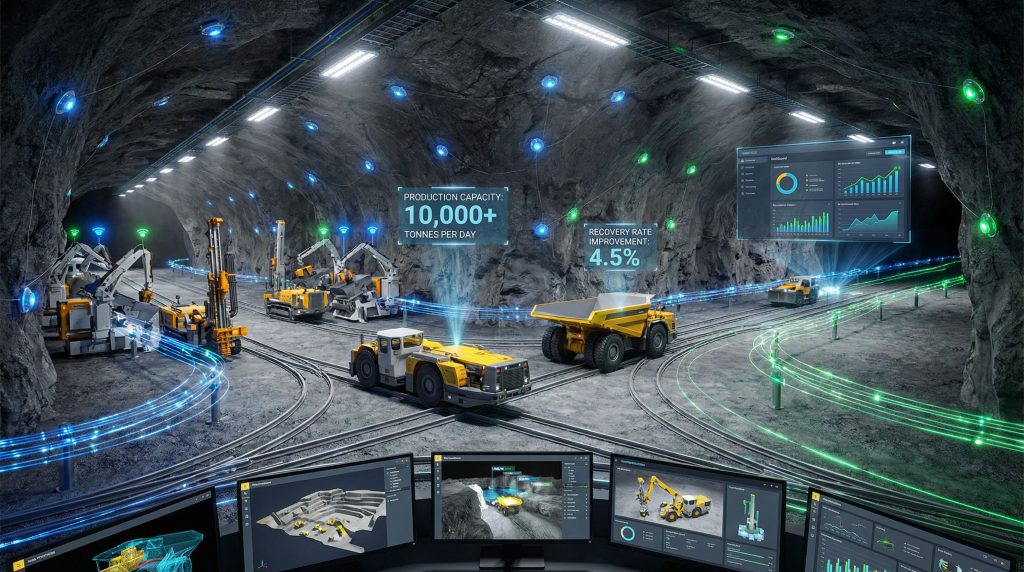
The underground mining sector stands at a technological crossroads where traditional extraction methods converge with sophisticated digital frameworks. This convergence represents more than incremental improvement; it embodies a fundamental restructuring of how subterranean operations monitor, control, and optimise complex mining systems. The technical architecture underlying this transformation encompasses integrated sensor networks, real-time data analytics, and automated control systems that collectively redefine operational possibilities in challenging underground environments.
Modern underground operations increasingly rely on comprehensive digital ecosystems that extend far beyond simple equipment tracking. These systems integrate multiple technological layers, from mesh communication networks replacing legacy infrastructure to advanced visualisation platforms providing three-dimensional operational oversight. The technical complexity involves seamless integration across mixed equipment fleets, automated production monitoring systems, and enhanced safety protocols through digital situational awareness capabilities.
When big ASX news breaks, our subscribers know first
Communication Network Evolution in Underground Mining
Underground digitalisation at Rampura Agucha demonstrates how mining operations have historically struggled with communication limitations inherent in deep subterranean environments. Traditional leaky feeder systems provided basic communication capabilities primarily along main haulage drives, leaving significant coverage gaps in cross-cuts and remote working areas. This infrastructure limitation created operational blind spots that impacted both productivity and safety coordination across underground workings.
Digital network deployment addresses these historical constraints through comprehensive coverage strategies that extend reliable communication throughout underground operations. Modern mesh networking technologies enable seamless connectivity across previously isolated sections, facilitating real-time coordination between surface control centres and underground personnel. These networks support multiple communication protocols simultaneously, ensuring redundancy and reliability in mission-critical operational environments.
The implementation of advanced communication infrastructure requires careful consideration of underground environmental factors including moisture, temperature variations, and electromagnetic interference from heavy equipment. Network design must accommodate the unique propagation characteristics of radio frequencies in confined underground spaces while maintaining sufficient bandwidth for data-intensive applications including video monitoring and automated system feedback.
Production Optimisation Through Digital Integration
Underground mining operations benefit from digital systems that identify and address production bottlenecks through continuous monitoring and analysis. Real-time data collection enables operational teams to pinpoint constraints across the production chain, from extraction through materials handling and processing. This analytical capability transforms reactive maintenance approaches into predictive operational strategies that prevent productivity losses before they occur.
Automated process control systems enhance flotation circuit performance by providing immediate feedback on ore characteristics and processing parameters. Online analytical equipment measures ore quality continuously, enabling automated adjustments to processing conditions that optimise recovery rates. This closed-loop control approach reduces variability in processing outcomes while maintaining consistent throughput rates across varying ore characteristics.
Key Digital Integration Benefits:
• Enhanced equipment utilisation tracking for maintenance scheduling optimisation
• Improved traffic flow coordination through intelligent navigation systems
• Reduced manual intervention requirements in hazardous processing environments
• Real-time production monitoring enabling immediate response to operational changes
The integration of digital systems across underground operations creates comprehensive visibility into production processes that were previously monitored through discrete, isolated measurements. This holistic approach enables operational teams to understand complex interdependencies between different production systems and optimise overall facility performance rather than individual component efficiency.
Enhanced Safety Through Digital Monitoring Systems
Digital transformation in underground mining fundamentally improves safety outcomes through enhanced monitoring capabilities and emergency response systems. Real-time personnel tracking provides immediate location awareness for all underground workers, enabling rapid response coordination during emergency situations. This capability extends beyond simple location monitoring to include environmental parameter tracking that can identify potentially hazardous conditions before they impact personnel safety.
Furthermore, AI in drilling technologies represent a significant advancement in operator safety by removing personnel from high-risk drilling locations while maintaining operational control and precision. These systems utilise advanced sensor feedback and communication networks to provide operators with comprehensive situational awareness from safe remote locations.
Predictive maintenance systems enhance safety by identifying equipment degradation patterns that could lead to dangerous failures. These systems analyse multiple data streams including vibration patterns, temperature variations, and operational parameters to predict component failures before they occur. Early intervention prevents catastrophic equipment failures that could endanger personnel and disrupt production operations.
Advanced Safety System Components:
• Comprehensive environmental monitoring throughout underground workings
• Emergency communication systems with redundant connectivity pathways
• Automated equipment shutdown protocols for hazardous condition detection
• Integration with surface emergency response coordination systems
Technical Implementation Challenges
Underground digital system deployment encounters unique technical challenges that differ significantly from surface industrial applications. Network infrastructure installation must contend with restricted access corridors, challenging environmental conditions, and the need for explosion-proof equipment in many underground mining environments. These constraints require specialised installation techniques and equipment designed specifically for underground deployment.
System integration across heterogeneous equipment fleets presents substantial technical complexity, particularly when incorporating legacy equipment with modern digital systems. Different manufacturers often utilise proprietary communication protocols and data formats that require middleware solutions for effective integration. The challenge extends to ensuring reliable data exchange between systems while maintaining cybersecurity standards appropriate for industrial control environments.
Connectivity reliability in deep underground operations faces unique technical obstacles including signal attenuation, electromagnetic interference from heavy equipment, and the physical constraints of underground infrastructure. Network design must incorporate redundancy mechanisms and fallback communication protocols to ensure continuous operation despite component failures or environmental disruptions.
Implementation Complexity Factors:
• Power supply infrastructure for distributed digital systems
• Cybersecurity requirements for networked industrial control systems
• Integration with existing mining automation and control systems
• Compliance with underground electrical safety regulations and standards
Advanced Analytics and Operational Intelligence
3D geological modelling platforms provide comprehensive operational oversight by integrating multiple data streams into intuitive interfaces that enable rapid decision-making. These systems combine real-time sensor data with geological models and production planning information to create dynamic representations of underground operations. The visualisation capability extends to mobile platforms, enabling field personnel to access critical operational information regardless of their location within the mine.
Predictive analytics applications utilise historical production data, equipment performance metrics, and geological characteristics to forecast operational outcomes and identify optimisation opportunities. Machine learning algorithms continuously refine their predictive accuracy by incorporating new operational data and adjusting model parameters based on observed outcomes. This iterative improvement process enhances the reliability of production forecasts and equipment maintenance predictions.
Online analytical systems provide immediate feedback on ore quality and processing efficiency, enabling automated adjustments to maintain optimal recovery rates. These systems integrate with flotation cell controls to implement real-time process optimisations based on continuous ore characterisation. The analytical feedback loop reduces response time to changing ore characteristics from hours to minutes, significantly improving processing efficiency and recovery rates.
What Are the Key Success Metrics for Underground Digital Transformation?
Success measurement for underground digitalisation at Rampura Agucha extends beyond traditional productivity indicators to encompass comprehensive operational performance metrics. Equipment utilisation improvements typically range from 15-25% through enhanced scheduling and predictive maintenance capabilities. Safety incident reduction often exceeds 30% when comprehensive digital monitoring systems are implemented effectively.
Processing efficiency gains represent another critical success metric, with automated control systems typically achieving 3-5% improvements in metallurgical recovery rates. Response time improvements for equipment maintenance and operational adjustments demonstrate the effectiveness of real-time monitoring systems in preventing costly production interruptions.
The next major ASX story will hit our subscribers first
Future Technology Integration Pathways
Artificial intelligence applications in underground mining extend beyond simple automation to encompass complex decision-making scenarios that traditionally required human expertise. However, the industry digital evolution requires careful consideration of decision boundaries and human oversight requirements to ensure safe and effective autonomous operation.
Internet of Things sensor networks expand monitoring capabilities throughout underground operations by providing distributed measurement capabilities for environmental parameters, equipment conditions, and process variables. These sensor networks generate substantial data volumes that require sophisticated data management and analytical capabilities to extract actionable insights. The scalability of IoT implementations enables gradual system expansion as operational requirements evolve and technology costs decrease.
Emerging Technology Applications:
• Autonomous equipment operation in hazardous underground environments
• Advanced machine learning for geological and resource estimation
• Integrated surface and underground operational coordination systems
• Cloud-based platforms enabling remote operational monitoring and control
How Does Digital Mining Support Sustainability Goals?
Sustainable mining transformation benefits significantly from digital system implementation through optimised resource utilisation and reduced environmental impact. Energy consumption reduction of 10-20% commonly results from intelligent equipment scheduling and automated process optimisation. Water management systems enhanced through digital monitoring achieve typical efficiency improvements of 15-30%.
Waste reduction through precise ore characterisation and automated processing control minimises tailings generation while maximising resource recovery. Digital systems enable continuous monitoring of environmental parameters, ensuring compliance with regulatory requirements while identifying opportunities for further sustainability improvements.
Investment Analysis and Financial Considerations
Digital transformation investments in underground mining require comprehensive financial analysis that considers both quantifiable benefits and strategic value creation. Productivity improvements through enhanced equipment utilisation and process optimisation provide measurable returns that can be directly attributed to digital system implementation. These benefits include reduced operating costs, increased production capacity, and improved recovery rates that translate to tangible financial value.
Safety enhancement investments deliver value through reduced insurance premiums, decreased incident investigation costs, and avoided production losses from safety-related shutdowns. Furthermore, boosted safety operations demonstrate substantial value particularly for operations with challenging safety profiles or regulatory oversight requirements.
| Investment Category | Primary Benefits | Measurement Approach |
|---|---|---|
| Communication Systems | Emergency response improvement | Response time reduction metrics |
| Fleet Tracking | Equipment utilisation optimisation | Operating hour efficiency gains |
| Process Automation | Recovery rate enhancement | Metallurgical performance improvement |
| Safety Systems | Incident prevention | Risk assessment and insurance evaluation |
The strategic value of digital transformation extends beyond immediate operational benefits to include competitive positioning, regulatory compliance enhancement, and organisational capability development. These factors contribute to long-term enterprise value but require different evaluation methodologies than traditional capital investment analysis.
What Investment Returns Can Underground Mining Expect?
Return on investment for underground digitalisation at Rampura Agucha typically ranges from 200-400% over a three-year implementation period. Initial capital requirements range from $5-15 million for comprehensive digital infrastructure depending on mine size and complexity. Operational cost savings through automated systems and predictive maintenance typically achieve $2-5 million annually for medium-scale underground operations.
The digitalisation implementation at Rampura Agucha mine demonstrates the practical benefits of comprehensive digital transformation in challenging underground environments. Additionally, Sandvik and Vedanta's partnership showcases how strategic technology collaboration accelerates digital adoption in underground mining operations.
Strategic Implementation Framework
Successful underground mining digitalisation requires systematic implementation approaches that minimise operational disruption while maximising technology adoption effectiveness. Phased deployment strategies enable gradual system integration and provide opportunities for operational adjustment and optimisation before full-scale implementation. This approach reduces implementation risk and enables continuous improvement based on operational experience and user feedback.
Technology selection criteria must balance functionality requirements with compatibility considerations for existing infrastructure and operational procedures. Vendor support capabilities become critical factors given the specialised nature of underground mining applications and the importance of ongoing system maintenance and optimisation. The selection process should evaluate not only initial system capabilities but also upgrade pathways and long-term technology roadmaps.
Implementation Success Factors:
• Comprehensive stakeholder engagement across all organisational levels
• Pilot program validation before large-scale deployment
• Integration planning that addresses legacy system compatibility
• Training programs that ensure effective technology utilisation
• Performance monitoring systems that track implementation success metrics
Change management becomes particularly important in underground mining environments where operational safety depends on consistent adherence to established procedures. Digital system implementation must incorporate comprehensive training programs and gradual transition protocols that maintain safety standards while enabling effective technology adoption. The human factors associated with technology implementation often determine the ultimate success of digitalisation initiatives.
Underground digitalisation at Rampura Agucha represents a comprehensive transformation of traditional extraction operations through sophisticated technology integration. The convergence of communication networks, automated systems, and advanced analytics creates unprecedented opportunities for productivity enhancement, safety improvement, and operational optimisation. While implementation challenges require careful planning and substantial investment, the measurable benefits demonstrate clear value for mining operations committed to technological advancement.
The ongoing evolution of digital mining technologies suggests continued opportunities for operational improvement and competitive advantage. Mining companies that effectively integrate these technologies position themselves for sustained operational excellence while meeting evolving safety, environmental, and regulatory requirements. The technical foundation established through current digitalisation efforts enables future technology adoption and continued operational optimisation as underground mining technology continues advancing.
Ready to Invest in the Next Major Mineral Discovery?
Discovery Alert instantly alerts investors to significant ASX mineral discoveries using its proprietary Discovery IQ model, turning complex mineral data into actionable insights. Understand why historic discoveries can generate substantial returns by exploring proven examples of exceptional outcomes, then begin your 14-day free trial today to position yourself ahead of the market.