August 25, 2026
The Hidden Architecture of the Modern Smart Mine: Layers, Logic, and Long-Term Value
The mining sector has rarely been associated with technological elegance. For most of its industrial history, extracting metals and minerals from the earth has been defined by brute-force engineering, massive capital expenditure, and an almost philosophical acceptance of inefficiency as an unavoidable cost of doing business. However, the structural economics of extraction are shifting in ways that analog operations are simply not equipped to absorb. Energy costs, labour constraints, environmental regulations, and commodity price volatility are all compressing margins simultaneously. Against that backdrop, the case for digital mining enhancing productivity and reducing environmental impact is no longer speculative. It is becoming measurable, operational, and increasingly urgent.
When big ASX news breaks, our subscribers know first
What Separates a Smart Mine From Its Analog Counterpart
The distinction between a digitalised mine and a traditional one is not merely a matter of having newer equipment on site. The difference is architectural. A smart mine is built around a network of embedded wireless sensors that continuously transmit operational data to a centralised system, eliminating the need for workers to conduct manual ground-level readings in potentially hazardous locations. This foundational layer of connectivity is what makes everything else possible.
Traditional mining operations, by contrast, depend on manual data collection cycles, physical cabling infrastructure, and reactive maintenance protocols. These characteristics are not simply inconvenient; they are structurally costly. Cabling systems in large open-pit and underground mines require significant installation investment and ongoing maintenance budgets. When cables fail or readings are delayed, the lag between a developing equipment problem and operator awareness can stretch into days.
Furthermore, data-driven mining operations are transforming this landscape by enabling real-time decision-making that was previously impossible. The technology stack that defines a modern smart mine operates in three distinct layers:
Layer 1 centres on wireless sensor networks that form the operational nervous system of the mine, feeding continuous data streams from both static and mobile assets.
Layer 2 introduces Operational Intelligence (OI) platforms that process this data using predictive analytics, enabling operators to anticipate equipment stress, failure risk, and process inefficiencies before they escalate.
Layer 3 applies automation software that uses the sensor network as its foundation, enabling remote management of autonomous trucks, drilling systems, and processing equipment without requiring physical operator presence.
| Capability | Smart Mine (Digital) | Analog Mine (Traditional) |
|---|---|---|
| Data Collection | Embedded wireless sensors | Manual ground readings |
| Asset Management | Remote-controlled, automated | On-site operator dependent |
| Predictive Maintenance | AI/OI-driven forecasting | Reactive repair cycles |
| Workforce Exposure | Minimised via automation | High-risk physical presence |
| Cabling Infrastructure | Eliminated | Extensive and costly |
| Downtime Risk | Proactively managed | Weeks-to-months exposure |
Why Organisational Culture Remains the Largest Barrier to Digital Adoption
It would be tempting to frame the slow uptake of digital technology in mining purely as a technical or financial challenge. In reality, the most persistent barrier is cultural. Mining operations are frequently structured as internally competitive units, where individual sites within the same company are benchmarked against each other on safety records, production output, and cost efficiency. This internal competition creates silos that actively obstruct the collaborative integration necessary for digital systems to function effectively across an enterprise.
Adding to this structural inertia is a documented trust deficit around cloud platforms and Internet of Things (IoT) solutions. Mining operators have often developed a cautious posture toward their operational data, partly shaped by the industry's long memory for high-profile technology failures and corporate data breaches involving vendors previously regarded as reliable. This wariness is not irrational; it reflects genuine risk management. However, when it hardens into blanket scepticism, it becomes a strategic liability.
Operations that delay digital integration do not simply fall behind in efficiency terms. They become structurally more expensive to run as digitalised peers use predictive intelligence to eliminate unplanned downtime, reduce maintenance overhead, and compress their per-unit production costs.
The compounding effect of delayed adoption is significant. As early movers accumulate operational data over multiple years, their OI platforms become progressively better at predicting failure patterns specific to their equipment, geology, and climate conditions. This creates a learning curve advantage that is genuinely difficult for late adopters to close simply by purchasing the same technology suite later.
The Operational and Financial Case for Predictive Maintenance
How Does Predictive Maintenance Change the Cost Calculus?
One of the most financially material benefits of mine digitalisation is the shift from reactive to predictive maintenance. In conventional mining operations, equipment is typically serviced either on a fixed schedule or after it has already begun to degrade. Both approaches carry hidden costs. Fixed schedules result in servicing equipment that does not yet need attention while potentially missing developing faults that fall between inspection cycles.
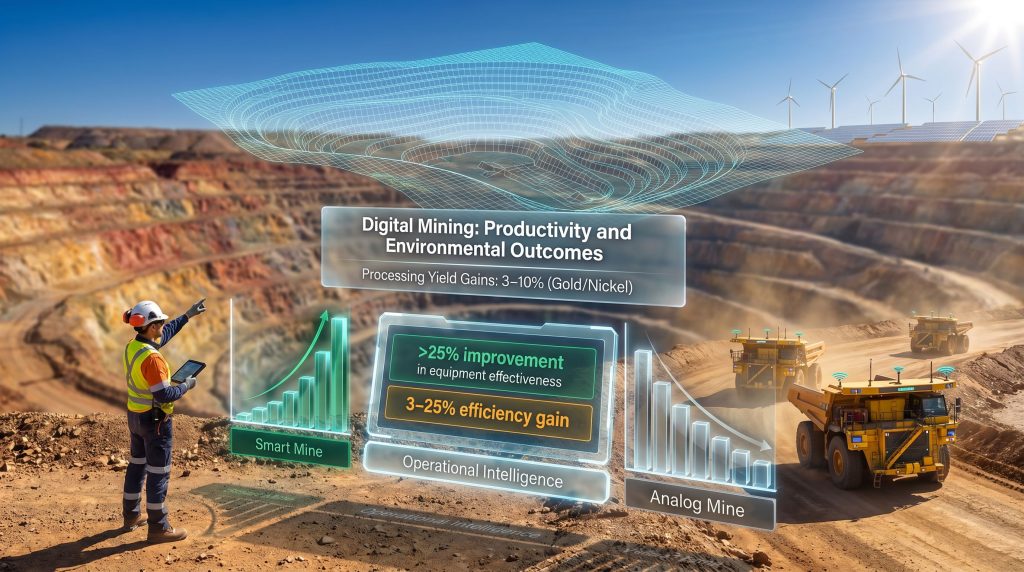
Predictive maintenance powered by AI and neural network analysis changes this calculus entirely. By continuously monitoring vibration signatures, temperature gradients, hydraulic pressure, and motor load across an asset fleet, OI platforms can detect anomalous patterns that precede mechanical failure with enough lead time for planned intervention. Industry benchmarks indicate that this approach can deliver improvements in overall equipment effectiveness exceeding 25% across multi-operator deployments.
The downstream value of avoiding unplanned operational shutdowns is substantial. In large-scale mining operations, production halts lasting weeks or months translate directly into missed revenue, broken contractual supply commitments, and reputational damage with offtake partners. The ROI differential between a mine with integrated predictive maintenance and one running on reactive repair cycles is not marginal; it is the kind of performance gap that determines competitive positioning over a multi-year horizon.
| Technology | Productivity Impact | Benchmark Period |
|---|---|---|
| Autonomous vehicle fleets | Labour reduction and 24/7 operation capability | 2023 to 2025 |
| Predictive maintenance (AI/neural networks) | Greater than 25% improvement in equipment effectiveness | Multi-operator surveys |
| Real-time performance monitoring | 3 to 10% yield improvement in gold and nickel processing | 2024 operational data |
| Digital twin simulation | Reduced blast inefficiencies and remote operator training | Anglo American, Los Bronces |
| IoT sensor integration | Minimised unplanned production pauses | Sector-wide adoption data |
Digital Twins and Scenario Modelling: Intelligence Before Action
A digital twin in a mining context is a virtual replica of a physical mine or specific operational system, updated in real time using sensor data from the actual site. The concept has moved well beyond theoretical novelty. Large open-pit operations have demonstrated that digital twin environments allow engineers to simulate blast patterns, optimise fleet routing, model ore processing throughput, and evaluate equipment placement without committing physical resources or exposing workers to risk.
The strategic value of this capability extends into environmental planning. Before a blasting sequence is executed, operators can model its energy propagation, vibration radius, and dust dispersion within the digital environment. This ability to pre-assess environmental outcomes before physical intervention is one of the less-discussed but most significant contributions of AI in drilling and blasting to responsible mining practice.
Digital twins also serve a workforce development function that is often overlooked. Remote operator training within simulated mine environments allows personnel to build competency on complex equipment configurations without requiring physical access to active operations, reducing both training costs and the risk of training-related incidents.
How Automation Transforms Both Productivity and Safety
What Impact Do Autonomous Fleets Have on Mine Efficiency?
The deployment of autonomous truck fleets represents perhaps the most visible productivity gain in modern mining. Mining automation trends show that automated haulage systems operate continuously without shift changes, fatigue limitations, or the performance variability inherent in human-operated equipment. When combined with AI-guided route optimisation that dynamically adjusts paths based on real-time load data, fuel consumption, and road conditions, autonomous fleets deliver measurable efficiency improvements that compound over long operational cycles.
The expansion of 5G connectivity infrastructure is accelerating this transition, particularly in underground and remote surface operations where reliable high-bandwidth communication previously constrained autonomous system deployment. With 5G-enabled latency in the millisecond range, remote operators can maintain meaningful real-time control over autonomous assets in environments that would otherwise be inaccessible or prohibitively dangerous for human workers.
From a safety perspective, the removal of workers from high-risk physical environments through automation is one of the most consequential outcomes of mine digitalisation. Workers performing manual readings in isolated, difficult-to-access areas of a mine face disproportionate injury risk. When sensors replace those manual rounds and automated systems handle mobile asset operations, the physical exposure of the workforce is materially reduced without any corresponding loss of operational output.
Safety Reality Check: Dam failures and structural collapses in mining environments carry catastrophic consequences for workers and surrounding communities. Operational Intelligence platforms that monitor structural integrity continuously and trigger alerts before critical thresholds are breached represent one of the most important life-safety applications of digital mining technology currently in active deployment.
Wearable technology with wireless connectivity adds a further dimension to workforce safety management. Real-time location tracking of personnel across complex mine environments improves emergency response capability and enables more precise labour coordination, particularly in underground operations where visual supervision is limited.
The next major ASX story will hit our subscribers first
Digital Mining and Environmental Performance: Beyond the Cost Argument
The environmental dimension of mine digitalisation deserves treatment that goes beyond the headline claim that smart mines are greener. The mechanisms through which digital technology reduces environmental impact are specific and worth examining individually. Indeed, renewable mining solutions are increasingly being integrated alongside these digital tools to further reduce the carbon footprint of extraction.
Blasting optimisation is a domain where digital tools have delivered demonstrable environmental improvements. Traditional blasting sequences are designed with conservative parameters that often result in over-fragmentation, excess vibration, and unnecessary energy dissipation into surrounding rock and soil. AI-optimised blasting design tightens these parameters, reducing ground vibration, limiting airblast overpressure, and decreasing the volume of waste rock generated per tonne of ore recovered.
Route and fuel optimisation in autonomous fleet management reduces diesel consumption per tonne hauled, directly lowering the carbon intensity of extraction. When real-time road condition data informs routing decisions continuously rather than relying on static shift plans, fuel efficiency improvements accumulate meaningfully over the operational life of a mine.
Remote operations reduce the energy overhead associated with maintaining large on-site workforces, including accommodation, transport logistics, catering, and infrastructure services that exist primarily to support physical human presence at remote mine sites.
Environmental DNA (eDNA) monitoring and satellite-based surveillance are emerging as important tools for real-time ecological risk assessment at mine sites. According to research published by the Intergovernmental Forum on Mining, eDNA analysis allows species presence to be detected non-invasively from water or soil samples, providing biodiversity data without physical disturbance of sensitive habitats.
The Mitigation Hierarchy: Where Digital Tools Fit in Responsible Mining Practice
Environmental management in mining is governed by a structured decision framework known as the Mitigation Hierarchy. Under this framework, project developers are required to work through a sequential series of obligations before reaching the stage of environmental offsetting:
- Avoid sensitive ecological areas and high-impact actions wherever operationally feasible.
- Minimise unavoidable impacts through operational controls, optimised design, and technology deployment.
- Restore affected areas following operational activity through active rehabilitation programmes.
- Offset residual environmental harm through biodiversity credits or structured conservation commitments.
Digital tools are most directly relevant to the first two stages of this hierarchy. AI-driven planning and digital twin simulation support better avoidance decisions during project design, while predictive optimisation of blasting, routing, and processing operations strengthens the minimise obligation during active operations.
Biodiversity offset frameworks are also evolving in sophistication. The principle of ecological equivalence requires that any offset deliver conservation outcomes comparable in type and quality to the habitat lost. As biodiversity credit markets mature, they are expected to create tradeable instruments for verified conservation outcomes that complement the carbon credit architecture already embedded in many mining companies' ESG reporting frameworks.
Cryptocurrency Mining vs. Traditional Digital Mining: Separating the Environmental Profiles
The term digital mining creates genuine confusion in public discourse because it encompasses two fundamentally different activities with sharply divergent environmental profiles. Traditional digital mining enhancing productivity and reducing environmental impact refers to the application of digital technology to physical mineral and metal extraction. Cryptocurrency mining using proof-of-work algorithms, however, refers to the computational process of validating blockchain transactions, which bears no operational connection to physical resource extraction.
| Dimension | Traditional Digital Mining | Crypto (Proof-of-Work) Mining |
|---|---|---|
| Primary Energy Use | Optimised via AI and automation | High-intensity, largely fossil-based (approximately 48% in 2025) |
| GHG Emissions Trajectory | Declining with progressive digitalisation | Elevated, linked to coal and gas-powered grids |
| Air Quality Impact | Improving via optimised blasting and dust control | PM2.5 increases reported near facilities |
| Renewable Energy Synergy | Integrated into operational energy planning | Potential flexible demand load for curtailed renewables |
| Regulatory Trajectory | Encouraged through ESG frameworks | Increasing scrutiny with proposed federal regulation |
| E-Waste Generation | Minimal | Significant hardware turnover cycles |
One emerging argument within the cryptocurrency mining debate is that proof-of-work operations could serve as flexible demand loads for curtailed renewable energy, absorbing excess grid generation during periods of low demand. This argument has genuine technical merit but remains contested, as the environmental benefit depends entirely on the specific grid mix accessed and the degree to which mining operations can genuinely shift to renewable supply.
The Competitive Calculus of Digital Transformation in Mining
For mining executives and investors evaluating the strategic case for digital transformation, the relevant question is no longer whether digitalisation delivers measurable value. The evidence for productivity improvement, cost reduction, and environmental performance gains is sufficiently established across enough operational deployments to move that question off the agenda.
Consequently, the more pressing question is what the competitive consequences of delayed adoption look like across a five-to-ten-year horizon. As the gap between digitalised and analog mines widens, the performance differential will increasingly be reflected in:
- Operating cost per tonne compared against sector peers
- Access to institutional capital, which is progressively tied to ESG performance metrics
- Offtake partner preferences for demonstrably lower-carbon supply chains
- Workforce attraction in a sector already facing skilled labour shortages
- Insurance and bonding cost structures tied to demonstrated safety and environmental management capability
Furthermore, AI-powered mining efficiency tools are increasingly influencing how investors assess operational value and long-term asset performance. As outlined by PlanRadar's analysis of digital mining management, the productivity gains from digital transformation are now well-documented across multiple mining regions and asset classes.
| Outcome Category | Impact | Supporting Evidence |
|---|---|---|
| Equipment effectiveness | Greater than 25% improvement | Neural network predictive maintenance data |
| Processing yield gains | 3 to 10% in gold and nickel | 2024 multi-operator benchmarks |
| Operational efficiency range | 3 to 25% across mine types | 2023 to 2025 industry surveys |
| Labour cost reduction | Significant via automation | Autonomous fleet deployment data |
| Carbon footprint per tonne | Declining with digitalisation | Route and energy optimisation outcomes |
| Unplanned downtime risk | Substantially reduced | OI platform adoption results |
| Worker safety exposure | Materially improved | Wearable technology and automation integration |
The skills gap accompanying this transition is a legitimate challenge. Digital mine environments require personnel who can interpret sensor data, manage autonomous systems, and maintain complex software infrastructure. Building this workforce capability requires investment in training programmes, partnerships with technical institutions, and a cultural shift in how the mining industry positions itself as a career destination for technology professionals.
Frequently Asked Questions: Digital Mining, Productivity, and Environmental Impact
What Is Digital Mining in the Context of Metal and Mineral Extraction?
It refers to the integration of wireless sensor networks, Operational Intelligence platforms, automation software, and data analytics into physical mining operations to improve efficiency, safety, and environmental performance.
What Is Operational Intelligence and How Does It Improve Mine Performance?
OI platforms aggregate real-time data from sensor networks and apply predictive analytics to identify equipment stress patterns, anticipate failures, and recommend maintenance interventions before costly breakdowns occur.
Does Mining Automation Reduce Jobs or Change the Nature of Work?
Automation primarily removes workers from high-risk physical tasks while creating demand for digital operations roles, remote system management, and data analysis functions. The nature of mining work shifts rather than simply contracting.
What Role Do Digital Twins Play in Modern Mining Operations?
Digital twins enable operators to simulate operational scenarios, optimise blast designs, model environmental outcomes, and train personnel within virtual environments before committing to physical actions.
How Does Digital Mining Help Reduce a Mine's Carbon Footprint?
Through route optimisation reducing fuel consumption, AI-optimised blasting reducing energy waste, remote operations lowering site energy overhead, and OI-driven efficiency improvements reducing the total resource input required per tonne of output. In this way, digital mining enhancing productivity and reducing environmental impact represents one of the most important strategic priorities in contemporary resource extraction.
Want to Stay Ahead of the Next Major ASX Mineral Discovery?
As digital transformation reshapes the economics of mining operations, the companies leading this charge are increasingly delivering the kind of transformative discoveries that reward early investors most significantly — Discovery Alert's proprietary Discovery IQ model scans ASX announcements in real time, turning complex mineral data into actionable opportunities, and you can explore historic examples of exceptional discovery returns or start your 14-day free trial today to position yourself ahead of the broader market.