August 26, 2026
The Hidden Productivity Crisis Reshaping How the World Extracts Critical Resources
Across the global extractive industries, a structural tension has been building for well over a decade. The world's appetite for metals and minerals, particularly those underpinning battery technology, renewable energy infrastructure, and advanced electronics, is accelerating at precisely the moment when digital mining enhancing productivity and reducing environmental impact has become the sector's defining challenge. Ore grades are declining as the most accessible deposits are progressively exhausted. Mining operations are pushing deeper into the earth and further into geographically hostile terrain. The cost of extracting each tonne of usable material continues to climb, even as commodity price cycles create unpredictable revenue environments.
When big ASX news breaks, our subscribers know first
Why Traditional Mining Operations Are Reaching Their Efficiency Limits
The productivity trajectory of conventional mining operations has followed a downward path for an extended period, driven by several reinforcing forces that analog operational models are poorly equipped to address.
Ore body complexity is increasing as near-surface, high-grade deposits become progressively scarcer. Operations are being pushed into deeper, more geologically variable environments where drilling accuracy, blast design precision, and ground control become exponentially more challenging. The consequence is higher explosive consumption per tonne of ore recovered, greater energy intensity per unit of metal produced, and expanding infrastructure requirements to manage deeper workings and longer haulage distances.
Simultaneously, input cost structures are shifting in ways that disproportionately burden labour-intensive operations. Manual data collection, field-based equipment monitoring, and reactive maintenance scheduling represent significant cost centres historically accepted as unavoidable operational realities. Furthermore, data-driven mining operations challenge this assumption directly by replacing labour-intensive physical processes with automated data capture, remote monitoring, and predictive analytics.
The gap between the resource demand required for the global energy transition and the extraction efficiency of conventional mining methods is not a temporary market imbalance. It reflects a structural mismatch that only systematic operational transformation can address.
The concept of a smart mine directly targets this mismatch. A smart mine is fundamentally defined by the digitalisation of its primary operational resources through embedded sensor networks that transmit continuous data streams to centralised management platforms. This architecture enables a qualitatively different approach to mine management, one built on real-time visibility rather than periodic manual assessment.
Two Distinct Industries Share One Label: Understanding the Digital Mining Divide
Before examining the benefits of digital transformation in traditional resource extraction, a critical analytical distinction must be established. The term digital mining is frequently applied to two fundamentally different and environmentally divergent industries. Conflating them produces significant analytical errors in both environmental and investment contexts.
| Dimension | Traditional Mining + Digital Technology | Proof-of-Work Cryptocurrency Mining |
|---|---|---|
| Primary Output | Physical minerals and metals | Cryptocurrency tokens |
| Productivity Trajectory | Improving through automation and AI optimisation | Hardware efficiency offset by competitive hashrate expansion |
| Energy Direction | Declining through process optimisation | Rising as network competition intensifies |
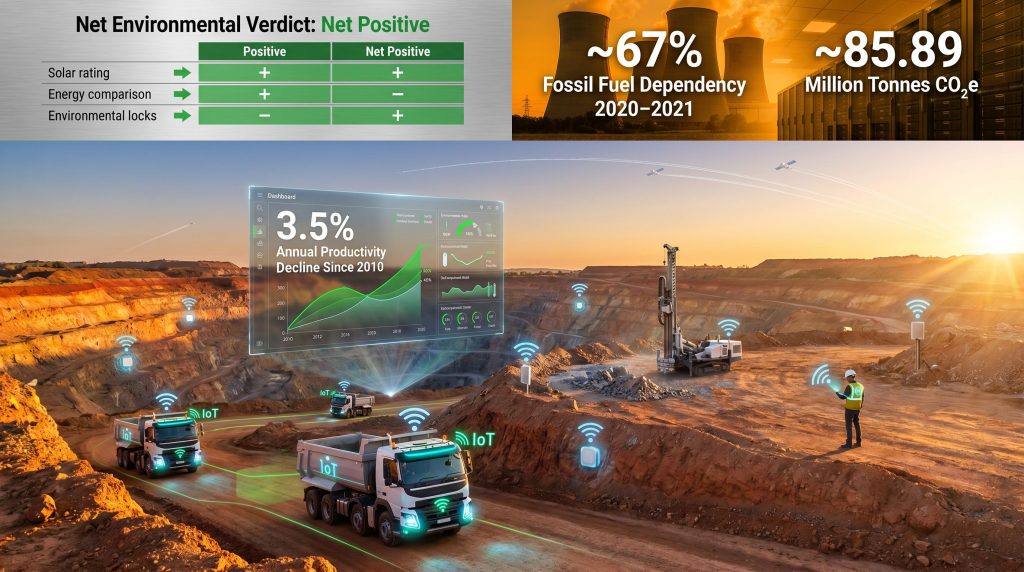
| Emissions Profile | Reducing through electrification and smarter operations | High fossil fuel dependency (~67% in 2020-2021; coal ~45%) |
| Waste Generation | Decreasing through improved tailings and water management | Growing volumes of rapidly obsolete hardware e-waste |
| Net Environmental Assessment | Positive when technologies are properly integrated | Negative across most independent environmental assessments |
The environmental profile of proof-of-work cryptocurrency mining warrants specific attention because it inverts the efficiency logic that defines digital transformation in traditional resource extraction. During the 2020-2021 period, cryptocurrency mining operations carried a fossil fuel dependency rate of approximately 67%, with coal constituting roughly 45% of the total energy mix. Carbon emissions attributable to Bitcoin mining reached an estimated 85.89 million tonnes of CO₂ equivalent during that measurement window, according to environmental assessments of the sector.
More structurally concerning is the environmental damage cost ratio. Independent analyses have estimated environmental harm costs at between $0.49 and $0.74 for every dollar of cryptocurrency value created, a ratio that compares unfavourably with virtually all categories of traditional extractive industry. This ratio persists because the competitive dynamics of proof-of-work networks structurally reward hashrate expansion, meaning that hardware efficiency improvements are absorbed by network growth rather than translating into aggregate energy reduction.
Regulatory interventions, including China's comprehensive cryptocurrency mining prohibition in 2021, have demonstrated that jurisdictional bans redistribute mining activity geographically rather than reducing total energy consumption or emissions. Hashrate migrates to lower-regulation jurisdictions, often with less favourable energy mixes, producing geographic displacement rather than environmental improvement.
The traditional mining sector's adoption of digital technologies operates on entirely different structural logic: efficiency gains reduce resource consumption per unit of output rather than incentivising expanded resource consumption.
The Technology Architecture of the Modern Smart Mine
Wireless Sensor Networks as the Operational Foundation
The foundational layer of smart mine architecture is a wireless sensor network that eliminates the need for labour-intensive manual data collection across mine infrastructure. Embedded sensor arrays capture continuous operational data from both fixed assets, including processing equipment, tailings storage facilities, structural infrastructure, and conveyor systems, and mobile assets such as haul trucks, drilling rigs, and load-haul-dump vehicles.
The operational implications of eliminating physical cabling requirements are substantial across multiple cost dimensions:
- Capital expenditure reductions from removing kilometres of cabling infrastructure in underground and remote surface operations
- Elimination of ongoing cable maintenance costs, which represent a persistent and significant expense category in deep underground workings
- Faster deployment timelines for sensor expansion as operations develop
- Reduced maintenance personnel requirements for network infrastructure management
- Enhanced flexibility to reconfigure monitoring networks as mining geometries evolve
The real-time data streams generated by wireless sensor networks create the informational foundation for every subsequent layer of digital capability, from predictive maintenance to autonomous equipment operation.
Operational Intelligence: Converting Data into Decisions
Raw sensor data has limited operational value in isolation. The transformative capability emerges when that data is integrated into an Operational Intelligence platform that correlates multiple data streams, applies analytical frameworks, and generates actionable insights continuously rather than in periodic reporting cycles.
Operational Intelligence systems in mining contexts typically integrate:
- Equipment performance telemetry from embedded sensors
- Maintenance history and component lifecycle records
- Production metrics and ore flow data
- Structural monitoring readings from tailings facilities and pit walls
- Environmental monitoring data including water quality, dust levels, and seismic activity
- Workforce location and safety monitoring from connected wearable devices
The critical distinction between Operational Intelligence and conventional data analytics is temporal. Standard analytics operates retrospectively on historical datasets, providing insight into what has already occurred. OI platforms process data in real time, enabling operators to identify developing problems before they escalate into operational disruptions or safety incidents.
This capability directly addresses one of the most significant cost categories in conventional mining operations: unplanned equipment failures that halt production for weeks or months. Operations that have integrated OI solutions, particularly those leveraging AI-powered mining efficiency, consistently demonstrate superior return on investment compared to analog counterparts precisely because of this preventive capability.
Autonomous Systems: The Physical Expression of Digital Integration
Automation represents the operational endpoint of digital integration, translating data-driven insights into physical operational actions without requiring continuous human intervention. The implementation pathway is fundamentally different for greenfield smart mines, designed with integrated digital infrastructure from inception, compared to brownfield operations attempting to retrofit automation onto legacy analog systems.
Key autonomous technologies reshaping operational practice include:
- Autonomous haulage systems operating through physical sensor networks and remotely managed software, performing extraction and transport functions that previously required large driver workforces
- Remote-controlled drilling rigs delivering consistent borehole accuracy, reducing explosive consumption per tonne and improving fragmentation outcomes
- Automated processing controls using real-time sensor feedback to optimise smelting and refining parameters, reducing energy consumption per unit of metal produced
Mines designed as integrated digital systems from the outset demonstrate materially faster automation deployment timelines and lower integration costs than those layering technology onto legacy infrastructure. This creates a compounding competitive gap between early adopters and organisations that delay digital architecture decisions.
The Financial Case for Digital Mining: Quantifying Operational Cost Reduction
Labour, Infrastructure, and Maintenance Cost Transformation
The financial benefits of digital integration in mining operations flow from three primary sources: labour cost reduction, infrastructure cost elimination, and the shift from reactive to predictive maintenance.
| Cost Category | Conventional Approach | Digitally Integrated Approach | Nature of Impact |
|---|---|---|---|
| Field data collection labour | Manual on-site personnel conducting regular physical readings | Remote wireless sensor monitoring eliminating field visits | Direct labour cost reduction |
| Cable infrastructure | Extensive physical cabling for data transmission | Wireless sensor network architecture | Significant capital and maintenance saving |
| Unplanned equipment downtime | Reactive repair following mechanical failure | Predictive maintenance through OI platform alerts | Weeks to months of production protected |
| Haul fleet fuel consumption | Driver-managed routing and load cycles | AI-optimised autonomous routing and load management | Measurable fuel efficiency improvement |
| Equipment lifespan | Standard operational cycles to scheduled replacement | Condition-based maintenance extending asset life | Reduced replacement capital expenditure |
| Safety incident costs | Periodic manual monitoring of high-risk zones | Continuous automated structural and environmental monitoring | Reduced incident frequency and severity |
The elimination of manual field readings represents more than a labour cost saving. Personnel conducting physical data collection in structurally unstable underground environments, on active haul roads, or at remote tailings facilities face genuine safety exposure. Removing the requirement for that physical presence simultaneously reduces direct labour costs and removes workers from documented high-risk operational environments.
The ROI Premium of Predictive Maintenance
The financial justification for Operational Intelligence investment is most compelling in the context of unplanned downtime prevention. Mining operations are capital-intensive enterprises where production interruptions carry disproportionate financial consequences. When a primary crusher fails unexpectedly, when a conveyor system suffers an undetected bearing failure, or when a haul truck experiences a drivetrain breakdown in a remote operational area, the cascading production impact can exceed millions of dollars per day in lost output, mobilisation costs, and emergency repair premiums.
Smart mines that have integrated OI-driven predictive maintenance frameworks consistently demonstrate superior return on investment metrics compared to analog operations across multiple commodity types. The mechanism is straightforward: condition-based maintenance schedules, calibrated to real-time equipment health data, replace both time-based maintenance intervals and failure-triggered reactive repairs.
Environmental Benefits: How Digital Mining Enhancing Productivity and Reducing Environmental Impact Works in Practice
Emissions Reduction Through Electrification and Process Optimisation
The environmental benefits of digital integration in traditional mining operations emerge across multiple impact categories, with emissions reduction representing the highest-profile dimension given the sector's exposure to carbon pricing mechanisms and ESG-driven capital allocation decisions.
Progressive deployment of autonomous and semi-autonomous electric vehicle fleets is displacing diesel-powered equipment across surface and underground operations. This transition delivers dual benefits: direct greenhouse gas emissions reduction and significant improvement in underground air quality, which has historically required extensive ventilation infrastructure with its own substantial energy consumption footprint.
AI-optimised blast design reduces explosive consumption per tonne of ore, decreasing blast-generated particulate emissions and minimising ground vibration impacts on surrounding ecosystems and communities. In addition, renewable mining solutions are enabling real-time processing controls that reduce energy consumption per unit of metal produced through the refining and smelting stages.
Water Management and Tailings Safety in the Digital Era
Two of mining's most critical environmental liability categories, water management and tailings storage facility integrity, benefit directly from continuous digital monitoring capabilities.
Advanced sensor monitoring of tailings storage facilities provides uninterrupted structural integrity data across seismic activity indicators, pore water pressure readings, and structural deformation measurements. OI platforms correlate these multiple data streams to generate composite risk assessments that human operators reviewing periodic manual readings cannot replicate. This capability addresses one of the industry's most severe environmental and safety liability categories, given the catastrophic consequences of tailings dam failures documented across multiple continents in recent decades.
Digital water management systems track consumption rates, recycling efficiency, and discharge quality in real time, supporting compliance with increasingly stringent environmental regulations while reducing freshwater consumption in operations located in water-stressed regions. This is particularly significant given the broader critical minerals demand driving expansion into increasingly water-sensitive regions.
Biodiversity Monitoring and Land Impact Minimisation
The integration of environmental monitoring tools into smart mine management systems extends beyond operational parameters to ecological surveillance. Environmental DNA (eDNA) analysis enables non-invasive monitoring of species presence in surrounding ecosystems, providing operators and regulators with continuous biodiversity data without the disturbance associated with traditional field survey methods.
Satellite-based environmental monitoring provides real-time land disturbance data across active mining footprints and surrounding buffer zones, supporting both internal environmental management and transparent external reporting to regulators and community stakeholders. Precision drilling and controlled fragmentation techniques enabled by digital blast design reduce habitat disturbance beyond the active extraction boundary.
The broader framework for managing ecological risk in modern mining increasingly incorporates biodiversity offsets as a structured mechanism for addressing unavoidable habitat impacts. These offsets operate through a rigorous mitigation hierarchy that prioritises avoidance first, then minimisation, then restoration, with offsets applied only to residual harm that cannot be addressed through operational controls. Emerging biodiversity credit markets are beginning to formalise these outcomes through verified, tradeable instruments structured analogously to carbon credits. According to guidance from the Intergovernmental Forum on Mining, digital technologies are increasingly central to minimising mining's environmental footprint.
The next major ASX story will hit our subscribers first
Workforce Safety: From Physical Exposure to Remote Operations
Removing Personnel from High-Risk Environments
Mining consistently ranks among the most hazardous industrial sectors, with risk exposure concentrated in specific operational categories: active blast zones, high-traffic haul roads, structurally unstable underground workings, and remote locations where emergency response is constrained by geography.
Digital transformation directly reduces personnel exposure across each of these categories:
- Wireless sensor networks eliminate the requirement for workers to conduct manual data readings in structurally compromised, chemically hazardous, or geographically isolated locations
- Autonomous haulage systems remove operators from active haul road environments, where vehicle interactions represent one of the highest-frequency injury categories in surface mining
- Remote drilling operations extract personnel from blast zones and from the physical proximity to drill-and-blast operations that carries inherent ground stability risks
- OI-driven predictive structural monitoring provides early warning for developing ground stability issues, enabling preventive action before conditions reach critical thresholds
Wearable Technology and Predictive Safety Analytics
IoT-connected wearable devices extend digital integration directly to the workforce, providing continuous biometric monitoring of fatigue indicators, heat stress levels, and real-time location data for personnel operating in active mine areas. This capability serves both individual safety functions and collective emergency response coordination, enabling rapid mustering verification and targeted response deployment during evacuation scenarios.
Predictive safety analytics platforms draw on historical incident data, real-time environmental conditions, and equipment status information to identify elevated risk periods before incidents occur. This represents a meaningful analytical capability that no manual safety management system can replicate, given the volume and velocity of data inputs required for meaningful pattern recognition across complex operational environments.
The Barriers Preventing Faster Digital Adoption Across the Mining Sector
Organisational Dynamics and the Problem of Internal Competition
Understanding why digital adoption in mining has proceeded more slowly than the operational case would suggest requires examining the internal structure of large mining companies. Individual mine sites within major corporations frequently operate as internally competitive units, benchmarked against one another on safety, production, and cost metrics. This competitive architecture creates powerful disincentives for cross-site information sharing and resists the coordinated multi-departmental commitment that successful digital integration requires.
Technology implementation programmes that lack simultaneous buy-in across operations, engineering, information technology, finance, and executive leadership consistently produce fragmented outcomes. Departmental protectionism, concerns about being disadvantaged in internal performance comparisons, and uncertainty about attribution of costs and benefits all contribute to delayed or diluted digital transformation programmes even when the business case is clearly established at the corporate level.
Data Security and the Cloud Confidence Deficit
Mining operators have historically maintained a cautious position regarding cloud-based data management and third-party IoT platforms. This caution is not irrational: proprietary geological data representing decades of exploration expenditure and competitive intelligence constitutes some of the most commercially sensitive information a mining company holds. High-profile cybersecurity breaches involving enterprise software providers have reinforced sector-wide scepticism about the security of externally managed data infrastructure.
Building the organisational confidence required for meaningful cloud and IoT adoption requires transparent vendor security auditing, robust data sovereignty agreements that clearly establish ownership and access rights, and phased adoption strategies that allow internal stakeholders to validate security frameworks before committing core operational data to external platforms.
Connectivity Infrastructure Gaps in Remote Operations
A structural constraint that no amount of organisational change or investment can immediately overcome is the telecommunications infrastructure deficit affecting mining operations in remote regions. Many of the world's most significant undeveloped mineral deposits are located in areas where connectivity is inadequate to support the real-time IoT data transmission that smart mine architectures require.
The adoption gap between digitally advanced mining jurisdictions and emerging economy operations reflects this infrastructure reality as much as it reflects capital or organisational constraints. Low-earth orbit satellite connectivity solutions are beginning to address remote connectivity barriers, however deployment costs remain prohibitive for smaller and mid-tier operators without the capital base to absorb infrastructure investment alongside operational expenditure.
Mining companies that continue deferring digital adoption while competitors accumulate OI data, calibrated predictive models, and autonomous systems experience are not maintaining a neutral competitive position. They are falling behind on a compounding curve that grows more difficult to close with each passing cycle.
The Competitive Imperative: Why Digital Adoption Is No Longer Optional
The Compounding Advantage of Early Adopters
The performance differential between digitally integrated and conventionally operated mining sites is not static. It compounds over time because the analytical value of operational data accumulates: predictive models become more accurate as they are trained on larger datasets, maintenance scheduling becomes more precisely calibrated as equipment health history deepens, and autonomous system performance improves as operational algorithms are refined through continuous feedback.
Operations that embedded digital infrastructure in their foundational design phase now hold analytical advantages that late adopters cannot rapidly replicate regardless of capital commitment. Historical operational datasets, refined predictive models, and calibrated safety systems represent genuine competitive assets with compounding value trajectories.
ESG Standards and the New Capital Access Framework
The ESG performance expectations of institutional investors and development finance institutions are increasingly defining the conditions under which mining operations can access capital on competitive terms. Digital platforms that generate continuous, auditable data on emissions, water consumption, energy intensity, equipment performance, and workforce safety metrics provide the evidentiary foundation for credible ESG reporting.
This creates a direct financial linkage between digital capability and capital access. Operations that can demonstrate real-time environmental compliance verification, predictive safety systems, and transparent operational data are positioned more favourably with capital allocators than those relying on periodic manual reporting with inherent data quality limitations. The concept of digital mining enhancing productivity and reducing environmental impact is, consequently, no longer an aspirational framework but a practical competitive requirement.
The mining operations that will define the next generation of resource extraction are not those waiting for digital technology to become unavoidable. They are those building integrated digital ecosystems now, accumulating data advantages and refining operational intelligence while the window for differentiation remains open.
Frequently Asked Questions: Digital Mining, Productivity, and Environmental Performance
What defines a smart mine and how does it differ from a conventional operation?
A smart mine is one in which core physical assets are connected through a wireless sensor network transmitting continuous data to a centralised management platform. This enables remote operation of both fixed and mobile assets, predictive maintenance scheduling, autonomous equipment control, and real-time environmental monitoring. Conventional mines rely on manual data collection, human-operated equipment fleets, and reactive maintenance protocols, resulting in higher labour costs, greater safety exposure, and less efficient resource utilisation across the operational lifecycle.
How does Operational Intelligence differ from standard mining data analytics?
Operational Intelligence integrates real-time data streams from equipment sensors, environmental monitors, production systems, and maintenance records into a unified analytical platform generating continuous actionable insights. Standard data analytics typically operates on historical datasets in periodic reporting cycles, providing retrospective analysis of completed performance periods. OI enables genuinely proactive decision-making, particularly valuable for safety-critical applications including structural monitoring and equipment failure prediction where lag time in insight generation has direct operational consequences.
Can digital technologies fully eliminate mining's environmental impact?
Digital technologies significantly reduce the environmental footprint of resource extraction through emissions reduction, water conservation, precision extraction techniques, and improved tailings management. However, they do not eliminate environmental impact entirely. Mining operations inherently disturb land, consume energy and water, and generate waste materials. Digital tools minimise these impacts and improve management of residual harm, but require complementary frameworks including biodiversity offset programmes, rigorous community engagement, and ongoing environmental stewardship commitments to achieve comprehensive environmental performance.
Why does organisational resistance slow digital adoption in mining despite clear financial benefits?
Resistance stems from the competitive internal architecture of large mining companies, where individual sites are benchmarked against one another in ways that create disincentives for cross-departmental collaboration. Capital constraints limit investment capacity for smaller operators. Data security concerns slow cloud and IoT adoption. Furthermore, in remote regions, inadequate telecommunications infrastructure makes real-time data transmission technically infeasible without additional connectivity investment that may exceed available capital budgets.
How does digital capability support ESG compliance and investor relations?
Digital platforms generate continuous, auditable operational data on emissions, water use, energy consumption, equipment performance, and workforce safety metrics, providing the evidentiary basis for credible ESG reporting. Real-time environmental monitoring supports regulatory compliance verification. Predictive safety systems demonstrably reduce incident rates. Transparent operational data strengthens credibility with institutional investors, regulators, and local communities who increasingly apply rigorous scrutiny to mining companies' environmental and social performance records. In this context, digital mining enhancing productivity and reducing environmental impact represents the clearest alignment between commercial and sustainability imperatives available to the sector today.
Want to Identify the Next Major Mineral Discovery Before the Market Does?
Discovery Alert's proprietary Discovery IQ model scans ASX announcements in real time, instantly converting complex mineral data into actionable investment insights across the commodities driving the global energy transition — including those at the heart of smart mine development. Start your 14-day free trial at Discovery Alert today, or explore how historic mineral discoveries have generated extraordinary returns on the discoveries page.