August 25, 2026
The Twin Forces Reshaping Portfolios: Where Monetary History Meets Technological Revolution
Every major technological revolution in history has arrived alongside a parallel crisis of monetary confidence. The printing press coincided with the debasement of European coinage. The industrial revolution unfolded against a backdrop of currency crises and gold standard debates. Today, the artificial intelligence boom is emerging during one of the most aggressive periods of fiscal expansion and debt accumulation the world has ever seen. This is not coincidence — it is a recurring pattern, and understanding it is essential to making sense of why the gold and AI boom are not competing investment narratives but deeply complementary ones.
When big ASX news breaks, our subscribers know first
The Macro Architecture Behind Two Simultaneous Mega-Trends
Fiscal Expansion, Debt Accumulation, and the Debasement Cycle
The simultaneous surge in gold prices and AI capital expenditure reflects a shared root cause rather than a coincidence of timing. Both are rational responses to the same structural conditions: expanding sovereign debt, monetary systems under pressure, and a geopolitical environment fragmenting along ideological and national lines.
The mechanics of fiat debasement are self-reinforcing. Greater debt issuance requires greater money creation, which erodes the purchasing power of existing currency, which in turn drives demand for non-sovereign stores of value that no government can inflate away. Gold and Bitcoin occupy this rare position in the monetary landscape, and of the two, gold carries a documented track record spanning approximately 50,000 years, with the earliest confirmed use of gold fragments traced to Palaeolithic Spain.
This is not a minor historical footnote. It means gold has persisted as a store of value through every prior technological revolution — from the wheel to the internet — without once being rendered obsolete. The argument that AI will somehow break this pattern lacks any historical foundation.
When to Own Gold and When to Avoid It
Not every decade is a gold decade. The 1980s and 1990s were periods of relatively disciplined monetary policy and strong real yields, during which holding gold carried a meaningful opportunity cost. By contrast, the 1970s and the early 2000s both featured fiscal excess, geopolitical fragmentation, and the erosion of real purchasing power through inflation or debt expansion. Gold significantly outperformed in both environments.
The current decade mirrors those conditions closely. Domestically divided political environments in both the United States and across Europe make sustained fiscal discipline politically improbable. A high-spending presidential administration, state-level polarisation between fiscally expansionary and fiscally conservative regions, and an ongoing cultural standoff between competing economic philosophies all point toward continued debasement of fiat currency as the path of least political resistance.
Furthermore, the gold price outlook for 2025 and beyond reflects precisely this environment, with geopolitical and economic tailwinds reinforcing the structural investment case.
The debasement of fiat money is structurally embedded in a debt-based monetary system. The more debt issued, the more currency is created, and the more that currency loses purchasing power. Gold exists outside this system entirely. No political actor can issue more of it.
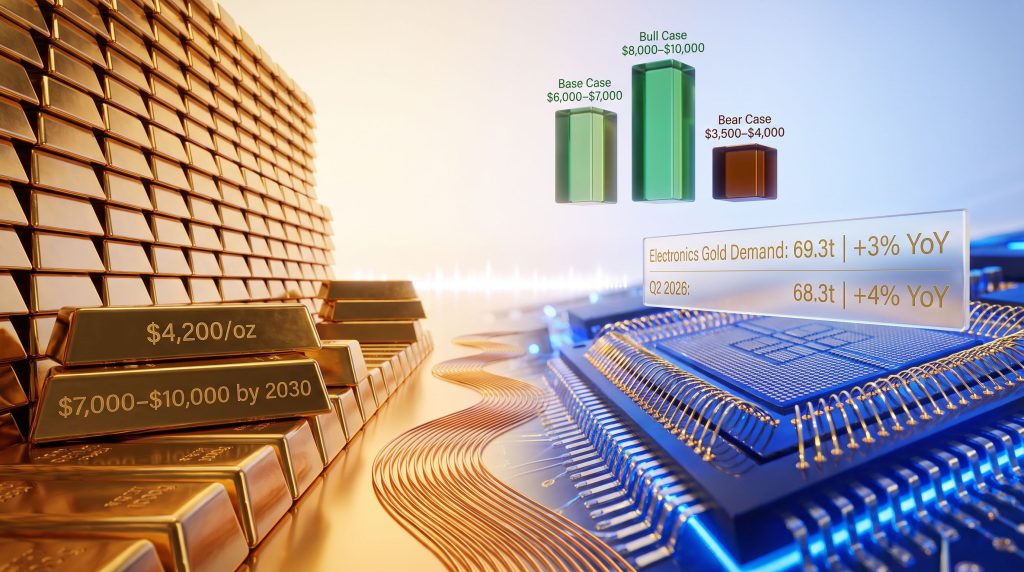
Gold at approximately $4,200 per ounce as of mid-2025 reflects a sustained repricing of this risk, following a significant rally and roughly nine months of consolidation. The current range appears to represent a digestion phase rather than a reversal. The $3,900 to $3,950 zone represents the key support level to watch, and a potential retest of that range cannot be ruled out before the next directional move higher.
How AI Actually Affects Gold Demand: A Two-Channel Framework
Channel One: Industrial Demand From Hardware and Electronics
Gold's physical properties make it irreplaceable in high-performance electronics. Its superior electrical conductivity, resistance to corrosion, and reliability under thermal stress make it the material of choice for chip connectors, memory substrates, and high-performance bonding wire in semiconductor packages. As AI hardware scales, so does this demand.
According to research on artificial intelligence gold demand, World Gold Council data provides useful benchmarks for tracking this trend:
| Metric | Period | Volume | Year-on-Year Change |
|---|---|---|---|
| Total Technology and Industrial Gold Demand | Q1 2026 | 81.6 tonnes | +1% |
| Electronics-Specific Gold Demand | Q1 2026 | 69.3 tonnes | +3% |
| Electronics-Specific Gold Demand | Q2 2026 | 68.3 tonnes | +4% |
The trajectory is positive but modest. AI infrastructure is partially compensating for declining demand from consumer electronics, but the overall industrial contribution remains a relatively minor component of total gold demand. Importantly, elevated gold prices are creating a self-limiting dynamic: the higher the price of gold, the greater the incentive for manufacturers to seek substitutes or minimise usage, which caps the upside from this channel.
Channel Two: Portfolio Demand as an AI Valuation Hedge
The more consequential link between the gold and AI boom is not found in the electronics supply chain — it is found in investor psychology and portfolio construction. As AI-related equity valuations have expanded dramatically, concentrated technology exposure has grown across institutional and retail portfolios alike.
Gold is increasingly being used as a counterweight: a hedge against the scenario where AI earnings fail to justify their implied valuations, triggering a sharp rotation away from growth assets. Macquarie commentary has noted this dynamic explicitly, describing gold as being positioned as protection against AI growth disappointment. When the growth narrative supporting elevated technology multiples is questioned, capital tends to rotate toward assets with no earnings dependency and no counterparty risk.
The industrial contribution of AI to gold demand is real but modest. The more structurally significant connection is gold's role as the preferred hedge when investors begin questioning whether AI-era valuations reflect achievable fundamental outcomes.
Gold's Price Outlook: Where Do the Numbers Point?
The consolidation observed since the major 2024 rally is consistent with historical post-breakout behaviour in commodity markets. Extended multi-month digestion following a sharp directional move is a normal feature of commodity price cycles, not a signal of structural reversal.
Looking further forward, analyst projections for end-of-decade gold prices are meaningfully above current levels:
| Scenario | Implied Price Range by 2030 | Primary Driver |
|---|---|---|
| Base Case | $6,000 to $7,000 per ounce | Sustained fiscal expansion, continued fiat debasement |
| Bull Case | $8,000 to $10,000 per ounce | Geopolitical escalation combined with AI equity correction |
| Bear Case | $3,500 to $4,000 per ounce | Aggressive monetary tightening and sustained real yield competition |
The bear case rests on interest rates rising substantially from current levels. Yield-bearing instruments become more competitive with gold as real yields increase, but the current political economy makes aggressive, sustained monetary tightening difficult to execute. The fiscal cost of higher rates on sovereign debt loads creates its own political pressure against maintaining that stance.
This is not investment advice. Price projections involve significant uncertainty and should be treated as scenario analysis rather than forecasts.
Mining at the Intersection of Two Supercycles
Why AI Infrastructure Creates Structural Metal Demand
Data centres, power grid expansion, semiconductor manufacturing, and the broader digital infrastructure buildout all require substantial quantities of physical metals. The copper supply crunch is the primary industrial concern, with copper used extensively in wiring, cooling systems, grid connectivity, and electric vehicle charging infrastructure. The reshoring of critical supply chains to the United States is, furthermore, accelerating domestic mining investment across multiple metal categories.
The case for metals exposure extends beyond copper:
| Metal | Primary AI and Tech Use Case | Demand Outlook | Key Structural Risk |
|---|---|---|---|
| Copper | Data centre wiring, grid infrastructure, EV charging | Strong, multi-year | Long mine development timelines, supply gap |
| Gold | Chip connectors, memory substrates, investment demand | Moderate industrial growth, strong investment demand | High prices limiting industrial uptake |
| Silver | Solar panels, electronics, industrial applications | Positive, leveraged to energy transition | Price volatility, substitution risk |
| Rare Earths | Permanent magnets, EV motors, defence systems | Strategic demand growth | Geopolitical supply concentration |
The copper supply gap deserves particular attention. No major new copper mines have entered production at scale for an extended period, and the lead time from discovery to production for a significant copper project typically spans 15 to 20 years. Exploration investment made today will not relieve near-term supply pressure. This structural deficit supports a sustained copper price premium and positions copper mining equities as leveraged plays on the AI infrastructure buildout.
In addition, critical minerals demand driven by the energy transition is compounding these supply pressures across multiple metal categories simultaneously.
How AI Is Transforming Mining From the Inside
There is a dimension of the gold and AI boom relationship that receives far less coverage than the supply chain narrative: AI is simultaneously transforming how mining companies operate and make decisions.
Mining is, at its foundation, an extraordinarily data-intensive industry. Consider the physical reality of a drill core programme: exploration companies generate boxes upon boxes of cylindrical rock samples, typically around three to four inches in diameter, representing hundreds or thousands of metres of subsurface geology. Every metre of that core must be logged, assayed, and entered into data management systems.
AI in mineral exploration can now process this data at a scale and speed no geological team could match manually. More significantly, these systems can cross-reference a specific deposit's geological signature against global databases of known deposits, identifying structural and compositional similarities across jurisdictions that human geologists would be unlikely to recognise without years of comparative study.
An AI system analysing drill core data from one project might identify a near-identical geological signature to a producing mine on another continent, directing geologists toward the highest-probability intercept zones before a single additional drill hole is commissioned. This kind of pattern recognition across global datasets represents a genuinely new capability in exploration science.
This matters enormously for the economics of exploration. A development or exploration stage mining company is, in many respects, an intellectual property business. Its primary asset is the accumulated geological knowledge of a specific land package and what lies within it. During commodity downturns, the market may ascribe near-zero value to this knowledge base. During commodity bull cycles, that same knowledge base can be worth hundreds of millions of dollars.
Consequently, AI is accelerating the rate at which that knowledge can be generated, interpreted, and translated into drill targets, which structurally reduces capital waste and compresses the timeline from initial discovery to resource definition.
The Dual Role of Mining Companies in the AI Economy
Mining companies occupy a genuinely unusual position in the current economic landscape. They are simultaneously:
- Suppliers to the AI economy, providing the copper, gold, silver, and critical minerals that form the physical substrate of every data centre, chip, and power grid
- Beneficiaries of the AI economy, as machine learning systems improve exploration efficiency, predictive maintenance in mining reduces unplanned downtime, and automated processing systems improve resource recovery rates
This dual positioning creates a compounding investment thesis that is distinct from simple commodity price exposure.
The Productivity Dividend and the Risk Dimension
Where AI Is Already Delivering Measurable Benefits
At the operational level, AI is producing tangible improvements in communication quality, negotiation outcomes, and decision speed for businesses of all sizes. Small businesses in particular benefit disproportionately: AI tools now provide access to capabilities that previously required expensive professional service engagements, including legal drafting assistance, financial modelling support, and strategic communication.
The aggregate effect of millions of individually better outcomes — fewer misunderstandings, faster conflict resolution, and more efficient resource allocation — compounds into macroeconomic productivity gains that are difficult to measure in real time but structurally significant over multi-year horizons.
The Risk Dimension Cannot Be Dismissed
The same capabilities that make AI valuable for constructive applications can be redirected toward harmful ones. Infrastructure vulnerability analysis, the synthesis of dangerous technical information, and the exploitation of systemic weaknesses all become more accessible as AI capabilities improve. The critical variable is not the technology itself but the governance framework and the intent of the operator deploying it.
AI also follows the same historical pattern as every prior enabling technology: it enhances outcomes in the domains it is applied to while atrophying the underlying human capacity it replaces. Writing reduced the need for memory. Calculators reduced mental arithmetic ability. AI-assisted communication is already reducing the need for direct interpersonal negotiation skills.
For gold investors, however, this risk dimension is not abstract. A more variable world — where both exceptional and catastrophic outcomes become more probable simultaneously — is precisely the environment in which non-sovereign, counterparty-free assets like gold command a sustained risk premium.
The next major ASX story will hit our subscribers first
Is Gold Still Structurally Relevant in an AI-Powered Economy?
The Bear Case Against Gold Examined
The most coherent argument against gold in an AI era is that productivity gains reduce monetary instability over time, eventually creating conditions under which disciplined monetary policy becomes politically viable again. If AI delivers the productivity dividend its proponents expect, the fiscal pressures driving debasement could theoretically ease.
This argument has surfaced in every major technology cycle. And in every prior instance, gold has reasserted its role once the cycle matured, corrected, or delivered less than its initial promise suggested. The productivity dividend, if it materialises, will be unevenly distributed. The monetary and geopolitical distortions driving gold demand are unlikely to resolve cleanly in a short timeframe.
The Structural Bull Case Remains Intact
The conditions that make gold compelling in the current decade are not transient. Domestically divided political landscapes in major economies, an ongoing geopolitical reordering, the weaponisation of technology in international competition, and a monetary architecture built on perpetual debt issuance all point toward sustained demand for non-sovereign stores of value.
Gold has survived every technological revolution for 50,000 years not because it is primitive but because it fulfils a function that no technological innovation has yet been able to replicate: it is a store of value that exists entirely outside the political system. In a world where AI amplifies both the productive and destructive potential of political actors, that property becomes more valuable, not less.
Frequently Asked Questions: Gold and the AI Boom
Does the AI boom increase gold demand?
Yes, through two distinct channels. The first is industrial: AI hardware components use gold for its conductivity and corrosion resistance, and electronics gold demand has grown 3 to 4 percent year-on-year through 2026. The second is through portfolio construction, where gold is increasingly used as a hedge against the risk of AI equity valuations disappointing. The investment channel currently represents the more significant demand driver of the two.
Will AI make gold obsolete as a store of value?
No analytical framework with credible historical grounding supports this conclusion. Gold's value proposition rests on its political neutrality and its structural immunity to debasement. AI is a productivity tool, not a monetary asset. It cannot fulfil the portfolio function that gold occupies.
Which metals benefit most from AI infrastructure growth?
Copper has the strongest and most direct industrial exposure. Gold benefits modestly on the industrial side and more significantly as a portfolio hedge. Silver, rare earths, and other critical minerals also carry meaningful exposure through the energy transition and defence technology supercycles that run parallel to the AI infrastructure buildout.
Are gold mining equities a sound investment during an AI boom?
Mining equities offer leveraged exposure to metal prices but carry additional operational, geological, and jurisdictional risks that direct metal ownership does not. Investors confident in the metals thesis over a multi-year horizon may find miners attractive, provided they accept the higher volatility profile. Investors seeking simpler exposure may prefer physical metal or ETF structures.
Key Takeaways
- The gold and AI boom are not competing investment themes — they are parallel expressions of the same underlying macro forces: fiscal expansion, monetary debasement, and structural uncertainty.
- AI contributes to gold demand through industrial electronics usage and through investor psychology, with the portfolio hedge channel currently more significant than the industrial one.
- The metals most exposed to AI infrastructure growth face structural supply constraints that are not cyclical, supporting a sustained price environment across copper, gold, silver, and rare earths.
- Mining companies are simultaneously suppliers to and beneficiaries of the AI economy, with AI-driven exploration science reducing capital waste and compressing discovery-to-development timelines.
- Gold's end-of-decade price trajectory under base-to-bull case scenarios ranges from $7,000 to $10,000 per ounce, driven by continued monetary debasement, geopolitical risk premiums, and sustained investment demand.
- The bear case for gold requires aggressive and sustained monetary tightening, which faces significant political economy constraints given current sovereign debt levels.
This article is for informational purposes only and does not constitute financial or investment advice. All price projections and analyst estimates involve uncertainty and should not be relied upon as predictions of future performance.
Want to Know Which ASX Gold and Critical Minerals Discoveries Are Happening Right Now?
Discovery Alert's proprietary Discovery IQ model scans ASX announcements in real time, instantly identifying significant mineral discoveries across gold, copper, and critical minerals — the very commodities at the intersection of the monetary and AI supercycles explored above. Explore historic discovery returns on Discovery Alert's dedicated discoveries page and begin your 14-day free trial to position yourself ahead of the broader market.