August 11, 2026
The Digital Mining Revolution Accelerates Beyond Early Adoption
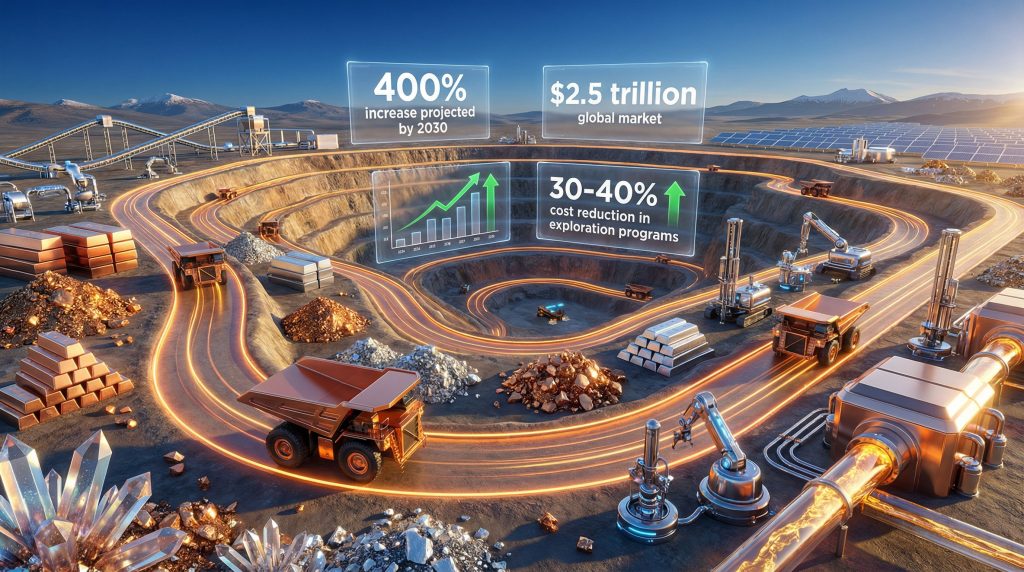
Global mining operations are experiencing a technological transformation that extends far beyond experimental pilot programs into measurable operational improvements. Advanced AI in drilling & blasting systems deployed across exploration sites now deliver consistent cost reductions between 30-40% while machine learning algorithms optimise geological modelling with unprecedented accuracy. This shift represents more than incremental improvement—it signals a fundamental restructuring of how mineral resources are discovered, extracted, and processed.
Mining companies worldwide are documenting substantial productivity gains through predictive maintenance systems that reduce unplanned downtime by 25-35%. These technologies have matured from theoretical concepts into essential operational tools that directly impact profitability and resource efficiency. Furthermore, the transition from demonstration projects to scalable implementations marks a critical inflection point for an industry historically resistant to technological change.
When big ASX news breaks, our subscribers know first
How Data Analytics Transform Geological Discovery and Risk Assessment
Modern exploration programmes integrate multiple data streams through sophisticated analytical platforms that identify mineral deposits with greater precision than conventional methods. Geological survey teams now utilise real-time monitoring systems that process seismic data, soil samples, and satellite imagery simultaneously to create comprehensive subsurface models. These integrated approaches reduce exploration risk while accelerating discovery timelines across diverse geological formations.
Digital twin technology enables mining engineers to simulate operational scenarios before implementing physical changes, thereby reducing operational risk and optimising resource allocation. Advanced mine planning software incorporates variables including weather patterns, equipment performance, and market conditions to enhance decision-making accuracy. Consequently, data-driven mining operations create operational advantages that extend throughout the mining value chain.
Key technological capabilities now operational include:
• Automated ore grade analysis using spectroscopic sensors
• Predictive geological modelling incorporating historical drilling data
• Real-time equipment performance monitoring across fleet operations
• Integrated safety systems reducing incident rates through early warning protocols
• Resource optimisation algorithms maximising extraction efficiency while minimising waste
Critical Minerals Security Reshapes Global Supply Chain Architecture
Government policies across major mining jurisdictions increasingly recognise critical minerals as strategic national assets requiring domestic processing capabilities. Recent policy shifts emphasise supply chain regionalisation to reduce dependence on concentrated production sources, particularly for battery metals essential to energy transition technologies. This strategic repositioning influences investment decisions, processing facility locations, and international partnership frameworks.
Supply chain vulnerability assessments reveal significant concentration risks in processing infrastructure for key commodities including lithium, rare earth elements, and high-grade nickel. However, diversification strategies implemented by major industrial consumers involve establishing alternative processing hubs while maintaining quality standards and environmental compliance. The critical raw materials transition requires substantial capital investments but provides strategic resilience against geopolitical disruptions.
Strategic supply chain developments include:
• Domestic processing capacity investments exceeding $15 billion across North American jurisdictions
• International partnership agreements for critical mineral security between allied nations
• Strategic stockpiling initiatives for materials essential to defence and clean energy applications
• Trade policy modifications affecting mineral flow patterns and processing location economics
Environmental Performance Becomes Competitive Differentiation
Environmental, social, and governance integration has evolved from compliance requirement to competitive advantage within global capital markets. Investment institutions increasingly correlate ESG performance with access to funding while demanding transparent reporting on environmental impact metrics. In addition, mining companies demonstrating superior sustainability performance secure preferential financing terms and maintain stronger social licence to operate within local communities.
Decarbonisation initiatives require estimated investments of $450 billion by 2030 to achieve net-zero mining operations across major producing regions. Electric fleet adoption timelines accelerate as battery technology improves and charging infrastructure expands at remote mine sites. Furthermore, renewable energy integration projects reduce operational costs while meeting increasingly stringent environmental standards.
Industry transformation requires systematic approaches to carbon reduction that maintain operational efficiency while meeting production targets.
Community partnership models deliver measurable operational benefits through improved stakeholder relationships and reduced project development risks. Transparency initiatives strengthen social licence by documenting environmental performance improvements and community investment outcomes. For instance, mining sustainability transformation practices create sustainable competitive advantages that influence long-term project viability and market positioning.
Automation Implementation Reaches Commercial Viability Thresholds
Battery-electric vehicle deployment across mining fleets demonstrates commercial viability through reduced maintenance costs and improved operational efficiency. Mining equipment manufacturers document performance improvements in conveyor system reliability following systematic retrofits with advanced monitoring capabilities. Moreover, asset life extension technologies gain commercial traction by optimising existing infrastructure rather than requiring complete replacement.
Clean processing innovations approach cost parity with conventional methods through technological improvements and scale economies. Training programme investments reaching $2.8 billion annually reflect industry commitment to workforce development aligned with automation requirements. These investments ensure smooth transitions while maintaining operational expertise across evolving technological platforms.
Commercial automation achievements include:
• Autonomous haul truck fleets operating 24/7 with minimal human intervention
• Remote-controlled drilling operations improving safety whilst maintaining productivity
• Automated material handling systems reducing labour requirements by 40%
• Integrated processing controls optimising throughput and quality metrics
Professional Development Adapts to Industry Transformation Requirements
Mining education curricula incorporate technical competencies for low-carbon mine design reflecting mining industry evolution trends toward sustainable operations. Automation readiness training programmes prepare engineers and technicians for technology-integrated work environments whilst maintaining safety standards. Cross-disciplinary collaboration capabilities become essential as mining projects require expertise spanning geology, data science, environmental engineering, and community relations.
Short course offerings align with future industry needs including responsible closure planning, digital systems integration, and stakeholder engagement methodologies. Technical session focus areas reflect industry priorities shifting toward implementation of proven technologies rather than experimental demonstrations. Professional certification programmes update curriculum requirements to address emerging competency areas including carbon accounting and community partnership development.
Knowledge transfer mechanisms facilitate intergenerational learning as experienced professionals share operational insights with technology-native workforce entrants. Networking formats accommodate remote participation whilst maintaining relationship-building effectiveness essential to industry collaboration. These developmental frameworks ensure continuity of expertise whilst accelerating adoption of beneficial innovations.
What Skills Will Future Mining Professionals Need?
The evolving mining landscape demands professionals who can seamlessly integrate traditional geological expertise with advanced digital competencies. Data analytics, automation systems management, and ESG compliance expertise become fundamental requirements rather than specialised skills. Additionally, cross-cultural communication capabilities prove essential as international partnerships become increasingly common in supply chain security initiatives.
The next major ASX story will hit our subscribers first
PDAC 2026 Signals Implementation Focus Over Theoretical Innovation
PDAC 2026 in a transforming mining industry reflects a fundamental shift from technology demonstrations to operational case studies documenting measurable results. Real-world deployment experiences take centre stage as companies share documented return on investment achievements rather than theoretical potential. This programmatic evolution indicates industry maturity in technology adoption and practical application of digital transformation initiatives.
ROI documentation becomes standard presentation format as stakeholders demand evidence-based assessments of technology investments. Implementation success stories provide templates for similar operations whilst identifying common challenges and effective mitigation strategies. Consequently, this knowledge-sharing approach accelerates technology diffusion across diverse operational contexts and geological settings.
Cross-border partnership models for critical mineral security gain prominence as geopolitical considerations influence supply chain planning. International standards development for responsible mining creates frameworks for consistent ESG implementation across jurisdictions. Furthermore, shared infrastructure initiatives reduce individual project risks whilst optimising capital utilisation across regional mining clusters.
How Will PDAC 2026 Showcase Industry Progress?
The PDAC 2026 Convention programming emphasises practical case studies over theoretical presentations, reflecting the industry's maturation in technology adoption. Technical sessions focus on documented ROI achievements and operational improvements rather than pilot project possibilities. Additionally, the convention's format accommodates increased international participation as global partnerships become essential for supply chain resilience.
Technology Adoption Timelines Indicate Mainstream Integration by 2027-2028
Artificial intelligence and automation technologies reach mainstream deployment as operational benefits become clearly documented and implementation costs decline. ESG integration becomes standard practice across operations as regulatory requirements align with investor expectations and competitive pressures. Digital transformation completion of initial phases by 2030 establishes foundation for subsequent innovation cycles incorporating emerging technologies.
Clean technology achievement of cost parity with conventional methods accelerates adoption timelines whilst maintaining production efficiency. Supply chain regionalisation advances through 2026-2028 as processing capacity comes online and logistics networks adapt to new flow patterns. Alternative financing models mature for ESG-compliant projects as capital markets develop standardised assessment criteria.
| Technology Domain | Mainstream Adoption Timeline | Key Success Metrics |
|---|---|---|
| AI/ML Exploration | 2027-2028 | 30-40% cost reduction verified |
| Automated Operations | 2026-2027 | 25-35% downtime reduction |
| ESG Integration | 2025-2026 | Capital access correlation |
| Clean Processing | 2028-2030 | Cost parity achievement |
Investment Decision Frameworks Evolve with Industry Maturation
Technology readiness assessments become standard due diligence components as investors demand evidence of operational benefits and scalability potential. ESG performance metrics influence valuation models through documented correlations between sustainability practices and financial performance. However, geopolitical risk factors integrate into project evaluation frameworks as supply chain security considerations affect long-term viability assessments.
Community partnership quality affects project timelines and regulatory approval processes, creating measurable impacts on development costs and production schedules. Digital maturity assessments enable competitive positioning comparisons whilst identifying improvement opportunities. Innovation adoption rates determine long-term operational viability as technological advancement accelerates across the industry.
Workforce development investments secure talent pipelines essential to operating sophisticated technological systems whilst maintaining safety standards. Sustainability performance rankings influence market access as customers and regulatory bodies implement preference systems for responsibly produced materials.
What Investment Criteria Drive Modern Mining Projects?
Modern mining investment decisions incorporate multiple assessment dimensions beyond traditional financial metrics. Technology readiness levels, ESG compliance scores, and community partnership quality all influence funding availability and project viability. For instance, projects demonstrating superior digital maturity and environmental performance secure preferential financing terms whilst maintaining competitive operational costs.
Measuring Success in the Transformed Mining Landscape
Performance measurement frameworks incorporate technology ROI metrics across exploration and production phases whilst tracking environmental impact reductions and community benefit outcomes. ESG compliance scores correlate with financial performance indicators creating integrated assessment methodologies. Supply chain resilience measurements evaluate diversification effectiveness and disruption response capabilities.
Community engagement effectiveness tracking documents relationship quality and stakeholder satisfaction levels that influence operational continuity. Asset optimisation through integrated digital systems provides measurable efficiency improvements whilst reducing environmental footprints. Risk mitigation via diversified supply strategies creates portfolio resilience against market volatility and geopolitical disruptions.
Long-term value creation strategies emphasise market positioning through sustainability leadership and innovation capacity building for sustained competitive advantage. The mining industry's transformation reflects broader economic shifts toward technology integration, environmental responsibility, and stakeholder collaboration as essential components of operational success.
For comprehensive insights into mining industry developments and educational resources, PDAC 2026 in a transforming mining industry will address these critical themes through technical sessions, case study presentations, and collaborative forums designed to advance practical implementation of industry-leading practices. The comprehensive programming focuses on reinventing the mining value chain through proven technological solutions and sustainable operational practices.
Want to Capitalise on Mining's Digital Transformation?
Discovery Alert's proprietary Discovery IQ model delivers instant notifications on significant ASX mineral discoveries, enabling subscribers to identify actionable opportunities as the mining sector evolves through this technological revolution. Begin your 30-day free trial with Discovery Alert today and position yourself ahead of the market in this rapidly transforming industry.