May 21, 2026
Understanding the Digital Mining Revolution in Canada
The transformation of mineral extraction knowledge has entered a new era through technological innovation and comprehensive data preservation. Traditional approaches to mining education have struggled to connect resource consumption with extraction origins, creating a significant disconnect between daily material usage and geological understanding. This gap has prompted the development of sophisticated digital platforms designed to bridge the knowledge divide between public awareness and mining operations across Canadian landscapes through initiatives like the historical Canadian mines hub.
The evolution of mining documentation reflects broader trends in data democratization and public transparency initiatives. Academic institutions, professional organizations, and technology companies have collaborated to create comprehensive databases that serve both educational and research purposes. These platforms represent a fundamental shift from proprietary information systems toward accessible public resources.
Digital mapping technologies have revolutionised how historical mining data is collected, analysed, and presented to diverse audiences. Geographic information systems enable sophisticated spatial analysis of mining footprints, environmental impacts, and regional development patterns. The integration of interactive visualisation tools allows users to explore complex geological and operational data through intuitive interfaces.
When big ASX news breaks, our subscribers know first
Comprehensive Database Architecture and Development
Platform Specifications and Database Scope
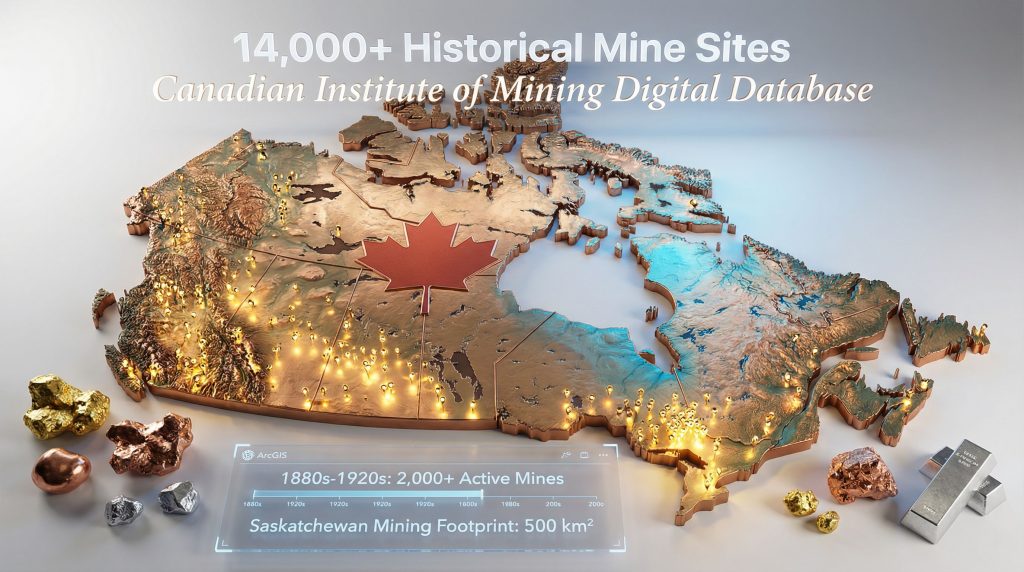
The historical Canadian mines hub represents a significant achievement in mining data compilation, encompassing over 14,000 mine records across multiple provinces and territories. This comprehensive database includes operational mines, historical sites, and abandoned operations dating back centuries. Saskatchewan's contribution includes 544 identified mines, demonstrating the province's substantial mining heritage and ongoing operations through 2025.
Database development follows systematic protocols for data verification and quality control. Historical records undergo validation processes to ensure accuracy and completeness. Missing information is clearly identified, and estimation methodologies are applied consistently across similar site types. For instance, for historical coal mines where surface impacts cannot be visually identified, standardised 10-metre by 10-metre footprint estimates provide conservative baseline measurements.
Institutional Collaboration Framework
The Canadian Institute of Mining plays a central role in platform governance and data stewardship. Academic partnerships with institutions like the University of Saskatchewan provide specialised expertise in geological engineering, geospatial analysis, and mining history research. These collaborations ensure that database content meets professional standards while remaining accessible to general audiences.
Professional networks contribute ongoing expertise through volunteer efforts and technical consultation. Furthermore, geoscientist consultants provide specialised knowledge in geochemistry, exploration methodologies, and regional geology. Research managers with geospatial specialisation contribute advanced mapping and analysis capabilities.
The platform operates on principles of complete public accessibility, designed to spark curiosity and conversation about mineral origins. Educational transparency serves as a foundational principle, encouraging users to explore connections between daily material consumption and extraction processes.
Regional Mining Heritage Distribution Analysis
Ontario's Historic Mining Concentrations
Ontario hosts several of Canada's most significant historical mining districts, each contributing unique chapters to national mining heritage. The Sudbury Basin stands as one of the world's largest nickel deposits, discovered in the 1880s and fundamentally shaping global nickel markets. This region's geological significance extends beyond economic importance to include scientific research into meteor impact structures and extreme geological processes.
The Porcupine-Kirkland Lake gold corridor represents one of Canada's premier gold mining regions, with production spanning over a century. These deposits contributed significantly to Canada's gold production during critical periods of economic development. The region's geological characteristics provide insights into Archean greenstone belt formation and gold mineralisation processes.
Cobalt silver district achieved National Historic Site designation, recognising its role in early 20th-century silver production and technological innovation. This region's mining heritage includes advancement in extraction techniques and labour organisation that influenced mining practices across North America.
Western Canada's Resource Development Timeline
British Columbia's documented 1,887 historical mine sites reflect the province's diverse geological settings and commodity production. These sites span precious metals, base metals, coal, and industrial minerals across varied terrain from coastal ranges to interior plateaus. In addition, the Rossland gold rush established critical infrastructure connections, including railway development that facilitated broader regional economic development.
Alberta's coal mining legacy demonstrates the evolution from early industrial coal extraction to modern energy sector diversification. Historical coal operations provided foundational energy resources for western Canadian development whilst contributing to transportation infrastructure and urban growth.
The Klondike gold rush created lasting economic and cultural impacts extending far beyond immediate gold production. This event attracted international attention to Canadian mining potential whilst establishing transportation routes and settlement patterns that influenced territorial development for decades.
Eastern Canada and Northern Territories Development
Newfoundland's mining heritage extends to 16th-century iron ore operations, representing some of North America's earliest European mining activities. These historical operations provide insights into early colonial economic strategies and technological capabilities.
Quebec's copper-gold mining hub development contributed significantly to provincial economic diversification and technological advancement. However, the province's diverse geological terranes support multiple commodity types and mining methods.
Northwest Territories uranium mining operations hold strategic importance for national energy security and international nuclear fuel markets. These operations demonstrate the evolution of northern mining capabilities and environmental management practices.
Maritime provinces' coal and gypsum extraction history reflects regional industrial development and export market participation. These operations contributed to local economic stability whilst supporting broader Canadian industrial growth.
Environmental Impact Assessment and Land Use Analysis
Saskatchewan Mining Footprint Quantification
Comprehensive spatial analysis reveals Saskatchewan's total visible mining footprint spans approximately 500 square kilometres compared to the province's 650,000 square kilometre total area. This represents less than 0.08% of provincial territory, providing important context for land use discussions and environmental impact assessments.
Saskatchewan's mining footprint of 500 km² remains smaller than the combined urban areas of Saskatoon and Regina (408 km²), demonstrating that mining operations occupy a relatively modest portion of the provincial landscape compared to urban development.
Comparative land use analysis provides additional perspective on human activity patterns. Saskatchewan's agricultural land encompasses approximately 244,000 square kilometres, whilst transportation infrastructure including paved and unpaved roads spans over 190,000 kilometres. These comparisons illustrate the relative scale of different land use categories.
Waste Management and Mining Comparisons
Interesting parallels emerge when comparing mining sites to waste management infrastructure. Saskatchewan hosts approximately 544 mines in the database compared to roughly 500 active landfills and 9 industrial landfills as of 2013. This comparison highlights that human activities consistently generate environmental footprints regardless of the specific industry or purpose.
Key Land Use Comparisons:
- Mining operations: 544 documented sites
- Active landfills: ~500 sites (2013 data)
- Industrial landfills: 9 sites (2013 data)
- Agricultural land: 244,000 km²
- Transportation infrastructure: 190,000 km of roads
Environmental Legacy Documentation
Historical mining operations in locations like Uranium City and Yellowknife serve as important case studies for understanding long-term environmental consequences of resource extraction. These sites provide valuable lessons for current environmental management practices and remediation strategies.
Scholarly documentation by researchers John Sandlos and Arn Keeling provides comprehensive analysis of environmental challenges associated with historical mining operations. Consequently, their work contributes essential knowledge for improving current environmental stewardship practices.
Water resource protection represents a critical priority for all land use activities. Mining operations, urban development, and industrial activities must incorporate robust water quality protection measures to preserve this essential resource for future generations.
Advanced Technologies in Mining Heritage Documentation
Geospatial Analysis and Mapping Systems
Modern mining heritage documentation relies heavily on sophisticated geospatial technologies and analysis methodologies. Polygon-based surface area analysis enables precise measurement of mining-affected areas through detailed satellite imagery and aerial photography review. This methodology provides quantitative data for environmental impact assessment and historical land use analysis.
Interactive mapping systems integrate multiple data layers including geological information, operational timelines, commodity types, and environmental considerations. Furthermore, 3D geological modelling techniques enable users to explore complex relationships between geological settings, mining methods, and regional development patterns.
Mobile-responsive platform design ensures accessibility across various devices and user contexts. Field researchers can access database information during site visits, whilst general users can explore mining heritage from any location with internet connectivity.
Data Quality Assurance Protocols
Systematic data verification processes ensure historical accuracy and reliability. Multiple source verification, cross-referencing with government records, and expert review contribute to data quality maintenance. Version control systems track changes and updates whilst preserving historical information integrity.
Conservative estimation methodologies provide standardised approaches for incomplete historical records. The 10-metre by 10-metre footprint estimate for historical coal mines represents a systematic approach to data gaps whilst acknowledging uncertainty in historical documentation.
Quality assurance measures include:
- Multi-source verification: Cross-referencing government records, company reports, and academic research
- Expert review processes: Professional geologist and historian validation
- Standardised estimation protocols: Consistent methodologies for incomplete data
- Regular database updates: Systematic review and enhancement cycles
- User feedback integration: Continuous improvement based on user input and corrections
Academic Research Integration and Professional Development
University Partnership Models
The University of Saskatchewan's geological engineering programme contributes specialised expertise in mining technology, environmental assessment, and regional geology. Academic partnerships provide research capabilities, student involvement opportunities, and professional development pathways for mining heritage preservation.
Multi-disciplinary research approaches combine geological science, environmental engineering, historical research, and social analysis. This comprehensive methodology ensures that mining heritage documentation addresses technical, environmental, and cultural dimensions of resource extraction history through examining data-driven mining trends.
Student involvement in data collection and verification processes provides valuable educational experiences whilst contributing to database accuracy and completeness. These opportunities develop technical skills, research methodologies, and professional networks within the mining and academic communities.
Professional Network Contributions
Geoscientist consultant networks provide specialised expertise in geochemistry, exploration techniques, and regional geological interpretation. Professional affiliations with organisations like the College of Graduate and Postdoctoral Studies ensure that research meets academic standards whilst addressing industry needs.
The Canadian Hub for Applied Social Research (CHASR) contributes geospatial research management and specialised analysis capabilities. These partnerships demonstrate the interdisciplinary nature of comprehensive mining heritage documentation.
Professional Development Opportunities:
- Technical skills advancement: GIS analysis, database management, historical research
- Professional networking: Connections across academic and industry communities
- Research publication: Opportunities for scholarly contribution and knowledge sharing
- Career pathway development: Skills applicable to mining, environmental consulting, and academic careers
The next major ASX story will hit our subscribers first
Economic Implications and Investment Intelligence
Historical Production Analysis for Future Planning
Comprehensive historical production data provides valuable insights for future exploration targeting and investment decisions. Pattern recognition in successful mining district development informs exploration strategies and risk assessment methodologies. Regional development histories demonstrate the relationship between resource extraction and broader economic growth.
Investment decision support benefits from comprehensive historical analysis including production volumes, operational challenges, infrastructure development costs, and community impact assessments. This information helps investors and developers understand the full scope of mining project development requirements whilst considering mining industry innovation trends.
Tourism and Cultural Economy Potential
Mining heritage tourism represents significant economic development opportunities for former mining communities. Educational programme development creates sustainable revenue streams whilst preserving important cultural heritage. These initiatives support economic diversification and community development in regions transitioning from active mining to heritage preservation.
Cultural preservation initiatives generate employment in heritage interpretation, facility maintenance, and visitor services. Community engagement strategies based on mining history create authentic tourism experiences whilst supporting local economic development.
Economic Development Opportunities:
- Heritage tourism revenue: Visitor spending, accommodation, and local services
- Educational programming: School visits, university research partnerships, professional development
- Cultural economy growth: Heritage interpretation, arts and crafts, cultural events
- Infrastructure investment: Tourism facilities, interpretive centres, trail development
Future Technological Innovation and Platform Enhancement
Artificial Intelligence and Advanced Analytics
Emerging technologies offer significant potential for mining heritage database enhancement and analysis. AI in mining operations applications in data analysis enable pattern recognition across large datasets, identifying relationships between geological characteristics, operational success factors, and environmental outcomes.
Machine learning algorithms can process historical production data, geological surveys, and environmental monitoring information to identify trends and predict future development potential. These capabilities support both academic research and commercial exploration planning.
AI Applications in Mining Heritage Analysis:
- Pattern recognition: Identifying successful exploration targets based on historical data
- Environmental modelling: Predicting long-term environmental impacts and remediation requirements
- Economic forecasting: Analysing historical commodity markets and production costs
- Risk assessment: Evaluating geological, environmental, and economic risk factors
Virtual Reality and Immersive Technologies
Virtual reality integration offers unprecedented opportunities for immersive historical site experiences. Users can explore reconstructed mining operations, understand extraction processes, and experience historical mining communities without physical site access.
These technologies support both educational and tourism applications whilst preserving fragile historical sites from excessive visitor impact. Virtual experiences can include safety training simulations, historical interpretation, and geological education components.
International Collaboration and Standardisation
Cross-border collaboration with United States and Mexico mining databases creates opportunities for continental-scale analysis of mining heritage and development patterns. Standardisation of international mining history documentation protocols facilitates comparative research and best practice sharing.
Global mining heritage database integration enables researchers and investors to analyse worldwide mining trends, technological development, and environmental management evolution. These comparative analyses inform current operational practices and policy development.
International Collaboration Benefits:
- Comparative analysis: Understanding global mining development patterns and best practices
- Technology transfer: Sharing innovative approaches to heritage preservation and analysis
- Research opportunities: Continental and global-scale studies of mining impacts and outcomes
- Policy development: Evidence-based approaches to mining regulation and environmental management
Regulatory Frameworks and Compliance Integration
Environmental Assessment Support
Comprehensive historical Canadian mines hub databases provide essential information for environmental impact assessments of new mining projects. Historical precedent analysis helps regulatory agencies and developers understand potential long-term consequences and develop appropriate mitigation measures.
Baseline environmental data from historical operations supports current environmental monitoring and compliance efforts. This information helps establish natural background conditions and identify areas requiring ongoing environmental management attention whilst considering mining permitting basics.
Stakeholder Engagement and Community Relations
Mining heritage information facilitates meaningful stakeholder engagement by providing transparent access to historical operational data, environmental impacts, and community benefits. This transparency supports informed decision-making and builds trust between mining companies, regulators, and local communities.
Community mining history serves as a foundation for culturally appropriate engagement strategies that acknowledge historical relationships and build on existing knowledge and experience. This approach recognises community expertise and promotes collaborative approaches to current mining development.
The historical Canadian mines hub represents a transformative approach to mining heritage preservation and public education. Through comprehensive data collection, advanced technological integration, and collaborative development models, this platform bridges the gap between resource extraction and public understanding. As mining continues to play an essential role in modern society, transparent and accessible heritage documentation ensures that lessons from the past inform responsible practices for the future.
Looking to Capitalise on Canada's Rich Mining Heritage?
Discovery Alert's proprietary Discovery IQ model delivers real-time alerts on significant ASX mineral discoveries, empowering investors to identify actionable opportunities ahead of the broader market. Understand why major mineral discoveries can lead to substantial market returns by exploring Discovery Alert's dedicated discoveries page, showcasing historic examples of exceptional outcomes, and begin your 14-day free trial today.