August 20, 2026
How Digital Transformation Is Reshaping Mining Career Pathways
The global resource extraction sector stands at a technological crossroads where artificial intelligence, autonomous systems, and digital integration are fundamentally altering operational frameworks. Traditional mining roles that once defined the industry are evolving into hybrid positions requiring both geological expertise and advanced technological proficiency. This transformation extends beyond simple automation, creating entirely new career categories while demanding unprecedented skill combinations from the mining workforce of the future.
Mining companies worldwide are grappling with a dual challenge: integrating sophisticated technologies to maintain competitive advantage while addressing critical talent shortages that threaten operational continuity. The convergence of these pressures is catalysing a comprehensive reimagining of how mining organisations structure their human capital strategies.
When big ASX news breaks, our subscribers know first
Quantifying the Digital Skills Revolution in Resource Extraction
Critical Technology Competencies for Mining Professionals
The mining workforce of the future will require mastery of interconnected technological systems that were barely conceptual a decade ago. Furthermore, data-driven mining operations now command premium salaries as companies seek to optimise extraction processes through predictive modelling.
| Technology Domain | Required Proficiency Level | Implementation Timeline | Salary Premium |
|---|---|---|---|
| AI-Driven Exploration | Advanced | 2025-2027 | 25-40% |
| Autonomous Equipment Oversight | Intermediate | 2024-2026 | 15-30% |
| Predictive Maintenance Analytics | Expert | 2025-2028 | 20-35% |
| ESG Data Management | Professional | 2024-2025 | 10-25% |
Automation Impact Analysis Across Mining Operations
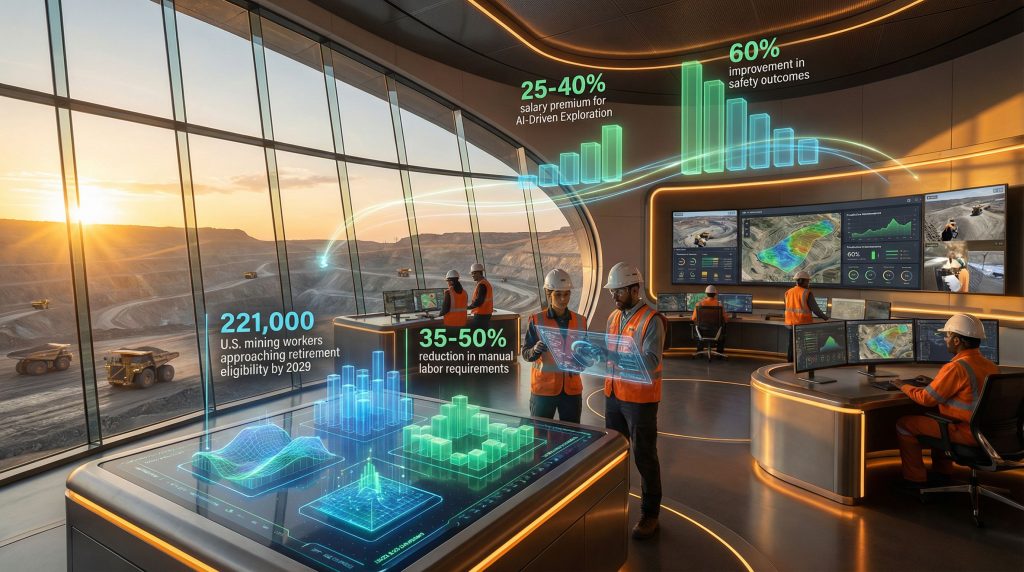
Autonomous systems are projected to reduce manual labour requirements by 35-50% in surface operations while creating 2.3 new technical roles for every traditional position eliminated.
Surface mining operations are experiencing the most dramatic transformation, with autonomous haul trucks and drilling systems becoming standard infrastructure. Underground operations face different automation challenges due to space constraints and safety considerations, but remote operation safety improvements are accelerating rapidly.
The economic implications extend beyond simple cost reduction. Mining companies implementing comprehensive automation strategies report 25% improvements in operational efficiency and 60% reductions in safety incidents across their operations.
Addressing the Skills Gap Crisis Threatening Mining Productivity
Demographic Cliff Analysis and Retirement Projections
The mining industry confronts an unprecedented demographic transition as experienced professionals approach retirement age. Current workforce demographics reveal concerning trends that threaten institutional knowledge preservation and operational continuity.
Critical Statistics:
- 221,000 U.S. mining workers approaching retirement eligibility by 2029
- 40% reduction in geoscience program enrolments over the past decade
- 47.2 years average age of mining professionals (compared to 42.1 across all industries)
- 67% of senior mining engineers planning retirement within seven years
Competitive Talent Market Dynamics
Mining companies increasingly compete with technology corporations for data scientists, software engineers, and cybersecurity specialists. This competition has fundamentally altered compensation structures and employment value propositions across the sector.
Industry Competition Factors:
- Technology sector offering 60-80% higher starting salaries for data scientists
- Remote work preferences conflicting with site-based mining operations
- Limited geographic mobility among younger professionals
- Enhanced work-life balance expectations in post-pandemic workforce
- Environmental sustainability concerns affecting career choice decisions
The traditional mining recruitment model emphasising physical presence at remote locations conflicts with emerging workforce preferences for flexible arrangements and urban proximity. Consequently, companies must adapt their strategies for attracting mining talent to remain competitive in this evolving landscape.
Emerging Roles Defining Future Mining Operations
Next-Generation Job Categories and Specifications
The mining workforce of the future will centre around five core professional categories: Digital Operations Specialists, Sustainability Integration Managers, Autonomous Systems Controllers, Predictive Analytics Engineers, and Cybersecurity Infrastructure Coordinators. These roles represent fundamental departures from traditional mining positions, requiring interdisciplinary expertise spanning geological science, information technology, and environmental management.
Hybrid Skill Architecture Requirements
Modern mining operations demand professionals capable of bridging traditional geological knowledge with cutting-edge technological applications. For instance, AI in mining operations creates entirely new competency requirements.
Essential Competency Combinations:
-
Geological AI Specialists – Traditional geology + machine learning algorithms
-
Sustainability Data Analysts – Environmental science + ESG reporting systems
-
Remote Operations Coordinators – Equipment operation + telecommunications management
-
Safety Technology Integrators – Occupational health + IoT sensor networks
-
Supply Chain Optimisation Engineers – Logistics + predictive modelling
These hybrid roles command significant salary premiums due to their specialised nature and limited talent pool. Organisations successfully developing internal candidates for these positions report 40% lower recruitment costs and 65% higher retention rates.
Building Adaptive Learning Systems for Mining Companies
Strategic Workforce Development Frameworks
Leading mining organisations are implementing modular training programs that combine traditional apprenticeships with digital simulation environments, reducing onboarding time by 45% while improving safety outcomes by 60%. These programmes utilise virtual reality platforms to simulate dangerous scenarios without physical risk exposure.
Immersive training technologies allow new employees to experience underground emergencies, equipment failures, and complex geological conditions in controlled environments. This approach accelerates competency development while maintaining safety standards.
Partnership Models for Skill Development
Strategic educational alliances enable mining companies to influence curriculum development while accessing emerging talent pools. These partnerships create pathways for students to gain industry-specific experience before graduation.
| Partnership Type | Investment Level | Skill Development Focus | ROI Timeline |
|---|---|---|---|
| University Collaborations | $500K-2M annually | Research & Development | 3-5 years |
| Technical Institute Programs | $100K-500K annually | Operational Skills | 1-2 years |
| Technology Vendor Training | $50K-200K annually | Equipment Proficiency | 6-12 months |
Companies investing in multi-tier educational partnerships report 35% improvements in graduate hire performance and 50% reductions in training-to-productivity timelines.
Diversity's Role in Mining's Transformation
Inclusive Workforce Performance Metrics
Companies with gender-diverse mining teams demonstrate 21% higher profitability and 35% better safety records, while culturally diverse operations show 67% greater innovation in problem-solving approaches.
Research consistently demonstrates correlation between workforce diversity and operational performance across multiple mining metrics. Moreover, future mining transformation shows that organisations with inclusive hiring practices access broader talent pools and generate more innovative solutions to complex technical challenges.
Demographic Expansion Strategies
Mining companies are implementing comprehensive diversity initiatives to address talent shortages while improving organisational culture and performance outcomes.
Talent Pool Diversification:
-
Indigenous community partnership programmes
-
Women in STEM recruitment initiatives
-
International talent visa facilitation
-
Neurodiversity inclusion frameworks
-
Veteran transition programmes
Indigenous partnership programmes have proven particularly valuable, combining cultural respect with practical benefits. Indigenous workers often possess intimate knowledge of local geological conditions and environmental patterns that enhance operational effectiveness.
The next major ASX story will hit our subscribers first
Remote Operations Reshaping Mining Careers
Geographic Decoupling of Mining Expertise
By 2028, an estimated 40% of mining technical roles will operate through remote control centres located in major cities, fundamentally altering traditional fly-in-fly-out workforce models and enabling access to broader talent pools. This transformation allows mining companies to recruit from urban centres while maintaining operational presence at remote sites.
Remote operations centres utilise advanced telecommunications infrastructure to provide real-time control over mining equipment located hundreds of miles away. Operators in Perth can control excavators in the Pilbara region, while 3D geological modelling teams in Vancouver monitor drilling operations across multiple Canadian provinces.
Technology Infrastructure Requirements
Remote mining operations demand sophisticated technological infrastructure to ensure operational safety and efficiency. Communication delays measured in milliseconds can impact equipment performance and worker safety.
Technical Specifications:
-
Ultra-low latency communication networks (sub-20ms)
-
Redundant cybersecurity protocols
-
Real-time data visualisation platforms
-
Immersive training simulation systems
Companies implementing comprehensive remote operations report 25% reductions in travel costs and 40% improvements in work-life balance metrics among technical staff.
Investment Strategies Supporting Workforce Evolution
Capital Allocation for Human Resource Development
Organisations allocating 8-12% of operational budgets to workforce development demonstrate 25% higher productivity gains and 40% lower employee turnover compared to industry averages. This investment level supports comprehensive training programmes, technology infrastructure, and competitive compensation packages.
Mining companies treating workforce development as strategic capital investment rather than operational expense achieve superior long-term performance outcomes across multiple metrics. Additionally, these companies often align with broader industry evolution trends that emphasise human capital development.
Technology-Enabled Training ROI Calculations
Advanced training methodologies generate measurable returns through improved safety performance, reduced equipment downtime, and accelerated skill acquisition timelines.
| Training Method | Cost Per Employee | Skill Retention Rate | Productivity Increase |
|---|---|---|---|
| VR Simulation | $15,000 | 85% | 30% |
| Mentorship Programs | $8,000 | 75% | 20% |
| Online Certification | $3,000 | 60% | 15% |
| Traditional Classroom | $5,000 | 55% | 12% |
Virtual reality training systems demonstrate superior performance across all measured criteria despite higher initial investment requirements. The technology's ability to simulate dangerous scenarios safely justifies premium costs through risk mitigation benefits.
Regulatory Changes Impacting Workforce Planning
Policy Framework Evolution and Compliance Requirements
Regulatory landscapes across major mining jurisdictions are evolving rapidly, creating new compliance requirements that demand specialised personnel. Environmental, social, and governance reporting mandates require dedicated staff with expertise spanning traditional mining operations and regulatory frameworks.
Regulatory Landscape Shifts:
-
Enhanced ESG reporting mandates requiring specialised personnel
-
Cybersecurity standards for critical infrastructure operations
-
Indigenous consultation requirements for workforce development
-
International trade regulations affecting skilled worker mobility
Compliance-Driven Skill Development Priorities
What certifications will become mandatory for mining professionals?
Cybersecurity awareness, ESG reporting competency, and autonomous systems safety protocols are becoming industry-standard requirements across multiple jurisdictions.
How do international regulations affect workforce planning?
Cross-border talent mobility requires navigation of visa regulations, professional recognition agreements, and cultural competency training programmes.
Mining companies operating across multiple jurisdictions must develop compliance frameworks addressing diverse regulatory requirements while maintaining operational efficiency.
Measuring Workforce Transformation Success
Key Performance Indicators for Future-Ready Teams
Successful workforce transformation requires comprehensive measurement frameworks addressing both quantitative performance metrics and qualitative cultural indicators.
Measurement Framework:
-
Digital literacy assessment scores
-
Cross-functional collaboration effectiveness
-
Innovation implementation rates
-
Safety incident reduction percentages
-
Employee engagement and retention metrics
Benchmarking Against Industry Leaders
Mining companies implementing comprehensive transformation strategies utilise sophisticated analytics to track progress against industry benchmarks and identify optimisation opportunities.
Comparative Analysis Tools:
-
Workforce agility index calculations
-
Technology adoption speed measurements
-
Skill development pipeline assessments
-
Cultural transformation progress tracking
Organisations achieving superior transformation outcomes typically demonstrate consistent measurement across all framework categories rather than excellence in isolated metrics.
Disclaimer: This analysis incorporates forward-looking projections based on current industry trends and technological developments. Actual workforce transformation timelines and outcomes may vary based on economic conditions, regulatory changes, and technological advancement rates. Investment decisions should consider comprehensive risk assessments and professional consultation.
Ready to capitalise on the next major mineral discovery?
Discovery Alert instantly alerts investors to significant ASX mineral discoveries using its proprietary Discovery IQ model, turning complex mineral data into actionable insights for both trading opportunities and long-term investment strategies. Understand why major mineral discoveries can lead to substantial market returns by exploring Discovery Alert's dedicated discoveries page, showcasing historic examples of exceptional outcomes, and begin your 30-day free trial today to position yourself ahead of the market in this rapidly transforming mining landscape.