July 8, 2026
Why Metamorphic Rock Fabric Is More Than Just Appearance
Every metamorphic rock carries within it a compressed archive of the conditions it endured millions of years ago. Pressure, temperature, fluid activity, and tectonic stress all leave measurable imprints on mineral grain geometry, boundary behaviour, and crystallographic orientation. For geologists, reading these textural signals is not merely an academic exercise. It is the primary method through which ancient burial depths, thermal gradients, and crustal dynamics are reconstructed from rocks now exposed at the surface.
Among the full spectrum of metamorphic fabrics, granoblastic texture in metamorphic rocks occupies a particularly revealing position. Its geometry encodes specific information about stress-free, high-temperature environments, and its identification in the field or under the microscope carries significant implications for understanding tectonic and thermal history.
When big ASX news breaks, our subscribers know first
Foliated vs. Non-Foliated Fabrics: Setting the Stage
Before examining granoblastic texture in detail, it helps to understand where it sits within the broader classification of metamorphic fabrics. Metamorphic rocks are broadly divided into those that display foliation and those that do not.
Foliated rocks such as slates, phyllites, schists, and gneisses develop their characteristic planar or banded fabrics under conditions of directed tectonic stress. Minerals with platy or elongate crystal habits, particularly micas and amphiboles, preferentially align perpendicular to the principal stress axis. The result is a visually striking layering that reflects the mechanical history of the rock.
Non-foliated metamorphic rocks tell a different story. Their textures reflect conditions where directed stress was minimal or absent, or where mineral assemblages lack the crystal habit necessary to produce planar alignment. Furthermore, the mineralogy of ores and mineral assemblages present during metamorphism plays a key role in determining which fabric ultimately develops.
| Fabric Type | Structural Feature | Stress Conditions | Common Rock Examples |
|---|---|---|---|
| Schistosity | Parallel mineral alignment | High directional stress | Schist |
| Gneissic Banding | Compositional layering | High directional stress | Gneiss |
| Granoblastic | Equidimensional mosaic | Low to absent shear stress | Quartzite, Marble, Hornfels |
| Porphyroblastic | Large crystals in fine matrix | Variable | Garnet schist |
| Decussate | Random elongate interlocking | Low directed stress | Hornblende rocks |
Granoblastic texture is the defining fabric of the non-foliated category, and its formation mechanism is thermodynamically distinct from any stress-driven process.
Defining Granoblastic Texture: The Core Characteristics
The Fundamental Fabric Description
Granoblastic texture describes a metamorphic rock fabric in which mineral grains are roughly equidimensional, polygonal to subhedral in shape, and interlocked within a continuous mosaic. Critically, there is no preferred crystallographic orientation among the grains. The fabric appears uniform and granular rather than layered or directionally organised.
The term itself carries etymological clarity: derived from the Latin granum meaning grain, and the Greek blastos meaning growth, it directly references the recrystallisation origin of the texture. Rocks displaying this fabric are commonly described as having a saccharoidal or sugary appearance, particularly in monomineralic varieties such as marble or pure quartzite.
The 120° Triple Junction: Geometry as Thermodynamic Proof
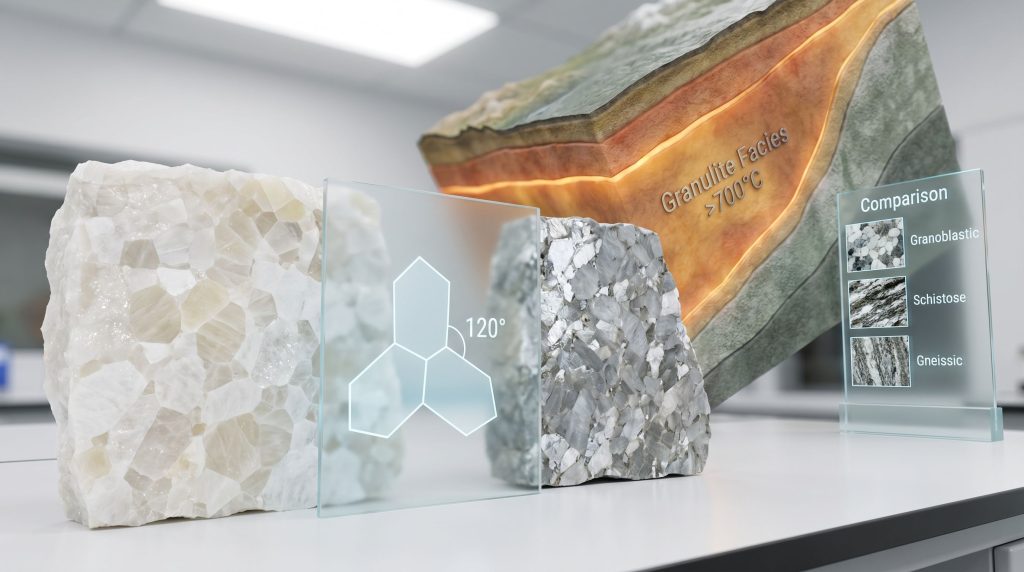
One of the most diagnostically significant features of granoblastic texture in metamorphic rocks is the angular geometry at which grain boundaries converge. In well-equilibrated granoblastic rocks, three grain boundaries consistently meet at approximately 120 degrees. This configuration is not coincidental.
The 120-degree triple junction geometry is the physical expression of minimum total grain boundary energy. When three boundaries converge at equal angles, the system has achieved the lowest possible surface energy configuration per unit volume.
This thermodynamic principle drives grain boundary migration throughout the recrystallisation process. Boundaries with curvature migrate toward their centre of curvature, consuming smaller grains and growing larger, more stable ones. The endpoint of this process, given sufficient time and temperature, is the perfectly equilibrated polygonal granoblastic mosaic.
The presence of well-developed triple junctions is therefore not just a textural descriptor. It is evidence that recrystallisation proceeded to near-completion under stable thermal conditions without significant mechanical disruption.
Microscopic and Macroscopic Properties at a Glance
| Property | Granoblastic Description |
|---|---|
| Grain Shape | Polygonal to subhedral, occasionally rounded |
| Grain Size | Medium to coarse; increases with metamorphic grade |
| Boundary Geometry | Straight to gently curved; 120° triple junctions |
| Preferred Orientation | Absent |
| Surface Appearance | Even, granular, saccharoidal |
| Foliation | None |
| Fracture Behaviour | Trans-granular fracture in monomineralic varieties |
How Granoblastic Texture Forms: The Recrystallisation Mechanism
Solid-State Recrystallisation: No Melt Required
A common misconception in introductory geology is that significant mineral transformation always involves melting. Granoblastic texture is proof to the contrary. It develops entirely through solid-state recrystallisation, a process in which pre-existing mineral grains reorganise their structure, shape, and size through atomic diffusion across grain boundaries, without the rock ever becoming a melt.
At elevated temperatures, atoms gain sufficient thermal energy to migrate across grain boundaries. When no dominant mechanical stress vector is present, this diffusion proceeds uniformly in all directions. The outcome is equidimensional grain growth rather than the elongated, aligned fabrics produced under stress.
Surface Energy Minimisation: The Thermodynamic Engine
Grain boundaries are zones of elevated energy compared to the ordered crystal interior. Natural systems evolve to reduce free energy, and grain boundary systems are no exception. The mechanisms involved include:
- Grain boundary migration, where boundaries move to reduce their total curvature and surface area
- Consumption of smaller grains by larger, energetically more stable neighbours
- Progressive coarsening of the overall grain size distribution with increasing temperature or time
- Development of triple junctions at approximately 120 degrees as the minimum energy boundary configuration is achieved
Higher metamorphic temperatures accelerate atomic diffusion rates, meaning that rocks subjected to more intense or prolonged thermal conditions will develop coarser, more perfectly equilibrated granoblastic mosaics than rocks that experienced only brief or lower-temperature metamorphism.
Step-by-Step Formation of Granoblastic Texture
- A protolith such as limestone, dolostone, or quartz-rich sandstone enters a metamorphic environment as temperature increases.
- Elevated temperature initiates atomic mobility at grain boundaries, beginning the recrystallisation process.
- Grain boundaries begin migrating toward zones of higher curvature, reducing total boundary area.
- Smaller, higher-energy grains are consumed as neighbouring crystals grow into lower-energy configurations.
- Grain shapes progressively shift from irregular to polygonal as boundaries straighten.
- Triple junctions develop at approximately 120 degrees as thermodynamic equilibrium is approached.
- The final granoblastic mosaic is established: equigranular, interlocking, and without preferred orientation.
This sequence is reversible only if the rock is subjected to renewed deformation, which would overprint the granoblastic fabric with a stress-related texture.
Geological Settings That Produce Granoblastic Texture
Contact Metamorphism: Heat Without Stress
When magmatic bodies intrude into the crust, the surrounding country rock is subjected to intense thermal metamorphism within a zone called the metamorphic aureole. Because this heating is driven by conduction from the intrusion rather than tectonic compression, directed stress is typically absent or minimal.
This combination of high temperature and low stress is the ideal environment for granoblastic recrystallisation. The product is hornfels, a dense, fine-grained, non-foliated metamorphic rock that represents one of the most commonly cited examples of granoblastic fabric. Grain size within contact aureoles typically decreases with increasing distance from the intrusion contact, reflecting the temperature gradient.
High-Grade Regional Metamorphism: Beyond the Deformation Front
In large-scale regional metamorphic terranes, rocks at the highest grades have often moved beyond the zone of active ductile shear into regions where recrystallisation rates outpace deformation rates. At these conditions, particularly within the granulite facies at temperatures exceeding 700°C, granoblastic textures become dominant.
Granulite facies rocks are significant because they represent some of the deepest and hottest non-molten crustal conditions accessible to study through exhumed metamorphic terranes. Their coarse granoblastic fabrics serve as direct evidence of sustained extreme temperatures at lower crustal depths, often between 20 and 50 kilometres below the ancient surface. The relationship between metamorphism and ore deposits in such high-grade settings is also of considerable economic interest.
Comparative Metamorphic Settings
| Setting | Temperature Range | Stress Conditions | Resulting Texture |
|---|---|---|---|
| Contact Metamorphism | 300–700°C | Low directed stress | Fine granoblastic (hornfels) |
| High-Grade Regional | 600–900°C+ | Low to moderate | Coarse granoblastic |
| Granulite Facies | >700°C | Low shear | Coarse granoblastic |
| Low-Grade Regional | 200–400°C | High directed stress | Foliated (slate, phyllite) |
Variations of Granoblastic Texture: A Classification Within a Classification
From Polygonal to Amoeboid: Reading the Degree of Equilibration
Not all granoblastic textures are identical. The degree of textural equilibration, reflecting how completely the system has minimised grain boundary energy, produces a recognisable spectrum of subtypes. This progression from less to more equilibrated mirrors increasing metamorphic intensity or duration.
| Subtype | Grain Boundary Character | Degree of Equilibration | Typical Occurrence |
|---|---|---|---|
| Polygonal | Straight, well-defined 120° junctions | Highest | Hornfels, granulites |
| Interlobate | Irregular, lobate boundaries | Moderate | Transitional metamorphic zones |
| Amoeboid | Highly irregular, poorly defined | Lowest | Lower-grade or rapidly cooled rocks |
| Decussate | Elongate, interlocking, random orientation | Moderate | Rocks with prismatic minerals |
| Nodular | Oval porphyroblasts in granoblastic matrix | Variable | Contact metamorphism |
The polygonal subtype is the textbook reference form, characterised by straight grain edges, consistent 120-degree boundary angles, and minimal boundary curvature. It represents the most thermodynamically mature expression of granoblastic fabric and is most frequently observed in monomineralic or bimineralic rocks where boundary energy is relatively uniform across all grain contacts.
Decussate Texture: An Important Granoblastic Variant
Decussate texture involves prismatic or elongate crystals arranged in a random, interlocking pattern. Despite the non-equidimensional grain shapes, the absence of any preferred orientation places this firmly within the granoblastic family. It is particularly common in rocks containing hornblende, tremolite, or other minerals that naturally grow with elongate crystal habits. Distinguishing decussate from schistose fabrics requires careful attention to whether any preferred orientation exists, however subtle.
The next major ASX story will hit our subscribers first
Rock Types That Characteristically Display Granoblastic Texture
Quartzite: Silica Recrystallised to Near-Perfection
Quartzite forms when quartz-rich sandstone or chert undergoes metamorphism. During recrystallisation, individual quartz grains dissolve along their original boundaries and regrow into an interlocking granoblastic mosaic. The resulting rock is exceptionally hard and resistant to weathering, properties that arise directly from the tightly interlocked fabric.
A diagnostic and lesser-known characteristic of granoblastic quartzite is its trans-granular fracture behaviour: rather than breaking around grain boundaries as sandstone would, metamorphic quartzite fractures directly through grains. This is a direct mechanical consequence of the interlocking granoblastic mosaic, where grain boundaries are no longer the weakest structural element.
Grain size in quartzite scales predictably with metamorphic grade, offering geologists a qualitative indicator of temperature conditions without requiring detailed chemical analysis.
Marble: The Saccharoidal Granoblastic Classic
Marble develops from the thermal or regional metamorphism of carbonate rocks. Calcite and dolomite recrystallise readily under elevated temperatures, producing the characteristic saccharoidal texture that makes marble visually distinctive. Pure monomineralic marble exhibits the most perfectly developed polygonal granoblastic fabric, precisely because grain boundary energy is uniform throughout the rock when only one mineral phase is present.
The visual smoothness of polished marble surfaces is, in geological terms, a direct expression of near-complete textural equilibration across billions of grain boundaries.
Hornfels, Granofels, and Granulites
- Hornfels forms at igneous intrusion contacts and is typically fine-grained due to the short duration of contact thermal metamorphism. Its non-foliated granoblastic fabric directly reflects the absence of tectonic stress in contact settings.
- Granofels is the broader petrographic term for any non-foliated, granoblastic metamorphic rock that does not fit neatly into the marble or quartzite categories. It serves as a useful field classification when mineral assemblages are complex or incompletely characterised.
- Granulites represent the highest-grade non-molten metamorphic products and frequently display coarse granoblastic textures, particularly in mafic and quartzo-feldspathic compositions. Their textures provide direct evidence of lower crustal thermal conditions.
Identifying Granoblastic Texture: Field and Laboratory Methods
What to Look For in the Field
Field identification of granoblastic texture relies on a combination of negative and positive criteria:
- The absence of foliation is the primary indicator. Granoblastic rocks lack the planar fabric of schists or gneisses.
- A granular or sugary surface texture is visible on fresh fracture faces, particularly in marble and quartzite.
- Mechanical resistance is high. The interlocking grain fabric makes granoblastic rocks resistant to disaggregation.
- Monomineralic or bimineralic composition is common in the most diagnostically clear examples.
Thin Section Analysis: The Microscopic Standard
Definitive identification requires petrographic thin section analysis under polarised light microscopy. The key diagnostic criteria are:
- Equigranular grain morphology with consistent grain dimensions across the field of view
- Polygonal boundary geometry featuring straight to gently curved edges and triple junctions converging near 120 degrees
- Random crystallographic orientations confirmed by rotating the microscope stage under crossed polarisers, which reveals no systematic extinction pattern
- Absence of porphyroblasts, distinguishing the texture from porphyroblastic fabric
Distinguishing Granoblastic from Similar Textures
| Texture | Key Difference from Granoblastic |
|---|---|
| Porphyroblastic | Anomalously large crystals set in a finer matrix |
| Schistose | Strong preferred mineral orientation producing foliation |
| Gneissic | Compositional banding with directional fabric |
| Igneous granular | Formed from melt crystallisation, not solid-state recrystallisation |
| Mylonitic | Grain size reduction and alignment from ductile shear |
What Granoblastic Texture Reveals About Metamorphic Conditions
Grain Geometry as a Geological Thermometer
The textural characteristics of granoblastic rocks are not merely descriptive. They carry quantitative and semi-quantitative information about the metamorphic conditions the rock experienced:
- Grain size functions as a proxy for metamorphic temperature and recrystallisation duration. Coarser grains indicate either higher temperatures, longer thermal residence, or both.
- Triple junction development signals proximity to thermodynamic equilibrium. Poorly developed or curved junctions indicate incomplete equilibration, suggesting either lower temperatures or more rapid cooling.
- Absence of foliation confirms that directed tectonic stress was minimal during the dominant phase of recrystallisation.
- The polygonal-to-amoeboid progression provides a relative scale of equilibration intensity applicable even where absolute temperature data are unavailable.
Petrogenetic Significance in Crustal Reconstruction
Granoblastic textures preserved in exhumed metamorphic terranes serve as essential data points in reconstructing the thermal and tectonic history of ancient orogenic belts. In addition, understanding their relationship with broader geological processes such as VMS ore deposits and IOCG deposit formation enriches our understanding of how metamorphic environments influence economic mineralisation. Specifically:
- Coarse granoblastic fabrics in granulite facies terranes provide evidence of lower crustal conditions at temperatures of 700 to 900 degrees Celsius and depths of 20 to 50 kilometres.
- The preservation of well-equilibrated granoblastic fabric constrains the cooling and exhumation rate of metamorphic terranes. Rapid exhumation may preserve high-grade textures; slow cooling allows further textural evolution.
- In contact aureoles, granoblastic hornfels documents the spatial extent of magmatic thermal influence, informing models of crustal heat flow and intrusion emplacement depth.
- Consequently, supercontinent cycles geology and the repeated assembly and dispersal of crustal masses have directly controlled where high-grade granoblastic terranes are now exposed at the surface.
The progression from amoeboid to interlobate to polygonal granoblastic texture directly mirrors increasing textural equilibration, which in turn is a reliable indicator of increasing metamorphic intensity or duration.
Frequently Asked Questions About Granoblastic Texture
What is the simplest definition of granoblastic texture?
Granoblastic texture is a metamorphic rock fabric consisting of equidimensional, interlocking mineral grains arranged in a mosaic pattern with no preferred orientation. It forms through solid-state recrystallisation under high-temperature conditions where directed stress is absent or minimal.
How does granoblastic texture differ from schistosity?
Schistosity involves the parallel alignment of platy minerals such as mica under directed tectonic stress, producing a foliated fabric. Granoblastic texture in metamorphic rocks lacks any preferred mineral orientation and forms in environments where stress is absent or where the mineral assemblage cannot produce directional alignment.
Why do grains meet at 120 degrees in granoblastic rocks?
The 120-degree triple junction geometry represents the configuration of minimum total grain boundary energy. When three grain boundaries converge at equal angles, the system achieves thermodynamic stability. Grain boundary migration actively drives the system toward this configuration during recrystallisation.
Which metamorphic grade is most associated with granoblastic texture?
Granoblastic texture is most strongly associated with medium to high-grade metamorphism, including contact metamorphic aureoles and granulite facies regional metamorphic terranes. However, it can develop at lower grades in monomineralic rocks with high recrystallisation potential, where even modest temperatures are sufficient to drive grain boundary equilibration.
Can granoblastic texture occur within otherwise foliated rocks?
Yes. Some high-grade metamorphic rocks display discrete domains of granoblastic texture within a broader foliated framework, particularly in lithologies that lack minerals capable of forming strong foliation planes. Quartzite layers within a gneiss are a well-documented example of this coexistence.
What is the difference between granoblastic and porphyroblastic texture?
Granoblastic texture is characterised by uniformly sized, interlocking grains with no dominant crystal size. Porphyroblastic texture involves anomalously large crystals, known as porphyroblasts, set within a distinctly finer-grained matrix. The two textures can coexist within a single rock when large crystals nucleate and grow within an otherwise equilibrated granoblastic groundmass.
Want To Know Which ASX Mineral Discoveries Could Deliver Significant Returns?
Discovery Alert's proprietary Discovery IQ model scans ASX announcements in real time, instantly translating complex geological and mineralogical data into actionable investment insights — whether you're tracking exploration in metamorphic terranes or monitoring high-potential commodity discoveries. Start your 14-day free trial today, or explore historic mineral discoveries and their market returns to understand just how transformative the right alert at the right moment can be.