May 9, 2026
When the Ground Itself Has a Track Record: Why Idaho's Fault-Hosted Systems Deserve Investor Attention
There is a category of mineral exploration target that stands apart from the speculative frontier — one where the geology has already demonstrated its hand, where historical production records confirm real-world grades, and where modern drilling techniques are being applied to systems that earlier generations lacked the tools to fully evaluate. Central Idaho's tungsten and gold districts occupy exactly that position in 2026, and the Resolution Minerals Golden Gate drilling Idaho tungsten gold project represents one of the most technically credible attempts to unlock that legacy value within a jurisdiction of growing strategic relevance.
Understanding why this matters requires looking beyond the drill results themselves and examining the geological architecture, metallurgical fundamentals, and supply chain dynamics that collectively define the opportunity.
When big ASX news breaks, our subscribers know first
The Horse Heaven District: Geology, Structure, and Multi-Commodity Potential
Central Idaho sits within a geologically complex terrane shaped by Cretaceous-age intrusions, subsequent fault reactivation, and hydrothermal fluid circulation that deposited metals across multiple mineralisation styles. The Horse Heaven Antimony-Tungsten-Gold-Silver Project, held by Resolution Minerals (ASX: RML, OTCQB: RLMLF, FRA: NC3), is positioned within this district and benefits from a combination of structural controls and historical production data that give the project unusual credibility for an early-stage exploration asset.
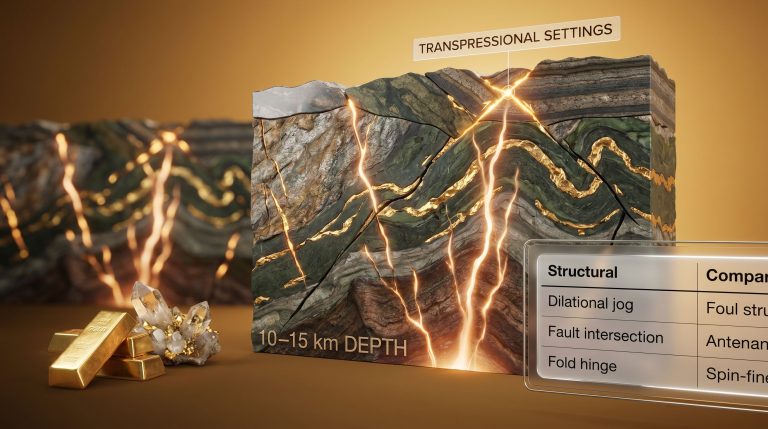
At the core of the Golden Gate target is a north-south trending fault zone that functions as both a conduit and a trap for mineralising fluids. This structural architecture is characteristic of orogenic gold systems and skarn-related tungsten deposits globally, where fault-controlled permeability allows metal-bearing hydrothermal solutions to migrate, concentrate, and precipitate within favourable structural or lithological environments.
The Surface Expression: What Grades at Outcrop Actually Signal
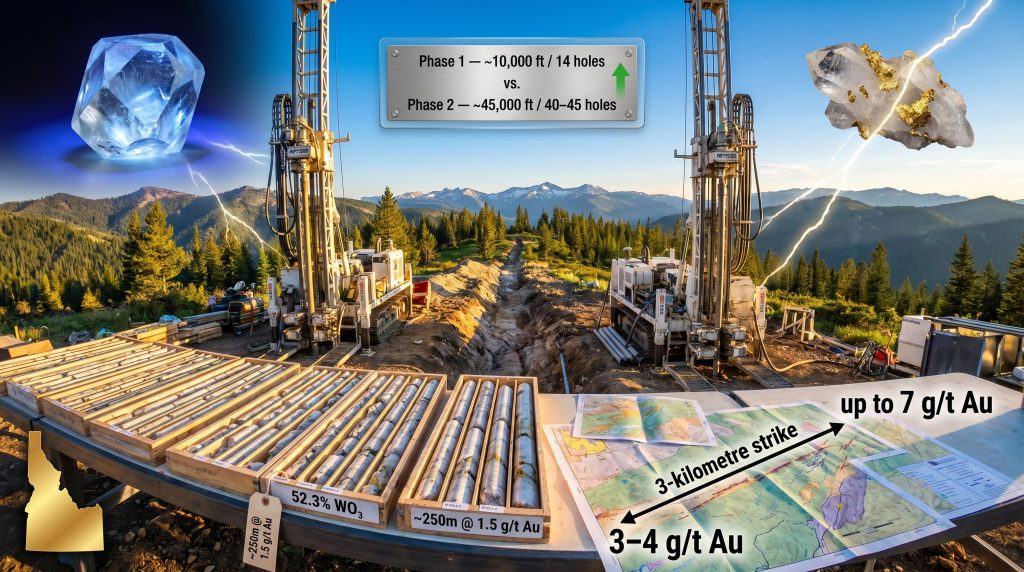
One of the technically significant aspects of the Golden Gate target is the strength of its surface geochemical expression. Soil surveys across the three-kilometre strike length have identified co-located gold and tungsten anomalies, and channel sampling at surface has returned gold grades of 3 to 4 g/t Au at the southern end of the target and values reaching up to 7 g/t Au at the northern end. These are not background anomalies — they reflect a mineralised system with genuine tenor at surface, which in fault-hosted settings typically indicates continuity at depth rather than a near-surface enrichment phenomenon.
The geological analogue most frequently cited by management is the Stibnite Gold Project operated by Perpetua Resources, located in a comparable structural setting in central Idaho. Stibnite hosts a resource of approximately 6.5 million ounces of gold and shares what Resolution Minerals' CEO of US Operations Craig Lindsay describes as similar geological characteristics to Golden Gate. Furthermore, Perpetua's strategic antimony positioning within the same region underscores the district's broader critical mineral significance. While analogue comparisons carry inherent uncertainty and should not be interpreted as predictive of Golden Gate's ultimate resource scale, they do provide a useful frame of reference for the district's endowment potential.
Phase 2 Drilling at Golden Gate: From Discovery to Resource Definition
The transition from exploration-phase drilling to systematic resource definition is one of the most capital-intensive and operationally demanding phases in a junior mining company's lifecycle. What makes the current Resolution Minerals Golden Gate drilling Idaho tungsten gold project notable is the scale of the step-change from Phase 1 to Phase 2.
Comparing Phase 1 and Phase 2: A Quantitative Picture
| Parameter | Phase 1 (2024) | Phase 2 (2026) |
|---|---|---|
| Total Footage | ||
| Number of Holes | 14 holes | 40 to 45 holes |
| Drill Rigs Deployed | Not specified | 2 x MP1500 diamond core rigs |
| Program Duration | Completed | ~3 to 3.5 months |
| Primary Objective | Initial discovery drilling | Resource definition + maiden estimate |
| Resource Target | None | Maiden estimate by late 2026 or Q1 2027 |
Key Insight: The Phase 2 program represents approximately a fourfold increase in drilling volume over Phase 1, reflecting a deliberate transition from discovery-phase work to systematic resource definition across both the northern and southern zones of the Golden Gate target.
Phase 1 delivered intercepts that immediately flagged the system's potential. The headline result of approximately 250 metres grading around 1.5 g/t Au is the kind of broad, low-to-medium grade intercept that characterises bulk-tonnage gold systems globally. A secondary intercept of 189 metres at approximately 1.3 g/t Au reinforced the message that grade distribution within the Golden Gate Fault Zone is consistent rather than erratic, which is a favourable indicator for eventual resource classification.
Critically, Phase 1 mineralisation remained open at depth, along strike, and laterally — meaning the drilling campaign did not close off the system in any direction. This is operationally significant because it means Phase 2 is not simply infilling a known envelope; it is simultaneously expanding and defining a target whose full dimensions remain unconstrained. For a more detailed overview of Resolution Minerals' 2026 drilling approach, the broader program context is worth examining.
The Southern Zone: A Largely Untested Opportunity
The Phase 2 campaign's initial focus on the southern Golden Gate zone addresses what is arguably the most important knowledge gap in the current dataset. The southern end of the three-kilometre target has received very limited historical drilling despite hosting soil geochemical anomalies for both gold and tungsten. This combination — surface geochemical expression without subsurface drill testing — represents exactly the kind of low-risk, high-upside target that systematic resource definition programs are designed to evaluate.
The strategic objective of establishing independent deposits at both the northern and southern ends of the strike before demonstrating inter-zone continuity reflects a methodologically sound approach to resource building. If the two zones prove to be part of a single continuous mineralised system at depth, the aggregate scale could be substantially larger than either zone evaluated in isolation.
The Tungsten Dimension: Metallurgical Performance and Strategic Value
While the gold story at Golden Gate is compelling on its own merits, the tungsten component introduces a layer of strategic and commercial complexity that deserves careful analysis. Tungsten's strategic importance to industrial and defence applications makes it one of the most irreplaceable metals in the modern economy, yet it remains among the least well-understood critical minerals from a general investor perspective.
What Tungsten's Chemistry Actually Means for Processing Economics
Tungsten occurs in two primary mineral forms: scheelite (calcium tungstate, CaWO₄) and wolframite (an iron-manganese tungstate). The distinction matters enormously for processing economics. Scheelite responds well to gravity separation and flotation circuits, whereas wolframite typically requires more complex and energy-intensive processing routes. The presence of scheelite as the dominant tungsten-bearing mineral at Golden Gate therefore has direct implications for capital intensity and processing cost.
The metallurgical test work completed on historic Johnson Creek stockpiles demonstrates this advantage concretely. Starting from a feed grade of approximately 1.85% WO₃, gravity separation alone successfully upgraded tungsten to concentrates grading 52.3% WO₃ — representing a roughly 19-times upgrade ratio achieved without reagent-intensive flotation or leaching. For context, a 52% WO₃ concentrate is commercially marketable to tungsten smelters and refiners, and the simplicity of the processing route suggests relatively modest capital requirements compared to projects where complex hydrometallurgical circuits would be required.
Historic Production as a Grade Validation Tool
The Golden Gate Tungsten Mine operated intermittently between approximately 1950 and 1980, producing material that reportedly graded between 1.5% and 2% WO₃ on a run-of-mine basis. The fact that acquired stockpiles assay at an average of approximately 1.85% WO₃, consistent with the historical production record, provides an important cross-validation of grade continuity. Historic mining grades and modern assay results aligning so closely is an unusual degree of data consistency and reduces one of the common uncertainties associated with projects relying on legacy production records.
Why This Matters for Investors: Projects where historic and modern data are internally consistent are lower risk from a grade continuity perspective than those where legacy records diverge significantly from contemporary sampling. The Golden Gate stockpile data provides a useful independent check on the historical mining record.
China's Tungsten Dominance: The Supply Chain Context
China accounts for the dominant share of global tungsten mine production and is the primary processor of tungsten intermediates and finished products. This concentration of supply has drawn sustained attention from US industrial and defence planners, given tungsten's role across a range of hard-to-substitute applications:
- Steel hardening: Tungsten carbide is the principal additive for producing high-speed tool steels used in machining and cutting applications
- Defence applications: Tungsten's density makes it the material of choice for kinetic energy penetrators and armoured vehicle components
- Electronics and semiconductors: Tungsten is used as interconnect metallisation in integrated circuit fabrication due to its low resistivity and high melting point
- Shipbuilding and heavy manufacturing: Tungsten alloys appear in structural and ballistic components across naval platforms
The US government has formally designated tungsten as a critical mineral, reflecting the strategic vulnerability created by import dependence. This policy context creates a structural incentive for domestic tungsten project development that did not exist with the same urgency during the mine's previous operating period.
The Horse Heaven Project: Beyond Golden Gate
The Golden Gate area is one component of the broader Horse Heaven Antimony-Tungsten-Gold-Silver Project. The Antimony Ridge component of the project has received FAST-41 permitting designation, a federal mechanism that coordinates and can accelerate environmental review timelines for qualifying resource and infrastructure projects. This designation applies specifically to the Antimony Ridge component and reflects the federal permitting framework rather than any broader project endorsement.
Antimony's critical role in modern industry mirrors that of tungsten, with China again dominating global supply. The combination of tungsten and antimony exposure within a single project area consequently creates a dual critical mineral value proposition that is relatively rare among junior exploration companies operating in the US.
The Johnson Creek Mill: Infrastructure Optionality at Low Cost
The acquisition of the Johnson Creek mill adjacent to the Golden Gate project area adds a dimension of strategic optionality that is difficult to replicate through exploration alone. The mill provides on-site processing infrastructure and, through the inherited stockpiles, a ready source of feed material for ongoing metallurgical test work.
The ability to conduct metallurgical programs on site, using existing infrastructure and historic stockpile material, accelerates the technical development pathway without requiring construction of new facilities. Several thousand tonnes of historic tungsten stockpiles now held by Resolution Minerals provide a near-term feedstock for extended metallurgical testing, including potential concentrate production trials that could inform downstream processing and offtake negotiations.
From Drill Holes to JORC Resource: The Resource Definition Pathway
The maiden resource estimate targeted for late 2026 or the first quarter of 2027 represents a significant value inflection point for the Golden Gate project. The pathway from drilling completion to a JORC 2012-compliant resource estimate involves a structured sequence of technical work:
- Drilling completion — 40 to 45 diamond core holes totalling approximately 45,000 feet across the northern and southern zones
- Sample preparation and assaying — multi-element geochemical analysis covering gold, tungsten, silver, and antimony across systematic sample intervals
- Geological logging and structural interpretation — geological logging codes and 3D modelling of the Golden Gate Fault Zone geometry and grade distribution from combined Phase 1, Phase 2, and historical drilling datasets
- Geostatistical resource estimation — grade interpolation methods applied to drill hole composites to generate a three-dimensional resource block model
- Resource classification — assignment of Inferred, Indicated, and Measured categories based on data spacing and geological confidence under JORC 2012
- Competent person review and sign-off — independent third-party audit to satisfy ASX and JORC reporting requirements
- Resource announcement — maiden gold-tungsten resource estimate targeting late 2026 or Q1 2027
The integration of Phase 1 results, Phase 2 drilling, and historical drilling completed during the 1980s and 1990s into a single estimation dataset should provide the data density required to support at least an Inferred resource classification. Understanding mining feasibility studies and resource estimation outcomes are inherently uncertain, however, until geostatistical analysis is complete.
The next major ASX story will hit our subscribers first
Capital Position and Market Access
Resolution Minerals completed an A$20 million equity financing at A$0.07 per share ahead of the Phase 2 drilling campaign, with management noting that a significant portion of the raise was supported by existing shareholders. This level of insider participation in a financing round is generally interpreted positively by market observers as a signal of internal confidence in the project's near-term prospects.
The company's current exchange coverage spans ASX (RML), OTCQB (RLMLF), and Frankfurt (NC3), with a Nasdaq listing application in progress. A successful Nasdaq listing would furthermore expand the investor base to include US-based funds and retail investors with specific interest in domestic critical minerals development, a cohort that has grown substantially in line with the policy focus on supply chain resilience.
Key Statistics Snapshot: Golden Gate Project
| Metric | Value |
|---|---|
| Golden Gate Strike Length | 3 kilometres |
| Phase 1 Drilling | ~10,000 feet across 14 holes |
| Phase 2 Drilling | ~45,000 feet across 40 to 45 holes |
| Best Phase 1 Gold Intercept | ~250 m at ~1.5 g/t Au |
| Surface Gold Grades (South) | 3 to 4 g/t Au |
| Surface Gold Grades (North) | Up to 7 g/t Au |
| Historic Tungsten Mine Grade | 1.5 to 2% WO₃ |
| Stockpile Average Grade | ~1.85% WO₃ |
| Gravity Concentrate Grade | 52.3% WO₃ |
| Metallurgical Upgrade Ratio | ~19 times |
| Geological Analogue Resource | ~6.5 Moz Au (Stibnite, Perpetua Resources) |
| Maiden Resource Target | Late 2026 or Q1 2027 |
| Recent Capital Raise | A$20 million at A$0.07 per share |
| Site Personnel (2026 Season) | ~25 |
Risks and Catalysts: What the Next Twelve Months May Deliver
Near-Term Catalysts to Monitor
- First assay results from Phase 2 drilling, which should begin emerging within weeks of drill commencement
- Confirmation or otherwise of tungsten mineralisation continuity at the previously untested Golden Gate South zone
- Progress updates on the Nasdaq listing application
- Developments in tungsten offtake discussions with smelters and refiners
- Continued permitting progress across the Horse Heaven project, including at Antimony Ridge
Key Risks to Assess
- Phase 2 drilling results may not confirm continuity between the northern and southern gold zones, limiting the eventual resource scale
- Metallurgical test work on primary ore from current drilling may produce different recovery outcomes compared to the historic stockpile material tested to date
- Permitting processes in Idaho are subject to federal and state regulatory requirements that can introduce timing uncertainty
- Tungsten and gold price movements remain an external variable that affects project economics and investor sentiment independent of exploration results
- The Nasdaq listing is subject to regulatory approval and prevailing market conditions, neither of which are within the company's control
Disclaimer: This article is provided for informational purposes only and does not constitute financial advice or a recommendation to buy or sell any security. Exploration-stage mining companies carry significant operational, geological, and financial risks. Forecasts and resource estimates referenced herein are subject to uncertainty and should not be relied upon as guarantees of future outcomes. Readers should conduct their own due diligence and consult a qualified financial adviser before making investment decisions.
Want To Be First When The Next Major ASX Mineral Discovery Is Announced?
Discovery Alert's proprietary Discovery IQ model delivers real-time alerts the moment significant mineral discoveries hit the ASX, transforming complex multi-commodity data into clear, actionable insights for both short-term traders and long-term investors — exactly the kind of edge that matters when fault-hosted systems like Golden Gate move from drilling to maiden resource. Explore how historic discoveries have generated extraordinary returns on Discovery Alert's dedicated discoveries page, and begin your 14-day free trial today to position yourself ahead of the broader market.