July 16, 2026
Why the World's Most Capital-Intensive Industries Are Being Rebuilt From the Inside Out
The extraction and energy sectors have always been defined by physical scale: enormous machines, vast terrain, complex logistics, and operational environments hostile to human presence. For generations, productivity gains came from larger equipment, deeper drilling, and more workers. That model has reached its structural ceiling. The next productivity frontier is not physical at all. It runs through data pipelines, sensor arrays, and machine learning algorithms embedded inside the very infrastructure that powers modern civilisation.
This is the underlying logic driving the transformation now reshaping digitalización en energía y minería globally. The numbers confirm it is no longer a future-state ambition. It is an operational reality with measurable financial and environmental consequences for every operator, investor, and policymaker in the sector.
When big ASX news breaks, our subscribers know first
The Three Pillars Holding Up Industrial Digitalisation
Before examining outcomes, it is worth understanding the structural architecture that makes industrial digital transformation possible. The shift is not driven by any single technology but by the convergence of three mutually reinforcing vectors.
Advanced electrification replaces combustion-dependent processes with electrically powered alternatives, reducing direct emissions while simultaneously opening the door to software-based energy management. Automation and remote control remove human operators from hazardous environments and replace decision latency with algorithmic precision. Real-time data analytics and applied artificial intelligence convert the raw output of thousands of connected sensors into actionable operational intelligence.
Each pillar reinforces the others. Electrified equipment generates cleaner and more consistent data signatures. Automated systems can act on that data faster than any human operator. Furthermore, AI models trained on real-time operational data continuously improve the efficiency of both the electrified assets and the automated systems managing them. The result is a compound productivity effect that no single technology could achieve in isolation.
Quantifiable Outcomes: What Digitalisation Actually Delivers
The debate about whether industrial digitalisation generates measurable returns has effectively closed. The evidence base is now strong enough to speak in specific numbers rather than directional claims.
| Impact Dimension | Core Technology | Documented Outcome |
|---|---|---|
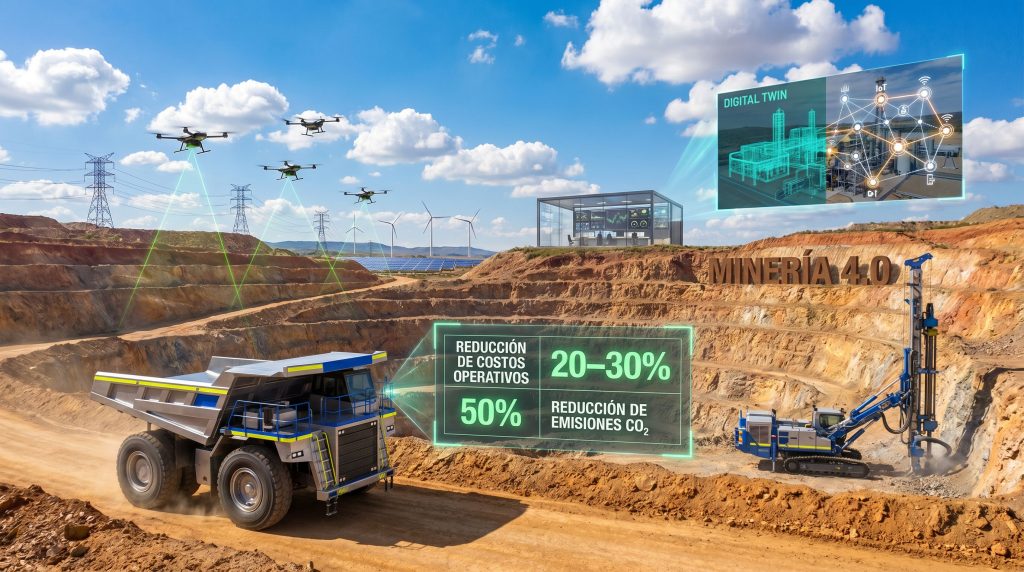
| Operational cost efficiency | Automation and predictive maintenance | 20–30% reduction in total operating costs |
| Carbon footprint reduction | Process electrification | Up to 50% decrease in direct CO₂ emissions |
| Energy savings per unit | Electric fleet and heavy equipment conversion | Up to 30% energy savings per operational cycle |
| Occupational safety | Remote operation and IoT sensor networks | Elimination of human exposure in high-risk zones |
| Asset performance | Digital twins and IIoT platforms | Reduced unscheduled downtime and optimised production cycles |
| Cycle speed | Electric haul truck deployment | Faster operational cycles beyond raw emissions savings |
According to Luis Pinchete, Regional Leader of ABB in Process Industries, the combination of autonomous operations with digital training programmes creates a compounding benefit structure. As worker competency in automated systems increases, operational risk decreases while productive output rises simultaneously. This reframes the traditional productivity-safety trade-off as a false dilemma.
The integration of remote operations with autonomous systems does not force a choice between efficiency and safety. Both improve together when the underlying digital architecture is properly deployed.
This insight challenges a deeply embedded assumption in industrial management: that increasing throughput inherently increases worker exposure and incident risk. Indeed, mining automation dissolves that assumption by physically separating human operators from hazardous environments while maintaining or exceeding the productive output of traditional manned operations.
Electrification as Competitive Necessity, Not Sustainability Optics
Among the forces reshaping industrial energy and mining operations, electrification carries perhaps the most consequential long-term implications. Its impact extends beyond environmental compliance into the core economics of industrial competitiveness.
Process electrification is responsible for eliminating up to 50% of the carbon footprint of large-scale industrial operations while simultaneously generating improvements of 20 to 30% in operational efficiency. These are not either-or outcomes. They occur together, which is precisely why electrification has transitioned from an ESG consideration to a structural operational requirement.
The application in large open-pit mining is particularly instructive. Heavy haul trucks represent the dominant source of fossil fuel consumption in surface mining operations. A single large mine running diesel-powered fleets generates emissions at a scale that makes meeting modern environmental reporting standards nearly impossible without fundamental fleet transformation. The electric alternative achieves 50% lower emissions per operational cycle and up to 30% energy savings per unit, while also delivering improved cycle speed as an additional operational benefit.
Furthermore, mining electrification is projected to accelerate at roughly 2.5 times its historical pace globally. This figure reflects the convergence of declining technology costs, tightening ESG capital market requirements, and 20-plus years of accumulated experience in industrial electrification, including the progressive electrification of oil and gas well infrastructure that has been underway since the early 2000s.
Electrification is no longer a differentiation strategy. It has become a condition of market entry. Operations that do not integrate it face structural disadvantages in cost, regulatory compliance, and access to institutional financing.
Note: The 2.5x acceleration projection reflects analysis from industry practitioners and should be evaluated alongside independent forecasting sources including IEA energy transition outlooks and comparable institutional research before being used as a basis for investment decisions.
The Technology Stack: How Industry 4.0 Actually Functions in the Field
Understanding the practical architecture of industrial digitalisation requires moving past the abstract language of transformation and into the specific tools deployed at each operational layer.
IoT Networks and Real-Time Sensor Infrastructure
Industrial IoT deployments in energy and mining environments serve as the nervous system of the entire digital operation. Sensor arrays embedded across electrical substations, remote wellheads, and processing facilities transmit continuous operational data that forms the input layer for all higher-order analytics. Wireless automation networks now manage fleet coordination for large-tonnage mining trucks, replacing radio-dependent manual dispatch systems with algorithmically optimised routing and loading cycles.
Artificial Intelligence and Predictive Operations
The value of collected operational data depends entirely on the analytical capacity applied to it. Consequently, AI-powered mining efficiency has become a central focus for leading operators. AI models deployed in industrial settings perform several distinct functions:
- Predictive failure detection for critical rotating equipment, identifying degradation signatures weeks before physical failure occurs
- Mineral flotation optimisation through machine learning models that adjust reagent dosing and froth characteristics in real time based on ore variability
- Dynamic energy demand forecasting that balances grid load across complex multi-facility operations
- Production projection modelling that adjusts scheduling based on equipment condition, geological data, and downstream logistics capacity
Digital Twins and Simulation Environments
Perhaps the most underappreciated technology in the industrial digitalisation stack is the digital twin. A virtual replica of a physical plant or transmission network allows operators to run simulated scenarios before committing physical resources. New processing configurations can be tested in simulation, reducing commissioning timelines and eliminating costly trial-and-error adjustments in live operations.
SCADA, EMS, and Centralised Control Architecture
Supervisory Control and Data Acquisition (SCADA) systems provide the command infrastructure for complex electrical networks, while Energy Management Systems (EMS) handle the real-time balancing of supply and demand across integrated renewable and conventional generation assets. These platforms are not new technologies, but their integration with cloud-connected AI layers represents a qualitative leap in capability beyond their original design parameters. In addition, renewable energy in mining environments is increasingly managed through these unified platforms.
Global Technology Leaders Driving Industrial Transformation
The scale of industrial digitalisation deployment is best understood through the operational footprint of the major technology providers executing it.
ABB operates as a global enterprise with over 100 years of localised presence in Latin American markets, combining international technical capability with in-country manufacturing, engineering teams, and long-duration project experience. The company's model of internal technology transfer means solutions proven in one operational geography can be adapted and deployed in another through established internal knowledge networks and client collaboration frameworks.
Schneider Electric's EcoStruxure platform manages €30 billion in energy across more than 4,500 global clients while actively supervising 60 million metric tonnes of CO₂ across its industrial portfolio. These figures illustrate the enterprise scale at which digital energy management now operates.
ENGIE's Darwin software manages 15,000 MW of renewable energy capacity, integrating with cloud processing infrastructure to handle real-time operational data from distributed generation assets. This represents the practical application of AI to the challenge that most threatens renewable energy reliability: variability management at grid scale.
The European illuMINEation project, a consortium of 22 partner organisations, represents a coordinated effort to apply advanced automation technologies specifically to European mining operations. Its IIoT-based geological control and real-time data management platforms offer a replicable model for operations in other regions.
The next major ASX story will hit our subscribers first
Latin America's Digital Mining Frontier: Where the Region Stands
Latin America presents a differentiated landscape for assessing the maturity of digitalización en energía y minería adoption. Chile and Peru represent the region's most advanced implementation environments, with major electrical transmission infrastructure projects now serving millions of beneficiaries and investment programmes exceeding US$1.2 billion directed at resilient grid development in Peru alone.
Argentina occupies a distinct position: a country with substantial mineral and energy resource endowments that is building its operational base from earlier project development stages. Simulation and remote operation capabilities are factored into the design architecture of new projects rather than being retrofitted to legacy operations, which provides a structural advantage over jurisdictions that must upgrade existing infrastructure.
Pinchete's characterisation of Argentina's trajectory is precise: the country is developing in the right direction but without the established operational baseline that more mature mining economies in the region have accumulated. Projects exist across multiple development phases simultaneously, from early-stage exploration through to execution and innovation contribution stages. The potential that industry observers had long attributed to Argentina is now visibly progressing toward materialisation.
Mining 4.0: The Operational Definition of a Smart Mine
A smart mine is an extractive operation that integrates IoT sensor arrays, real-time data analytics, equipment automation, and AI-driven decision systems to maximise productive efficiency, minimise environmental impact, and eliminate human exposure to operational hazards.
This definition matters because it sets a practical benchmark against which any operation can be evaluated. The six core operational advantages that digitalisation delivers in a mining context are:
- Elimination of unscheduled downtime through predictive maintenance protocols
- Per-unit energy consumption optimisation across the full processing chain
- Occupational safety improvement through systematic remote operation deployment
- Complete value chain traceability supporting ESG compliance and investor reporting
- Real-time data-driven mining operations replacing cycle-delayed operational reviews
- Total operating cost reduction of 20 to 30% across integrated operations
The sixth point deserves particular emphasis. A 20 to 30% reduction in operating costs is not a marginal improvement. For a mid-scale copper operation processing 50,000 tonnes per day, that scale of efficiency gain can represent the difference between marginal and highly profitable operation at mid-cycle commodity prices.
Structural Challenges That Still Constrain Adoption
Acknowledging the transformative potential of industrial digitalisation does not require ignoring the real barriers that slow its deployment, particularly in emerging market contexts.
Connectivity infrastructure gaps in remote mining and energy environments create fundamental constraints on IoT deployment. Many of the most mineral-rich zones in Latin America sit outside reliable 4G coverage, let alone the 5G or private LTE networks required for high-density sensor communication.
Industrial cybersecurity represents a risk that grows proportionally with the density of connected infrastructure. Operational Technology (OT) environments face threat vectors that conventional IT security frameworks are not designed to address. The integration of internet-connected devices into critical industrial control systems creates attack surfaces that did not exist in analogue operations. Emerging regulatory frameworks for critical infrastructure protection are attempting to address this gap, but implementation lags significantly behind the pace of digital deployment.
Human capital gaps may be the most structurally significant constraint. The professional profiles required by digitalised industrial operations sit at the intersection of process engineering expertise and data science competency. These hybrid profiles are genuinely scarce across Latin American labour markets. Developing them requires sustained institutional investment in technical education rather than short-cycle training programmes. For instance, digitalización en la gran minería highlights how the skills transition challenge remains one of the most underestimated barriers to full sector adoption.
Technology by Operational Stage: A Comparative Framework
| Operational Stage | Primary Technology | Key Benefit | Regional Adoption Status |
|---|---|---|---|
| Geological exploration | Autonomous drones and AI modelling | Reduced prospecting cost and timeline | Advanced in Chile, growing in Argentina |
| Extraction and drilling | Robotic automation and IoT sensors | Operational safety and precision | Mature in Australia and Europe |
| Mineral processing | Digital twins and big data analytics | Improved metallurgical recovery rates | Expanding across Latin America |
| Internal transport | Autonomous electric fleets | 50% emissions reduction, 30% energy savings | Active deployment in Chile and Peru |
| Energy management | SCADA and EMS with integrated renewables | Grid resilience and operational decarbonisation | Global, with European and LATAM focus |
| Traceability and ESG | Blockchain and reporting platforms | Origin certification and regulatory compliance | Emerging globally |
Common Questions About Industrial Digitalisation
How much can digitalisation reduce mining operating costs?
Documented outcomes from integrated digitalisation programmes — combining predictive maintenance, automated fleet management, and real-time energy optimisation — demonstrate operating cost reductions in the range of 20 to 30% compared to conventional analogue operations.
What technologies matter most for decarbonisation in the energy sector?
Process electrification combined with intelligent energy management systems delivers the largest single emissions reduction lever available, with documented potential to eliminate up to 50% of direct carbon emissions in large-scale industrial operations.
How does remote operation change workforce risk profiles in mining?
By relocating human operators to control rooms physically separated from extraction and processing environments, remote operation systems eliminate direct exposure to the blast zones, equipment corridors, and atmospheric hazards that historically generated the highest-severity incident categories in mining operations.
What is the difference between automation and digitalisation in industrial contexts?
Automation refers specifically to the replacement of manual processes with machine-executed equivalents. Digitalisation is the broader framework within which automation operates, encompassing data collection, connectivity, analytics, AI-driven decision support, and the integration of all these elements into a unified operational intelligence layer. Automation is a component of digitalisation, not a synonym for it.
The 2026–2030 Investment Horizon and What Drives It
The period through 2030 is shaping up as the most intensive phase of industrial digital investment in the extractive and energy sectors to date. Several converging forces are driving this acceleration beyond the pace of earlier adoption cycles.
Capital markets have effectively monetised the ESG performance gap between digitalised and conventional operations. Institutional investors with decarbonisation mandates apply measurable cost-of-capital differentials to high-emission industrial operators. This creates a direct financial incentive structure that bypasses the traditional debate about sustainability as a cost centre and reframes it as a balance sheet variable.
Regulatory frameworks across major mining jurisdictions are progressively tightening emissions disclosure requirements, creating compliance timelines that force adoption decisions. Operations that defer digital investment face the compounding risk of retrofitting legacy infrastructure under regulatory pressure rather than integrating digital capabilities into greenfield project design.
The technology cost curve continues to favour accelerated deployment. Sensor hardware, connectivity infrastructure, and cloud processing capacity are all following declining cost trajectories that improve the economics of digitalisation investment with each passing year.
Operations that have not yet integrated automation, real-time data analytics, and electrification into their core operational models are not simply behind a technology curve. They are accumulating structural cost disadvantages, compliance liabilities, and financing risk simultaneously. The longer the deferral, the larger the remediation cost.
Digitalisation as Long-Term Industrial Architecture, Not a Technology Cycle
The most important reframe that industrial digitalización en energía y minería requires is temporal. This is not a technology refresh cycle with a defined endpoint. It is a fundamental restructuring of the operational architecture of the energy and mining industries, with compounding returns that extend across the full productive life of the assets involved.
For operators, the strategic implication is that digitalisation investment should be evaluated as infrastructure capital, not as a technology expense. For investors, the differentiation between operations that have made this transition and those that have not is increasingly legible in cost structures, emissions profiles, and safety records — all of which are now subject to disclosure requirements that make the comparison unavoidable.
For regional economies like Argentina's, which are building their industrial mining base during this transitional period, the opportunity is to embed digital capabilities from project inception rather than inheriting legacy infrastructure that must be expensively upgraded later. That is a structural advantage that should not be underestimated, and it is precisely the direction that current project development trajectories in the country appear to be taking.
This article reflects publicly available information and expert perspectives from the industrial digitalisation sector as of May 2026. Projections, efficiency claims, and adoption forecasts involve inherent uncertainty and should not be interpreted as investment advice. Readers should conduct independent research before making operational or financial decisions based on the data presented here.
Want to Know Which ASX Mining Companies Are Leading the Digitalisation Charge?
As the extraction and energy sectors undergo fundamental operational transformation, the companies making early moves in automation, electrification, and real-time data systems are precisely the kind of high-potential discoveries that Discovery Alert's proprietary Discovery IQ model is built to identify — delivering instant ASX alerts the moment significant mineral discoveries are announced. Explore Discovery Alert's discoveries page to see how historic finds have generated substantial returns, and start your 14-day free trial today to position yourself ahead of the broader market.