August 10, 2026
The Commercial Logic Reshaping How Venezuelan Crude Reaches Global Refineries
Heavy crude markets operate on a simple but often misunderstood principle: the value of a discounted barrel is only as real as a refinery's ability to upgrade it. For decades, Venezuelan crude sat at the intersection of two competing forces — extraordinary geological endowment and extraordinary commercial restriction. The Orinoco Belt holds some of the largest proven reserves on the planet, yet the refineries best positioned to process its output spent years locked out of direct access by a trader-dominated intermediary system reinforced by U.S. sanctions architecture.
That architecture is now fracturing. The emergence of confirmed direct buyers of Venezuelan crude in 2026 represents more than a commercial reordering — it signals a structural transformation in how PDVSA monetises its production, how global refiners secure heavy sour feedstock, and how commodity traders must reposition themselves in a market that increasingly bypasses their principal function. Understanding the direct PDVSA policy shift underpinning these changes is essential to appreciating why this moment is commercially significant.
When big ASX news breaks, our subscribers know first
Why the Economics of Direct Procurement Are Fundamentally Different
The trader-intermediated model that dominated Venezuelan crude exports during the peak sanctions era was never designed for efficiency. It was designed for compliance risk absorption. Trading houses accepted the legal and reputational exposure of handling sanctioned crude in exchange for substantial per-barrel margins that end refiners ultimately paid. Those margins, layered onto already discounted Venezuelan grades, compressed the net feedstock advantage that deep conversion refineries could extract.
Direct procurement eliminates that compression. When a refiner contracts with PDVSA without a trading intermediary in the principal position, several structural advantages converge simultaneously:
- Margin recovery: The reseller spread charged by trading houses flows back to the refinery's bottom line rather than to an intermediary's trading book.
- Scheduling control: Direct contractual relationships give buyers authority over cargo timing, loading windows, and volume allocation that spot-market traders cannot offer.
- Pricing benchmark flexibility: Direct contracts allow negotiation of pricing structures tied to specific crude benchmarks, rather than accepting the terms embedded in a trader's resale arrangement.
- Supply continuity: For complex refineries optimised around a specific feedstock slate, predictable supply is operationally valuable in ways that per-barrel margin calculations alone do not capture.
For refineries engineered around coking units, vacuum distillation columns, and hydrocracking capacity, these advantages compound. The discount differential between Venezuelan heavy sour grades and light sweet benchmarks like WTI or Brent is structurally significant, but it only translates into refinery margin if the facility can fully upgrade the barrel. Direct access secures the feedstock; refinery configuration determines whether the economics are realised.
Merey 16: Understanding the Grade at the Centre of This Shift
Most coverage of Venezuelan crude flows treats the commodity generically. Understanding which grade is driving the direct-buyer phenomenon matters for appreciating both the opportunity and its limits.
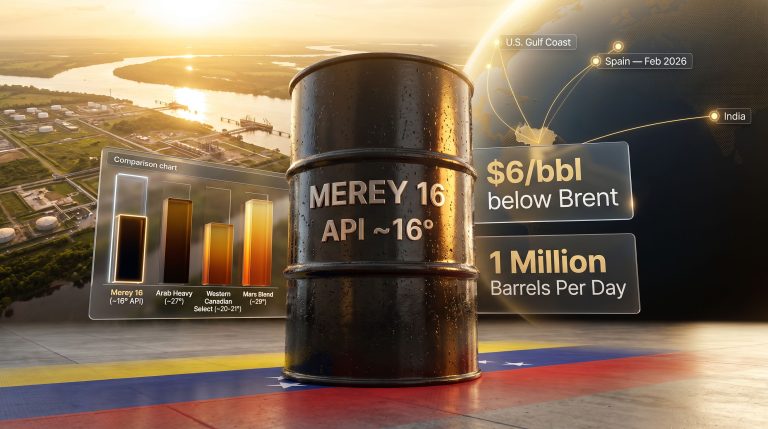
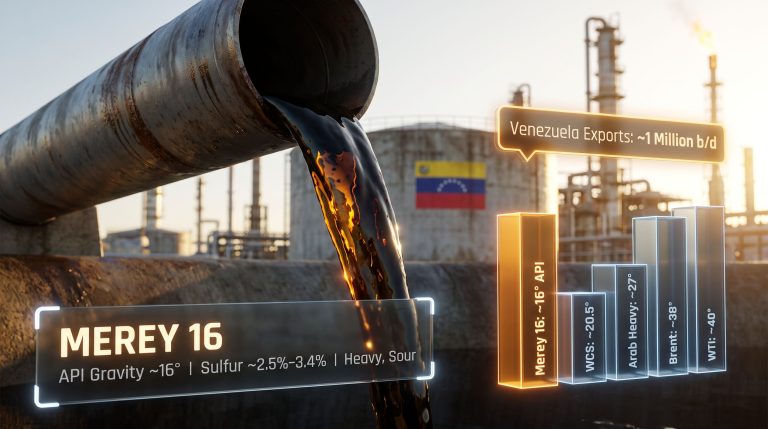
Merey 16 is a blended export grade produced from Orinoco Belt production. Its specifications are demanding by any standard:
- API gravity: Approximately 16 degrees, placing it firmly in the extra-heavy crude category
- Sulfur content: Typically above 2.5% by weight, classifying it as high-sulfur or sour crude
- Viscosity: Sufficiently high that it requires diluent blending or heating for pipeline transport and vessel loading
These properties explain why Merey 16 trades at a substantial discount to dated Brent and WTI. They also explain why only a specific subset of global refineries can process it profitably. Facilities without coking capacity will produce a disproportionate volume of low-value residual fuel oil from Merey 16, eliminating the feedstock cost advantage entirely. Facilities with cokers convert the heavy residuum into lighter, higher-value products, transforming the crude quality limitation into a margin opportunity unavailable to simpler refinery configurations.
The discount embedded in Merey 16 is not a gift to all buyers equally. It is a reward specifically calibrated to refineries that invested in deep conversion infrastructure — and a trap for those that did not.
Who Are the Confirmed Direct Buyers of Venezuelan Crude in 2026?
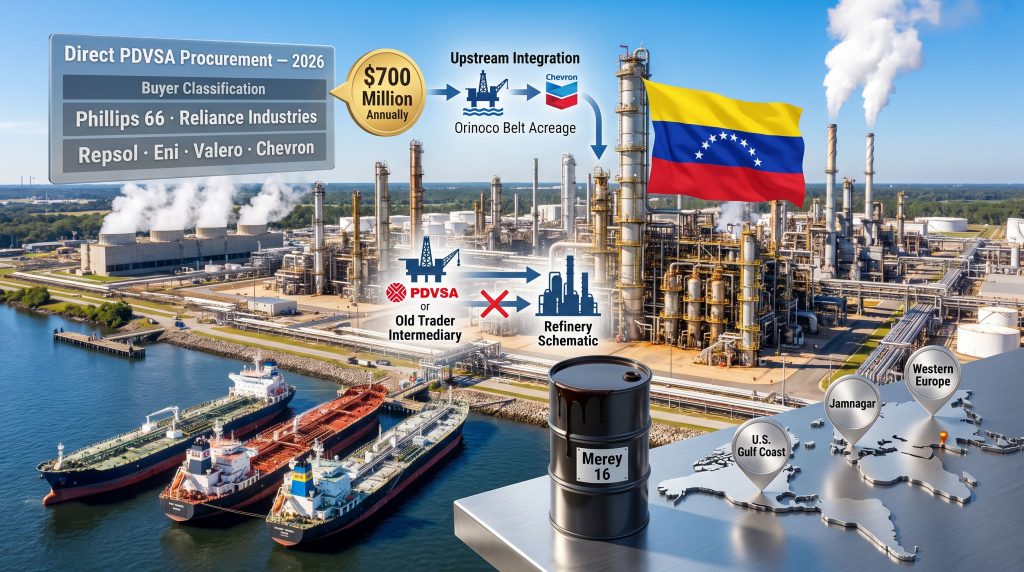
The confirmed and prospective direct buyer landscape as of mid-2026 spans multiple continents and refinery types, reflecting how broadly the feedstock economics apply to complex processing facilities worldwide. Furthermore, oil geopolitics and supply dynamics have accelerated the pace at which refiners are seeking to formalise these arrangements.
| Buyer | Country | Status | Key Detail |
|---|---|---|---|
| Phillips 66 | United States | Confirmed | Resumed direct PDVSA purchases in May 2026 after a seven-year absence; three Merey 16 cargoes allocated in July 2026 |
| Reliance Industries | India | Confirmed | Loaded a 2-million-barrel cargo directly from PDVSA in April 2026; formal direct purchases began in May |
| Repsol | Spain | Confirmed | Expanded direct liftings for European refining operations; converted prior receivables into crude allocations |
| Eni | Italy | Confirmed | Mirrored Repsol's receivables-to-liftings structure; supplying European deep conversion units |
| Valero | United States | Confirmed | Purchased a cargo in January 2026 as part of the Washington-Caracas commercial arrangement; further expansion anticipated |
| Chevron | United States | Confirmed + Upstream Integrated | Holds equity positions in Venezuelan joint ventures including Petroindependencia; operates across exploration, production, and offtake |
| Tipco Asphalt | Thailand | Prospective | Identified as a likely direct buyer; loading windows not yet assigned as of mid-July 2026 |
| Citgo | United States | Negotiating | Reported in February 2026 to be in active negotiations for direct Venezuelan crude procurement |
Phillips 66: The Significance of a Seven-Year Return
When Phillips 66 resumed direct PDVSA purchases in May 2026, it marked the most commercially significant re-entry by a U.S. refiner since sanctions dramatically curtailed Venezuelan crude flows. The allocation of three Merey 16 cargoes for July 2026 loading is particularly telling — this is not opportunistic spot purchasing but the establishment of a recurring supply relationship. Phillips 66's Gulf Coast refining network, including facilities at Lake Charles and Sweeny, Texas, carries the coking and conversion infrastructure required to fully exploit Merey 16's economics (Reuters, January 2026).
Reliance Industries: Jamnagar's Entry Into the Direct-Buy Model
Reliance Industries operates what is arguably the world's most sophisticated refining complex at Jamnagar in Gujarat, India. The site's two refineries combined represent one of the highest-complexity processing installations globally, with extensive secondary conversion capacity. A 2-million-barrel direct cargo loaded in April 2026 under U.S. Treasury oversight established Reliance as a landmark participant in the new direct-buyer cohort. India's refining sector had previously satisfied its appetite for discounted crude through Russian Urals and Middle Eastern heavy grades; Venezuelan supply now represents a third pillar of its discount-feedstock strategy. In addition, insights into sanctions and oil trading from comparable market transitions help contextualise India's approach here.
Chevron's Integrated Position: Beyond Simple Cargo Purchasing
Chevron's engagement with Venezuelan crude operates on a fundamentally different plane from that of the other confirmed buyers. Rather than functioning as a feedstock customer, Chevron has positioned itself as an upstream participant with equity exposure at multiple points in the Venezuelan value chain.
The company expanded its stake in the Petroindependencia joint venture with PDVSA and secured rights across new Orinoco Belt acreage, giving it direct involvement at the exploration and production level. This means Chevron's Venezuelan crude exposure is not subject to the same cargo-by-cargo commercial negotiation that governs relationships for Phillips 66, Valero, or Reliance. Its cost visibility extends back to the wellhead.
According to Bloomberg reporting from January 2026, optimising Venezuelan production across Chevron's Orinoco acreage positions could contribute up to $700 million per year in additional operating cash flow. That figure reframes the strategic calculus: Venezuela is not a marginal feedstock opportunity for Chevron but potentially a material contributor to its upstream earnings base (Bloomberg, January 9, 2026).
Bloomberg's January 2026 analysis indicated that full optimisation of Chevron's Venezuelan upstream positions could generate up to $700 million annually in incremental operating cash flow, a figure that underscores why the company has pursued equity integration rather than limiting its role to refinery feedstock procurement.
The Receivables-to-Liftings Model Used by Repsol and Eni
One of the less-discussed but structurally innovative mechanisms enabling European refiner access to Venezuelan crude is the receivables conversion arrangement deployed by both Repsol and Eni. Both companies had accumulated financial claims against PDVSA arising from prior commercial engagements during periods when Venezuela's fiscal capacity to service obligations in cash was effectively non-existent.
Rather than pursuing cash settlement, which Venezuela lacked the foreign exchange capacity to provide, both companies negotiated a conversion of outstanding balances into crude lifting entitlements. The practical effect is significant:
- PDVSA services legacy financial obligations without cash outflows, preserving scarce foreign exchange reserves.
- Repsol and Eni receive Venezuelan crude at an all-in acquisition cost effectively below even the discounted spot market price, since a portion of each barrel offsets a pre-existing receivable.
- The arrangement creates a structured, ongoing supply relationship anchored in a pre-existing commercial history rather than requiring new capital commitment.
Both Repsol's Spanish refining network and Eni's Italian operations include deep conversion infrastructure capable of processing high-sulfur, low-API grades, making Merey 16 economically compatible with their existing refinery configurations.
The next major ASX story will hit our subscribers first
How the Licensing Framework Controls Who Can Participate
The pace at which direct buyer relationships can expand among U.S.-domiciled refiners is not determined solely by commercial appetite. It is governed by the licensing architecture administered by the U.S. Office of Foreign Assets Control (OFAC), the sanctions enforcement arm of the U.S. Treasury Department.
Each direct purchase by a U.S. refiner requires an active, specific OFAC licence that defines:
- Permissible counterparties within the PDVSA corporate structure
- Authorised payment mechanisms and financial institutions
- Reporting and compliance obligations
- Transaction volume and cargo-specific parameters
The January 2026 Valero cargo was explicitly described by Reuters as part of a broader Washington-Caracas commercial arrangement, indicating that individual transactions operate within a diplomatically managed framework rather than purely commercial terms. Reuters also reported that additional U.S. refiners were expected to join the direct purchasing cohort as licence issuance expanded through 2026 (Reuters, January 22, 2026).
For non-U.S. buyers such as Reliance Industries and the European majors, the OFAC framework does not apply directly, though U.S. Treasury oversight of specific transactions involving U.S. counterparties or dollar-denominated settlements has been reported as a feature of the current arrangement. However, crude price geopolitical analysis suggests that the broader diplomatic environment will remain a key variable in determining how quickly further licences are issued.
How Trader Roles Are Compressing Under the New Model
The transition from trader-dominated to refiner-centred Venezuelan crude distribution does not eliminate commodity traders from the picture. It restructures their function.
| Function | Trader Role Under Sanctions (Pre-2026) | Trader Role Under Direct-Buy Model (2026) |
|---|---|---|
| Crude procurement | Primary buyer and reseller to end refiners | Substantially reduced; displaced by direct PDVSA contracts |
| Compliance risk absorption | Central commercial function | Diminished as OFAC licences expand to end refiners |
| Logistics and vessel management | Secondary to principal trading | Retained and growing in relative importance |
| Short-term cargo financing | Actively deployed | Continues, particularly for smaller or unlicensed buyers |
| Market access for non-licensed buyers | Dominant function | Persists where direct licensing is unavailable |
The structural economics that made trader intermediation both necessary and highly profitable are eroding precisely because the risk that traders were compensated to absorb is being redistributed. Furthermore, oil price trade impacts from broader geopolitical realignments are compounding the pressure on traditional intermediary business models. As OFAC licences flow directly to refining entities and bilateral diplomatic frameworks normalise Venezuelan crude transactions, the principal trading margin compresses toward zero for the major buyer cohort.
Refinery Configuration: The Technical Filter That Determines Who Benefits
Not every refinery that wants access to discounted Venezuelan crude can profitably use it. The technical requirements are specific and capital-intensive:
| Region | Key Facilities | Crude Compatibility |
|---|---|---|
| U.S. Gulf Coast | Phillips 66 (Lake Charles, Sweeny), Valero (Port Arthur, Texas City) | High — coking and deep conversion capacity |
| India | Reliance Jamnagar (West and East complexes) | Very High — among the world's most complex refining configurations |
| Western Europe | Repsol (Cartagena, Bilbao), Eni (Sannazzaro, Taranto) | High — vacuum distillation and hydrocracking units |
| Southeast Asia | Tipco Asphalt (Thailand) | Moderate — asphalt-grade heavy crude processing capability |
Facilities without coking or equivalent deep conversion capacity face a fundamental yield problem with Merey 16. The heavy residual fraction that cannot be upgraded accumulates as low-value fuel oil or vacuum residue, dramatically eroding the margin advantage that the feedstock discount is supposed to deliver. The crude discount is effectively a subsidy paid to refineries that invested in conversion infrastructure — and a penalty for those that did not. Global refiners are increasingly recognising this reality and restructuring their procurement strategies accordingly.
Scenario Analysis: How Venezuelan Production Volumes Shape the Direct-Buyer Landscape
The durability of the direct-buyer model depends critically on Venezuela's ability to grow and sustain production volumes. PDVSA's infrastructure has experienced severe degradation through years of underinvestment, and production recovery is neither linear nor guaranteed.
| Production Scenario | Impact on Direct Buyers | Impact on Traders |
|---|---|---|
| Production stagnates below 800,000 bbl/day | Cargo competition intensifies; early movers retain allocation advantage | Traders retain volume facilitation relevance |
| Production recovers to 1.0–1.2 million bbl/day | New direct buyer entrants become viable; Tipco and Citgo formalise relationships | Trader margins compress further as more buyers go direct |
| Production exceeds 1.5 million bbl/day with upstream investment | Full refiner-centred export model established; surplus volume available for new entrants | Structural disintermediation largely complete for tier-one buyers |
Early movers in the direct procurement cohort are building contractual relationships and PDVSA familiarity that later entrants will find difficult to replicate quickly, particularly if production growth creates cargo competition rather than surplus. Consequently, U.S. refiners such as Phillips 66 and Citgo are actively working to secure their positions before the competitive landscape tightens further.
Key Takeaways for Investors and Industry Observers
- Six confirmed direct buyers of Venezuelan crude are already active in 2026, with Tipco Asphalt and Citgo in various stages of formalising their own arrangements.
- Chevron's integrated upstream position distinguishes it from all other participants, with Bloomberg estimating up to $700 million annually in potential additional operating cash flow from optimised Venezuelan production.
- Refinery configuration is the critical filter — only deep conversion facilities can fully monetise the Merey 16 discount; simpler refineries gain nothing from direct access.
- The receivables-to-liftings model used by Repsol and Eni represents an under-appreciated financing innovation that simultaneously resolves PDVSA's legacy obligations and secures European refiner feedstock at below-market cost.
- OFAC licence expansion remains the controlling variable for U.S. refiner participation — the diplomatic pace of Washington-Caracas engagement directly determines how quickly the direct-buyer cohort can grow.
- Traders are not disappearing, but their principal buying-and-reselling function is contracting as major refiners secure their own PDVSA relationships and regulatory clearances.
Disclaimer: This article contains forward-looking assessments, production scenarios, and financial projections sourced from third-party reporting including Bloomberg and Reuters. These represent estimates and analytical frameworks rather than confirmed outcomes. Readers should conduct independent due diligence before making investment or commercial decisions based on any of the information presented here. Venezuelan crude market conditions are subject to rapid change driven by geopolitical developments, U.S. sanctions policy, and PDVSA operational factors.
For further reporting on Venezuelan crude market dynamics and the evolving PDVSA commercial landscape, explore coverage at worldenergywire.com, as well as primary source reporting from Reuters and Bloomberg on Washington-Caracas licensing arrangements and Chevron's Venezuelan upstream operations.
Want to Stay Ahead of the Next Major Commodity Shift?
The structural changes reshaping Venezuelan crude markets are a reminder that commodity and energy dynamics can move fast — and that early positioning matters. Discovery Alert's proprietary Discovery IQ model scans ASX announcements in real time, delivering instant alerts on significant mineral discoveries across more than 30 commodities, turning complex market data into clear, actionable opportunities for both traders and long-term investors. Explore historic discoveries and the returns they generated, then begin your 14-day free trial at Discovery Alert to ensure you're positioned before the broader market catches on.