August 10, 2026
The Crude That Refiners Cannot Ignore: Understanding Merey 16 Venezuela Crude Oil
Global heavy crude markets operate on a fundamental paradox: the most difficult barrels to process are often the most commercially attractive to buy. For refineries engineered to handle dense, sulfur-rich feedstocks, the steeper the discount on acquisition, the wider the potential margin on refined products. This dynamic sits at the heart of why Merey 16 Venezuela crude oil has regained significant attention from energy majors, independent refiners, and trading desks across four continents.
The story of Merey 16 is not simply about one nation's oil exports recovering from a period of disruption. It is a window into how geological reality, refinery configuration, sanctions architecture, and geopolitical positioning interact to determine which crude grades flow to which markets, and at what price. Furthermore, understanding the Venezuela oil market impact requires examining these interconnected forces in detail.
When big ASX news breaks, our subscribers know first
From Ultra-Heavy Reservoir to Tradeable Barrel: The Geology Behind Merey 16
The Orinoco Oil Belt in eastern Venezuela contains one of the most significant concentrations of extra-heavy crude on the planet. The raw reservoir crude extracted from this formation carries an API gravity of approximately 8° to 10°, a density so extreme that the material behaves closer to a semi-solid bituminous substance than a conventional liquid hydrocarbon. At that viscosity, pipeline transport is physically impossible without intervention.
To convert this reservoir fluid into a marketable export product, PDVSA and its joint venture partners blend the ultra-heavy feedstock with light diluents, typically naphtha or condensate, raising the API gravity of the resulting mixture to approximately 16°. The finished blend, known internationally as Merey 16, then meets the minimum viscosity threshold for pipeline movement to Venezuela's Caribbean export terminals.
This blending requirement is not a minor logistical footnote. It creates a structural dependency that shapes every aspect of Venezuela's export economics:
- Without a reliable diluent supply chain, Orinoco crude cannot reach export terminals regardless of how much oil sits in the reservoir
- Diluent costs are embedded in the effective production cost of every barrel of Merey 16, reducing the net realisation PDVSA receives
- Any interruption to condensate or naphtha supply, whether from sanctions, infrastructure failure, or commercial disputes, directly caps Venezuela's export ceiling
- The diluent blending ratio must be carefully managed to achieve consistent API gravity specifications, as cargo-to-cargo variability creates operational risk for receiving refineries
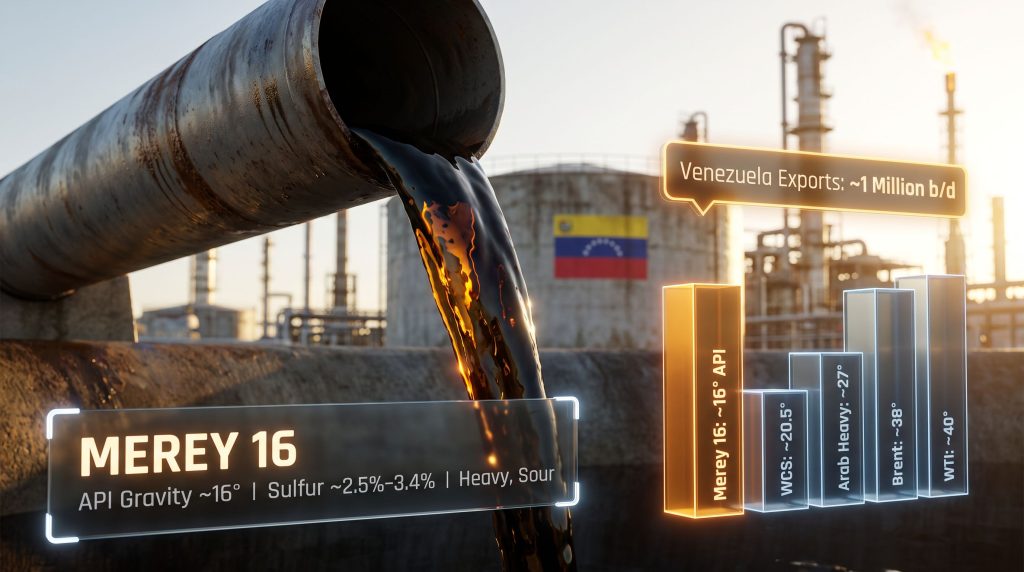
The sulfur content of the finished Merey 16 blend typically falls between 2.5% and 3.4%, firmly in the high-sulfur or "sour" classification used by international commodity markets. This characteristic, combined with the low API gravity, defines the refinery infrastructure required to process the crude efficiently. For a detailed technical overview, Shale24's profile of Merey 16 provides comprehensive background on its history and market challenges.
Merey 16 Technical Specifications: How It Compares to Global Benchmarks
| Property | Merey 16 | Western Canadian Select | Arab Heavy | Brent Crude |
|---|---|---|---|---|
| API Gravity | ~16° | ~20.5° | ~27° | ~38° |
| Sulfur Content | ~2.5%–3.4% | ~3.5% | ~2.8% | ~0.37% |
| Viscosity Profile | Very high (diluent required) | High | Moderate | Low |
| Refinery Requirement | Coking + hydrocracking + HDS | Coking + HDS | Moderate conversion | Simple distillation viable |
| Typical Price vs. Brent | Significant discount | Significant discount | Moderate discount | Benchmark |
Key Insight: At 16° API, Merey sits among the heaviest benchmark crudes traded on organised markets. The conventional boundary between medium and heavy crude sits around 22° API, meaning Merey 16 falls well into heavy territory. Its primary structural competitor for U.S. Gulf Coast coking refinery slots is Western Canadian Select, and when Venezuelan supply is constrained, WCS tends to capture the displaced demand.
Why Complex Refineries Chase the Heavy Crude Discount
The commercial logic driving refinery interest in Merey 16 Venezuela crude oil rests on a concept known as the crack spread: the difference between the cost of acquiring crude and the combined market value of the refined products it yields. For heavy sour crudes, this spread can be considerably wider than for light sweet grades, provided the refinery has the processing depth to unlock value from a dense, high-sulfur feedstock.
Three categories of processing infrastructure determine whether a refinery can economically handle Merey 16:
- Coking units apply thermal energy to crack the heaviest residual fractions, converting what would otherwise be low-value fuel oil into lighter, more commercially valuable product streams including naphtha and gas oil
- Hydrocracking units use pressurised hydrogen to further upgrade intermediate fractions into premium diesel and jet fuel, which command the highest product margins in most refined product markets
- Hydrodesulfurization (HDS) units remove sulfur compounds from product streams to meet ultra-low sulfur specifications mandated in major consuming markets across North America, Europe, and increasingly Asia
Refineries that lack these conversion units cannot process Merey 16 without absorbing significant yield penalties. This restricts the addressable buyer pool to a relatively limited number of complex, deep-conversion facilities, which in turn concentrates the crude's trade flow toward specific geographic markets.
The Historical Refinery Markets for Venezuelan Heavy Crude
| Market Region | Refinery Configuration | Role in Venezuelan Crude Trade |
|---|---|---|
| U.S. Gulf Coast | Coking-heavy, high complexity | Historically dominant destination |
| India | Growing complex refinery capacity | Price-sensitive, expanding buyer |
| Europe | Selective complex facilities | Repsol, Eni maintain operational exposure |
| China and broader Asia | Large-scale complex refineries | Primary buyer during maximum sanctions period |
The Diluent-for-Crude Barter Model: A Structural Innovation in Venezuelan Oil Trade
One of the most analytically significant and underreported dimensions of the modern Merey 16 trade is the mechanism by which some international energy companies are being compensated for services rendered to PDVSA. Companies including Repsol and Eni supplied diluents and operational support to Venezuelan joint ventures over extended periods, accumulating large receivables that PDVSA lacked the hard currency to settle in cash.
Rather than writing these receivables off or pursuing costly legal arbitration, a pragmatic barter structure emerged:
- The service provider and PDVSA agree on the accumulated receivable balance in dollar terms
- That balance is converted into the right to lift a defined volume of physical Merey 16 barrels at agreed scheduling intervals
- The lifting company takes title to the crude cargo and sells it independently on global markets
- Proceeds from the sale extinguish the receivable without requiring cash to leave Venezuela's treasury
Structural Significance: This crude-for-service settlement model is not simply a financial workaround. It represents a durable framework for sustaining commercial relationships between international energy companies and a sanctions-affected state oil producer. The model keeps technical expertise, equipment supply, and operational partnerships alive while preserving PDVSA's limited foreign exchange reserves.
For European energy majors, the arrangement provides a practical recovery mechanism for stranded receivables. For Venezuela, it maintains the foreign technical support and diluent supply that the Orinoco Belt's production system fundamentally requires. Neither side has an incentive to collapse the arrangement, which gives it unusual commercial resilience.
Venezuela's Export Recovery and What the Production Data Reveals
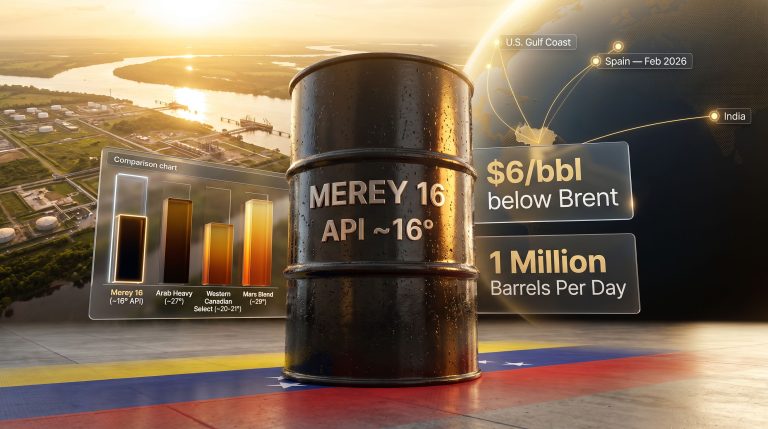
Bloomberg reported in May 2026 that Venezuelan oil exports reached approximately 1 million barrels per day, described as the highest export volume achieved in the post-Maduro era. This milestone carries significant implications beyond the headline number.
Venezuela's production peak, recorded in the late 1990s, exceeded 3 million barrels per day. The gap between the 2026 recovery level and that historical peak reveals a crucial insight: Venezuelan crude output is not geologically constrained. The Orinoco Belt contains resource volumes sufficient to sustain production multiples above current levels. The binding constraints have been political, commercial, and infrastructural, not geological.
This distinction matters for market participants assessing the medium-term supply outlook. In addition, monitoring crude oil price trends provides further context for evaluating Venezuela's re-entry into mainstream markets:
- A continued normalisation of commercial channels could unlock significant additional export volume without requiring major new exploration or resource development
- Infrastructure rehabilitation of PDVSA's ageing pipeline network, upgrader facilities, and export terminals represents the primary technical challenge to scaling output
- Diluent supply expansion would be required in parallel with any production ramp-up, given the structural blending dependency of Orinoco extra-heavy crude
- Sanctions policy remains the most unpredictable variable, capable of either accelerating or sharply reversing the recovery trajectory depending on U.S. political conditions
According to Bloomberg's May 2026 reporting, Venezuela's export recovery to approximately 1 million barrels per day marked a meaningful post-Maduro milestone, though the country's late-1990s production capacity of over 3 million barrels per day underscores the scale of potential re-entry into global markets that remains unrealised.
The next major ASX story will hit our subscribers first
The Sanctions Dimension: How Geopolitics Reshapes Merey 16 Trade Flows
During periods of maximum U.S. sanctions pressure, Merey 16 was effectively excluded from mainstream energy trade. The crude was rerouted through intermediary trading structures, often involving multiple jurisdictions and opaque ownership chains, with the final destination predominantly being Chinese and other Asian refineries willing to absorb the compliance and reputational risk in exchange for steep discounts.
This created a two-tier market for Venezuelan crude. Buyers who accepted sanctions-era risk required larger discounts to compensate for the compliance exposure, the logistical premium of opaque shipping chains, and the difficulty of reselling barrels in transparent markets. Trading houses that positioned themselves as intermediaries in this structure captured significant arbitrage value during the period of maximum sanctions enforcement.
As sanctions frameworks evolved through 2025 and 2026, the picture shifted materially. Reporting by the New York Times in January 2026 confirmed that U.S. refineries were actively evaluating and pursuing direct procurement arrangements with PDVSA, bypassing the intermediary premium that had characterised the sanctions era. Consequently, PDVSA policy changes have played a central role in facilitating this transition, representing a structural change in how Merey 16 Venezuela crude oil reaches global refineries.
Merey 16 as a Geopolitical Instrument
Beyond its refining economics, Merey 16 carries strategic value that extends well beyond the barrel itself. Venezuela's capacity to offer discounted heavy crude to energy-hungry markets provides diplomatic leverage, a mechanism for attracting foreign investment under commercially favourable terms, and a tool for settling international obligations through barrel-denominated transactions rather than cash.
Countries and companies that establish preferential access to Venezuelan crude effectively secure a position in future supply allocation. Venezuela, in turn, gains the operational partnerships, technical expertise, and foreign exchange flows needed to sustain and expand production. The Merey 16 barrel therefore functions simultaneously as a commodity, a financial instrument, and a foreign policy asset.
Key Risks for Refiners Sourcing Merey 16
Despite the commercial attractions of heavy crude discounts, sourcing Merey 16 carries a distinctive risk profile that experienced energy procurement teams must assess systematically. Furthermore, the broader context of sanctions and oil trading provides useful comparative insight into how geopolitical restrictions reshape commodity flows:
- Sanctions reinstatement risk: U.S. policy toward Venezuela is subject to political change and has historically reversed with limited warning. Any reimposition of sanctions could rapidly disrupt supply chains and expose buyers to compliance liability with potentially severe financial consequences
- Cargo quality variability: Unlike tightly standardised benchmark crudes with established quality tolerance histories, Merey 16 can exhibit cargo-to-cargo variation in API gravity, sulfur content, and contaminant levels, requiring independent assay testing before each lifting
- Infrastructure reliability: PDVSA's production and export infrastructure has experienced years of deferred maintenance and underinvestment, creating scheduling uncertainty and the potential for force majeure events during cargo loading
- Diluent supply disruption: Any interruption to the condensate or naphtha supply chain can reduce the volume of blend-ready crude available for export, affecting contracted cargo commitments
Sophisticated buyers manage these exposures through a combination of approaches:
- Structuring contracts with quality tolerance clauses that trigger price adjustments when delivered specifications deviate from contracted parameters
- Conducting independent crude assay analysis on each cargo rather than relying on seller-provided certificates of quality
- Maintaining feedstock flexibility by operating with the capability to blend Merey 16 against lighter crudes to optimise refinery feed quality
- Engaging experienced counterparties with established Venezuelan crude logistics knowledge to manage compliance documentation and shipping arrangements
Competitive Implications for Global Heavy Crude Markets
A sustained Venezuelan production recovery would alter the competitive dynamics of the global heavy sour crude market in ways that extend beyond Venezuela itself. The most direct competitive pressure would fall on Western Canadian Select, which has historically captured U.S. Gulf Coast coking refinery demand during periods of Venezuelan supply restriction. However, the effects of trade war oil markets dynamics add further complexity to this competitive landscape.
Middle Eastern heavy crude producers, particularly those relying on heavy grade export volumes to Asian markets, would also face increased competition from Venezuelan barrels as logistics infrastructure and commercial channels normalise. For U.S. Gulf Coast refiners that invested in coking capacity specifically to process discounted heavy crude, a wider pool of supply options improves their negotiating position and potentially compresses the discounts they must offer to attract barrels.
The Merey 16 story is ultimately a case study in the intersection of resource endowment, industrial infrastructure, and geopolitical frameworks. Venezuela holds the geological foundation for one of the world's most significant heavy crude supply bases. The question facing energy markets is not whether those barrels can eventually re-enter mainstream trade channels, but at what pace, under what political conditions, and with what implications for the pricing of every competing heavy grade in the global supply stack. Riviera Maritime Media's reporting on Venezuelan crude lifts confirms that whilst traders have actively moved these barrels, stateside refiners have continued to navigate real operational and compliance challenges in processing them.
Disclaimer: This article contains forward-looking statements, market projections, and analysis based on publicly available information at the time of writing. Crude oil markets, sanctions frameworks, and geopolitical conditions are subject to rapid change. Nothing in this article constitutes financial or investment advice. Readers should conduct independent due diligence before making any investment or procurement decisions.
For further reporting on Venezuelan crude trade dynamics, Latin American energy markets, and Orinoco Belt developments, visit World Energy Wire.
Want to Stay Ahead of the Next Major Resource Discovery?
While energy markets navigate complex geopolitical shifts like Venezuela's crude oil re-entry, Discovery Alert's proprietary Discovery IQ model scans ASX announcements in real time, delivering instant alerts on significant mineral discoveries across more than 30 commodities — explore historic discovery returns on the Discovery Alert discoveries page and begin your 14-day free trial to position yourself ahead of the broader market.