August 9, 2026
The Geography of Leverage: How One Narrow Passage Controls Global Energy Security
Every so often, the global energy system is reminded of a fundamental truth: decades of infrastructure investment, complex supply chains, and sophisticated trading markets can be held in tension by a strip of water barely 33 kilometres wide at its narrowest point. The Strait of Hormuz has long represented the single most consequential chokepoint in the world's oil and gas network, and the current crisis unfolding in 2026 is demonstrating precisely why that geography translates so directly into geopolitical power.
Iran rejects U.S. talks on Strait of Hormuz reopening, and in doing so, has made clear that the standoff is not a logistical problem awaiting a technical fix. It is a sovereignty contest wearing the clothing of a shipping dispute.
When big ASX news breaks, our subscribers know first
Why the Strait of Hormuz Is Irreplaceable
Under normal operating conditions, roughly one-fifth of the world's entire oil trade moves through the Strait of Hormuz. That figure understates the true concentration of risk, because the waterway also serves as the primary export corridor for Qatari liquefied natural gas, making it simultaneously the world's most critical oil chokepoint and one of its most important gas transit routes.
Unlike the Suez Canal, which has a functioning bypass in the form of the SUMED pipeline and Cape of Good Hope routing, the Strait of Hormuz has no equivalent alternative capable of absorbing its full throughput at comparable cost and speed. Furthermore, the LNG supply outlook for global markets becomes significantly more precarious when this corridor is constrained.
The two primary overland alternatives are:
- The Abqaiq-Yanbu crude oil pipeline (Saudi Arabia), running from the Eastern Province to the Red Sea port of Yanbu, with a capacity of approximately 5 million barrels per day — a fraction of normal Hormuz throughput
- The Iraq-Turkey pipeline system, which is limited in capacity and has suffered repeated disruptions from geopolitical conflict in northern Iraq
This infrastructural reality is not incidental. It is the foundation of Iran's negotiating leverage. Without a credible bypass, any disruption to Hormuz cannot be fully absorbed elsewhere, which means Tehran holds something genuinely valuable: the capacity to impose asymmetric cost on global energy markets at relatively limited cost to itself, particularly while sanctions already constrain its export revenues.
The Strait of Hormuz is not simply a shipping lane. It functions as a geopolitical instrument whose value to Iran increases precisely because no equivalent alternative exists.
The Current State of Disruption: What Escorted Shuttle Operations Actually Mean
Since conflict began earlier in 2026, commercial shipping through the strait has not returned to anything resembling pre-crisis norms. A system of escorted shuttle operations has allowed limited cargo movement to continue, but this arrangement represents a deeply suboptimal substitute for open commercial transit.
Escorted shuttle operations involve naval escort of individual or grouped commercial vessels through disputed or high-risk maritime corridors. The practical limitations of this approach include:
- Severely reduced throughput compared to open transit, as escort capacity constraints create bottlenecks
- Substantially higher insurance premiums for vessels transiting under escort, inflating delivered energy costs for importing nations
- Scheduling uncertainty that undermines the just-in-time inventory models that many Asian refiners rely upon
- Increased counterparty risk for long-term supply contracts, as force majeure clauses are increasingly invoked
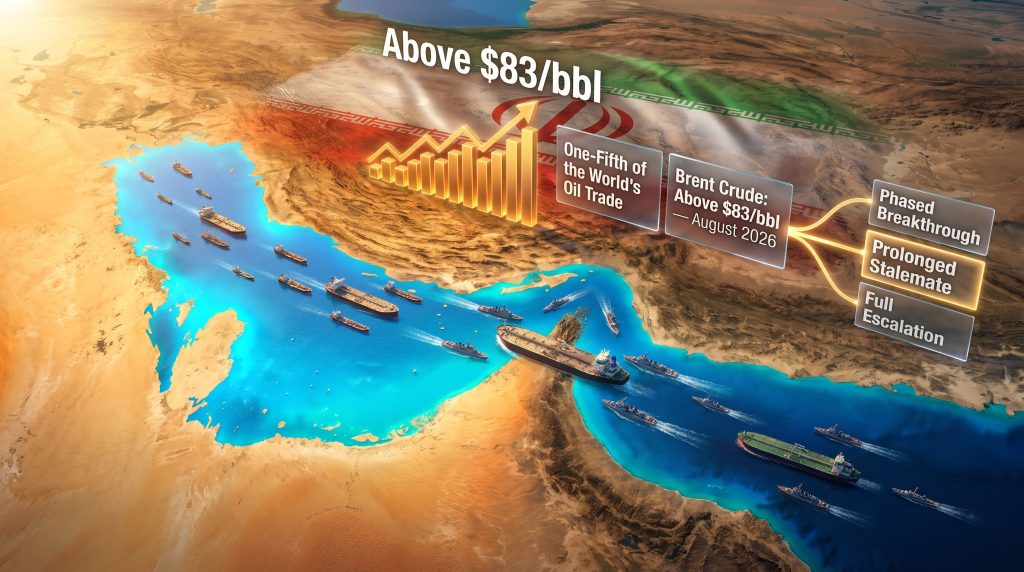
The absence of a formal reopening agreement leaves the global energy supply chain in a condition of managed uncertainty rather than resolved stability. As of August 2026, Brent crude is holding above $83 per barrel, a price level that reflects sustained trader anxiety rather than a panic premium. Consequently, these oil market disruptions are reverberating well beyond the immediate region.
| Market Indicator | Status as of August 2026 |
|---|---|
| Brent Crude Price | Above $83/bbl |
| Strait of Hormuz Traffic | Heavily disrupted; escorted shuttles only |
| Commercial Shipping Status | Not restored to normal |
| Diplomatic Progress | Stalled; indirect communication via intermediaries |
| LNG Export Continuity | Significantly affected; spot market competition elevated |
Why Iran Refuses Direct Engagement With Washington
Iranian Foreign Minister Abbas Araghchi confirmed publicly that Tehran will not resume direct negotiations with the United States. The stated reason is Iran's accusation that Washington violated a memorandum of understanding that was reached earlier in 2026 and proved short-lived. Communication is continuing, but exclusively through third-party intermediaries rather than through direct diplomatic channels.
This distinction between direct and indirect talks matters more than it might initially appear. Indirect communication through intermediaries is inherently slower, more susceptible to miscommunication, and structurally limited in its capacity to resolve complex multi-condition disputes. The use of intermediaries also signals to domestic political audiences on both sides that no formal engagement is occurring, which provides cover but simultaneously constrains the space for genuine compromise.
The core substantive dispute is not procedural. It is a direct contest over whether Iran possesses recognised authority to manage transit through the strait. Tehran is seeking some form of international acknowledgment of its role as a transit authority. Washington disputes this claim on freedom of navigation grounds, viewing any such concession as potentially establishing a precedent applicable to other contested maritime corridors globally.
Iran has laid out four conditions that function as preconditions rather than negotiating positions:
- Full lifting of economic sanctions imposed by the United States and allied governments
- Termination of the U.S. naval blockade on Iranian ports
- Withdrawal of U.S. military forces from Iran's regional periphery
- Release of frozen Iranian sovereign assets held in foreign financial jurisdictions
These are framed explicitly as preconditions, not opening bids. That framing is analytically critical because it means Iran is not signalling a willingness to trade concessions. It is demanding resolution before talks formally begin.
Oman's Mediation Role and Why the Deal Has Not Closed
Oman has historically occupied a unique diplomatic position in the Gulf: trusted by both Iran and Western powers, non-aligned on the core sovereignty disputes, and willing to invest diplomatic capital in back-channel facilitation. This is the role Muscat is reprising in the current crisis, and Omani officials have described the atmosphere of ongoing discussions as proceeding in a positive and constructive manner while urging all parties to avoid destabilising actions.
Earlier reporting indicated that Iran and Oman had moved close to a framework agreement that would establish a temporary shipping corridor through the strait, with Iran managing vessel movement in coordination with Omani authorities. That apparent near-breakthrough subsequently stalled after Tehran attached additional conditions, including demands for U.S. financial compensation and what Iranian sources described as tangible verification of compliance commitments.
The current obstacle map looks as follows:
| Obstacle | Iranian Position | U.S./International Position |
|---|---|---|
| Transit Authority | Iran must control ship movement | Iran does not hold legal control |
| Sanctions Relief | Must precede any reopening | Cannot be linked to transit access |
| Frozen Assets | Must be released as precondition | Subject to separate legal processes |
| Naval Blockade | Must be lifted before talks progress | Separate security consideration |
| Verification Standards | Requires tangible proof of compliance | Disputes scope of verification demands |
The table above reveals why progress is structurally difficult. Each item is linked to the others in Iran's framing, but treated as a separate and non-negotiable matter by Washington. This parallel framing problem means there is no obvious first-mover concession that either party can make without appearing to capitulate on a foundational position.
The Houthi Dimension: Why Regional Escalation Undermines Diplomacy
Over the same weekend that Hormuz talks stalled, Yemen's Houthi movement claimed responsibility for a drone strike on Saudi Aramco's Jizan refinery. Saudi authorities confirmed that a fire at the facility had been extinguished and reported no casualties, though they did not officially attribute the incident to Houthi action. The Houthis have been systematically expanding their targeting campaign to include Saudi shipping and energy infrastructure across the Red Sea corridor.
The strategic significance of this escalation extends well beyond its immediate physical impact. Every successful or claimed attack on Gulf energy infrastructure raises the geopolitical temperature across the entire region, making it politically harder for any party to make the kind of quiet concessions that diplomatic breakthroughs typically require.
A combined disruption scenario, in which Hormuz remains closed to normal commercial shipping while Houthi attacks continue to threaten Red Sea energy infrastructure, would represent a compounding supply shock of a type that global energy markets have not fully priced:
- The Red Sea corridor accounts for approximately 12% of global trade by volume, including significant refined product flows
- Rerouting via the Cape of Good Hope adds 10 to 14 days to voyage times between the Gulf and European markets, inflating shipping costs and tightening delivered supply
- Simultaneous disruption to both corridors would force importing nations to compete aggressively for Atlantic basin and U.S. LNG cargoes, driving global gas prices materially higher
If Houthi attacks on Saudi infrastructure intensify while Hormuz talks remain stalled, markets may begin pricing in a sustained dual-chokepoint disruption scenario. That repricing would push Brent crude materially above current levels.
How Does This Compare to Previous Oil Price Shocks?
In historical context, the current disruption echoes previous episodes where oil price shock events reshaped global energy procurement strategies almost overnight. However, the dual-corridor dimension of the present crisis is considerably more complex than prior single-chokepoint disruptions.
The next major ASX story will hit our subscribers first
Three Scenarios for What Happens Next
Scenario A: Phased Diplomatic Breakthrough (Low-to-Medium Probability)
Oman successfully brokers a limited interim agreement on a temporary shipping corridor. Iran accepts a partial confidence-building measure such as a staged asset release or a specific sanctions carve-out. Commercial shipping resumes on a restricted basis within weeks, and Brent crude retreats toward the $75 to $78 per barrel range on breakthrough news.
Scenario B: Prolonged Stalemate (Highest Current Probability)
Indirect talks continue without resolution across several months. Escorted shuttle operations persist as the de facto status quo. Oil markets remain range-bound above $80 per barrel with elevated volatility. Regional escalation risk from Houthi activity and potential naval incidents keeps a structural risk premium embedded in prices.
Scenario C: Diplomatic Collapse and Full Escalation (Tail Risk)
A breakdown in indirect communications or a triggering incident leads to the complete suspension of escorted operations. A global energy supply shock drives Brent crude sharply higher. IEA member nations co-ordinate emergency strategic petroleum reserve releases. Geopolitical pressure mounts for a forced negotiated resolution under full crisis conditions.
Which Economies Face the Greatest Exposure?
The geographic distribution of Hormuz dependency is not uniform, and the asymmetry in exposure is itself a factor shaping the diplomatic dynamics.
| Region | Hormuz Dependency | Alternative Supply Access | Vulnerability Rating |
|---|---|---|---|
| East Asia (China, Japan, South Korea) | Very High | Moderate (LNG spot markets) | Critical |
| South Asia (India) | High | Moderate (diversified suppliers) | High |
| Europe | Moderate | High (Atlantic basin, Norway, U.S. LNG) | Medium |
| North America | Low | Very High (domestic production) | Low |
East Asian economies face the most acute exposure. Japan imports approximately 90% of its crude oil from the Middle East, the vast majority of which transits Hormuz under normal conditions. South Korea is similarly dependent. China, while pursuing aggressive supply diversification through Russian pipeline agreements, still routes significant crude volumes through the strait.
India occupies a particularly complex position. New Delhi has maintained diplomatic relationships with both Tehran and Washington, but its energy security calculus depends heavily on access to affordable Gulf crude. A prolonged Hormuz disruption forces India into spot market competition with better-capitalised East Asian buyers, a dynamic that increases delivered energy costs and pressures the current account.
The LNG Supply Chain: A Less-Discussed but Critical Vulnerability
Qatar is the world's largest exporter of LNG by volume, and a significant portion of its export volumes transit the Strait of Hormuz to reach Pacific and European markets. The current disruption is therefore not exclusively an oil supply problem. It is simultaneously a global gas supply problem that is being somewhat obscured by the more visible crude oil price signal.
European buyers who restructured their LNG procurement in the years following the 2022 supply shock are now facing renewed cost pressure as spot cargo availability tightens. The mechanism works as follows:
- Qatari LNG volumes to Asia are reduced or rerouted due to Hormuz disruption
- Asian buyers who cannot secure Qatari cargoes compete aggressively for spot LNG from U.S., Australian, and African producers
- Increased Asian spot demand tightens the Atlantic basin LNG market
- European buyers face higher spot prices and reduced availability for flexible cargoes
This indirect transmission mechanism means that European energy consumers are bearing real economic costs from the Hormuz crisis even though European direct Hormuz dependency is classified as moderate.
The Sovereignty Dispute That Makes This Crisis Structurally Difficult to Resolve
Beneath the negotiations over shipping lanes, asset releases, and sanctions frameworks lies a dispute of a fundamentally different character. Tehran's insistence on international recognition of its transit management authority over the strait is not merely a tactical bargaining position. It reflects a long-standing Iranian strategic objective that predates the current crisis and will outlast any temporary agreement.
Any agreement that explicitly denies this recognition is politically difficult to sell within Iran's domestic political framework. Conversely, any agreement that implicitly or explicitly grants this recognition creates a precedent that the United States views as threatening to the freedom of navigation doctrine, a principle that underpins U.S. naval strategy across all contested maritime environments globally.
In addition, oil price geopolitics of this nature rarely resolve quickly, as the interplay between domestic political pressures and international negotiating positions tends to entrench both sides well beyond what the economic fundamentals would otherwise justify.
This structural tension means that even a successful near-term agreement brokered by Oman would likely be fragile. Without resolving the underlying legitimacy question, any technical shipping arrangement remains vulnerable to being unilaterally suspended by Tehran the next time a political grievance emerges.
How Does OPEC Factor Into the Current Situation?
It is also worth noting that OPEC's market influence is being tested in an unusual way by this crisis. The cartel's ability to manage price stability through production adjustments is significantly complicated when a key transit corridor remains effectively closed to normal commercial operations.
Key Indicators to Watch in the Weeks Ahead
For analysts and market participants tracking this situation, the following signals carry the most informational weight:
- Oman's diplomatic tone: A shift from the current characterisation of talks as constructive toward language suggesting urgency or difficulty would indicate either an imminent breakthrough or a deepening impasse
- Brent crude price trajectory: A sustained move above $90 per barrel would signal that markets are repricing toward the prolonged stalemate or escalation scenario rather than a near-term resolution
- U.S. sanctions posture signals: Any indication of flexibility on the frozen asset question or targeted sanctions relief would materially shift Iran's negotiating calculus
- Houthi operational tempo: An intensification of Red Sea attacks, particularly those targeting major Saudi or UAE energy infrastructure, would compound supply disruption risk across two corridors simultaneously
- Iranian domestic economic indicators: Internal economic pressure within Iran is a double-edged variable. It could accelerate Iran's willingness to negotiate, or it could entrench hardline positions as leadership seeks to deflect blame onto external actors
Iran rejects U.S. talks on Strait of Hormuz reopening as the ultimate expression of a sovereignty and legitimacy dispute that has taken on the operational form of a logistics problem. Until the political dimension is addressed at a level above technical negotiations, any agreement reached through Oman or other intermediaries will be provisional at best. Markets are pricing that uncertainty at above $83 per barrel, and the longer the stalemate persists, the more deeply that risk premium becomes structurally embedded in global energy costs.
This article draws on reporting from World Oil (worldoil.com), which provides ongoing upstream industry analysis of Middle East energy developments and Hormuz disruption impacts. All price references and diplomatic positions reflect publicly reported information as of August 2026. This article is for informational purposes only and does not constitute financial or investment advice. Forward-looking scenarios involve inherent uncertainty and actual outcomes may differ materially from those described.
Want to Capitalise on the Next Major Commodity Discovery Before the Market Moves?
While geopolitical disruptions reshape global energy markets, Discovery Alert's proprietary Discovery IQ model instantly scans ASX announcements to identify significant mineral discoveries across 30+ commodities — converting complex data into clear, actionable opportunities for both short-term traders and long-term investors. Explore historic examples of exceptional discovery returns and begin your 14-day free trial at Discovery Alert to position yourself ahead of the broader market.