August 9, 2026
The Refinery Equation That Decides Which Crude Survives
Not every barrel of oil is equal, and not every refinery can process every grade. This fundamental asymmetry in the global refining industry is what gives heavy sour crude its peculiar power in commodity markets. While lighter, sweeter grades attract a broader base of buyers, heavy sour blends like Merey 16 occupy a narrower but highly strategic niche, one where pricing discounts and refinery configuration intersect to generate outsized margins for those equipped to capture them.
Understanding why the Merey 16 Venezuela oil comeback matters requires understanding this refinery economics puzzle first. The crude itself is commercially unattractive to most processors, yet intensely valuable to those with the right infrastructure. For a broader crude oil market update, that paradox is precisely what makes it worth examining in depth.
When big ASX news breaks, our subscribers know first
What Merey 16 Actually Is: A Technical Profile
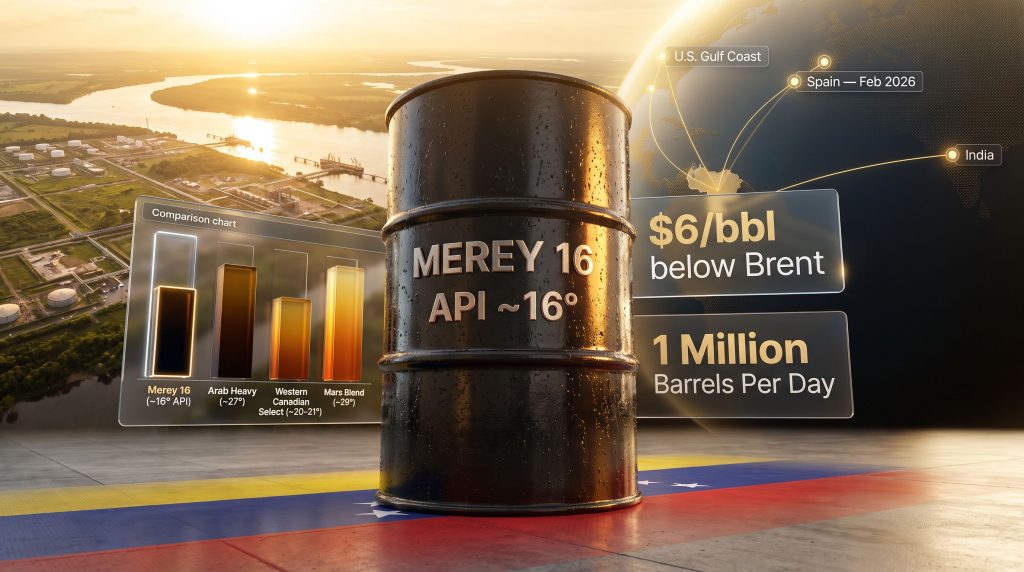
Merey 16 is Venezuela's primary benchmark export blend, produced from the Orinoco Oil Belt in the south of the country. Its defining characteristics are an API gravity of approximately 16 degrees and a sulfur content exceeding 2.5%, placing it firmly within the heavy sour classification used by refiners worldwide.
To understand what those numbers mean in practice, consider the crude quality spectrum below:
| Crude Grade | API Gravity | Sulfur Content (%) | Primary Market |
|---|---|---|---|
| Merey 16 (Venezuela) | ~16° | ~2.5%+ | U.S. Gulf Coast, Europe, Asia |
| Arab Heavy (Saudi Arabia) | ~27° | ~2.9% | Asia, Europe |
| Western Canadian Select | ~20-21° | ~3.5% | U.S. Midwest, Gulf Coast |
| Mars Blend (U.S. Gulf) | ~29° | ~1.8% | U.S. Gulf Coast |
Merey 16 sits at the bottom of the API gravity range among traded heavy benchmarks, meaning it is among the densest and most viscous crude grades actively exported in commercial volumes. Its low gravity creates a processing challenge that lighter grades simply do not impose.
The Viscosity Problem and the Diluent Solution
One of the lesser-understood operational realities of Orinoco crude is that its viscosity, at reservoir conditions, is so extreme that it cannot travel through export pipelines without chemical assistance. Extra-heavy crude from the Orinoco Belt must be blended with light hydrocarbons, typically condensate or naphtha, before it can flow efficiently through the pipeline network connecting production fields to the José export terminal on Venezuela's northeast coast.
This dependency on diluents is not merely a logistical footnote. It transforms diluent supply into a geopolitically sensitive variable. When sanctions on oil trading disrupted Venezuela's access to imported condensate and naphtha during the peak restriction period, production volumes were directly impacted. This is also the underlying reason why European companies such as Repsol and Eni, which supplied diluents and gas to PDVSA over multiple years, accumulated significant receivables that could not easily be recovered in cash.
The diluent dependency embedded in Orinoco production creates a structural leverage point for external suppliers, one that ultimately shaped how European companies chose to recover value from their Venezuelan operations through crude lifting arrangements rather than cash settlement.
The Orinoco Oil Belt: Geological Scale and Commercial Consequence
The Orinoco Heavy Oil Belt spans roughly 55,000 square kilometres across central Venezuela and represents one of the largest accumulations of petroleum in the world by volume. The U.S. Geological Survey has estimated recoverable resources in the region at several hundred billion barrels, though the extra-heavy nature of the crude means that recovery rates and economics differ substantially from conventional oil fields.
The crude formed through biodegradation processes over geological timescales, which stripped lighter hydrocarbon fractions and left behind the dense, metal-rich, sulfur-laden material that characterises Merey 16 today. This geological origin explains several commercially important properties:
- High vanadium and nickel concentrations, which complicate catalyst management in refineries
- Elevated asphaltene content, which contributes to viscosity and processing difficulty
- Low natural pressure, requiring artificial lift and more intensive production engineering
- Poor flowability at surface temperatures, necessitating diluent blending before transport
These characteristics mean that Orinoco crude is not simply heavy oil in the conventional sense. It occupies a category sometimes described as extra-heavy crude, sitting below the standard heavy oil threshold and requiring either upgrading to synthetic crude or blending before export. Furthermore, the Merey 16 blend itself is the product of mixing raw Orinoco extra-heavy crude with lighter diluent streams to produce a grade that is transportable and marketable. For more on oil's global importance, the Orinoco Belt's scale is a useful reference point.
Why Refiners Are Buying Merey 16 Again in 2026
The commercial logic driving renewed interest in Merey 16 is straightforward: price. In January 2026, Venezuelan crude was being offered to U.S. Gulf Coast refiners at approximately $6 per barrel below Brent, according to reporting by The New York Times. At that spread, and depending on the specific refinery configuration and logistics cost structure, Venezuelan barrels were competitive with or superior to Canadian heavy alternatives for certain processing facilities.
However, not all refiners can participate. Processing Merey 16 profitably requires specific units that are not universally available:
- Coking units, which convert the heaviest residual fractions of crude into lighter, more valuable products such as gasoline and diesel
- Hydrocracking units, which use hydrogen under high pressure to upgrade middle distillates and improve product yields
- Hydrodesulfurization capacity, to remove sulfur compounds that would otherwise violate product quality specifications
Refineries with this configuration, concentrated on the U.S. Gulf Coast, in parts of Europe, and across major Asian refining hubs in India and China, can unlock margins from Merey 16 that are structurally unavailable to simpler facilities processing lighter crudes.
Refineries equipped with coking and hydrocracking infrastructure can extract meaningfully higher margins from discounted heavy sour crude than from lighter sweet grades trading at or near benchmark prices. The key condition is that supply access must be reliable enough to justify the operational and compliance risk of procuring Venezuelan barrels.
The Competitive Position Against Canadian Heavy Crude
A frequently overlooked dimension of the Merey 16 story is how it competes against Western Canadian Select for Gulf Coast refinery throughput. Both grades are heavy sour and trade at discounts to Brent, but they arrive at U.S. refineries via fundamentally different logistics chains.
Canadian heavy crude travels by pipeline to the Gulf Coast, incurring pipeline tariff costs but benefiting from a well-established and reliable supply infrastructure. Venezuelan barrels arrive by tanker, with shipping costs and loading logistics at the José terminal adding complexity. Consequently, when the Merey 16 discount is wide enough to absorb these logistics differences, Venezuelan crude wins the margin competition. When the discount narrows, Canadian supply reasserts its logistical advantage. These oil price movements between competing grades remain a key variable for Gulf Coast procurement teams throughout 2026.
Direct PDVSA Sales: Who Is Buying Venezuelan Crude in 2026
Perhaps the most significant commercial development in Venezuela's oil sector during 2026 has been the return of direct sales between PDVSA and major Western refiners, bypassing the trading house intermediaries that dominated Venezuelan crude flows during the sanctions era. The recent PDVSA policy changes have been central to enabling this structural shift.
Phillips 66 and the U.S. Gulf Coast Re-Entry
Phillips 66 resumed spot cargo purchases directly from PDVSA in May 2026, ending a gap of approximately seven years during which direct transactions of this type were either prohibited or commercially unviable due to sanctions exposure. By July 2026, the company had been allocated three Merey 16 cargoes for delivery at the José terminal, according to reporting by Discovery Alert sourcing trade flow data.
This development carries significance beyond the individual volumes involved. The return of a major U.S. refiner to direct PDVSA transactions signals a structural shift in how Venezuelan crude reaches Western markets, reducing the cost and opacity associated with intermediary trading structures that had become entrenched during the isolation period.
European Refiners Restart Venezuelan Flows
In February 2026, Venezuelan crude flows resumed to Spain, with Repsol reactivating purchases of Merey 16. Italy's Eni also restarted procurement of Venezuelan barrels during the same period. Both companies had accumulated receivables from prior arrangements under which they supplied diluents and gas to PDVSA and were not fully compensated in cash.
The mechanism used to settle these obligations is commercially innovative and increasingly significant:
- Rather than receiving cash payments, Repsol and Eni structured arrangements to receive crude liftings as compensation
- PDVSA satisfies its financial obligations by allocating export volumes rather than transferring funds
- This crude-for-debt conversion preserves commercial relationships, reduces cash pressure on PDVSA, and gives European companies a practical path to recovering value from outstanding receivables
- The model functions as a structured barter arrangement embedded within formal commercial agreements
The scalability of this model is constrained by PDVSA's export capacity and the willingness of creditors to accept crude rather than cash. However, it represents a creative commercial architecture that could be applied to other outstanding obligations. Industry analysts at Kpler have noted that Chevron's return to Venezuela similarly risks triggering a heavy crude price correction as volumes recover.
Venezuela's Export Recovery: The 2026 Numbers
Bloomberg reported that Venezuelan oil exports crossed the 1 million barrels per day threshold in early 2026, a milestone that illustrates how rapidly commercial channels can reactivate when regulatory and political conditions shift. This recovery is all the more striking when measured against the trough: at the peak of sanctions enforcement, Venezuelan exports had collapsed to well below 500,000 barrels per day.
The current export destination breakdown reflects the diverse market strategy PDVSA is pursuing:
| Destination Region | Status in 2026 | Key Buyers |
|---|---|---|
| U.S. Gulf Coast | Resumed (spot basis) | Phillips 66, others |
| Spain / Southern Europe | Resumed February 2026 | Repsol, Eni |
| India | Active and growing | Multiple state refiners |
| China | Continued (reduced from peak) | State-linked entities |
| Other Asia | Selective engagement | Various |
The recovery has not followed a smooth trajectory. Pricing swings driven by sanctions uncertainty, logistics bottlenecks at the José terminal, and fluctuating diluent availability have all contributed to uneven monthly volumes throughout 2026.
The next major ASX story will hit our subscribers first
The Sanctions Architecture and What Has Changed
The partial relaxation of U.S. export restrictions in late 2025 and into 2026 opened a commercially meaningful window for direct transactions between PDVSA and Western refiners. This shift followed years during which the U.S. Office of Foreign Assets Control maintained a sanctions framework that effectively blocked most Western companies from engaging with Venezuelan oil.
The sanctions framework has not been fully dismantled. Compliance risk remains a live consideration for any Western refiner evaluating Venezuelan crude procurement, and the potential for policy reversal exists as a persistent background risk that complicates long-term supply contracting.
During the period of maximum sanctions enforcement, trading houses filled the commercial gap by purchasing Venezuelan crude through structures designed to insulate Western end-buyers from direct sanctions exposure. These intermediaries extracted substantial premiums for this service, effectively transferring a portion of Venezuela's natural price discount from refiners to trading firms. In addition, the return of direct sales channels is progressively dismantling this structure, removing a layer of cost from the supply chain while also reducing PDVSA's dependence on opaque intermediary relationships. As OilPrice.com has reported, however, the overall comeback is proving considerably harder than initially anticipated.
Structural Risks That Could Derail the Recovery
The Merey 16 Venezuela oil comeback faces several barriers that could limit its sustainability:
- PDVSA's infrastructure deficit: Years of underinvestment have left Venezuela's production and export infrastructure in deteriorated condition, with aging pipelines, limited upgrader capacity, and constrained refinery throughput
- Diluent supply vulnerability: Any disruption to condensate or naphtha imports directly reduces the volume of Orinoco crude that can be blended for export, creating a supply reliability problem for purchasing refiners
- Sanctions reinstatement risk: U.S. policy on Venezuela remains subject to change, and any deterioration in the political relationship could rapidly reverse the access gains achieved in 2025 and 2026
- Competitive pressure from other heavy sour grades: Arab Heavy, Western Canadian Select, and Iraqi Basrah Heavy all compete for the same complex refinery throughput, and their pricing will respond to any sustained Venezuelan volume increase
- Compliance and reputational considerations: Western refiners must weigh the ongoing compliance burden and potential reputational exposure associated with PDVSA procurement against the margin benefits of discounted heavy sour supply
Is This a Structural Recovery or a Cyclical Window?
Three conditions would need to hold simultaneously for the Merey 16 recovery to be judged durable rather than opportunistic:
- Sustained sanctions stability, providing refiners with enough regulatory certainty to justify long-term supply contracting rather than one-off spot purchases
- PDVSA operational improvement, requiring capital investment in production infrastructure, upgrader capacity, and diluent supply chains that cannot be achieved quickly
- Persistent pricing competitiveness, meaning Merey 16 must maintain a discount wide enough to compensate refiners for the logistical and compliance complexity of Venezuelan procurement
Currently, condition one remains uncertain, condition two is in early stages at best, and condition three is holding but fragile. The 2026 recovery is real and commercially significant, but whether it represents the beginning of Venezuela's genuine reintegration into global energy trade or a policy-sensitive window that could close quickly remains an open question.
What is clear is that Merey 16 has moved from the margins of global crude markets back toward their centre. For complex refiners with the infrastructure to process it, the discount pricing and renewed supply access represent a genuine commercial opportunity. For the broader energy market, Venezuela's benchmark heavy crude serves as a live indicator of how sanctions, geology, refinery economics, and geopolitics intersect to determine which barrels reach which buyers at what price.
This article contains forward-looking statements, market projections, and analytical assessments based on publicly available information as of the date of publication. Readers should conduct independent due diligence before making any commercial or investment decisions based on information contained herein. Sanctions regulations and geopolitical conditions are subject to change without notice.
Further Exploration: Readers seeking ongoing coverage of Venezuela's oil sector, PDVSA operations, and Latin American energy market dynamics can find additional reporting and analysis at worldenergywire.com.
Want to Identify the Next Major Commodity Discovery Before the Market Does?
Discovery Alert's proprietary Discovery IQ model scans ASX announcements in real time, transforming complex mineral and commodity data into actionable investment insights — explore the historic returns major discoveries have generated and begin your 14-day free trial at Discovery Alert to position yourself ahead of the broader market.