May 20, 2026
The UK's direct lithium extraction sector is experiencing unprecedented momentum as domestic battery manufacturing expands and supply chain security concerns intensify. Direct lithium extraction in the UK offers transformative potential to reduce dependency on volatile international markets while addressing complex technical challenges that have historically delayed project development. Traditional lithium extraction methods require extensive timeline commitments that conflict with rapidly evolving market demands, creating opportunities for technological innovation to reshape fundamental production approaches.
Advanced Extraction Technologies Redefining Production Timelines
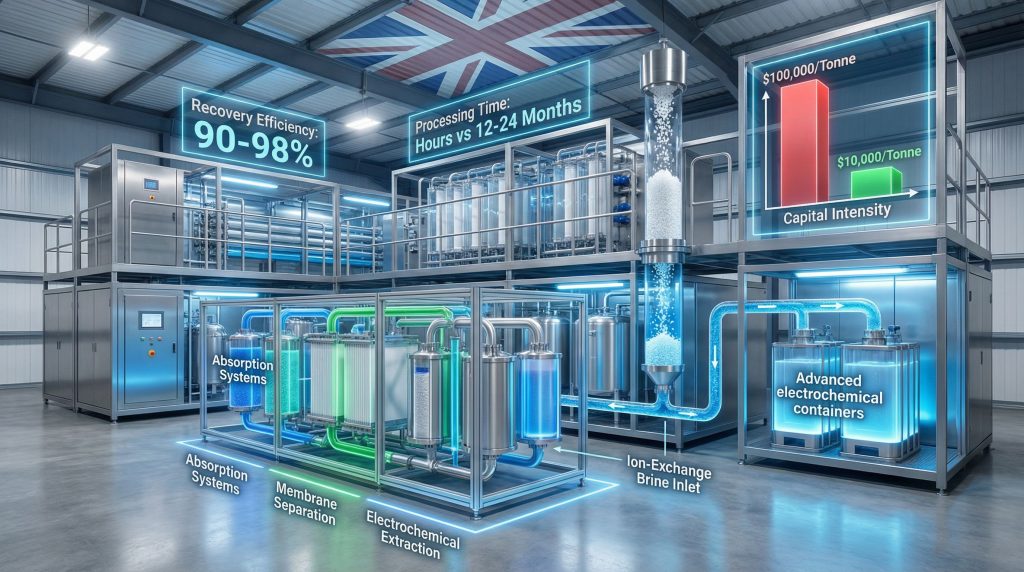
Direct lithium extraction in the UK represents a fundamental departure from conventional evaporation pond methodologies that have dominated global production for decades. Where traditional approaches require 12 to 24 months of evaporation cycles, modern DLE systems compress extraction timelines to hours or days, dramatically altering project economics and capital deployment strategies.
Three primary technological pathways have emerged as commercially viable options for UK operations:
• Absorption-based systems utilising selective materials for targeted lithium recovery
• Membrane separation processes employing physical barriers for enhanced selectivity
• Electrochemical extraction routes enabling direct conversion to final products
Each methodology addresses distinct brine chemistry challenges while optimising recovery efficiency and environmental impact profiles. The selection criteria depend heavily on site-specific geological conditions and downstream processing requirements that vary significantly across UK formations. Furthermore, these lithium industry innovations continue to evolve as operators seek competitive advantages.
Technical Integration Challenges Driving Project Delays
The most significant obstacle facing direct lithium extraction in the UK stems not from extraction technology limitations but from flowsheet integration complexity. According to industry analysis from the UK Direct Lithium Extraction Summit, pilot-scale failures predominantly result from poor integration between pre-treatment, extraction, and polishing stages rather than weak individual component performance.
Most technical failures occur because developers combine DLE packages that were never designed for unified operation, creating systematic incompatibilities that emerge only during integrated testing phases.
Critical risk factors requiring comprehensive characterisation include:
• Silica precipitation potential across varying temperature and pH conditions
• Scaling formation tendencies on membrane and extraction equipment surfaces
• Membrane fouling risks specific to individual brine compositions
Early-stage sampling and bench-scale testing prove essential for identifying these failure modes before system design finalisation. Elena Gil Aunon from Worley emphasises that thorough brine characterisation prevents downstream equipment failures in both DLE units and post-extraction polishing systems, potentially saving millions in redesign costs. Additionally, these challenges mirror broader mining innovation trends affecting various extraction technologies.
Comparative Technology Performance Analysis
| Technology Type | Water Usage | Energy Requirements | Chemistry Sensitivity | Recovery Efficiency |
|---|---|---|---|---|
| Absorption Systems | High | Moderate-High | Medium | 85-95% |
| Membrane Systems | Low-Medium | Low-Medium | High | 90-98% |
| Electrochemical | Very Low | Low | Low | 92-99% |
Despite superior performance characteristics in membrane and electrochemical systems, absorption technologies currently dominate commercial deployments due to established operational experience and proven scalability. However, performance degradation occurs when brine chemistry shifts beyond design parameters, driving increased industry interest in alternatives offering greater operational stability.
Daniel Parr from IDTechEx identifies absorption system limitations centring on water consumption intensity and energy demands, coupled with performance variability across different brine chemistries. This has accelerated commercial interest in membrane-based and electrochemical alternatives, though neither will perform reliably without rigorous pre-treatment protocols.
When big ASX news breaks, our subscribers know first
Capital Efficiency Crisis in UK Project Development
A critical market dysfunction has emerged where upstream developers pursue comprehensive vertical integration, creating capital intensity approaching $100,000 per tonne compared to global averages of approximately $10,000 per tonne. Gemma Cooper from Tees Valley Lithium identifies this ten-fold cost multiplication as stemming from attempts to concentrate extraction risk, first-stage refining complexity, and OEM qualification requirements within single project structures.
The Split-Model Solution Framework
An alternative bifurcated approach separates upstream technical-grade carbonate production from specialised refining operations, fundamentally reducing individual project risk profiles and development timelines. This model enables upstream firms to focus exclusively on extraction optimisation while dedicated refiners handle final product specifications and customer qualification processes.
Key advantages of the split model include:
- Risk distribution across specialised operators
- Timeline compression through focused development scope
- Capital efficiency via reduced project complexity
- Market flexibility enabling multiple feedstock sources
Qualification processes can compress to approximately six months when product volumes and specifications achieve stability, contradicting industry assumptions about multi-year approval requirements.
Tees Valley Lithium has successfully implemented this approach by securing trader feedstock arrangements and early UK supply partnerships, providing refinery flexibility while enabling upstream developers to exit after achieving technical-grade production capabilities. Consequently, this approach aligns with emerging battery-grade lithium refining trends across global markets.
Investment Risk Perception Versus Technical Reality
Stewart Dickson from Weardale Lithium highlights a fundamental disconnect between investor risk perception and actual technical performance. Despite strong extraction workstream performance in pilot operations, investors consistently focus on brine reinjection stages, treating subsurface injection as the primary project risk factor.
This mismatch creates a development dilemma between two competing strategies:
• Compressed engineering schedules to meet funding windows, accepting downstream redesign risk
• Conservative development pacing to validate flowsheet reliability, risking missed funding opportunities
The situation contradicts traditional mining industry norms, as lithium projects carry significantly heavier front-end metallurgical requirements than gold or copper operations yet face investor timeline pressures that conventional mining projects do not experience. Furthermore, these dynamics reflect broader lithium market dynamics affecting global investment decisions.
Emerging Technology Pathways for UK Applications
Container-Based Electrochemical Systems
ElectraLith's container-based electrochemical system represents a paradigm shift in processing simplification, eliminating most water and reagent requirements while delivering lithium hydroxide directly. Charlie McGill notes that when modelled on tested brine compositions, this approach positions itself at the lower end of industry cost curves.
Upcoming pilot deployments scheduled across Western Australia, South America, and UK locations will validate process simplification potential and scalability across diverse geological conditions. The technology's low chemistry sensitivity profile makes it particularly attractive for complex brine compositions that challenge conventional approaches.
Advanced Membrane Technology Development
Selective membrane systems address traditional absorption technology limitations around water consumption and energy intensity while providing improved performance stability across varying brine chemistries. However, reliable operation requires comprehensive pre-treatment systems and thorough sampling protocols to prevent membrane fouling and performance degradation.
Recent advances in membrane selectivity and durability have positioned these systems as viable alternatives for UK applications, particularly where water availability constraints limit absorption system deployment. For instance, the University of Manchester spinoff has successfully commercialised advanced DLE technology specifically for UK conditions.
Regulatory Framework Impact on Development Timelines
Despite the UK and EU occupying the lowest formal risk brackets for mining investment, capital flows more readily toward regions with perceived higher political instability. This mismatch between actual and perceived risk creates unique funding challenges for European DLE projects despite superior regulatory frameworks and infrastructure access.
Local resistance adds development timeline extensions, though public engagement challenges have historically influenced project pacing across European mining operations. These factors emphasise the importance of clear, early flowsheet demonstration at pilot scale to build stakeholder confidence and regulatory approval momentum.
However, recent developments show progress, as Northern England partnerships have delivered the UK's first commercial DLE facilities, demonstrating regulatory pathway viability.
Production Scaling Pathways for Domestic Supply
Current direct lithium extraction in the UK initiatives target initial production outputs ranging from 100 to 1,500 tonnes annually, with expansion plans reaching 10,000 to 20,000 tonnes within a decade. These capacity targets align with domestic gigafactory supply requirements while reducing import dependency for critical battery materials.
Integration with Renewable Energy Systems
Many UK projects combine DLE operations with geothermal energy generation, creating integrated systems that provide both lithium production and renewable power output. This dual-purpose approach improves project economics while supporting national sustainability objectives and energy security requirements.
The synergy between geothermal resources and lithium-bearing brines offers UK projects unique competitive advantages compared to conventional extraction operations that rely entirely on external power sources. In addition, this approach supports broader battery metals investment strategies focusing on sustainable supply chains.
Market Positioning Strategies for Commercial Viability
Successful direct lithium extraction in the UK projects must achieve capital intensity closer to global averages through simplified flowsheets, proven technology integration, and disciplined engineering approaches. Early-stage technical validation reduces downstream redesign risks and associated cost overruns that have plagued numerous international developments.
Projects positioned to supply technical-grade carbonates to specialised refiners may achieve faster development timelines and reduced capital requirements compared to fully integrated operations targeting battery-grade production from project inception.
Demonstration-Scale Validation Requirements
Clear flowsheet demonstration at pilot scale proves essential for investor confidence and regulatory approval, particularly given the complexity of integrating multiple processing stages. Comprehensive brine characterisation and bench-scale testing prevent technical failures and enable more accurate cost estimation for full-scale deployment.
Modular processing approaches enable staged capacity expansion while reducing initial capital requirements and technical risk. This architecture supports operational learning and process optimisation before committing to full-scale production investments.
The next major ASX story will hit our subscribers first
Future Market Dynamics and Investment Considerations
The UK direct lithium extraction sector faces a critical juncture where technology selection, capital efficiency, and market positioning will determine long-term commercial viability. Projects that successfully navigate flowsheet integration challenges while maintaining capital discipline are positioned to capture growing domestic demand from expanding battery manufacturing capacity.
Investment success factors include:
• Disciplined technology selection based on site-specific brine chemistry
• Early-stage comprehensive sampling and characterisation protocols
• Modular system architecture enabling staged expansion
• Clear market positioning within the technical-grade to battery-grade value chain
• Effective stakeholder engagement and regulatory compliance strategies
The convergence of technological advancement, regulatory support, and market demand creates unprecedented opportunities for UK direct lithium extraction development, provided projects can overcome historical integration challenges and achieve global cost competitiveness.
Disclaimer: This analysis contains forward-looking statements and market projections that involve inherent risks and uncertainties. Actual results may differ materially from those projected. Investment decisions should be based on comprehensive due diligence and professional advice.
Looking to Capitalise on the UK's Lithium Extraction Revolution?
Discovery Alert's proprietary Discovery IQ model delivers real-time alerts on significant lithium and battery metals discoveries across the ASX, instantly empowering subscribers to identify actionable opportunities ahead of the broader market. Begin your 14-day free trial today and secure your market-leading advantage in the rapidly evolving battery metals sector.