June 6, 2026
Understanding Direct Reduction Grade Iron Ore: A Technical Foundation for Modern Steel Production
The metallurgical industry stands at a crossroads where traditional iron ore processing methods intersect with evolving technological demands for higher-purity feedstock materials. This convergence has elevated the importance of direct reduction grade iron ore that can meet stringent chemical and physical specifications required by advanced reduction technologies. Understanding these materials requires examining their unique properties, processing requirements, and applications within the broader context of industrial iron and steel production.
Chemical Composition Requirements for DR-Grade Materials
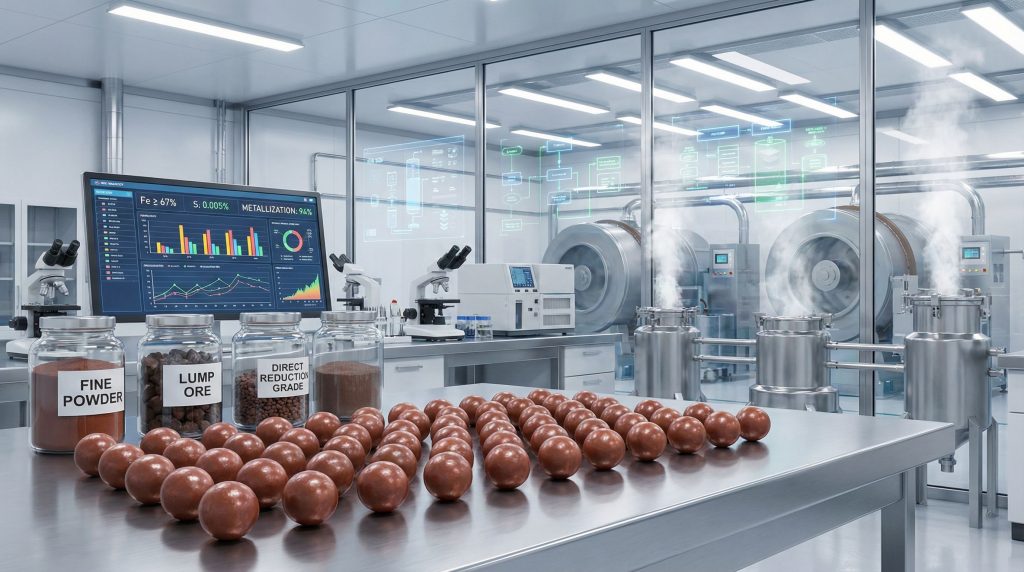
Direct reduction grade iron ore operates under fundamentally different metallurgical principles compared to conventional blast furnace feedstock. The critical threshold begins with iron content specifications of 67% Fe minimum for pellets, establishing the baseline for solid-state reduction compatibility. This elevated iron content requirement stems from the need to minimise gangue mineral interference during gas-solid reactions in direct reduction reactors.
Gangue mineral limitations impose strict controls on silicon dioxide (SiO₂) and alumina (Al₂O₃) content, typically maintaining SiO₂ below 3-4% and Al₂O₃ under 1-2% in premium grade materials. These specifications ensure optimal reduction kinetics while preventing excessive slag formation that could compromise reactor efficiency.
| Specification | DR-Grade Pellets | Blast Furnace Grade |
|---|---|---|
| Iron Content (Fe) | 67%+ | 65-66% typically acceptable |
| Gangue Limitations | Strict (<20% typical) | Higher tolerance (25-30%+) |
| Impurity Control | Tight (SiO₂, Al₂O₃ controlled) | Moderate tolerance |
| Physical Form | Uniform pellets (8-16mm) | Mix of pellets and lump |
| Porosity Requirements | High porosity (20-25%) | Lower porosity acceptable |
| Reduction Pathway | Solid-state gas reduction | Liquid slag formation in hearth |
The metallurgical properties that enable solid-state reduction distinguish DR-grade materials through their capacity to maintain structural integrity while facilitating gas penetration. High porosity requirements of 20-25% allow reducing gases to access internal iron oxide surfaces, accelerating conversion rates while maintaining pellet strength during handling and transport.
Physical Form Categories and Applications
Physical specifications for direct reduction grade iron ore extend beyond chemical composition to encompass mechanical properties critical for reactor performance. Cold crushing strength (CCS) requirements typically exceed 300 N/pellet according to ISO 13930 testing standards, ensuring pellets can withstand mechanical stresses during charging and reduction cycles.
Tumble index specifications maintain pellet integrity during transport and handling, with requirements typically exceeding 90% retention as measured by ISO 11257 standards. Size distribution parameters focus on the 8-16mm range for optimal gas flow dynamics in shaft furnace operations.
Furthermore, lump ore characteristics require different considerations, emphasising size distribution uniformity and reduced fines generation. Fine ore limitations reflect the operational challenges of maintaining consistent gas flow patterns in direct reduction reactors, where excessive fines can cause pressure drop increases and channeling effects.
When big ASX news breaks, our subscribers know first
Advanced Direct Reduction Technologies and Iron Ore Transformation
Gas-Based Direct Reduction Processes
Shaft furnace technologies represent the predominant pathway for converting direct reduction grade iron ore into metallic iron through controlled gas-solid reactions. The counter-current flow principle enables progressive reduction as pellets descend through temperature zones ranging from 400-500°C in upper regions to 800-1,050°C in lower sections.
Midrex technology employs external reforming of natural gas to generate reducing gas compositions rich in hydrogen and carbon monoxide. The process achieves metallisation rates exceeding 90% through precise control of gas composition, temperature profiles, and residence time distributions.
HyL processes utilise alternative gas generation methods, including direct reduction using syngas from coal gasification or biomass sources. Modern HyL reactors demonstrate flexibility in accommodating hydrogen-rich feeds, positioning the technology for transition toward lower-carbon reduction pathways.
Temperature profiles and gas flow dynamics require careful optimisation to prevent operational issues such as pellet clustering, channeling, or incomplete reduction. The reducing gas mixture typically contains 55-60% hydrogen and 35-40% carbon monoxide, with nitrogen and carbon dioxide as secondary components.
Coal-Based Direct Reduction Methods
Rotary kiln operations utilise intimate mixing of coal with direct reduction grade iron ore to achieve reduction through combustion-generated carbon monoxide. Operating temperatures exceeding 1,100°C enable reduction of lower-grade pellets through enhanced thermal driving forces, though energy efficiency remains lower than gas-based alternatives.
Coal requirements focus on volatile matter content, ash composition, and sulphur levels to optimise reduction chemistry while minimising impurity transfer to the final product. In addition, typical coal consumption rates range from 600-800 kg per tonne of direct reduced iron, depending on coal quality and operational parameters.
Fluidised bed processes offer advantages for fine ore utilisation, employing turbulent gas-solid contact to achieve rapid reduction rates. These systems require specialised pellet properties to prevent agglomeration and maintain fluidisation characteristics throughout the reduction cycle.
Emerging Hydrogen-Based Pathways
Pure hydrogen reduction chemistry operates through the fundamental reaction: Fe₂O₃ + 3H₂ → 2Fe + 3H₂O, producing only water vapour as a byproduct. This process demonstrates how direct reduced iron can be produced using cleaner technologies. Operating temperatures of 700-800°C enable efficient reduction while minimising energy consumption compared to traditional high-temperature processes.
Equipment modifications for hydrogen compatibility include specialised cooling systems for water vapour condensation, alternative refractory materials resistant to hydrogen embrittlement, and enhanced safety systems for hydrogen handling. These technical requirements substantially increase capital investment needs for conversion projects.
Direct reduction grade iron ore specifications become even more critical in hydrogen-only systems, as impurities cannot be effectively removed through slag formation. The elevated purity requirements justify premium pricing for hydrogen-compatible feedstock materials.
Global Supply Dynamics for DR-Grade Iron Ore Deposits
Major Production Regions and Deposit Characteristics
Global supply distribution reflects the limited number of deposits capable of producing direct reduction grade iron ore without extensive beneficiation. Brazil dominates seaborne supply through operations in Minas Gerais state, where high-grade hematite deposits enable direct pellet production with minimal upgrading requirements.
The Simandou project in Guinea represents a significant addition to global supply capacity, with Rio Tinto's development targeting high-grade hematite ore suitable for DR-grade pellet production. However, project timelines extending 5-7 years from final investment decision to production highlight the extended lead times characteristic of major iron ore developments.
Australian iron ore leadership continues through operations in Western Australia that contribute through beneficiated magnetite and hematite production, though transportation distances to key consuming regions influence delivered cost structures. Indian production from Odisha and Karnataka states focuses primarily on domestic consumption, with limited export availability.
Quality Assessment and Beneficiation Requirements
Reducibility testing protocols employ standardised procedures to evaluate reduction degree (RD) performance, typically targeting >85% reduction under controlled laboratory conditions. ASTM C1559 methodology provides comparative assessment of different ore sources under simulated direct reduction conditions.
Swelling and clustering behaviour evaluation identifies potential operational issues in shaft furnace operations. Excessive volume expansion during reduction can cause bridging and gas flow disruption, making swelling index measurements critical for feedstock qualification.
Thermal stability measurements assess pellet integrity under repeated heating and cooling cycles, simulating operational stresses in direct reduction reactors. These tests identify potential decrepitation or structural failure modes that could compromise reactor performance.
Operational Challenges in DR-Grade Iron Ore Production
Beneficiation Process Complexities
Magnetic separation technologies for hematite concentration face unique challenges due to the weakly magnetic nature of many hematite ores. High-intensity magnetic separators operating at field strengths exceeding 20,000 gauss enable effective separation, though energy consumption and equipment costs remain substantial.
Flotation techniques for gangue removal require precise control of pH, collector dosages, and flotation cell design to achieve selective separation. Reverse flotation processes target silica removal while maintaining iron oxide recovery rates above 95% to optimise plant economics.
Pelletising operations demand careful control of binder systems, typically utilising bentonite additions of 0.5-1.0% to achieve adequate green pellet strength. Firing parameters in pelletising furnaces require precise temperature control between 1,250-1,350°C to develop required metallurgical properties while avoiding over-firing that reduces porosity.
Quality Control and Process Optimisation
Real-time monitoring systems employ X-ray fluorescence (XRF) analysers and laser diffraction instruments to track chemical composition and particle size distribution throughout the beneficiation process. Automated sampling systems ensure representative quality assessment while minimising manual intervention requirements.
Statistical process control methodologies identify sources of variation in pellet quality, enabling optimisation of operating parameters to maintain consistency within specification limits. Control charts for key parameters such as iron content, crushing strength, and tumble index provide early warning of process deviations.
Advanced process control systems integrate multiple measurement points to optimise beneficiation circuit performance through real-time adjustment of equipment settings. These systems demonstrate capability to reduce quality variation by 15-25% compared to manual control methods.
Market Dynamics and Investment Considerations for DR-Grade Materials
Capital Investment Requirements and Financial Challenges
Pelletising plant construction requires substantial capital commitments, with modern facilities requiring $500-800 million investment for 5-7 million tonne annual capacity installations. Engineering and construction timelines extend over 5-7 year periods, creating exposure to commodity price volatility throughout development phases.
Recent market dynamics demonstrate the challenge facing investors, with DR-grade pellet premiums declining from $95 per tonne to $38 per tonne over a three-year period. This premium compression reduces project economics while the fundamental requirement for DR-grade materials continues growing under decarbonisation scenarios.
Without assurance of durable premiums, final investment decisions face indefinite delays despite long-term demand projections. Furthermore, the International Energy Agency's Net Zero Emissions pathway suggests demand for direct reduction grade iron ore could increase 5 to 10-fold by 2050, yet current supply represents less than 5% of global seaborne tonnage.
Price Premium Structures and Market Mechanisms
DR-grade pellet pricing mechanisms operate through quality-based premium calculations that reflect specific metallurgical advantages over standard blast furnace pellets. Premium structures typically incorporate iron content differentials, impurity penalties, and physical property bonuses to establish final pricing.
Long-term contract structures provide greater price stability compared to spot market transactions, though recent market conditions have pressured buyers toward shorter-term arrangements. Offtake agreements linking steelmakers and miners offer risk-sharing mechanisms that can support project financing while guaranteeing supply security.
Market development requires transparent benchmarks specifically designed for direct reduction grade iron ore products. Regional price indices for key consuming areas such as the Middle East, North Africa, and Asia could provide enhanced price discovery mechanisms for this specialised market segment.
Integration with Steel Decarbonisation Strategies
Electric Arc Furnace Compatibility and Performance
Direct reduced iron charging practices in electric arc furnaces enable scrap substitution ratios of up to 100%, providing flexibility in raw material sourcing while maintaining steel quality standards. DRI charging rates typically range from 15-30% of total metallic charge, though specialised EAF designs can accommodate higher proportions.
Melting efficiency improvements result from the higher metallisation content of DRI compared to iron ore pellets, reducing energy consumption by 50-100 kWh per tonne of steel produced. These energy savings contribute to overall decarbonisation objectives while improving operational economics.
Quality impacts from direct reduction grade iron ore utilisation include reduced residual element content in finished steel products, enabling production of higher-grade steel specifications. Phosphorus and sulphur levels remain consistently lower compared to scrap-based steelmaking routes.
Carbon Footprint Reduction Pathways
Emissions comparison between direct reduction-electric arc furnace routes and conventional blast furnace-basic oxygen furnace systems demonstrates significant carbon intensity reductions. Gas-based DR-EAF systems typically achieve 20-30% lower CO₂ emissions per tonne of steel, while hydrogen-based systems offer potential for 80-95% reduction.
Life cycle assessment considerations encompass upstream emissions from iron ore mining and processing, transportation impacts, and electricity grid carbon intensity for EAF operations. However, regional variations in electricity generation sources significantly influence overall carbon footprints of DR-EAF steelmaking routes.
Hydrogen-based reduction environmental benefits depend critically on hydrogen production methods, with green hydrogen from renewable electricity offering maximum decarbonisation potential. Blue hydrogen from natural gas with carbon capture provides intermediate emission reductions while supporting transition to fully renewable hydrogen supply.
The next major ASX story will hit our subscribers first
Future Outlook for Direct Reduction Grade Iron Ore Markets
Capacity Expansion Projects and Technology Development
Planned pelletising plant developments focus on regions with access to high-grade iron ore deposits and proximity to growing direct reduction capacity. Major expansions in Brazil, West Africa, and the Middle East reflect strategic positioning for serving hydrogen-based DRI markets.
Technology upgrades at existing facilities emphasise improvements in energy efficiency, automation levels, and product quality consistency. Advanced process control systems, alternative binder technologies, and enhanced firing systems contribute to operational optimisation while reducing environmental footprints.
Regional supply-demand balance projections indicate potential shortfalls in direct reduction grade iron ore availability relative to planned DRI capacity additions. Europe and the Middle East face particular supply challenges given limited domestic high-grade ore resources and dependence on imported feedstock.
Innovation Trends and Technology Evolution
Advanced reduction reactor designs focus on improved gas utilisation efficiency, enhanced heat recovery systems, and increased throughput capacity. Computational fluid dynamics modelling enables optimisation of gas flow patterns and temperature distributions within reactor vessels.
Mining industry innovation drives alternative reducing agent research that explores biomass-derived syngas, waste-based carbon sources, and enhanced hydrogen production technologies. These developments could expand feedstock flexibility while maintaining environmental benefits of direct reduction processes.
Process integration concepts link hydrogen production, iron ore reduction, and steel production within integrated facilities to optimise energy utilisation and minimise emissions. For instance, DR-grade iron ore pellets demonstrate how these approaches require substantial capital investment but offer potential for significant operational cost reductions.
Technical Specifications and Quality Requirements
Critical Parameters for DR-Grade Materials
Direct reduction grade iron ore specifications encompass multiple interdependent parameters that collectively determine suitability for direct reduction applications. Iron content requirements of 67%+ Fe represent the minimum threshold, with premium grades achieving 68-69% Fe through advanced beneficiation.
| Parameter | DR-Grade Specification | Test Method |
|---|---|---|
| Iron Content (Fe) | 67% minimum | ISO 9035 |
| Silica (SiO₂) | 3-4% maximum | X-ray fluorescence |
| Alumina (Al₂O₃) | 1-2% maximum | X-ray fluorescence |
| Cold Crushing Strength | >300 N/pellet | ISO 13930 |
| Tumble Index | >90% retention | ISO 11257 |
| Reduction Degree | >85% (standard test) | ASTM C1559 |
| Swelling Index | <10% volume increase | ISO 13933 |
Process compatibility requirements extend beyond chemical composition to include physical and metallurgical properties that ensure reliable reactor performance. Porosity specifications of 20-25% enable gas penetration while maintaining pellet structural integrity throughout reduction cycles.
Supply Chain Considerations and Market Development
Transportation infrastructure requirements for direct reduction grade iron ore reflect the specialised handling needs of high-value pellets. Covered storage facilities prevent moisture absorption and quality degradation during storage and transfer operations.
Regional market development depends on establishing reliable supply chains linking pellet producers with DRI operators across global trade routes. Port facilities require specialised equipment for pellet handling while maintaining quality specifications throughout logistics chains.
Nevertheless, iron ore price trends continue to influence market transparency through standardised pricing mechanisms and quality certification programmes that could accelerate adoption of DR-grade materials while reducing transaction costs for buyers and sellers. Industry standardisation efforts focus on harmonising testing procedures and specification requirements across regional markets.
Industry Transformation and Strategic Implications
The evolution toward direct reduction grade iron ore as a critical enabler of steel industry decarbonisation reflects broader transformation patterns within global commodity markets. Technical specifications that once represented niche requirements have become strategic necessities for companies pursuing low-carbon manufacturing strategies.
Understanding these materials requires integration of metallurgical science, process engineering, and market dynamics to appreciate their role in enabling sustainable steel production. Furthermore, BHP's iron ore strategy exemplifies how investment decisions spanning multiple years must account for evolving technology pathways, regulatory frameworks, and competitive positioning within an industry undergoing fundamental change.
The technical foundation provided by high-quality iron ore materials supports the broader objective of industrial decarbonisation while maintaining the performance standards required for modern steel applications. Success in this transition depends on continued innovation in processing technologies, supply chain optimisation, and market development initiatives that can support the scale of transformation required for global climate objectives.
Consequently, the largest iron ore mines 2025 will play a crucial role in meeting this growing demand for specialised materials that enable cleaner steel production pathways.
Ready to Capitalise on the Growing DR-Grade Iron Ore Market?
Discovery Alert's proprietary Discovery IQ model delivers real-time notifications on significant iron ore discoveries across the ASX, empowering investors to identify actionable opportunities in this specialised market before broader market recognition. Explore Discovery Alert's dedicated discoveries page to understand how historic mineral discoveries have generated substantial returns, then begin your 30-day free trial to position yourself ahead of the evolving direct reduction iron ore sector.