
July 15, 2026
When Trade Architecture Matters More Than Trade Volume
Global commodity markets have long been shaped not just by what a country produces, but by how it connects those resources to the world. For decades, the structural reality for many African commodity producers has been a reliance on intermediary layers, opaque pricing mechanisms, and limited access to sophisticated trade finance. The emergence of dedicated bilateral trade corridors between African exchanges and global free-trade zone ecosystems signals something more fundamental than a diplomatic handshake. It represents a rearchitecting of how African resource wealth reaches institutional capital.
The formalisation of the DMCC Botswana Stock Exchange MoU in mid-2026 is one of the clearest expressions of this shift to date. Signed following the 41st World Diamond Congress in Singapore, the agreement between DMCC (Dubai Multi Commodities Centre) and the BSE Group, operator of the Botswana Mercantile Exchange (BMX), creates what both parties describe as Africa's first sister-hub trading corridor between Dubai and Gaborone. Understanding what this means in practice requires looking well beyond the headline announcement.
When big ASX news breaks, our subscribers know first
What Is DMCC and Why Does Its Ecosystem Matter to African Producers?
DMCC is not merely a trade body or a regulatory authority. It operates as an integrated free-trade zone headquartered in Dubai that encompasses physical commodity trading infrastructure, financial services, digital asset frameworks, and logistics connectivity. With over 23,000 member companies spanning more than 170 countries, DMCC functions as a multi-commodity ecosystem rather than a single-sector exchange.
For commodity-producing nations, this distinction is critical. Accessing DMCC is not simply listing a product on an exchange. It means connecting to a network of buyers, financiers, vault operators, trade finance providers, and increasingly, digital asset platforms operating within a single regulatory and commercial environment. This ecosystem depth is precisely what makes the DMCC Botswana Stock Exchange MoU structurally significant for Botswana's commodity exports.
The Botswana Mercantile Exchange: A New Infrastructure Layer for an Old Resource Economy
The BSE Group, as the operator of the BMX, is positioning Botswana's commodity sector for a structural upgrade. While the country has long been one of the world's leading diamond producers by value, its exchange infrastructure for commodity trading has historically lagged behind the sophistication of its resource base. The BMX is designed to close that gap by providing a formalised, structured trading venue for physical commodities originating in Botswana.
The Okavango Diamond Company (ODC), Botswana's state-owned rough diamond marketing entity, sits at the centre of this architecture. ODC was established in 2012 following Botswana's renegotiation of its diamond sales agreement with De Beers, giving the country direct control over a portion of its rough diamond production for independent marketing. This institutional backstory matters because it frames the DMCC partnership not as an external initiative imposed on Botswana, but as an evolution of a deliberate, decade-long strategy to capture more value from the country's primary export.
Furthermore, the broader African mining finance trends context helps explain why this kind of institutional architecture is gaining momentum across the continent, as producers seek to reduce dependency on traditional intermediary structures.
A Clause-by-Clause Look at What the MoU Actually Covers
The agreement spans a notably broad set of operational and strategic pillars. Rather than a narrow commercial arrangement, it functions as a framework for integrating Botswana's commodity sector into a globally recognised trading ecosystem across multiple dimensions.
| Partnership Pillar | Mechanism | Expected Outcome |
|---|---|---|
| Market Access | Direct buyer-producer connectivity via DMCC ecosystem | Reduced intermediary layers for Botswana exporters |
| Trade Finance | DMCC FinX digital infrastructure | Broader institutional capital access |
| Vaulting and Logistics | BMX vault in Gaborone under DMCC Global Good Delivery Standard | Internationally certified storage for cross-border trade |
| Digital Assets | Tokenisation of physical commodity parcels as RWAs | New global institutional investment pathways |
| Islamic Finance | Shariah-compliant instruments alongside conventional financing | Access to Gulf Cooperation Council (GCC) capital pools |
| Diamond Trade | Coordinated tenders between Okavango Diamond Company and Dubai Diamond Exchange | Direct commercial link between Botswana production and Dubai buyers |
Each of these pillars carries distinct implications. The vaulting infrastructure component is particularly noteworthy. The BMX vault in Gaborone is targeted to become the inaugural facility certified under the DMCC Global Good Delivery Standard, a multi-commodity vault certification framework developed specifically to support cross-border trade transparency, commodity financing, and storage standards in emerging markets.
A DMCC-certified vault in Gaborone would represent a meaningful infrastructure upgrade, enabling internationally recognised storage standards that underpin trade finance, cross-border settlement, and institutional investor confidence in African commodity value chains.
Commodities Covered: Far Wider Than Diamonds
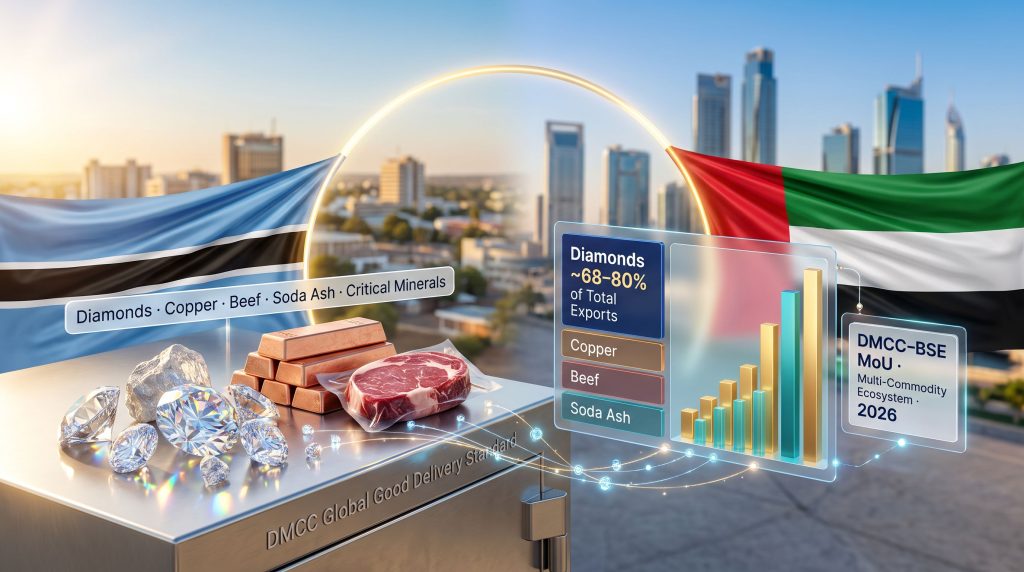
One of the less-reported aspects of the DMCC Botswana Stock Exchange MoU is the breadth of its commodity coverage. While diamonds naturally anchor the agreement given their dominance in Botswana's export profile, the partnership encompasses a genuinely diversified basket.
- Diamonds remain the primary anchor, with coordinated tenders between ODC and the Dubai Diamond Exchange expected to commence in late 2026
- Copper and critical minerals position Botswana within global energy transition supply chains, reflecting the rising critical minerals demand driven by the clean energy transition
- Beef and agricultural products extend the partnership beyond the extractive sector entirely
- Coal and soda ash address niche industrial commodity categories with specific logistics dependencies
This diversification is not incidental. It directly reflects Botswana's underlying policy imperative to reduce economic concentration risk. Diamonds currently account for an estimated 68 to 80 percent of total export value, a dependency that successive administrations have sought to address through deliberate structural reform.
Botswana's Export Dependency: The Numbers Behind the Strategy
Understanding the strategic urgency behind the DMCC Botswana Stock Exchange MoU requires a clear picture of Botswana's current export profile.
| Commodity Category | Estimated Share of Total Export Value | Key Destination Markets |
|---|---|---|
| Diamonds | ~68-80% of total exports | UAE, India, Belgium, USA |
| Copper and Nickel | Secondary mineral exports | China, Europe |
| Beef | Livestock sector export | UAE (accredited 2023), EU, regional markets |
| Soda Ash and Coal | Industrial minerals | Regional and Asian markets |
The UAE's existing role as a destination market for Botswana commodities, including diamonds and beef following a 2023 market accreditation, gives the DMCC partnership a commercial foundation that goes beyond aspiration. The Dubai Diamond Exchange already processes a significant share of global rough diamond trade, making it a natural partner for Botswana's direct marketing ambitions.
Botswana's Minerals and Energy Minister Bogolo Joy Kenewendo has indicated that the country's economic transformation agenda is focused not only on sustaining production volumes but on creating stronger market access, attracting investment, and advancing beneficiation across the value chain. The partnership with DMCC and the BSE is framed as part of the ecosystem needed to achieve these goals.
The next major ASX story will hit our subscribers first
Digital Infrastructure and the RWA Opportunity: A Less Understood Dimension
The tokenisation of physical commodity parcels as Real World Assets represents perhaps the most technically novel aspect of the DMCC Botswana Stock Exchange MoU, and also the least understood dimension among general market observers.
RWA tokenisation involves converting ownership rights to a physical commodity, such as a parcel of rough diamonds or a copper lot held in a certified vault, into a digital token that can be traded, financed, or invested in across digital asset platforms. DMCC's FinX infrastructure is designed to facilitate precisely this kind of transaction.
The practical implications are significant:
- Fractionalisation of large commodity parcels allows smaller institutional or even retail investors to gain exposure to physical commodities that would otherwise require substantial minimum commitments
- Settlement speed in tokenised transactions can be compressed from days to near-real-time, reducing counterparty risk
- Provenance tracking embedded within tokenised asset structures can support Kimberley Process compliance and ethical sourcing documentation for diamonds
- Islamic finance compatibility is enhanced when asset-backed digital instruments can be structured to meet Shariah screening criteria, unlocking Gulf Cooperation Council capital pools that conventional instruments may not reach
The intersection of Shariah-compliant financial structuring and tokenised commodity parcels represents an under-explored frontier in African commodity finance, with the GCC institutional capital base offering a meaningfully differentiated funding source compared to traditional Western trade finance channels.
The Diamond Sector Focus: Okavango, Dubai, and the 41st World Diamond Congress
The decision to sign the MoU in Singapore, at the conclusion of the 41st World Diamond Congress, is a deliberate signal about where Botswana's diamond sector ambitions are being positioned. The World Diamond Congress is the principal governance and policy forum for the global diamond industry, convening producers, manufacturers, traders, and regulatory bodies. Botswana's participation at that level, culminating in the formalisation of a commercial architecture with DMCC, places the country at the centre of industry governance rather than at its periphery.
The coordinated diamond tender mechanism linking ODC with the Dubai Diamond Exchange deserves specific attention. Unlike traditional tender processes where buyers travel to the producing country or a fixed trading centre, a coordinated bilateral tender structure creates a persistent commercial corridor between Botswana's production system and Dubai's buyer network. This reduces friction costs, increases buyer competition for Botswana's stones, and over time should support pricing outcomes for ODC.
The Luanda Accord and the Natural Diamond Council are also referenced within the partnership, reinforcing the industry standards dimension of the agreement. The Luanda Accord, adopted by African diamond-producing nations, promotes transparency, responsible governance, and value retention within producing countries. The Natural Diamond Council focuses on consumer demand stimulation for natural diamonds against the growing presence of lab-grown alternatives.
Comparing the 2026 MoU to the 2021 DMCC-ODC Agreement
This is not DMCC's first engagement with Botswana's diamond sector. A 2021 agreement between DMCC and the Okavango Diamond Company established a narrower commercial relationship focused on diamond auctions through the Dubai Diamond Exchange and Kimberley Process compliance alignment. The 2026 DMCC Botswana Stock Exchange MoU is categorically broader.
| Agreement | Year | Scope | Key Mechanism |
|---|---|---|---|
| DMCC and ODC | 2021 | Diamond-specific | Dubai Diamond Exchange auctions; Kimberley Process compliance |
| DMCC and BSE Group (BMX) | 2026 | Multi-commodity | Full ecosystem integration: finance, logistics, digital assets, vaulting |
The evolution from a single-commodity auction arrangement to a multi-pillar ecosystem integration reflects both the maturation of the relationship and a deliberate escalation of Botswana's ambitions within the global commodity trading architecture. In addition, this progression mirrors wider shifts in metals and mining geopolitics, where producing nations are increasingly asserting greater control over how their resources are priced and distributed globally.
Risks and Structural Challenges That Investors Should Monitor
No MoU, however well-structured, automatically translates into operational outcomes. Several risk dimensions warrant careful monitoring:
-
Execution risk remains the primary concern. The gap between memoranda of understanding and functioning operational infrastructure in emerging markets has historically been wide. Vault certification, digital infrastructure deployment, and tender coordination all require sustained institutional commitment from both parties.
-
Regulatory alignment between Botswana's financial markets regulatory framework and DMCC's standards will require active harmonisation. Tokenisation and RWA frameworks in particular sit in evolving regulatory territory across most jurisdictions.
-
Commodity price volatility affects the commercial viability of the partnership's more ambitious elements. Diamond market conditions in 2025 and early 2026 have been challenging, with lab-grown diamond competition compressing prices in certain categories. However, understanding commodities trading opportunities within volatile environments can help investors identify where structural value remains despite near-term headwinds.
-
Value distribution remains a structural question. Ensuring that the infrastructure and financial gains from greater market access translate into measurable benefits for Botswana's producers and communities, rather than primarily accruing to intermediaries, is the enduring policy challenge underlying every diversification initiative.
What the Next 12 to 24 Months Will Reveal
Three specific developments will determine whether the DMCC Botswana Stock Exchange MoU delivers on its structural promise. First, whether the BMX vault achieves DMCC Global Good Delivery Standard certification on schedule. Second, whether the coordinated ODC and Dubai Diamond Exchange tenders expected in late 2026 generate meaningfully improved price outcomes for Botswana's rough diamond production. Third, whether the digital asset and Islamic finance components move from framework agreement into live transaction structures.
For investors, producers, and policymakers tracking African commodity market development, the Dubai-Gaborone corridor is one of the most substantive structural experiments underway. Furthermore, the role of mining private equity in supporting such corridor infrastructure is increasingly relevant, as institutional capital seeks structured exposure to African resource assets through credible frameworks. Its success or failure will inform whether the sister-hub model can be replicated across other Sub-Saharan African commodity producers seeking to bypass traditional intermediary layers and connect directly to global institutional capital.
Frequently Asked Questions: DMCC Botswana Stock Exchange MoU
What is the DMCC Botswana Stock Exchange MoU?
A memorandum of understanding signed between DMCC and the Botswana Stock Exchange Group, operator of the Botswana Mercantile Exchange, to connect Botswana's commodity producers with Dubai's global trade, finance, and logistics ecosystem.
Which commodities are included in the DMCC BSE partnership?
The agreement covers diamonds, copper, critical minerals, coal, soda ash, beef, and broader agricultural products originating from Botswana.
What is the DMCC Global Good Delivery Standard?
A multi-commodity vault certification framework developed by DMCC to support cross-border trade transparency, commodity financing, and storage standards in emerging markets. The BMX vault in Gaborone is targeted as its inaugural certified facility.
When are the first commercial diamond tenders expected?
The first coordinated diamond tenders between Botswana's Okavango Diamond Company and the Dubai Diamond Exchange are anticipated in late 2026.
How does RWA tokenisation apply to physical commodities?
It converts ownership rights to a physical commodity held in a certified vault into a tradeable digital token, enabling fractional ownership, faster settlement, and access to a broader global investor base including Islamic finance markets.
How does the 2026 MoU differ from the 2021 DMCC-ODC agreement?
The 2021 agreement was narrowly focused on diamond auctions and Kimberley Process compliance. The 2026 MoU is substantially broader, encompassing multi-commodity trade, digital financial infrastructure, vaulting certification, Islamic finance, and institutional capital access.
Readers seeking broader context on African commodity market developments and trade infrastructure can find ongoing sector coverage at engineeringnews.co.za.
This article contains forward-looking statements and analysis based on publicly available information. It does not constitute financial advice. Outcomes described are subject to execution risk, regulatory developments, and market conditions.
Want to Track the Next Major Mineral Discovery Before the Broader Market Does?
Discovery Alert's proprietary Discovery IQ model delivers real-time alerts on significant ASX mineral discoveries, transforming complex resource data into actionable investment insights for both short-term traders and long-term investors — begin your 14-day free trial today and see why historic discoveries have generated extraordinary returns.