
May 21, 2026
The United States stands at a critical juncture in energy technology evolution, where artificial intelligence computing demands and advanced manufacturing requirements are creating unprecedented electricity consumption patterns. Traditional energy infrastructure faces mounting pressure to deliver reliable, carbon-free power while maintaining grid stability and economic competitiveness. This convergence of technological advancement and energy security trends imperatives has catalysed a fundamental shift in nuclear energy policy, moving from decades of regulatory caution toward accelerated deployment strategies that prioritise speed and innovation over conventional approval pathways.
The emergence of small modular reactors and advanced nuclear technologies represents more than incremental improvement—it signals a strategic repositioning of American energy independence and technological leadership. Private sector companies are now assuming financial risks previously considered too substantial for commercial ventures, while regulatory frameworks are adapting to accommodate compressed development timelines that would have been inconceivable under traditional nuclear project management approaches.
This transformation is occurring against the backdrop of intensifying global competition in nuclear technology exports, where nations that successfully demonstrate rapid deployment capabilities gain significant advantages in international markets. The ability to move from concept to operational reactor within compressed timeframes has become a critical differentiator in establishing nuclear technology standards and supply chain dominance worldwide.
What Is the DOE Nuclear Reactor Pilot Program and Why Does It Matter?
The doe nuclear reactor pilot program represents a fundamental departure from traditional nuclear development approaches, establishing a streamlined authorisation pathway that separates construction approval from operational licensing. This innovative framework allows participating companies to begin site preparation and reactor construction while fuel loading permissions remain under separate regulatory review, effectively reducing the sequential dependencies that have historically extended nuclear project timelines.
Program Foundation and Strategic Objectives
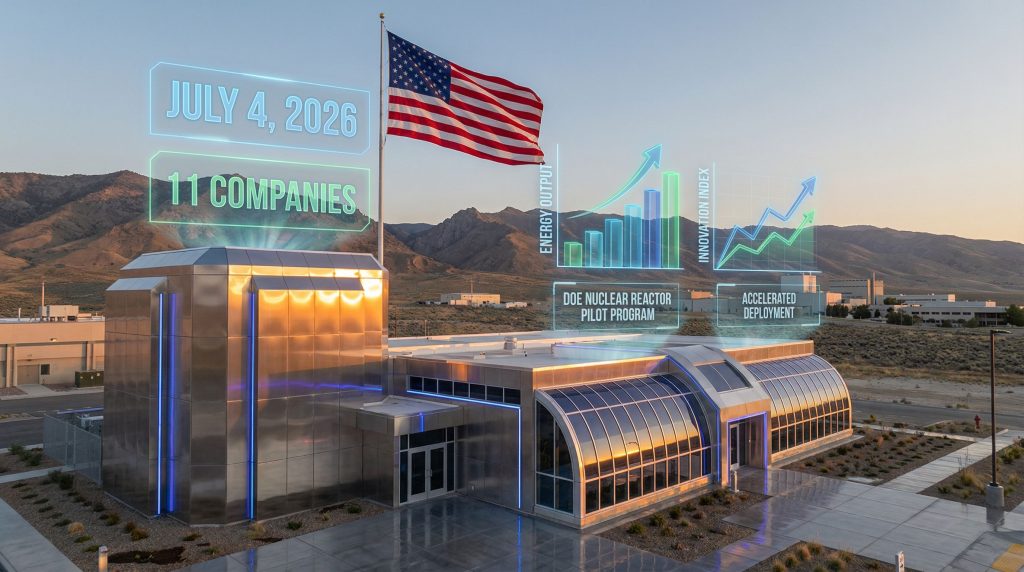
The pilot program operates under executive orders signed approximately ten months prior to March 2026, creating policy frameworks designed to accelerate advanced nuclear technology deployment. The initiative received applications from 11 companies, with DOE officials confirming that at least three to four reactors demonstrate technical readiness to achieve criticality by the July 4, 2026 deadline.
According to Theodore Garrish, DOE Assistant Secretary for Nuclear Energy, the initial feasibility assessment of this timeline seemed improbable, but the strength of industry response and demonstrated technical progress has made achievement appear possible. Furthermore, the program fills a critical gap between research and development activities and full commercial deployment, designed to de-risk advanced reactor technologies while establishing regulatory precedents for accelerated licensing pathways.
Economic and Energy Security Rationale
The strategic imperative driving this program extends beyond domestic energy production to encompass technological sovereignty and international competitiveness. With artificial intelligence and advanced manufacturing creating exponential growth in electricity demand, traditional energy infrastructure faces unprecedented strain. Additionally, the pilot program addresses these challenges by demonstrating that advanced nuclear technologies can be deployed on compressed timelines while maintaining safety standards.
The initiative also serves national security objectives by reducing dependence on foreign nuclear fuel suppliers and establishing domestic supply chain capabilities. The $2.7 billion investment in domestic uranium enrichment capacity over ten years, announced in January 2026, demonstrates the federal commitment to nuclear fuel independence and strategic material security. This aligns closely with broader US uranium import ban policies aimed at reducing reliance on foreign suppliers.
When big ASX news breaks, our subscribers know first
How Does the Pilot Program's Authorisation Process Work?
The regulatory framework governing the doe nuclear reactor pilot program operates through DOE-STD-1271-2025, a streamlined standard that enables phased project approval. This approach separates construction authorisation from fuel loading permissions, allowing developers to begin physical infrastructure development whilst nuclear fuel handling systems undergo separate evaluation processes.
DOE-STD-1271-2025 Regulatory Framework
The authorisation process represents a significant departure from traditional Nuclear Regulatory Commission licensing procedures, which require comprehensive design approval before any construction activities can commence. Under the pilot program framework, companies can obtain construction permits for site preparation, reactor vessel installation, and control system infrastructure while fuel handling and loading procedures remain under independent review.
This phased approach reduces project risk by allowing developers to demonstrate construction competency and validate engineering assumptions before committing to fuel cycle operations. Moreover, the methodology enables iterative design improvements based on construction experience, potentially reducing the first-of-a-kind technology risks that have historically plagued nuclear projects.
Risk Management and Oversight Structure
The pilot program implements a company-funded development model with zero federal construction costs, placing financial and technical risk assumption entirely on private entities rather than taxpayers. This structure theoretically addresses historical problems in nuclear project management where developers lacked direct financial incentives to maintain schedule discipline and cost control.
DOE Assistant Secretary Garrish and Idaho National Laboratory Director John Wagner both emphasised that nuclear projects have historically lacked mechanisms that incentivise developers to maintain budget and timeline commitments. Consequently, the private funding model attempts to correct this misalignment by ensuring that cost overruns and schedule delays directly impact project companies rather than being distributed across federal budgets or utility ratepayers.
Which Companies Are Participating in the 2026 Pilot Program?
The doe nuclear reactor pilot program encompasses diverse advanced reactor technologies, with participating companies representing different approaches to small modular reactor design and deployment strategies. The program's technology portfolio includes microreactors designed for remote applications, fast reactors utilising fuel recycling, molten salt configurations for high-temperature process heat, and transportable systems for distributed power generation.
Selected Reactor Technology Portfolio Analysis
Table: DOE Pilot Program Participants and Technology Specifications
| Company | Reactor Type | Key Innovation | Development Status | Target Market |
|---|---|---|---|---|
| Aalo Atomics | Micro-reactor | Transportable design | Groundbreaking completed Sept 2025 | Remote/military applications |
| Oklo Inc. | Fast reactor | Waste utilisation | Groundbreaking completed Sept 2025 | Commercial power generation |
| Kairos Power | TRISO-fueled | High-temperature process heat | Hermes testing validated | Industrial/utility scale |
| TerraPower | Natrium reactor | Sodium-cooled design | NRC construction permit approved March 2026 | Utility-scale deployment |
The diversity of reactor technologies participating in the program reflects the DOE's strategy of parallel development tracks rather than technology-specific focus. This approach increases the probability that multiple reactor designs will demonstrate commercial viability, providing utilities and industrial customers with competitive technology options whilst supporting broader uranium market dynamics.
Geographic Distribution and Infrastructure Access
Aalo Atomics and Oklo Inc. have both completed groundbreaking at Idaho National Laboratory sites, with construction activities underway since September 2025. These projects represent the most advanced construction progress within the pilot program, with approximately 9-10 months of site development completed as of March 2026.
TerraPower's receipt of NRC construction approval for its Natrium reactor in Wyoming on March 4, 2026, demonstrates that advanced reactor designs can navigate traditional regulatory pathways whilst parallel pilot program activities proceed. Furthermore, this dual-track approach provides regulatory precedent for future commercial deployments whilst validating technical assumptions through pilot operations.
The concentration of pilot program activities at Idaho National Laboratory provides significant infrastructure advantages, including existing nuclear research facilities, trained technical personnel, and established safety and security systems. This infrastructure foundation reduces project development costs whilst providing robust technical support capabilities for participating companies.
What Are the July 4, 2026 Criticality Targets and Feasibility?
The July 4, 2026 criticality deadline represents more than a symbolic milestone—it establishes proof-of-concept for accelerated nuclear deployment methodologies that could fundamentally reshape international energy technology competition. The target demonstrates that advanced reactors can progress from construction authorisation to initial criticality within timeframes that contrast sharply with historical nuclear project patterns.
Timeline Assessment and Progress Indicators
DOE officials confirmed that at least three reactors will achieve criticality by July 4, 2026, with potential for four reactors reaching this milestone. In addition, additional reactors are anticipated to achieve criticality later in 2026, extending the demonstration of accelerated deployment capabilities throughout the year.
The confidence expressed by DOE Assistant Secretary Garrish and INL Director Wagner regarding deadline achievement represents a significant validation of compressed nuclear development timelines. Both officials initially expressed scepticism about feasibility, but technical progress and industry response have demonstrated that accelerated deployment targets are achievable with appropriate regulatory frameworks and private sector commitment.
Success Metrics and Performance Benchmarks
Criticality achievement in the pilot program context refers to reactor core reaching sustained nuclear fission, confirming that physics design calculations, neutron economy optimisation, and control systems function as engineered. This milestone represents the transition from construction completion to operational validation, proving that theoretical reactor designs can achieve practical operation.
Table: Reactor Progress Toward July 4, 2026 Criticality
| Company | Construction Start | Site Status | Criticality Probability | Remaining Milestones |
|---|---|---|---|---|
| Aalo Atomics | September 3, 2025 | Construction underway | High confidence | Reactor vessel installation, control system integration |
| Oklo Inc. | September 29, 2025 | Construction underway | High confidence | Fuel handling infrastructure, safety system testing |
| Kairos Power | Testing phase | Hermes reactor validation | Moderate confidence | Shielding plan completion, operational procedures |
| TerraPower | Construction authorised March 2026 | Early development | Later 2026 target | Full construction phase initiation |
Consequently, the achievement of multiple reactor criticality milestones within a single calendar year would represent an unprecedented demonstration of nuclear deployment velocity, potentially establishing new industry standards for project execution and regulatory approval.
How Does This Program Address Nuclear Industry Cost Overrun Concerns?
Historical nuclear project cost escalation has created substantial barriers to new reactor deployment, with recent examples demonstrating cost multipliers exceeding 2.1 times initial estimates. The Vogtle AP1000 reactors in Georgia experienced cost growth from an estimated $14 billion to more than $30 billion, illustrating the financial risks that have deterred utility and investor participation in nuclear projects whilst highlighting critical investment risk signals.
First-of-a-Kind (FOAK) Technology Risk Mitigation
Idaho National Laboratory Director John Wagner acknowledged that any first-of-a-kind technology inevitably encounters higher development costs due to unforeseen complications, unexpected design modifications, and regulatory adjustments that emerge during initial deployment. However, subsequent iterations utilising proven designs demonstrate substantially lower costs, creating economic advantages for reactor designs that successfully complete pilot program validation.
Kairos Power CEO Mike Laufer articulated that the company's iterative design-build-test approach reduces FOAK technology risk by allowing incremental validation of engineering assumptions rather than attempting full-scale deployment of unproven designs. This methodology contrasts with traditional nuclear projects that commit to large capital investments before comprehensive operational validation.
Legislative Solutions and Risk-Sharing Mechanisms
The Accelerating Reliable Capacity (ARC) Act, reintroduced by Senators James Risch and Ruben Gallego in 2026, proposes federal risk-reduction program mechanisms to protect companies against unforeseen cost overruns whilst maintaining private sector responsibility for baseline project execution. This legislative approach attempts to balance public interest protection with private sector development incentives.
Table: Nuclear Project Cost Risk Comparison
| Risk Category | Traditional Large Reactor | Pilot Program Approach | Risk Mitigation Strategy |
|---|---|---|---|
| Construction Cost Overruns | 100-200% escalation typical | Private funding assumption | Direct developer financial responsibility |
| Regulatory Delays | Multi-year schedule impacts | Streamlined DOE authorisation | Phased approval pathway |
| Technology Validation | Full-scale first deployment | Iterative testing approach | Incremental design validation |
| Market Acceptance | Utility commitment required | Power purchase agreements secured | Pre-commercial contract validation |
Furthermore, the private funding model implemented in the pilot program theoretically addresses cost control problems by ensuring that financial consequences directly impact project developers rather than being distributed across federal budgets or utility customer bases.
What Role Does Domestic Nuclear Fuel Supply Play?
Domestic nuclear fuel supply security has emerged as a critical component of advanced reactor deployment strategy, with the $2.7 billion domestic enrichment investment announced in January 2026 representing the largest federal commitment to nuclear fuel independence in decades. This investment targets both low-enriched uranium (LEU) and high-assay low-enriched uranium (HALEU) production capabilities over the next 10 years.
Enrichment Capacity Investment Strategy
The domestic enrichment initiative addresses strategic vulnerabilities in nuclear fuel supply chains that have historically relied on foreign suppliers for critical materials. DOE Assistant Secretary Garrish characterised enrichment capacity as one of the most important challenges facing American nuclear energy development, emphasising that fuel supply security directly impacts reactor deployment feasibility whilst addressing nuclear waste disposal safety concerns.
The timeline for domestic enrichment facility construction involves establishing milestones over the next several months, followed by construction phase initiation. This schedule aligns with pilot program reactor deployment timelines, ensuring that domestic fuel supply capabilities develop in parallel with advanced reactor demonstration projects.
Fuel Cycle Innovation and Recycling Policy
Idaho National Laboratory Director John Wagner emphasised that the Nuclear Waste Policy Act, now more than 40 years old, requires comprehensive modernisation to align with current nuclear technology capabilities and fuel recycling opportunities. The 1982 legislation provides no incentives for fuel recycling and does not accommodate the Nuclear Lifecycle Innovation Campus framework that DOE has initiated.
Wagner advocated for prompt but thoughtful modifications to nuclear waste policy, noting that the current regulatory framework constrains advanced fuel cycle technologies that could significantly improve nuclear waste management and fuel utilisation efficiency. Moreover, the integration of fuel recycling capabilities with advanced reactor designs represents a strategic opportunity to address long-term waste management challenges whilst improving resource utilisation.
Key Fuel Cycle Innovation Areas:
- HALEU production capacity for advanced reactor fuel requirements
- Fuel recycling technology integration to reduce waste volumes
- Domestic supply chain development to eliminate foreign dependencies
- Advanced fuel fabrication capabilities for next-generation reactor designs
The next major ASX story will hit our subscribers first
How Does the Program Connect to Broader Energy Policy Goals?
The doe nuclear reactor pilot program operates within a comprehensive energy policy framework that recognises nuclear technology leadership as essential to national competitiveness and energy security. Senator Mike Lee emphasised that energy capabilities will determine global balance of power for the next generation, warning that hesitation in nuclear technology development could result in operating within systems defined by foreign standards and supply chains.
Bipartisan Political Support Analysis
Senator Ruben Gallego characterised current Congressional sentiment as demonstrating a genuine bipartisan commitment to elevating and expanding nuclear power, particularly as artificial intelligence and advanced manufacturing energy demands continue accelerating. This political alignment creates favourable conditions for sustained federal support of nuclear technology advancement initiatives.
The bipartisan nature of nuclear energy support extends beyond partisan politics to encompass regional economic interests, with senators from nuclear technology development states recognising the industrial and employment benefits of advanced reactor deployment. Consequently, this broad-based political support provides stability for long-term nuclear energy investment strategies.
International Competitiveness Implications
The pilot program's compressed deployment timeline serves strategic objectives beyond domestic energy production, establishing American nuclear technology capabilities that can compete effectively in international markets. Nations that successfully demonstrate rapid reactor deployment gain significant advantages in nuclear technology exports and supply chain standard-setting.
Global Nuclear Technology Competition Factors:
- Deployment speed demonstration as competitive advantage in international sales
- Regulatory framework exportability for allied nation technology transfer
- Supply chain independence reducing strategic material vulnerabilities
- Technical standard establishment in advanced reactor technology markets
Furthermore, the success of accelerated nuclear deployment within the United States could position American companies as preferred suppliers for international nuclear projects, particularly in allied nations seeking energy independence and carbon reduction capabilities.
What Are the Key Challenges and Risk Factors?
Despite optimistic progress assessments from DOE officials, the pilot program faces substantial technical, regulatory, and market challenges that could impact successful deployment outcomes. The compressed timeline for achieving reactor criticality creates inherent risks associated with accelerated development processes and potential unforeseen technical complications.
Technical and Regulatory Hurdles
First-time deployment complexity represents the most significant technical challenge, as each pilot program reactor design incorporates innovative technologies that lack extensive operational history. Wagner's acknowledgement that FOAK technology inevitably encounters unexpected issues highlights the inherent uncertainty in predicting technical challenges that may emerge during construction and initial operations.
Regulatory coordination between DOE oversight responsibilities and eventual NRC commercial licensing requirements creates potential complications for companies planning post-pilot commercial deployment. The transition from DOE-STD-1271-2025 authorisation to full NRC licensing represents a regulatory pathway that has not been previously tested with advanced reactor technologies.
Market and Financial Sustainability Questions
Commercial viability assessment remains challenging until pilot program reactors demonstrate sustained operational performance and economic competitiveness. While companies like Kairos Power have secured power purchase agreements with Google and Tennessee Valley Authority, broader utility adoption depends on proven operational reliability and competitive electricity pricing.
Long-term operational cost competitiveness compared to alternative energy technologies will ultimately determine market acceptance beyond initial demonstration projects. The success of compressed development timelines in reducing capital costs must be validated through extended operational periods to establish confidence in lifecycle economic performance.
Critical Risk Assessment: The concentration of pilot program activities within a compressed timeline creates systemic risks where technical challenges affecting one project could impact overall program perception and future funding support.
What Happens After the Pilot Program Phase?
The transition from pilot program demonstration to commercial nuclear deployment represents a critical phase that will determine whether accelerated development methodologies can scale to utility-sized projects. Success in achieving July 2026 criticality milestones establishes proof-of-concept, but commercial viability requires sustained operational performance and economic competitiveness validation.
Commercial Deployment Pathway
NRC licensing fast-track procedures for pilot program-validated designs could significantly reduce the regulatory timeline for commercial reactor deployment. Reactor designs that demonstrate successful operation under DOE oversight would establish regulatory precedents that streamline future NRC commercial licensing applications.
The DOE Nuclear Energy Launch Pad expansion, introduced in March 2026, provides additional infrastructure and programmatic support for transitioning pilot program technologies toward commercial scale deployment. This framework integrates reactor pilot programs with fuel cycle development initiatives, creating comprehensive support for nuclear technology commercialisation.
Technology Export and Global Market Expansion
International reactor technology sales represent substantial economic opportunities for companies that successfully complete pilot program validation. Advanced reactor designs proven through American deployment could capture significant market share in international nuclear technology markets, particularly among allied nations seeking energy security and carbon reduction capabilities.
Regulatory framework exportability provides additional competitive advantages, as countries adopting American nuclear technology standards create long-term market relationships and supply chain dependencies. Furthermore, the establishment of international nuclear technology partnerships through proven reactor designs could generate decades of economic benefits beyond domestic deployment.
Strategic alliance opportunities with allied nations could accelerate global nuclear technology adoption whilst strengthening geopolitical relationships through energy technology cooperation. Nations that successfully collaborate on nuclear technology development often establish lasting strategic partnerships that extend beyond energy sector cooperation.
Frequently Asked Questions About the DOE Nuclear Reactor Pilot Program
Program Participation and Selection
How were the 11 companies selected for the pilot program?
Companies were selected through a competitive application process following requests for proposals issued after the executive orders were signed. Selection criteria likely included technical readiness, financial capability, reactor design innovation, and timeline feasibility for achieving July 2026 criticality targets.
Can additional companies join the pilot program?
The DOE Nuclear Energy Launch Pad expansion suggests that additional participation opportunities may be available, though specific application processes and selection criteria for new participants have not been publicly detailed. The program's success could potentially lead to expanded participation opportunities in future phases.
What happens if companies miss the July 2026 deadline?
DOE officials indicated that reactors not achieving July 4, 2026 criticality may still achieve this milestone later in 2026. Missing the specific deadline does not necessarily disqualify companies from pilot program participation, though it may impact their competitive position for future commercial deployment opportunities.
Safety and Environmental Considerations
How does DOE oversight compare to NRC regulation?
DOE oversight under the pilot program operates through DOE-STD-1271-2025 standards, which provide streamlined approval processes compared to traditional NRC licensing. However, safety requirements and environmental protection standards remain rigorous, with DOE assuming regulatory responsibility for pilot program reactor operations.
What environmental review processes apply to pilot program reactors?
Environmental review requirements for pilot program reactors likely follow National Environmental Policy Act (NEPA) processes, though specific environmental assessment procedures under DOE oversight may differ from traditional NRC environmental impact evaluations. Detailed environmental review documentation has not been publicly released for individual pilot program projects.
How is nuclear waste from pilot reactors handled?
Nuclear waste management for pilot program reactors falls under existing federal nuclear waste policies, with Idaho National Laboratory providing waste handling infrastructure for INL-based projects. Long-term waste management solutions remain subject to Nuclear Waste Policy Act provisions, which INL Director Wagner has identified as requiring modernisation.
Economic and Commercial Impact
Will successful pilot reactors continue operating commercially?
Successful pilot program reactors may transition to commercial operation subject to appropriate regulatory approvals and economic viability assessments. The pathway from pilot program demonstration to commercial operation would likely require additional NRC licensing for utility-scale deployment.
How does this affect existing nuclear power plants?
The pilot program complements rather than competes with existing nuclear power plants, as advanced reactors target different market segments including distributed power generation, industrial process heat, and remote applications. Existing large reactor facilities continue serving utility-scale electricity generation markets.
What job creation potential exists?
Nuclear reactor manufacturing, construction, and operations create substantial employment opportunities across multiple skill levels, from advanced engineering positions to construction trades and plant operations personnel. Successful pilot program deployment could establish domestic nuclear manufacturing capabilities that support thousands of jobs across the nuclear supply chain.
Readers interested in comprehensive nuclear energy policy developments and advanced reactor technology progress can explore additional educational resources through the American Nuclear Society proceedings and the US Department of Energy's reactor pilot program, which provide ongoing coverage of federal nuclear energy initiatives and industry advancement efforts.
Ready to Invest in the Next Major Nuclear Energy Breakthrough?
Discovery Alert's proprietary Discovery IQ model delivers real-time alerts on significant energy and mining discoveries, instantly empowering subscribers to identify actionable opportunities ahead of the broader market in sectors driving America's energy transition. With the DOE's nuclear reactor pilot programme accelerating advanced nuclear deployment, understanding how major mineral discoveries can generate substantial returns positions investors to capitalise on the uranium and critical minerals fuelling this nuclear renaissance.