
June 12, 2026
Why Simple Dollar-Gold Logic Fails Sophisticated Investors
Most market participants operate with a mental model that is dangerously incomplete. The assumption that a stronger dollar automatically means weaker gold, and vice versa, has persisted in mainstream financial commentary for decades. Yet investors who acted on this simplification during the crises of 2008, 2020, and 2022 found themselves repeatedly blindsided by asset behaviour that defied the conventional script.
The reality is that both the U.S. dollar and gold are simultaneously stores of value, crisis assets, and monetary instruments, but they occupy fundamentally different positions in the global financial architecture. Understanding how they interact requires moving beyond correlation charts and into the structural mechanics of how global capital actually behaves under stress. The dollar milkshake theory and gold relationship offers one of the most intellectually rigorous frameworks available for navigating this complexity.
When big ASX news breaks, our subscribers know first
What the Dollar Milkshake Theory Actually Argues
The Core Premise: A Global Liquidity Funnel
The Dollar Milkshake Theory begins with a straightforward observation about the post-Bretton Woods monetary system. For decades, central banks and institutions around the world expanded their balance sheets in a broadly synchronised fashion, creating an enormous global pool of investable capital. Much of this capital found its way into U.S. dollar-denominated assets, from Treasuries to equities to real estate, because the dollar remained the world's primary settlement currency and the U.S. capital markets remained the deepest and most liquid available.
The theory's central mechanical claim is that during periods of financial stress, this accumulated capital does not flow evenly across global markets. Instead, it gets drawn toward dollar assets with disproportionate force, like liquidity being pulled through a straw. The structural architecture of global trade, debt servicing obligations, and derivative contracts — all denominated in dollars — creates an almost gravitational pull toward the greenback precisely when conditions deteriorate. For a deeper exploration of these mechanics, Brent Johnson's podcast interview provides an authoritative breakdown of the theory's original framework.
Treasuries and Dollars Are Not the Same Thing
One of the most important and frequently misunderstood distinctions within this framework is the difference between U.S. Treasuries and U.S. dollars. These are often conflated by analysts and investors, but treating them as equivalent creates serious analytical errors.
Treasuries are future dollars, not present dollars. They are claims on dollars at a future date, and their present value fluctuates with interest rates. In an environment of rising rates, Treasury prices fall while yields rise and while the dollar itself often strengthens. This divergence — a falling Treasury price coexisting with a rising dollar — confuses investors who assume that U.S. government instruments should move in lockstep with dollar demand. The milkshake framework explains this divergence elegantly: demand is for dollars, not for dollar-denominated paper with duration risk attached.
Gold's Role Within This Framework Is More Nuanced Than the Headlines Suggest
Gold Is a Liquidity Asset First
Gold is frequently described as a safe haven asset, an inflation hedge, or a monetary relic. All of these descriptions capture partial truths but miss a critical operational reality. Gold's primary advantage during a financial crisis is not that it holds value in some abstract sense, but that it is immediately liquid without any counterparty risk. It cannot default. It cannot be frozen in a correspondent banking system. It cannot have its settlement delayed by a failing institution.
This makes gold extremely valuable during a crisis, but not in the way most retail investors expect. Gold is valuable precisely because you can sell it to get dollars when you need them. During acute market stress, sovereign institutions, emerging market central banks, and institutional investors do not sell gold because they distrust it. They sell it because they trust it completely, specifically trusting that it will convert cleanly into the dollars needed to service obligations or acquire distressed assets at crisis-level discounts.
Gold's role in a crisis is often misread. Its liquidity and counterparty-free nature make it one of the first high-quality assets converted into dollars when obligations must be met quickly — not because it has failed as a store of value, but because it is reliable enough to be monetised efficiently.
Why Gold and the Dollar Can Rise Together
The table below illustrates how gold, the dollar, and Treasuries behave differently across the phases of a financial crisis, highlighting why simplistic inverse-correlation thinking consistently misleads investors:
| Crisis Phase | U.S. Dollar | U.S. Treasuries | Gold |
|---|---|---|---|
| Pre-crisis risk-off building | Mild appreciation | Rally, yields fall | Moderate appreciation |
| Initial acute stress | Temporary decline | Sell-off, yields rise | Sold for liquidity |
| Deepening global crisis | Sharp surge | Continued pressure | Recovers as debasement fears rise |
| Post-crisis monetary response | Weakens | Stabilises or falls | Strong multi-year appreciation |
The 2022 through 2025 period demonstrated this pattern clearly. Gold's record multi-year rally through 2025 can be traced partly to the systemic consequences of the dollar surge in 2022, which created widespread financial stress across emerging markets and dollar-debt holders, catalysing policy responses including central bank gold accumulation that supported gold prices for years afterward.
The Dollar's Two-Phase Crisis Behaviour: Understanding the Boomerang
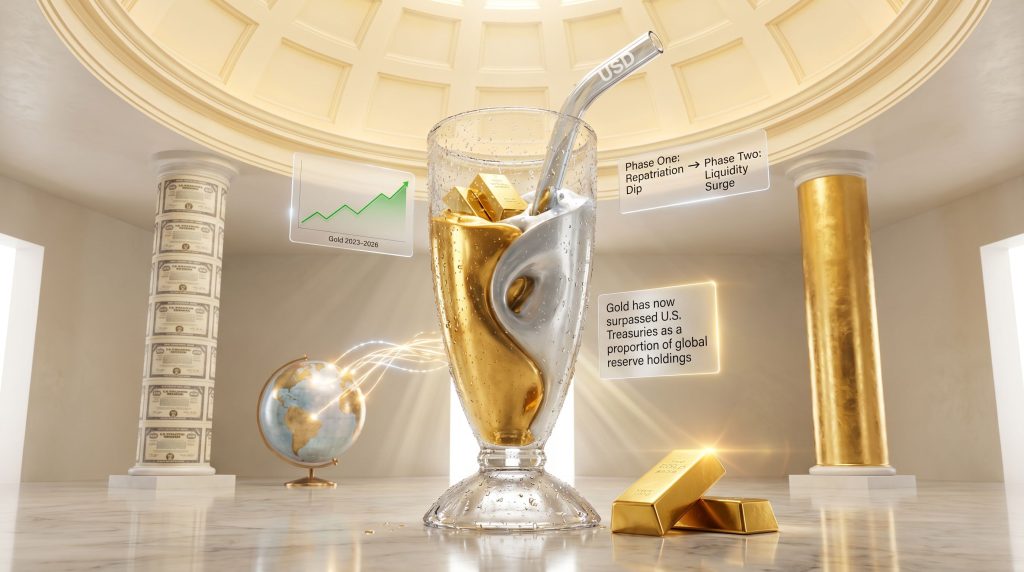
Phase One: Why the Dollar Initially Falls
There is a persistent misconception that in any financial crisis, the dollar immediately and strongly appreciates. Historical data challenges this assumption. In the initial stages of a credit crisis, the dollar often falls before it rises — a counterintuitive pattern explained by the mechanics of global capital repatriation.
For years preceding a crisis, institutions across the world accumulate excess savings by investing in U.S. dollar assets. When a slowdown begins and those institutions face local funding pressures or debt obligations, they are forced to tap their accumulated reserves. This means selling U.S. dollar assets, receiving dollars, then converting those dollars back into euros, yen, or local currencies to address domestic needs. That sequence of selling dollar assets and buying foreign currencies temporarily pushes the dollar index lower, not higher.
The historical record supports this clearly:
- In September 2008, at the very onset of the global financial crisis, the U.S. dollar index fell approximately 5% over a two-week window as foreign institutions liquidated U.S. assets and repatriated capital back to their home markets
- In early March 2020, the same repatriation dynamic repeated itself, with an initial dollar decline preceding the sharp dollar reversal that followed as the crisis deepened globally
- In April 2025, a similar initial dollar decline occurred, but the crisis resolved within approximately two to three weeks, meaning the secondary surge phase never fully materialised
Phase Two: The Boomerang Effect
If the crisis is not quickly contained by central bank intervention, it transitions from a regional repatriation event into a systemic global liquidity crisis. At that point, the dynamic reverses completely. Borrowers holding dollar-denominated debt around the world must source dollars to service their obligations, and this structural demand overwhelms the earlier repatriation selling. The dollar reverses sharply, often surging well beyond its pre-crisis levels.
The step-by-step mechanics of this boomerang effect work as follows:
- A global stress event triggers risk-off sentiment across markets
- Foreign institutions sell U.S. dollar-denominated assets and repatriate capital into local currencies
- This selling pressure temporarily depresses the dollar index
- If the crisis deepens and becomes systemic rather than localised, global dollar demand surges
- Borrowers with dollar-denominated debt must source dollars urgently to avoid default
- The dollar reverses sharply higher, often to levels exceeding its pre-crisis position
- This extreme dollar strength then stresses the global system further, ultimately seeding the monetary conditions that benefit gold over the subsequent multi-year cycle
The 2025 episode differed from 2008 and 2020 precisely because monetary authorities acted quickly enough to prevent the initial stress from becoming systemic, cutting the boomerang short before Phase Two could fully develop. Furthermore, understanding how economic cycles interact with these dynamics helps investors anticipate where gold and the dollar may head next.
Is Extreme Dollar Strength Actually the Most Bullish Scenario for Gold?
The Counterintuitive Case
The instinct to view dollar strength as fundamentally bearish for gold misses the most important dynamic in the long-term relationship between these assets. A dollar that rises moderately is manageable for the global financial system. A dollar that surges to systemic extremes forces a cascade of responses that ultimately create the most powerful multi-year tailwinds gold can experience.
When the dollar rises to levels that stress emerging market balance sheets, accelerate sovereign debt distress, and undermine the competitiveness of global trade, central banks and governments respond. That response takes the form of liquidity injections, debt monetisation, currency interventions, and coordinated accommodation — all of which erode the purchasing power of fiat currencies and historically drive gold significantly higher over the subsequent cycle.
A dollar that goes too high does not defeat gold. It defeats the monetary system that makes the dollar's dominance possible in the first place, and gold is the primary beneficiary of any system-level repair that follows.
The 2022 Dollar Surge as a Case Study
The sharp dollar appreciation through 2022 serves as a compelling illustration of this mechanism. That dollar strength created widespread financial stress across emerging market economies and institutions holding dollar-denominated debt. The stress catalysed several long-term structural responses:
- Accelerated central bank diversification away from dollar-denominated reserves
- Increased sovereign gold accumulation as a reserve asset not subject to counterparty or political risk
- Growing institutional recognition of gold's role as a debasement hedge in an environment of unsustainable fiscal expansion
- Broader adoption of the view that fiat monetary systems face structural constraints that only real assets can address
These responses combined to support gold prices strongly from 2023 onward, with the multi-year rally through 2025 to 2026 attributable in meaningful part to the systemic consequences set in motion by that earlier dollar surge. The dollar milkshake theory and gold relationship, as analysed by independent economic commentators, continues to gain credibility precisely because these cause-and-effect chains have played out so consistently.
Gold's Growing Share of Global Reserves
A Structural Reorientation Is Underway
One of the most significant milestones in the recent evolution of global reserve management is that gold has surpassed U.S. Treasuries as a proportion of global reserve holdings by dollar value. This shift reflects two concurrent forces: gold prices rising substantially over the past several years, and U.S. Treasury prices declining as yields have risen. The result is a structural reorientation in how sovereign institutions manage reserve risk, even if the immediate drivers are partly price-related rather than purely compositional.
Central bank gold reserves have become a consistent and well-documented phenomenon in recent years, providing a structural demand floor that did not exist in earlier decades when reserve managers relied almost exclusively on dollar-denominated instruments. This institutional buying reflects not a rejection of dollars per se, but a recognition that diversification into counterparty-free assets offers risk management properties that sovereign balance sheets increasingly require.
The Debasement Trade in Institutional Context
The narrative driving much of gold's appreciation prior to the acute crisis phases in recent years has been the debasement trade. The recognition that governments facing structural fiscal deficits have limited options beyond money creation has driven institutional and sovereign buyers to treat gold differently than in previous decades. Rather than viewing gold as a speculative commodity, an increasing number of reserve managers treat it as a monetary asset with unique properties in a world where all major fiat currencies are subject to expansion. In addition, the global monetary shift towards gold — particularly driven by China — has accelerated this institutional reorientation considerably.
The next major ASX story will hit our subscribers first
Does the Milkshake Theory Ultimately Predict Gold Wins?
The Long-Game Argument
Some analysts frame the dollar milkshake theory as a dollar-versus-gold debate, positioning the two assets as competitors for monetary supremacy. This framing fundamentally misreads the theory's long-run implications. The more accurate reading is that the theory anticipates gold's long-run ascendancy as a consequence of the very dollar dynamics it describes, not in opposition to them.
The dollar's structural strength under the current monetary architecture is precisely the mechanism that stresses that architecture to breaking point. As dollar strength becomes extreme enough to destabilise the system, the monetary responses required to stabilise global finance — debt monetisation, liquidity injections, fiscal accommodation — erode the real value of fiat currencies and validate gold's monetary role. Gold winning is embedded in the thesis, not contrary to it.
The theory has consistently maintained that gold ultimately wins, and that the bigger risk to global stability is a dollar that goes too high rather than too low. When the dollar remains within a manageable range, liquidity is generally adequate and asset prices tend to perform reasonably. However, the systemic danger is when dollar strength becomes destabilising — and it is precisely that scenario that creates the most powerful multi-year conditions for gold appreciation.
Key Takeaways for Investors Navigating This Framework
Understanding the interaction between the dollar milkshake theory and gold requires separating short-term tactical dynamics from long-term structural forces. The key investor implications are:
- Short-term: Gold can face selling pressure during acute dollar-demand events as institutional investors convert liquid assets into dollars to service obligations or acquire distressed positions — this does not represent a fundamental breakdown in gold's value proposition
- Medium-term: Dollar strength that persists long enough to cause systemic stress historically accelerates the debasement-driven demand for gold, often with a lag of one to two years before the full effect manifests in prices
- Long-term: The milkshake framework does not position gold as the dollar's opponent; it positions gold as the ultimate beneficiary of the dollar system's internal contradictions once those contradictions require resolution through monetary expansion
- Reserve context: Gold now representing a greater dollar value in global reserves than U.S. Treasuries signals a structural shift in institutional preferences that provides a persistent demand floor
- Crisis navigation: Recognising the two-phase dollar crisis pattern — repatriation dip followed by potential liquidity surge — allows investors to contextualise short-term gold weakness without misreading it as evidence of fundamental deterioration
Disclaimer: This article is intended for informational and educational purposes only and does not constitute financial advice. All references to historical price movements, reserve composition data, and macroeconomic frameworks involve elements of interpretation and analysis. Past market behaviour does not guarantee future outcomes. Investors should conduct independent research and consult qualified financial professionals before making investment decisions. Forward-looking statements and theoretical frameworks carry inherent uncertainty and should not be treated as predictive of specific future market behaviour.
Want to Identify ASX Mineral Discoveries Before the Broader Market Does?
Discovery Alert's proprietary Discovery IQ model delivers real-time alerts on significant ASX mineral discoveries, cutting through complex data to surface actionable investment opportunities the moment they are announced — explore historic discoveries and their exceptional returns to understand the potential, then begin your 14-day free trial at Discovery Alert to position yourself ahead of the market.