
July 16, 2026
The energy landscape is experiencing transformative shifts as governments and industries recognise the urgent need for unified action in domestic cell manufacturing to address growing supply chain vulnerabilities. Furthermore, recent developments in battery recycling breakthroughs and lithium refinery developments are creating new opportunities for integrated manufacturing strategies that can enhance both sustainability and supply security.
Strategic Fundamentals of Manufacturing Coordination
Manufacturing coordination in the battery sector represents a comprehensive alignment of policy frameworks, resource allocation mechanisms, and industrial development strategies. This systematic approach integrates federal oversight with regional implementation, creating standardised pathways for investment, technology transfer, and workforce development across multiple jurisdictions.
Integrated Framework Components
Effective coordination mechanisms encompass several interconnected elements that function as a unified system:
• Regulatory standardisation across different administrative levels to eliminate compliance fragmentation
• Infrastructure sharing including testing facilities, research centres, and specialised manufacturing equipment
• Supply chain vertical integration from raw material extraction through final cell assembly
• Innovation networks linking academic institutions with commercial manufacturers
The complexity of battery cell production requires simultaneous coordination across multiple technical disciplines, regulatory frameworks, and economic development strategies. According to industry analysis from the Stationary Energy Storage India conference, over 450 industry leaders from more than 10 countries participated in discussions around unified approaches, demonstrating the international scope of coordination challenges.
Implementation Architecture
Successful manufacturing coordination relies on establishing clear governance structures that can manage both technical specifications and commercial relationships. These frameworks must address quality control standards, intellectual property sharing arrangements, and risk distribution mechanisms across participating entities.
Policy harmonisation requires standardised certification processes that enable manufacturers to operate across multiple markets without duplicative compliance requirements. In addition, resource pooling mechanisms allow smaller manufacturers to access expensive testing equipment and specialised facilities that would otherwise be prohibitively expensive for individual companies.
When big ASX news breaks, our subscribers know first
Global Manufacturing Capacity Competition
Nations worldwide are implementing aggressive strategies to establish domestic battery manufacturing capabilities as supply chain vulnerabilities become increasingly apparent. The strategic importance of battery technology extends beyond economic considerations to encompass national security, industrial competitiveness, and technological sovereignty.
Supply Chain Risk Assessment
Current global manufacturing patterns have created dangerous concentration risks that threaten supply security during geopolitical tensions or natural disasters. Over-reliance on single-source suppliers has repeatedly demonstrated its vulnerability during recent global disruptions, forcing industries to reassess their procurement strategies.
The battery industry faces particular challenges due to the technical complexity of manufacturing processes and the limited number of facilities capable of producing high-quality cells at scale. Quality control requirements for automotive and grid-scale applications create additional barriers to rapid supply source diversification.
Economic Development Implications
Domestic manufacturing development generates significant economic multiplier effects across multiple sectors:
• Direct employment in manufacturing facilities and supporting industries
• Technology spillovers benefiting adjacent manufacturing sectors
• Export potential for finished products and specialised components
• Reduced transportation costs and associated carbon emissions
Manufacturing localisation also provides enhanced supply chain visibility and quality control capabilities that are difficult to maintain with geographically dispersed production networks. This increased oversight capability becomes particularly important for applications requiring high reliability standards such as grid stabilisation and emergency backup systems.
Critical Supply Gap Analysis
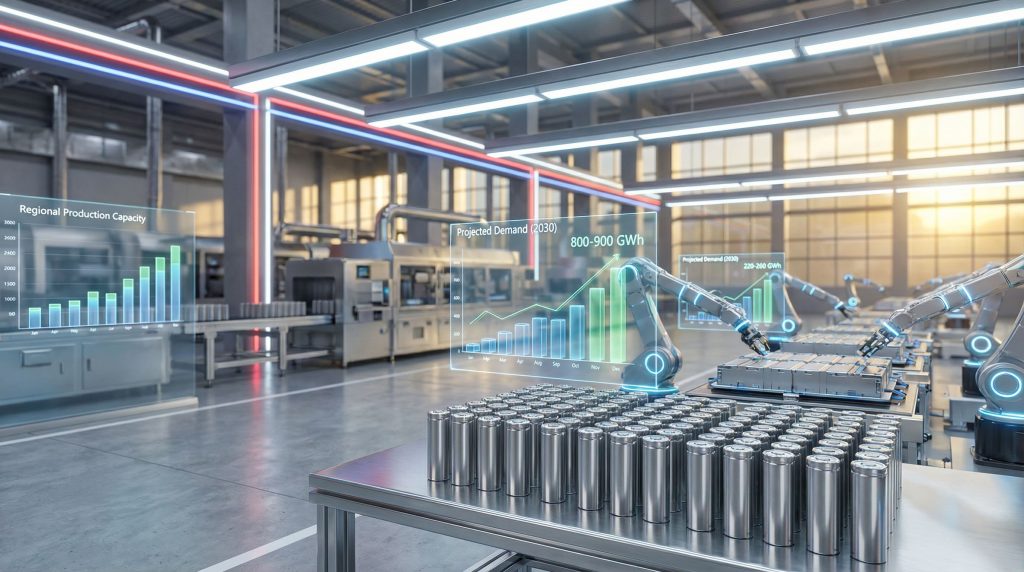
The magnitude of projected supply shortfalls has created unprecedented urgency around capacity expansion initiatives. Analysis from India's energy storage sector reveals demand projections reaching 220-260 GWh by 2030 and 800-900 GWh by 2035, driven primarily by electric mobility applications accounting for 60-70 per cent of demand, with stationary storage representing 30-40 per cent.
Current Capacity Constraints
| Region | Projected Demand (2030) | Current Capacity | Supply Gap |
|---|---|---|---|
| India | 220-260 GWh | 150-180 GWh | 60-80 GWh |
| Asia-Pacific | 800-900 GWh | 650 GWh | 150-250 GWh |
| North America | 220-260 GWh | 180 GWh | 40-80 GWh |
| Europe | 300-350 GWh | 250 GWh | 50-100 GWh |
According to Debmalya Sen, President of the India Energy Storage Alliance, domestic manufacturing capacity stands at 150-180 GWh, with only approximately 40-50 GWh expected to become operational in the near term. This creates a substantial supply gap that forces continued reliance on imports for both finished cells and critical components.
Component Manufacturing Dependencies
The technical complexity of battery manufacturing creates dependencies across multiple specialised components, each requiring distinct production capabilities and quality control systems. Current import dependency patterns reveal critical vulnerabilities in the manufacturing supply chain.
Component import dependency reaches over 80 per cent for key materials including cathodes, anodes, electrolytes, and separators. These materials require specialised manufacturing processes and quality control systems that take significant time to develop domestically.
Manufacturing facilities must coordinate across multiple technical disciplines simultaneously, as cell production requires precise integration of chemical, mechanical, and electrical engineering capabilities. This technical complexity explains why capacity expansion cannot be achieved simply through increased investment but requires systematic development of technical expertise and manufacturing infrastructure.
Raw Material Strategic Constraints
Material costs represent over 30 per cent of total battery production expenses, with graphite and lithium comprising the largest cost components. This cost concentration creates significant vulnerabilities to price volatility and supply disruptions that can undermine manufacturing competitiveness, highlighting the importance of critical minerals energy security.
Pricing Mechanism Vulnerabilities
Current lithium carbonate pricing relies heavily on China's Shanghai Metals Market index, creating dependency on external pricing mechanisms that may not reflect domestic market conditions. This dependency exposes domestic manufacturers to potential market manipulation and reduces their ability to achieve stable, predictable input costs.
Samir Patel, Chief of Technology and Operations at SPML's BESS Energy Division, emphasised that policy frameworks must address raw material pricing mechanisms to avoid vulnerability to external market manipulation. Alternative pricing frameworks or bilateral supply agreements could provide greater stability for domestic manufacturers.
Material Security Strategies
Effective material security requires diversified approaches that reduce dependence on single-source suppliers:
• Domestic mining development for long-term resource security
• Recycling infrastructure expansion to create secondary material sources
• Strategic partnership agreements with multiple supplier countries
• Alternative chemistry research to reduce dependence on scarce materials
"Robust recycling and stronger local supply chains represent essential components of long-term competitiveness, particularly as material costs continue to represent a significant portion of total production expenses."
Circular economy approaches offer dual benefits of reduced virgin material dependence and improved cost competitiveness through secondary material recovery. Recycling infrastructure development requires coordinated investment in collection systems, processing facilities, and quality control capabilities.
Policy Framework Integration
Successful manufacturing coordination requires comprehensive policy frameworks that address multiple interconnected challenges simultaneously. Industry experts emphasise that fragmented state policies create inefficiencies and barriers to large-scale industrialisation, underscoring the need for unified action in domestic cell manufacturing.
Unified Framework Requirements
According to industry analysis, effective policy frameworks must integrate several critical elements under a single, sustained strategy:
• Mineral sourcing security through domestic development and strategic partnerships
• Testing facility standardisation to ensure consistent quality across manufacturers
• Workforce skill development aligned with evolving technology requirements
• Power purchase agreement mechanisms to provide stable demand signals
The complexity of these requirements demonstrates why unified action is essential for domestic cell manufacturing success. Coordination across multiple policy domains prevents conflicts and inconsistencies that can undermine investment confidence.
Implementation Timeline Coordination
Policy implementation requires careful sequencing to ensure that supporting infrastructure and regulatory frameworks are established before major manufacturing investments commence. This sequencing prevents bottlenecks that could delay production capacity additions.
Faster approval processes for manufacturing facilities represent a critical policy priority, as lengthy permitting timelines can undermine project economics and investor confidence. Streamlined approval mechanisms must maintain quality and safety standards while reducing administrative delays.
Manufacturing Capability Acceleration
Accelerating domestic manufacturing capabilities requires coordinated development of technological expertise, workforce skills, and production infrastructure. Kumar M, Founder of Smart Grid Analytics, highlighted that fostering policies supporting innovation, quality, and talent development enables positioning energy storage sectors as global leaders in reliability and performance standards.
Technology Transfer Mechanisms
Effective technology transfer requires structured partnerships that facilitate knowledge sharing while protecting intellectual property rights. These mechanisms include:
- Joint venture arrangements with established international manufacturers
- Research collaboration agreements between industry and academic institutions
- Licensing agreements for proven manufacturing technologies
- Indigenous innovation programmes for next-generation battery technologies
Technology transfer success depends on having adequate technical infrastructure and skilled workforce capabilities to absorb and implement transferred knowledge effectively. This requires coordinated investment in both physical facilities and human capital development, including lithium industry innovations that can enhance competitiveness.
Workforce Development Integration
Manufacturing capability development requires systematic workforce training programmes that align with evolving technology requirements. These programmes must address both current manufacturing needs and future technology transitions.
Technical education programmes must be closely aligned with industry requirements to ensure graduates possess relevant skills. Apprenticeship programmes linking education with manufacturing operations provide practical experience that enhances workforce readiness.
The next major ASX story will hit our subscribers first
Economic Impact Assessment
Domestic manufacturing development generates significant economic benefits beyond direct employment in production facilities. These broader economic impacts justify coordinated investment in manufacturing infrastructure and supporting systems.
Industrial Ecosystem Effects
Battery manufacturing creates demand for numerous supporting industries including specialised equipment manufacturers, chemical suppliers, and testing service providers. This supplier network development generates additional employment and technological capabilities.
Local content requirements encourage the development of domestic supplier networks while ensuring that economic benefits remain within the domestic economy. These requirements must be carefully balanced to avoid compromising cost competitiveness or product quality.
Competitive Positioning Advantages
Domestic manufacturing capabilities provide several competitive advantages:
• Cost competitiveness through economies of scale and reduced transportation expenses
• Quality differentiation through advanced manufacturing processes and quality control
• Innovation leadership in emerging battery technologies and applications
• Strategic autonomy in critical technology sectors
Export potential for both finished products and specialised components creates additional revenue opportunities while leveraging domestic manufacturing capabilities. This export development requires consistent quality standards and competitive pricing relative to international alternatives.
Implementation Strategy Models
Successful implementation of unified action in domestic cell manufacturing requires learning from proven strategies while adapting to local conditions and requirements. Different countries have employed various approaches based on their economic development priorities and existing industrial capabilities.
Integrated Development Approaches
Several implementation models have demonstrated effectiveness in different contexts:
• Vertical integration strategies where companies control entire value chains from raw materials to finished products
• Geographic cluster development concentrating related industries in specific regions
• Platform-based approaches providing shared infrastructure and services to multiple manufacturers
• Innovation network models emphasising collaborative research and development
Each approach offers distinct advantages depending on existing industrial capabilities, available resources, and strategic priorities. Vertical integration provides greater control over quality and costs but requires substantial capital investment across multiple technical disciplines.
Phased Implementation Planning
Systematic implementation requires careful phasing to ensure that supporting infrastructure and capabilities are developed in coordination with manufacturing capacity expansion:
Phase 1 (12-18 months): Policy framework establishment and regulatory harmonisation
Phase 2 (24-36 months): Infrastructure development and workforce training programmes
Phase 3 (36-60 months): Production scaling and supply chain integration
Phase 4 (60+ months): Market competitiveness achievement and export development
This timeline recognises that manufacturing capability development requires sustained investment over multiple years before achieving commercial competitiveness. Early phases focus on establishing foundation capabilities that enable subsequent scaling.
Future Technology Evolution
Manufacturing strategies must account for ongoing technology evolution that will reshape production requirements and competitive dynamics. Next-generation battery chemistries may require substantially different manufacturing processes and quality control systems.
Technology Adaptation Requirements
Emerging battery technologies including solid-state cells, sodium-ion chemistries, and advanced lithium formulations will require manufacturing process adaptations. These technology transitions create both opportunities and risks for domestic manufacturers, particularly as direct lithium extraction methods become more prevalent.
Automation and digitalisation trends are transforming manufacturing processes, requiring new technical skills and quality control capabilities. Investment in flexible manufacturing systems enables adaptation to technology evolution without requiring complete facility reconstruction.
Market Evolution Impacts
Electric vehicle adoption rates directly influence demand patterns and technical requirements for battery cells. Rapid adoption creates opportunities for domestic manufacturers while demanding consistent quality and cost competitiveness relative to established suppliers.
Energy storage market growth in grid applications creates additional demand segments with distinct technical requirements. Stationary storage applications may have different performance priorities compared to mobile applications, requiring manufacturing flexibility, as highlighted by recent research into sustainable manufacturing approaches.
However, the path forward requires addressing significant challenges while capitalising on emerging opportunities. Coordinated policy frameworks, strategic investment in infrastructure, and systematic workforce development will determine the success of unified action in domestic cell manufacturing initiatives across global markets.
Disclaimer: This analysis contains forward-looking projections and market assessments that involve inherent uncertainties. Manufacturing capacity development timelines, demand projections, and economic impact estimates are based on current market conditions and policy frameworks that may change. Investment decisions should consider multiple scenarios and risk factors beyond those discussed in this analysis.
Looking to Capitalise on Battery Manufacturing Opportunities?
Discovery Alert's proprietary Discovery IQ model delivers instant notifications on significant mineral discoveries, including lithium and critical battery materials that power the domestic cell manufacturing revolution. Begin your 14-day free trial today and secure your market-leading advantage by staying ahead of the discoveries that could transform the energy storage sector.