July 16, 2026
The Structural Shift Rewriting Global Lithium Supply Chains
Brine-based lithium extraction has existed as an industrial process for decades, yet the economics, technology, and geopolitical urgency surrounding it have never looked quite like they do today. The acceleration of electric vehicle adoption across major consumer markets, combined with the rapid scaling of grid-level battery storage, has fundamentally altered what it means to control a large, high-grade lithium brine deposit. For mining companies with the balance sheet depth to act decisively, the Lithium Triangle of Argentina, Chile, and Bolivia has moved from an area of interest to an area of strategic necessity.
It is within this context that Rio Tinto lithium in Argentina and Chile becomes one of the most consequential capital allocation stories in the global resources sector. The scale of commitment, the novelty of the extraction technology being deployed, and the complexity of the regulatory environments being navigated all combine to make this a case study worth examining in depth.
When big ASX news breaks, our subscribers know first
Why the Lithium Triangle Attracts Capital at This Scale
The Geology Driving the Investment Logic
The Lithium Triangle is not simply a geographic label. It describes a specific geological condition where ancient seawater became concentrated in high-altitude enclosed basins over millions of years, producing brine deposits with lithium concentrations far exceeding what is found in most of the world's hard-rock spodumene deposits. The Atacama salt flat in Chile, for example, contains brine with lithium grades that can reach 1,500 to 2,000 milligrams per litre, a concentration level that makes processing economics materially more attractive than lower-grade alternatives.
This geological reality is why the Lithium Triangle is estimated to hold between 50 and 60 percent of the world's known lithium brine reserves. When a mining company is designing a production target measured in hundreds of thousands of tonnes annually, it cannot realistically achieve that goal without access to brine resources at this scale and quality. Understanding lithium brine extraction helps contextualise why Australian spodumene, while geologically reliable and operationally mature, requires energy-intensive conversion processes that create a structural cost disadvantage relative to high-grade brine in most market price scenarios.
The Arcadium Acquisition as Strategic Foundation
Rio Tinto's current South American exposure did not develop organically. The US$6.7 billion acquisition of Arcadium Lithium, completed in October 2024, was the transaction that repositioned the company from a minor lithium participant into a credible Tier-1 aspirant almost overnight. The deal brought with it not just resource inventories but operational infrastructure, existing customer relationships, and, critically, a portfolio of proprietary direct lithium extraction technology that now underpins Rio Tinto's technical value proposition across every brine project it operates.
The Arcadium acquisition should be understood not as a bet on lithium prices but as the purchase of a production platform. Without it, Rio Tinto would have had neither the resource base nor the technology toolkit to credibly commit to a 200,000 tonne per annum capacity target by 2028.
Post-acquisition, Rio Tinto disclosed a portfolio of Argentine assets including positions in Olaroz, Fenix, Sal de Vida, and Cauchari, collectively representing approximately 56.6 million tonnes of lithium carbonate equivalent (LCE) in total resources. Furthermore, Argentina alone now accounts for more than half of Rio Tinto's global lithium resource base by volume, a concentration that reflects the extraordinary density of brine mineralisation in the country's northwest.
Argentina: The Rincon Project and What a $2.5 Billion Commitment Actually Involves
From Starter Plant to Industrial Scale
The Rincon Lithium Project, located on the Rincon salt flat in Salta Province, occupies a particularly important position within Rio Tinto's South American strategy. A 3,000-tonne per annum starter plant is already operational at the site, functioning both as a commercial facility and as a real-world testing environment for DLE technology under the specific brine chemistry conditions of the Rincon deposit.
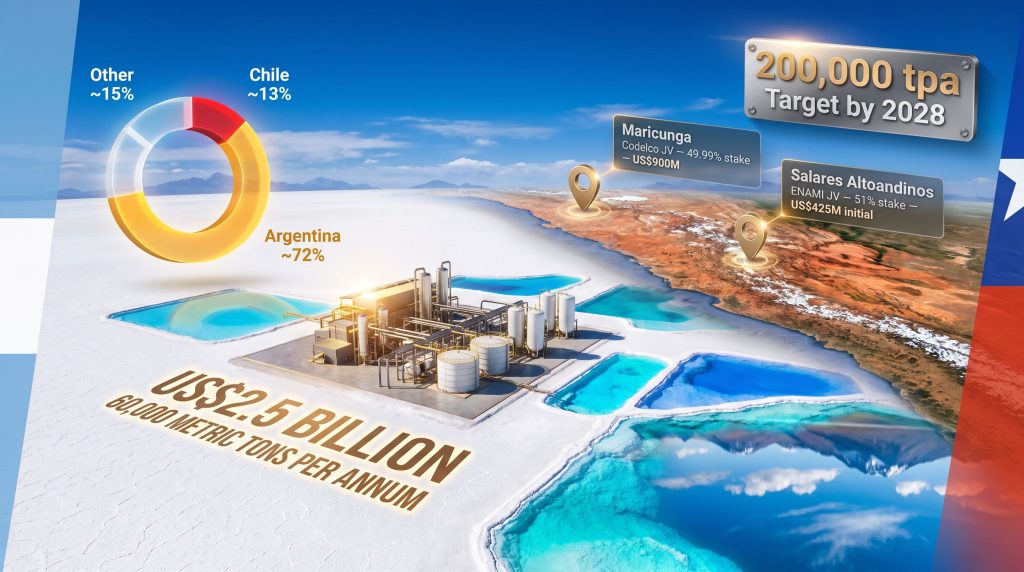
This distinction matters more than it might appear. Brine chemistry varies significantly between deposits, and DLE systems that perform well in one environment do not automatically replicate that performance elsewhere. Rincon's starter plant is consequently generating operational data that is directly informing the engineering design parameters for the 57,000-tonne expansion facility, which would bring total site output to 60,000 metric tons per annum of battery-grade lithium carbonate.
Rincon Project: Key Parameters
| Parameter | Detail |
|---|---|
| Total Planned Capacity | 60,000 metric tons per annum (LCE) |
| Starter Plant Capacity | 3,000 tpa (operational) |
| Expansion Capacity | 57,000 tpa (new build) |
| Total Capital Commitment | US$2.5 billion |
| Construction Commencement | Mid-2025 |
| First Production Target | 2028 |
| Ramp-Up Duration | Three years to nameplate capacity |
| Regulatory Approval | May 2025 (Argentine government) |
| Extraction Technology | Direct Lithium Extraction (DLE) |
| Location | Salta Province, Argentina |
What Argentina's Regulatory Approval Actually Signals
In May 2025, the Argentine government granted formal approval to the Rincon expansion, making it the first project approved under Argentina's new large-scale mining investment framework. This approval carries significance that extends well beyond the Rincon project itself. For further detail on this expansion commitment, Reuters reported on Rio Tinto's $2.5 billion investment decision in full.
Argentina has historically been regarded with caution by large foreign mining investors, primarily due to currency instability, fiscal unpredictability, and inconsistent regulatory administration. The new investment framework, introduced under the Milei administration, offers qualifying projects long-term tax stability provisions and export guarantee arrangements. Rincon's status as the inaugural beneficiary of this framework transforms it into a live case study that every other prospective investor in the Argentina lithium brine market will monitor closely.
Rincon's approval is not merely a permit. It is a proof-of-concept for Argentina's new investment architecture, and its long-term operational performance will shape how global mining capital views the country for the next decade.
Understanding DLE: Why It Changes the Project Economics
Traditional brine lithium extraction relies on large evaporation ponds where lithium-rich brine is pumped to the surface and left to concentrate through solar evaporation over 12 to 24 months. This approach carries substantial water consumption costs, requires vast land footprints, and ties up significant working capital in slow-moving inventory. In high-altitude Andean environments, the evaporation rate also varies seasonally, introducing production variability.
DLE technology bypasses the evaporation stage entirely. Using selective adsorption or ion exchange mechanisms, DLE systems extract lithium directly from brine within a matter of hours, returning the depleted brine to the aquifer. The implications are material:
- Recovery rates are typically higher under DLE than conventional evaporation, meaning more lithium is extracted per unit of brine processed
- Working capital requirements are dramatically reduced because the product cycle is measured in hours rather than months
- Water and land disturbance is significantly lower, reducing environmental permitting complexity and community opposition risk
- Product purity from DLE systems tends to be more consistent, which is valuable when supplying directly to battery-grade chemical processors
No operator has yet successfully deployed DLE technology at the 50,000-plus tonne annual scale that Rincon's expansion demands. This is the central technology risk of the entire programme, and it is why the starter plant's operational data is so strategically important to Rio Tinto's investment case.
Chile: State Partnership as the Entry Condition
A Fundamentally Different Governance Model
Chile's approach to lithium governance is structurally distinct from Argentina's framework in ways that are not always well understood by observers outside the sector. In Chile, lithium is classified as a strategic mineral under the 1979 Mining Code, which means the state retains ultimate control over its development and private operators cannot access deposits through the standard mining concession system. For a broader view of how the country manages its resources, the Chile lithium strategy provides useful context.
This classification created a system in which only state-authorised entities could produce lithium for decades. The relatively recent policy evolution allowing private companies to participate through joint ventures with state mining enterprises represents a meaningful shift, but it is a partnership model by design, not by compromise. Any company seeking Chilean lithium exposure must consequently negotiate with either Codelco or ENAMI, Chile's two primary state mining entities.
Rio Tinto's Two Chilean Partnerships Compared
| Feature | Maricunga Project | Salares Altoandinos Project |
|---|---|---|
| State Partner | Codelco | ENAMI |
| Rio Tinto Equity | 49.99% | 51% |
| Rio Tinto Investment | Up to US$900 million | US$425 million (initial) |
| Total Project Investment | Not publicly disclosed | ~US$3 billion |
| Agreements Formalised | May 2025 | May 2025 |
| Operational Lead | Rio Tinto | Rio Tinto |
| Technology Focus | High-grade brine extraction | DLE pilot and feasibility |
| Brine Characteristics | Among world's highest grades | High-grade Atacama brine |
Maricunga: When Brine Grade Becomes a Competitive Moat
The Maricunga deposit's significance lies in its brine chemistry. Industry data consistently ranks Maricunga among the highest-grade lithium brine deposits globally, with concentrations that translate directly into lower processing costs per unit of output. In lithium brine economics, grade is not merely a geological feature; it is a cost structure determinant.
Higher lithium concentration per litre of brine means fewer litres need to be pumped, processed, and managed per tonne of final product. This reduces energy consumption, chemical reagent requirements, and infrastructure sizing, all of which feed directly into the project's operating cost structure. At a time when lithium spot prices remain well below their 2022 peak, high-grade brine assets carry a resilience that lower-grade projects lack.
Rio Tinto's decision to structure its Maricunga stake at 49.99 percent rather than 50 percent is unlikely to be accidental. Under Chilean resource governance principles, a stake at or above 50 percent may trigger different regulatory treatment or state veto provisions. The near-50 position likely reflects careful legal structuring designed to maximise operational influence while respecting the sensitivities embedded in Chile's state-ownership framework.
Salares Altoandinos: Technology as Negotiating Capital
The ENAMI partnership for the Salares Altoandinos project introduces a dimension that is rarely discussed in standard coverage of the Rio Tinto lithium strategy: the role of DLE technology as a negotiating asset rather than simply an operational tool. Rio Tinto's initial US$425 million commitment to this project is explicitly allocated to DLE pilot operations and feasibility development.
By contributing technology rather than capital alone, Rio Tinto positions itself as a partner that brings something the state entity cannot easily replicate internally. This gives Rio Tinto structural leverage in the partnership that a pure capital contributor would not possess. The total project investment is estimated at approximately US$3 billion, meaning the initial tranche represents only the early-stage commitment in what is expected to be a multi-phase development programme extending well beyond 2030.
Through its Chilean agreements, Rio Tinto becomes only the third private company authorised to mine lithium in Chile, a country that has maintained tight sovereign control over the resource throughout its modern mining history. That status carries first-mover value in a jurisdiction where future private access will almost certainly remain restricted.
Rio Tinto's confirmation as preferred partner on the Salares Altoandinos project underlines just how significant this milestone is for the company's broader South American ambitions.
The Portfolio Architecture: How Argentina and Chile Fit Together
Resource Concentration in the Lithium Triangle
Following the Chilean partnership agreements, Rio Tinto's total lithium resource base is heavily concentrated within the Lithium Triangle. The approximate distribution reflects a deliberate geographic strategy rather than coincidental asset accumulation.
| Region | Approximate Share of Total Lithium Resources |
|---|---|
| Argentina | ~72% |
| Chile | ~13% |
| Other Jurisdictions | ~15% |
This concentration creates both strength and vulnerability. The strength is that brine resources in this region are among the most economically recoverable on the planet. However, the vulnerability is that any systemic regional risk, whether political, hydrological, or regulatory, would affect the majority of Rio Tinto's lithium production capacity simultaneously.
The 200,000 Tonne Target: A Realistic Assessment
Rio Tinto lithium in Argentina and Chile forms the backbone of the company's stated goal of reaching 200,000 tonnes per annum of lithium capacity by 2028, a figure that deserves careful examination rather than straightforward acceptance. The arithmetic depends on several concurrent conditions being met:
- Rincon's 60,000-tonne expansion must begin construction mid-2025 and execute a three-year ramp without material delays
- Arcadium's inherited operational assets must continue performing at or near nameplate capacity throughout the ramp period
- No significant permitting, community, or hydrological challenges must emerge at any of the key production sites
- DLE technology must scale from the starter plant's 3,000-tonne demonstration level to the 57,000-tonne commercial configuration without fundamental performance degradation
The Chilean projects are unlikely to contribute meaningfully to the 2028 figure given their current development stage. Their production contribution is more realistically a post-2030 event. Investors should therefore interpret the 200,000 tpa figure as a capacity framework rather than a guaranteed production outcome.
Risk Dimensions That Deserve Investor Attention
Lithium Price Exposure and the Timing Problem
Lithium carbonate spot prices fell sharply through 2023 and 2024, declining from historic highs above US$80,000 per tonne to levels below US$15,000 per tonne in some markets. Rio Tinto's multi-billion dollar capital commitments are being made during this period of price weakness, which creates a genuine capital allocation risk if the recovery timeline extends beyond consensus expectations.
The structural demand thesis, driven by EV penetration and battery storage deployment, remains directionally intact. However, near-term demand softness in key markets including China and Europe has extended the timeline for price normalisation. Companies committing capital at the bottom of a commodity cycle are historically well-positioned if timing proves correct, but that timing is not guaranteed.
The DLE Scaling Challenge: An Underappreciated Technical Risk
Much of the industry commentary around DLE technology focuses on its theoretical advantages over evaporation pond extraction. Less attention is paid to the engineering challenges of scaling DLE systems from pilot configurations to commercial-scale facilities. The specific risks include:
- Membrane and adsorbent material degradation at sustained high-throughput volumes
- Brine chemistry variability across different aquifer zones within the same deposit
- Process water management at large scale, particularly in water-stressed Andean environments
- Integration complexity between the DLE extraction stage and the downstream lithium carbonate conversion and purification circuits
No operator globally has yet validated DLE performance at the annual output scale that Rincon's expansion requires. This is not a reason to dismiss the technology, but it is nonetheless a reason to treat the three-year ramp-up timeline with appropriate scepticism.
Country Risk: A Comparative Assessment
| Risk Factor | Argentina | Chile |
|---|---|---|
| Regulatory Stability | Improving; first-mover approval validates new framework | Stable but state-controlled; private access structurally limited |
| Currency and Fiscal Risk | Elevated; peso volatility remains a structural concern | Lower; stronger institutional framework |
| Environmental and Community Risk | Water usage in Salta Province; Indigenous consultation | High-altitude brine extraction; Atacama ecosystem sensitivity |
| Partnership Dependency | Sole operator at Rincon | Requires ongoing Codelco and ENAMI alignment |
The next major ASX story will hit our subscribers first
What This Means for the Global Battery Supply Chain
Supply Implications at Scale
If Rincon reaches its 60,000 tpa nameplate capacity on schedule, it would rank among the largest single-site brine lithium operations in the world. To contextualise this: 60,000 tonnes of lithium carbonate equivalent is broadly sufficient to supply the battery requirements of approximately 1.2 to 1.5 million electric vehicles annually, depending on battery size and chemistry assumptions. That figure alone underscores why Rio Tinto lithium in Argentina and Chile is being tracked closely by battery manufacturers, cathode producers, and automotive supply chain planners.
Rio Tinto's combined Lithium Triangle portfolio, if fully developed across the 2028 to 2035 timeframe, could plausibly position the company as a top-three global lithium supplier. The purity profile enabled by DLE technology also makes Rio Tinto's production well-suited for direct integration into battery-grade chemical supply chains, potentially supporting long-term offtake arrangements with major cathode and cell manufacturers.
The Broader Significance for Resource Sovereignty Debates
Chile and Argentina are both navigating a tension that will define resource governance across the developing world for the next generation: how to attract the foreign capital necessary to develop strategic mineral resources at industrial scale while retaining sufficient sovereign benefit to justify the environmental and social costs involved.
Rio Tinto's willingness to operate through state joint ventures in Chile and to comply with Argentina's new investment framework suggests the company has made a deliberate strategic choice to engage with nationally defined governance structures rather than resist them. This adaptive approach may prove to be as important a competitive advantage as the DLE technology itself, particularly as resource nationalism continues to intensify across Latin America and beyond.
Readers seeking further regional context on Rio Tinto's Latin American operations and broader mining sector developments may find value in exploring industry coverage available through BNamericas, which tracks infrastructure, mining, and energy projects across the region.
This article contains forward-looking statements and projections based on publicly available information. Actual outcomes may differ materially from those discussed. Nothing in this article constitutes financial or investment advice. Readers should conduct their own due diligence before making investment decisions.
Want to Capitalise on the Next Major Lithium Discovery Before the Broader Market?
Discovery Alert's proprietary Discovery IQ model scans ASX announcements in real time, instantly identifying significant mineral discoveries — including lithium — and delivering actionable alerts to subscribers before the broader market has time to react. Explore historic examples of extraordinary discovery returns and begin your 14-day free trial today to position yourself at the forefront of the next major find.